
Blog
Limited Equipment: Build Strength With Twice Weekly Training
Published October 15, 2026 · 10 min read
You can keep building strength with a small set of equipment, as long as you hold to three priorities: train each major muscle group at least twice a week, add progressive overload in small steps, and track how hard each set felt using reps in reserve (RIR). Everything below is a copyable plan built on those three habits.
TL;DR:
- Choose two weekly sessions that train your whole body, or use three alternating sessions; stop most sets with one to three reps in reserve.
- Add one rep per set until you reach the top of your target range, then slow the lowering phase, shorten rests, or advance the exercise.
- Record reps and reps in reserve; buy heavier equipment only after you exceed your target with slow repetitions and still have reps left.
- On disrupted weeks, one hard set of four or five major movements still counts; single set training and weekend sessions have the strongest support.
Table of Contents
- What to prioritize when your gear is limited
- The best equipment for a small setup
- Three limited-equipment programs you can copy
- Swaps and progressions for squat, hinge, press, and row
- Advanced tricks to raise the stimulus with light loads
- How to track progress when your weights barely change
- A note on choosing a plan you will keep
- Log every set and let Coach set your next load
- FAQ
- Sources
What to prioritize when your gear is limited
Gear matters less than most lifters assume. ACSM's updated resistance training guidelines state that the best program is the one you will actually stick with, and that training all major muscle groups twice per week does far more than chasing a complex routine. The ACSM resistance training plan says the same in simpler terms: do something, and be consistent. If you want to see how weekly scheduling plays out, our article on training frequency for hypertrophy goes deeper.
When you cannot add weight, you still have plenty of ways to raise the challenge. A systematic review of training with different loads found that a wide spectrum of loads can produce hypertrophy when volume or effort is matched. Apply this checklist to every session:
- Cover squat, hinge, push, and pull patterns at least twice per week.
- Add one rep per set before you change anything else.
- Slow the lowering phase.
- Shorten rest periods once your reps are stable.
- End most sets with one to three reps still in the tank, and log that number.
The best equipment for a small setup
If you can buy only a few things, ACSM's home gym essentials point to multipurpose, durable gear: resistance bands, kettlebells, and a yoga mat. We would add an adjustable dumbbell pair and a sturdy bench or chair, because they unlock rows, presses, and split squats with very little floor space.
- Adjustable dumbbells: the most flexible single purchase, covering nearly every pattern.
- One kettlebell: goblet squats, swings, and one-arm rows from a single tool.
- Resistance bands: a narrative review of minimal-dose training supports elastic tubes as an effective low-equipment option.
- Sturdy chair or bench: step-ups, incline push-ups, and supported split squats.
- Household loads: a backpack filled with books or a jug of water works, and ACSM's guidance on lifting at home suggests choosing something that feels heavy but does not cause pain. Check that bags and handles are secure before you load them.
Light loads can still drive muscle growth when you push the effort.
Pro Tip: Buy bands in different tensions and stack them for in-between steps, so you can progress without waiting for a heavier band.
Three limited-equipment programs you can copy
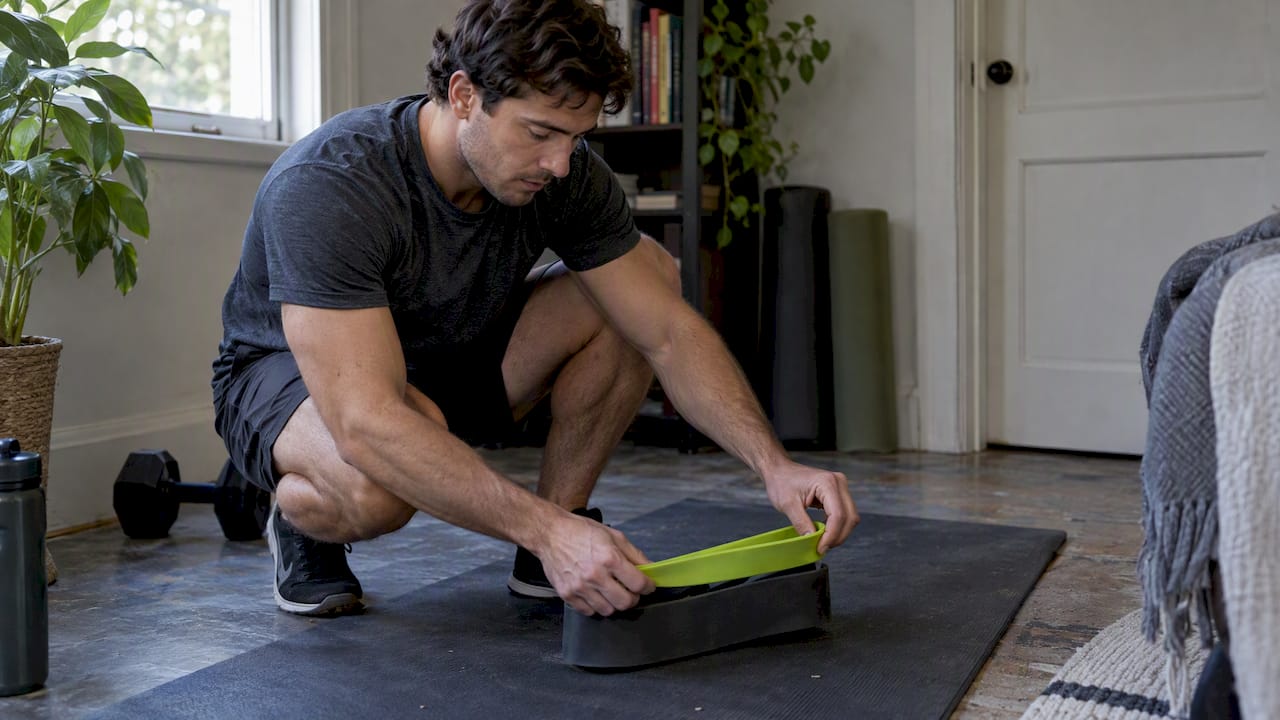
Pick the plan that matches your schedule, then scale each exercise to what you own: bodyweight only, bands, one kettlebell, or light dumbbells.
- Beginner, two full-body days per week. This matches the ACSM twice-weekly guidance. Do goblet squats, push-ups (incline if needed), one-arm rows, hip hinges, and a plank, stopping with two or three reps in reserve. Warm up with easy movement and a lighter set of each lift. Once you hit the top of the rep range on every set, make the exercise harder.
- Intermediate, three sessions per week. Alternate two full-body days with one lighter day. Use split squats, single-leg Romanian deadlifts, floor presses, band or kettlebell rows, and overhead presses. When load increments are coarse, progress by adding a rep each session, then slowing the tempo, then switching to a one-leg variation. Keep one or two reps in reserve on the last set of each exercise.
- Time-crunched, minimal dose. An overview of minimal-dose strategies found that Weekend Warrior sessions, single-set training, and short resistance "snacks" all increase muscle strength, with Weekend Warrior and single-set approaches having the strongest support. In practice, that means one hard set of four or five big movements, such as squats, push-ups, rows, and hinges, done in a short session. If your week falls apart, one such session is far better than none.
If your goal is more muscle, our muscle gain workout plans show how to scale these ideas up.
Swaps and progressions for squat, hinge, press, and row
Every major lift has a limited-gear version, and each version has a ladder you can climb without buying anything.
- Squat: goblet squat, then split squat, then Bulgarian split squat, then pistol squat progressions. Load any of them with a loaded backpack, or add a pause at the bottom.
- Hinge: single-leg Romanian deadlift, kettlebell swing, and hip thrusts with your shoulders on a chair and a backpack across your hips.
- Press: push-ups, floor press with dumbbells or a kettlebell, and band press from a door anchor or around your back.
- Row: one-arm row with a kettlebell or loaded backpack, and band rows. If you have a sturdy bar, band-assisted chin-ups build toward unassisted reps.
Once a variation feels easy, change the demand instead of the load. Lower slowly, work one side at a time, or use partial-range overload at the hardest part of the lift. Our dumbbell workout plans include demo videos if you want to see form for these movements.
Advanced tricks to raise the stimulus with light loads
Blood flow restriction (BFR) training uses a cuff or wrap to limit blood flow out of a working limb, which lets light work feel much harder. A systematic review of BFR with aerobic or bodyweight training found gains over non-BFR equivalents in the included studies.
Bodyweight resistance training with BFR increased hypertrophy by 3–5% and strength by 4–11% compared with non-BFR equivalents. That makes it a real option when you cannot lift heavy, though it needs proper technique.
Other ways to raise the stimulus:
- Eccentric emphasis: lower slowly to increase mechanical tension on a light load.
- Slow tempo: pair slow reps with sets that end close to failure, the condition under which the load review found low loads worked.
- Minimal-dose options: use single-set or short snack sessions on busy days, as described in the minimal-dose overview, and keep your full sessions on the other days.
Learn correct BFR application from a qualified professional before you try it, and check with a clinician first if you have a cardiovascular condition or another health concern.
How to track progress when your weights barely change
When you cannot add weight, your log has to show progress in other ways. Record reps, RIR, and a short note on movement quality for every set. Add a repeat-effort benchmark, such as maximum clean push-ups or a set of goblet squats to two reps in reserve, and retest it every few weeks.
- Log reps and RIR for each set, plus tempo if you changed it.
- Set a rep target range, then use RIR to decide whether to add reps or make the variation harder.
- Add one rep per session until you reach the top of the range.
- Then slow the tempo, shorten rest, or move to a harder variation.
- Buy heavier gear only when you exceed your rep range with a slow tempo and still have reps left.
RIR is the quiet engine here. If a set that left you three reps from failure last week leaves you with one rep in reserve at the same weight and reps today, something is off, and your log will show it. If the same set feels easier, you have found room to progress.
Pro Tip: When two sessions in a row end with three or more reps in reserve, skip the small tweak and jump straight to the next exercise variation.
A note on choosing a plan you will keep
I have watched people spend months hunting for the perfect setup, and I have seen the same people make steady progress the week they settled for what they owned. ACSM makes the same point: the best resistance training program is the one you will stick with. A short plan you actually do beats a demanding program you quit. Pick the routine that fits your calendar, write down every set, and let the numbers show you when to push harder. Perfect equipment is a distraction. A logbook is not.
— Guilherme
Log every set and let Coach set your next load
Small weight options make the numbers more valuable, because progress hides in single reps and small effort changes. We built RIRLift to log each set with weight, reps, and RIR, and our Coach (AI Coach on first mention) reads that history to recommend your next load, so a stalled bench of light dumbbells still has a next step. You can start on the free tier, or browse our home workout plans with demo videos. Prices for Pro are on Rirlift.
FAQ
Can you build muscle with only light weights?
Yes, if you push your sets close to failure. A systematic review of different loads found comparable hypertrophy with low loads when taken to failure or matched for volume, although high loads are better for maximal strength.
How often should you train when you lift with limited equipment?
Train each major muscle group at least twice per week. ACSM's guidelines say this does far more than a complex routine. Two full-body sessions are enough to start.
Are resistance bands enough for strength training at home?
For many people, yes. A narrative review of minimal-dose training supports elastic tubes as an effective low-equipment option, and ACSM lists bands among its home gym essentials.
What if I only have 15 minutes?
One hard set of a few big movements still counts. An overview of minimal-dose strategies found that single-set training increases muscle strength.
Sources
- ACSM Publishes Updated Resistance Training Guidelines
- Resistance Exercise Minimal Dose Strategies for Increasing Muscle Strength in the General Population: an Overview
- Chronic adaptations to blood flow restriction aerobic or bodyweight resistance training: A systematic review
- Effects of Resistance Training Performed with Different Loads in Untrained and Trained Male Adult Individuals on Maximal Strength and Muscle Hypertrophy: A Systematic Review