
Blog
Top Set and Back-Off Sets: How to Program Both
Published October 22, 2026 · 15 min read
A top set is one heavy, hard set at the start of your working sets, and back-off sets are the lighter sets that follow it, done after a full rest with a planned drop in load. You pick the top set by effort (usually 1 to 3 reps in reserve), cut the weight by roughly 5 to 15 percent for the back-offs, and let the first set tell you how the day is going.
This guide shows you how to choose each number, how the research supports the structure, and how to log it so next week's top set is a decision rather than a guess.
TL;DR
- A top set is your heaviest planned work set of the day; back-off sets use a lower load so you can keep quality reps and add volume.
- Set the top set by effort, not ego: most lifters do well stopping 1 to 3 reps short of failure, then reducing load for the back-offs.
- A reduction of about 5 to 15 percent is a practical starting range; the right number is the one that lets you hit your target reps at the planned RIR.
- Rest longer after the top set and slightly less between back-off sets, as long as technique stays crisp.
- Log weight, reps and RIR for every set, because the back-off load only makes sense relative to what the top set actually was.
Table of Contents
- What a top set and back-off sets actually are
- Why the structure works
- Step 1: Choose the top set by effort
- Step 2: Choose how much to cut for the back-offs
- Step 3: Set the reps and number of sets
- Step 4: Rest differently for each set
- A worked example: bench press, strength and size
- Progressing from week to week
- Back-off sets, drop sets and cluster sets: how they differ
- Common mistakes
- Our view on top sets
- Logging it so the numbers do the thinking
- FAQ
- Sources
What a top set and back-off sets actually are
The structure is simple. After your warm-up sets, you perform one heavy working set, the top set. You rest, reduce the load by a planned amount, and perform one or more back-off sets (also called down sets). A review in the NSCA Strength and Conditioning Journal describes back-off sets as a paradigm built on an initial heavy set, a rest period and a planned load reduction, used to maintain or increase training volume.
A few terms before we go further:
- Hard set: a set taken close enough to failure that it produces a real training stimulus.
- Reps in reserve (RIR): the number of reps you could still have done when you stopped. If you could have done two more, that set was 2 RIR. Our guide to how to use reps in reserve covers the basics.
- RPE: the same idea on a 1 to 10 scale, where RPE 10 equals 0 RIR and RPE 9 equals 1 RIR, as laid out in this PMC paper on the RIR-based RPE scale.
The point of the structure is to get one high-quality heavy exposure and then more total work than you could have managed if you had tried to repeat that heavy load for every set.
Why the structure works
The same NSCA review notes that back-off sets let lifters accumulate more total volume than they could by holding a heavy load across every set. That matches what you feel in the gym: the third set of five at your top weight is usually a grind, and the bar speed and form on it are rarely what you want to practice.
Two things are worth separating here, because they are often blurred:
- Volume you can recover from. Lowering the load lets later sets stay close to the same quality of reps, so the set counts as productive work rather than survival.
- Less fatigue per set. A 2022 scoping review on proximity to failure found that training to absolute failure is not clearly superior to non-failure training for hypertrophy, and that it may add neuromuscular fatigue and recovery time. Taking back-off sets short of failure is consistent with that.
Some sources also suggest the heavy top set may prime the nervous system for the lighter sets that follow. That idea is plausible and popular, but treat it as a possible bonus rather than the reason to use the method. The dependable benefits are heavy practice plus manageable volume.
The structure is also efficient. A paper on the minimum effective training dose in powerlifters reported that a total of roughly 3 to 6 working sets per lift, spread across one to three sessions a week, can be an effective minimum for maximal strength. Its experiments included protocols built around a heavy single followed by a small number of back-off sets. You do not need a mountain of volume for the method to work. You need the right sets, done at the right effort, consistently.
Step 1: Choose the top set by effort
There are two common ways to define a top set, and you can use either.
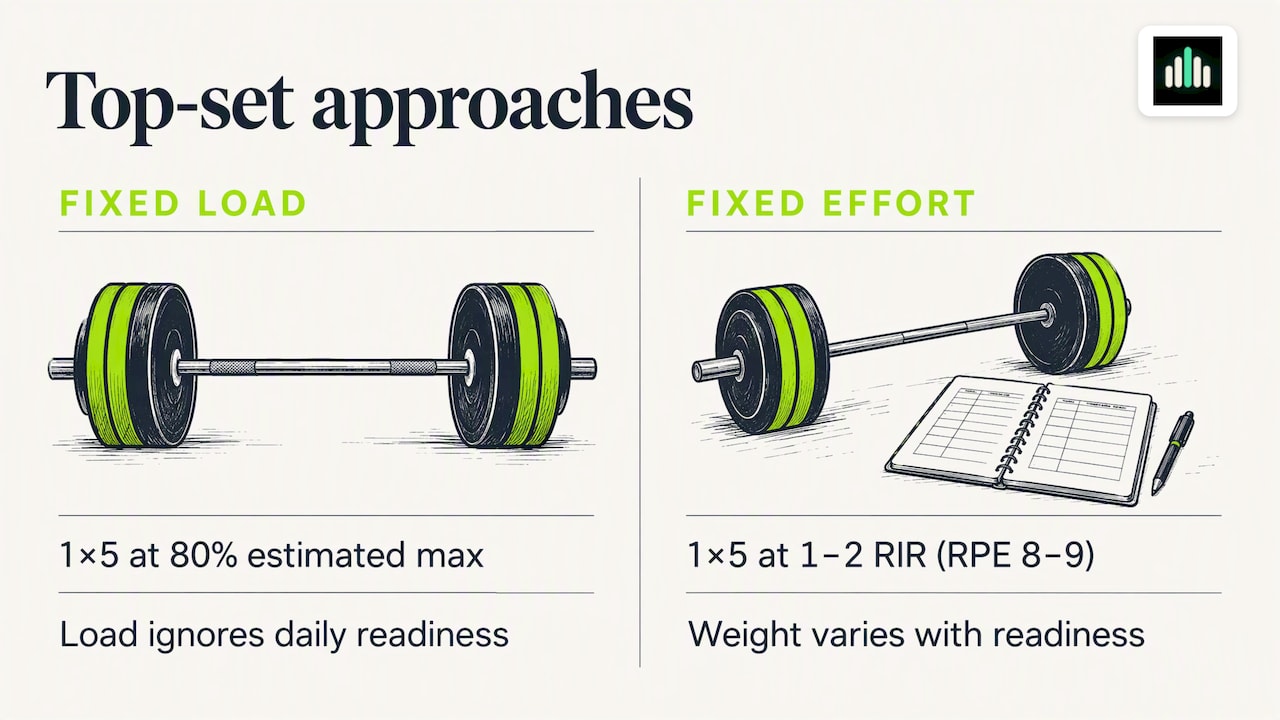
A fixed load. For example, 1 set of 5 at 80 percent of your estimated max. This is simple, but it ignores how you slept, ate and recovered. If you want a starting number, our one-rep max calculator adjusts for RIR so a set that was not to failure still gives a usable estimate.
A fixed effort. For example, work up to one set of 5 at 1 to 2 RIR (RPE 8 to 9) and let the bar weight land where it lands. This is autoregulation, and it is what most experienced lifters prefer, because the weight moves with your readiness.
A 12-week study on autoregulation with reps in reserve found greater strength improvements with RIR-based loading than with fixed loading. That is one study, so read it as encouraging rather than final, but it supports using effort as the guide.
How hard should the top set be?
As a practice guideline, not a research finding:
| Goal | Typical top set | Target effort |
|---|---|---|
| Maximal strength | 1 to 5 reps | 1 to 3 RIR (RPE 7 to 9) |
| Strength and size | 4 to 8 reps | 1 to 2 RIR |
| Size focus, isolation lifts | 6 to 10 reps | 0 to 2 RIR |
Notice that none of these say "to failure" on the compound lifts. If you are unsure where your own line should sit, see our research-based guide on whether to train to failure.
A caution on RIR accuracy
Your estimate of reps in reserve improves with experience, and it is more accurate close to failure than far from it. A study on RIR reliability for prescribing load supports RIR as a tool for setting resistance training load, but it works best when you have calibrated yourself. If you are newer, log your RIR guesses for several weeks and compare them with how the sets actually went. A top set called "2 RIR" that turns out to have been a near grinder is useful information, not a failure.
Step 2: Choose how much to cut for the back-offs
This is where most programs give you one number and leave you to guess whether it fits you. The research gives a rough range: the PMC paper cited above discusses back-off approaches where load reductions in the low single digits are used to modulate volume. Beyond that, the percentages you see online are coaching practice, not tested prescriptions. Here is how we would think about it.
| Reduction from top set | What it does | When it fits |
|---|---|---|
| 2 to 6 percent | Keeps the back-offs heavy, close to the top set's effort | Low-rep strength work, peaking phases |
| 7 to 10 percent | Lets you repeat or add a rep or two at lower RIR cost | General strength and size blocks |
| 10 to 15 percent | Opens a hypertrophy rep range after a heavy set | Powerbuilding, higher-rep back-offs |
| More than 15 percent | Becomes closer to a different kind of work | Technique practice, fatigue-limited days |
Treat these as starting points. The reduction is right when your back-off sets land at the effort you planned, not when they match a percentage on a chart.
A quick test
On the first back-off set, ask: did the set land at the RIR I planned? If it was far easier (say you planned 2 RIR and it felt like 4), the cut was too big and you can raise the weight on the next one. If it was harder than planned, trim the load. Percentage calculators cannot do this part, because they do not know how the top set felt.
Step 3: Set the reps and number of sets
The back-off reps depend on what you want from the day.
- Strength focus: keep back-offs in the same range or one to three reps higher than the top set. A top set of 3 may be followed by 3 sets of 3 to 5.
- Size focus: use the cut to open a higher rep range. A top set of 6 to 8 may be followed by 2 to 3 sets of 8 to 12.
How many back-off sets? Often two to four is plenty. The research on minimum effective dose suggests that you do not need many total working sets per lift to improve strength, and the NSCA review frames back-offs as a way to add volume without adding too much fatigue. Stop adding sets when the reps start to degrade or your RIR falls below the target.
If you want a deeper look at the set counts for a whole session, our straight sets article shows what the no-top-set alternative looks like, and a comparison with it will help you decide when a top set earns its place.
Step 4: Rest differently for each set
A common mistake is taking the same rest after every set. The top set is a high-intent set: you want to be recovered enough to be as strong as you can be at your chosen effort. Back-off sets use a lower load, so the NSCA review's view is that rest can be a bit shorter without hurting total volume, provided technique does not slip.
As a practice guideline:
- After the top set: 3 to 5 minutes on heavy compounds.
- Between back-offs: 2 to 3 minutes, shortening only if your rep counts hold.
- On isolation lifts: 1.5 to 2.5 minutes is usually enough.
If your reps fall off by more than one on the second back-off, that is the sign to rest longer or stop, not to push on.
A worked example: bench press, strength and size
Suppose your estimated working weight for a set of 5 at 2 RIR is 200 lb. Your plan:
- Warm-up: the bar x 10, 135 x 5, 165 x 3, 185 x 1.
- Top set: 200 lb x 5 at 2 RIR. Rest 4 minutes.
- Back-off: reduce by about 10 percent, to 180 lb. Do 3 sets of 6 to 8 at 2 RIR, resting 2 to 3 minutes.
Now the decisions. Say the top set was 200 x 5 and felt like 3 RIR, not 2. The load was light, so next time you can nudge the top set up, and today you could trim the cut (say 185 lb) to hold the effort. If the top set was 200 x 5 and looked like a grinder at 0 RIR, the day is telling you something, and the back-offs should drop further, to perhaps 170 to 175 lb, to keep them honest.
That is the real advantage of the structure: one set sets the tone, and the rest follow it.
Progressing from week to week
Progression works on two levels:
- Top set: add a rep at the same weight until you hit the top of your range, then add load and drop back to the bottom of the range. For a range of 4 to 6, you might go 200 x 4, 200 x 5, 200 x 6, then 205 x 4.
- Back-offs: keep the percentage cut constant, so the back-off weight rises as the top set rises, and progress reps within the range.
When the top set stalls for two or three sessions in a row, look at the surrounding picture before changing the plan: sleep, calories, and total weekly volume. A planned lighter week can help, and our site has a separate article on deloads if you are in that spot. On a related note, some of the clearest writing on how rest feeds adaptation comes from other sports, such as this piece on why rest builds strength for rock climbers, and the same principle applies to a heavy top set.
Back-off sets, drop sets and cluster sets: how they differ
The three get confused, particularly in the question "What is the difference between a drop set and a back-off set?"
| Back-off sets | Drop sets | Cluster sets | |
|---|---|---|---|
| Rest between loads | Full rest | Little or none | Short intra-set rests |
| Load change | Planned cut, then a new set | Reduce immediately after failure | Usually same load |
| Purpose | Add quality volume after a heavy set | Extend a set for local fatigue | Keep rep quality high at heavy loads |
The key difference is the rest. A drop set is a continuation of the same effort, with the weight stripped off straight after the set ends. A back-off set is a separate set, started fresh. If you do try related methods such as rest-pause sets, log them differently from a back-off, because the stimulus and fatigue are not the same.
Common mistakes
- Treating the top set as a max test every week. A top set at 0 RIR each session wrecks the back-offs. Keep most top sets short of failure.
- Cutting the load by a fixed percentage, regardless of the day. Use the percentage as a start, and adjust on the first back-off.
- Using the same rest everywhere. Rest longer after the top set.
- Doing top sets on every exercise. One or two lifts per session are plenty. Use straight sets on the rest.
- Ignoring logs. Without a record of the top set's actual weight, reps and RIR, you will not know whether next week's jump is reasonable.
Our view on top sets
We think the top set and back-off structure is one of the most honest ways to organize a session, because it forces a single question at the start: how strong am I today? Everything after the top set is an answer to that question rather than a pre-written order.
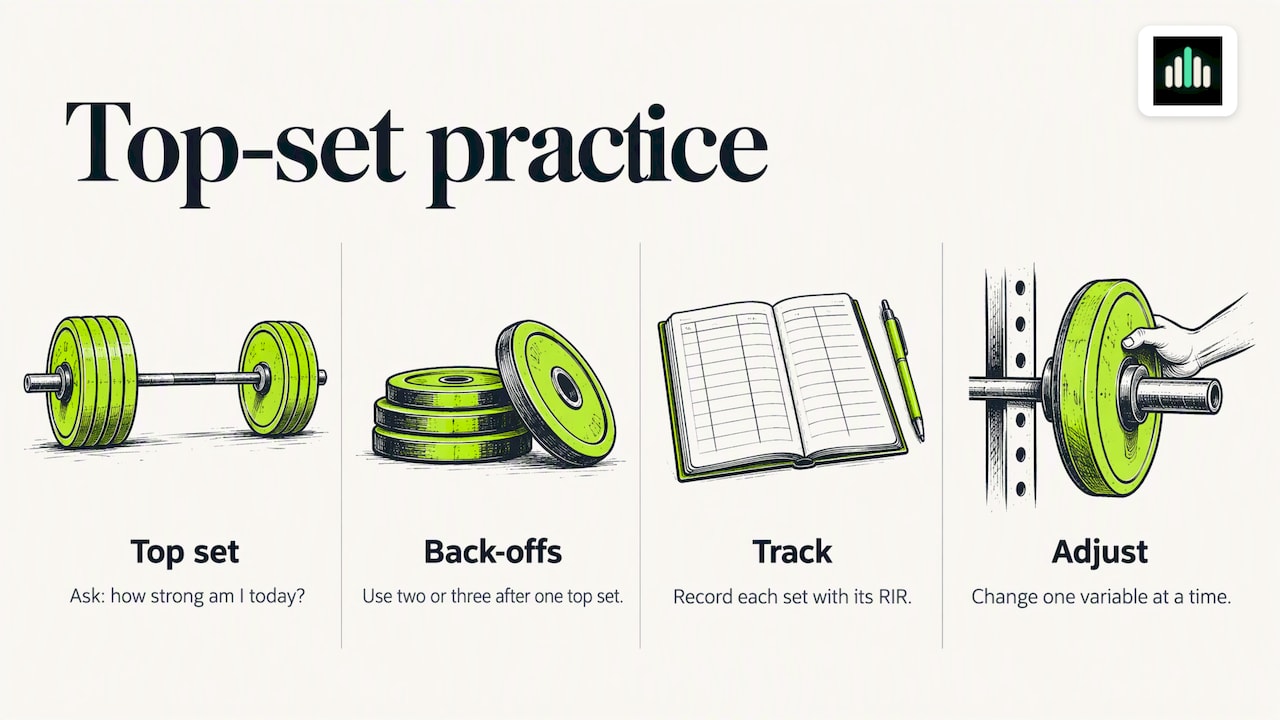
Where lifters go wrong is not in the percentages. It is in treating the top set as a fixed number rather than a measurement. A 200 lb set of 5 on a great day and the same set on a poor one are different events, and the back-off load should reflect that. Logging each set with its RIR lets patterns appear over weeks: the days when your cut was too large, the lifts where your estimates run optimistic, the weeks when the top set rose while back-off effort stayed the same.
Our advice is to keep it small. One top set, two or three back-offs, a clear RIR target, and a written record. Then change one variable at a time.
— Guilherme
Logging it so the numbers do the thinking
If you train with an iPhone and Apple Watch, RIRLift lets you log weight, reps and RIR for every set, and its AI Coach reads that history to suggest the next load. The free plan covers core logging, and Pro, at $9.99 per month or $79.99 per year, unlocks advanced coaching, analytics and unlimited routines. You can see the plans on the RIRLift home page, or build a session with the Session Builder before you go to the gym.
FAQ
What is a back-off set?
A back-off set is a set performed at a reduced load after a heavier set, usually your top set. Unlike a drop set, you rest first and start fresh. It lets you add quality volume without repeating the heavy weight.
How many back-off sets should I do?
Two to four is a common range, depending on the lift and your goal. Research on minimal effective dose suggests that a small number of total working sets per lift can improve strength, so more is not automatically better. Stop when reps fall below your target or your RIR drops under plan.
How much weight should I drop for back-off sets?
A 5 to 15 percent reduction is a reasonable starting range, with smaller cuts for strength work and larger ones when you want more reps. The percentages come from coaching practice rather than a single study. Adjust after the first back-off based on how close to your target RIR it felt.
Should my top set be to failure?
Usually not. A top set at 1 to 3 RIR gives a strong stimulus and leaves enough in the tank for back-offs. The 2022 scoping review on proximity to failure suggests failure training is not clearly superior for hypertrophy and may add fatigue.
Sources
- Utility of Back-Off Sets: An Overview, Strength & Conditioning Journal
- The Minimum Effective Training Dose Required for 1RM Strength in Powerlifters, PMC
- Application of the Repetitions in Reserve-Based RPE Scale for Resistance Training, PMC
- Proximity-to-failure scoping review, PubMed
- Repetitions in Reserve Is a Reliable Tool for Prescribing Resistance Training Load, PubMed
- Autoregulation by Repetitions in Reserve and 12-week strength gains, PubMed