
Blog
Block periodization: how it works, and when a lifter actually needs it
Published November 1, 2026 · 13 min read
Block periodization has the vocabulary of something elite. You meet it first in articles about Olympic throwers and national-team cyclists, wrapped in talk of residual training effects and concentrated loading, and it sounds like the thing that separates a coached athlete from everyone else grinding away in a commercial gym. Some of that reputation is earned, because the model was built for a real and specific problem. Most of it is not relevant to a lifter chasing size and strength. The honest version is simpler: block periodization is a sensible way to arrange a few months of training, it solves one problem better than the alternatives, and for a hypertrophy lifter it is neither magic nor necessary most of the time. Here is what it actually is, what it does for muscle, and the far more useful question of when it earns its complexity for you.
What is block periodization?
Block periodization is a way of structuring training so that each phase, or block, concentrates on one primary quality at a time, in sequence, instead of training everything at once or shifting a single quality slowly across the whole program. A block runs roughly two to six weeks, develops one target hard, and then hands off to the next block, which builds on what the last one left behind. The classic sequence runs through three block types: an accumulation block that builds work capacity and muscle with higher volume at moderate loads, an intensification block (sometimes called transmutation) that converts that base into strength with heavier loads and less volume, and a realization block that peaks the result by cutting volume further and sharpening the top-end before a test or a new cycle.
The idea came out of elite sport, where Vladimir Issurin formalized it as an answer to a scheduling problem that traditional year-long plans handled badly: a high-level athlete cannot develop every quality at once without the stimuli interfering with each other, and cannot hold a single peak across a long season. Concentrating one quality per block, then sequencing the blocks so their effects stack, was the fix. For a lifter the same logic scales down to a training cycle of a few months: build, then press the advantage, then peak or back off, rather than asking one program to do all three jobs in every session.
The three blocks: accumulation, intensification, realization
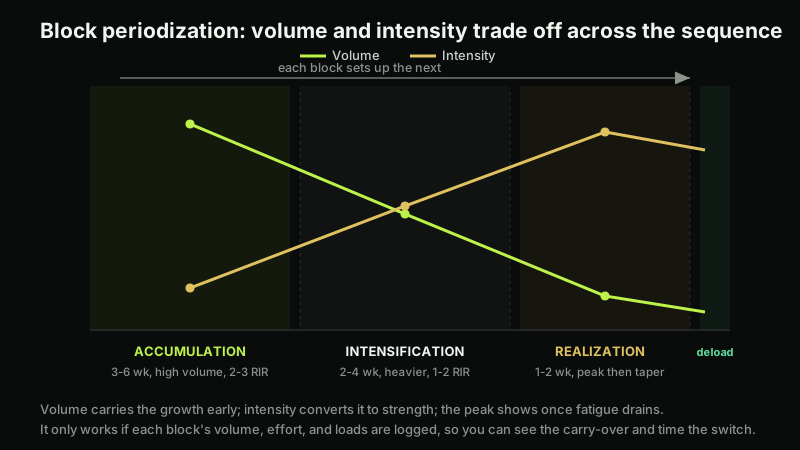
The sequence is the whole point. Each block sets up the next, and the load and volume move in opposite directions as you progress through them.
| Block | Length | Volume | Load / intensity | Main job |
|---|---|---|---|---|
| Accumulation | 3 to 6 weeks | High | Moderate (more reps, 2 to 3 RIR early) | Build muscle and work capacity; bank the volume |
| Intensification | 2 to 4 weeks | Moderate, falling | Heavy (fewer reps, 1 to 2 RIR) | Turn the base into strength |
| Realization | 1 to 2 weeks | Low | Very heavy or peak, then taper | Express the peak, shed fatigue, test |
Two things in that table matter more than the exact numbers. The first is that volume and intensity trade off across the sequence rather than climbing together: the accumulation block carries the growth stimulus on volume, and by the realization block you are doing very little work at a very high intensity so fatigue drains and the peak shows. The second is that effort, read as reps in reserve, still governs every set inside every block. An accumulation set at 2 to 3 RIR and an intensification single at 1 RIR are both prescribed by proximity to failure, not by the rep count alone, which is what keeps the stimulus honest while the loads and volumes change underneath it.
Block vs linear vs undulating periodization
Block periodization is easiest to understand next to the two models it is usually set against. All three are just different ways of arranging load and reps inside the same training cycles of a macrocycle, mesocycle, and microcycle; the cycles are the containers, and these are the ways of filling them.
| Linear | Block | Undulating (DUP/WUP) | |
|---|---|---|---|
| How qualities are arranged | One quality, shifted slowly across the whole program | One quality concentrated per block, blocks sequenced | Qualities rotated every session or every week |
| Time scale of variation | Months | Weeks (per block) | Days to a week |
| Best use | Peaking for one dated event | Intermediate to advanced lifters wanting to build then peak, or peak more than once a year | Keeping strength and size moving together with no single peak |
| Main drawback | Long single-focus phases bleed off the untrained qualities | More planning; the carry-over between blocks has to be tracked to trust it | Harder to plan and track; needs a real log to run honestly |
Linear periodization moves one quality in a straight line toward a single peak, which is excellent when there is a date and one number to hit and clumsy when there is not. Undulating periodization rotates the qualities on a short cycle so none of them goes stale, which suits general and hypertrophy training with no fixed peak. Block periodization sits between them in time scale: longer focus than undulating, shorter and more sequenced than classic linear, and built specifically so you can build a base and then cash it in for strength without losing the base in the process. The practical difference from undulating is concentration. Undulating keeps every quality present every week; block concentrates on one at a time and trusts the previous block's effect to persist while you work the next.
Does block periodization build more muscle?
This is the question most lifters actually arrive with, and the answer is the least dramatic part of the topic. For hypertrophy specifically, the periodization model is not the lever that moves growth. What drives muscle is total weekly hard sets per muscle, taken close enough to failure, progressed over time. When studies equate volume between periodized and non-periodized groups, or between one model and another, the size difference is small and inconsistent. Stronger by Science's review of what the periodization data actually say lands there: periodized training tends to beat genuinely unstructured training, and block periodization has reasonable evidence for strength and peaking, but no model out-grows another once the volume is matched. The dose-response relationship that Schoenfeld, Ogborn, and Krieger found between weekly hard sets and hypertrophy holds no matter how you slice those sets into blocks.
So block periodization is not a growth multiplier, and treating it as one is the mistake. Where it genuinely earns its place is strength and peaking. Concentrating a heavy block after an accumulation block lets a trained lifter push intensity hard without the fatigue of simultaneously chasing high volume, and the realization block exists precisely to turn that work into a peak on a chosen day. It also allows more than one peak a year, which a single long linear plan does not. For a natural lifter whose goal is size, the useful reading is that the accumulation block is where almost all the growth happens, and the rest of the sequence is about expressing strength and managing fatigue, not about adding muscle the simpler plan would have missed.
Where a hypertrophy lifter actually uses it
Here is the part that makes block periodization less exotic than it sounds: if you already run a hypertrophy mesocycle, you are already running a light version of it. A standard mesocycle is an accumulation block. You build volume across four to six weeks, push effort from around 2 to 3 reps in reserve toward 1 to 2 as the weeks climb, and then take a deload to clear accumulated fatigue before the next block starts fresh. That is a single accumulation block followed by a backoff, which is the first and most important piece of the full model.
Full block periodization is what you get when you deliberately sequence those blocks toward a goal rather than repeating the same accumulation mesocycle on a loop. A lifter who wants to add size and then test a heavier set of fives might run a volume-heavy accumulation block, follow it with a lower-volume, higher-load intensification block, and finish with a short realization block to hit the heavy triple or the new rep max. A strength template like the 5/3/1 program is a packaged version of the same idea at a monthly scale, with its percentage waves and its built-in backoff. The decision that defines the whole thing is when to transition: you leave the accumulation block when the volume has done its job and move to intensification, and you only know it has done its job if you can see what the block actually delivered.
Running block periodization is a tracking problem
That last point is the gap every elite-sounding article on this topic skirts. Block periodization only works if the blocks carry over, and carry-over is invisible unless it is recorded. The accumulation block is supposed to leave you with more muscle and work capacity than you started with, so the intensification block has something to convert; the intensification block is supposed to leave you stronger, so the realization block has something to peak. Run the sequence out of your head and you cannot tell whether the accumulation block actually added weekly hard sets per muscle or just felt busy, whether the intensification block moved your heavy loads or just felt heavy, or when the right moment to transition arrived. The blocks blur into "harder for a while, then heavier for a while" and the model loses the thing that made it a model.
The only way the sequence means anything is written down, and it needs three numbers across each block: the volume you accumulated, the effort you worked at, and the load you actually moved on the key lifts. This is the job RIRLift is built for. It does not write a block periodization plan or decide your transitions; it is the fastest place to run and record the one you are following. You set a rep range and a target reps in reserve per exercise when you build each block, and keep each block's rep and effort target on your wrist before the set instead of in your head. Because RIR is recorded as a first-class value on every set rather than guessed after the fact, the accumulation weeks and the intensification weeks become comparable, the weekly hard sets by muscle total without a spreadsheet, and the estimated one-rep max surfaced during rest shows whether the intensification block is actually moving your strength. That is the signal that tells you a block has done its work and it is time for the next one.
Who should run block periodization, and who should not
If you are a beginner, do not start here. You can still add load almost every session, and a straightforward linear progression will out-produce any sequenced plan while that lasts, with far less to manage. Spend that phase first; the model solves a problem you do not have yet.
Block periodization earns its place for the intermediate or advanced lifter who has a specific strength goal or a date, and who wants to build a base and then peak off it rather than hold everything at once. It suits anyone who competes or tests, because the realization block is purpose-built for a peak, and anyone who wants to cycle through more than one peak in a year. For a general hypertrophy lifter with no test on the calendar, the honest recommendation is lighter: run good accumulation mesocycles with deloads, which is most of the benefit, and reach for a full sequenced block plan only when you have a strength goal worth peaking for. Undulating periodization is often the better fit for pure size with no peak, because it keeps every quality present week to week.
The one group that should be wary is the same one every periodization model warns off: lifters who will not keep a record. Block periodization without a log is the worst trade available, all of the planning and none of the feedback, and it is exactly where the method earns its reputation for being fussy and academic. The complexity is real. It only pays off when it is tracked.
The verdict
Block periodization is a sound way to organize a training cycle, not an elite secret and not a cheat code for growth. Sequencing an accumulation block into an intensification block into a realization block lets a trained lifter build a base and then convert it into peak strength without the two goals fighting each other, which is why it suits intermediate and advanced lifters with a strength goal or a date, and why it does little for a beginner who can still progress every session. For hypertrophy at matched volume it will not out-grow a simpler plan, so run it for its real strength and peaking benefits and keep expecting the size to come from weekly hard sets taken close to failure. And treat it as what it is underneath the vocabulary: a carry-over problem that only reads clearly on a record. Set each block's targets, log the load, reps, and RIR for every set as it happens, and watch the volume, the effort, and the strength trend across the blocks. Do that and the sequence becomes a plan you can steer. Skip it and block periodization is just three ordinary training months wearing a scientific name.
Frequently asked questions
What are the three phases of block periodization? Accumulation, intensification, and realization. Accumulation builds muscle and work capacity with higher volume at moderate loads; intensification converts that base into strength with heavier loads and less volume; realization cuts volume further to peak the result and shed fatigue before a test or the next cycle.
Which block lays the foundation for the others? The accumulation block. It is the longest and carries the volume, and the intensification and realization blocks only have something to work with if accumulation actually added muscle and capacity first, which is why it is worth tracking what that block delivered.
Is block periodization better than linear or undulating for building muscle? No model reliably out-grows another once weekly volume is matched. Block periodization has its edge in strength and peaking, not hypertrophy. For pure size with no competition date, a well-run accumulation mesocycle or an undulating plan is usually simpler and just as effective.
How long should each block be? Roughly three to six weeks for accumulation, two to four for intensification, and one to two for realization, adjusted to how fast you recover and how advanced you are. The signal to transition is not the calendar alone; it is whether the current block's numbers show it has done its job.