
Blog
Giant sets: do they build muscle, and how to log them
Published August 12, 2026 · 13 min read
You finish a set of incline dumbbell press with maybe a rep in the tank, and instead of racking the weights and sitting down, you walk straight into flyes. Then cable crossovers. Then push-ups until your chest quits. Four exercises, no rest, one long burning stretch of work, and you rack up feeling like you just did the work of a whole chest day in five minutes. Surely that counts for four hard sets.
That feeling is exactly why giant sets get oversold, and it is exactly where lifters mislog them. A giant set packs a huge amount of local fatigue into a short window, so it burns, it pumps, and it feels enormously productive. What it does to your weekly training stimulus, and what it does to the honesty of your log, are two very different questions. The useful version of this technique lives in the gap between how a giant set feels and what it actually adds to your weekly volume by muscle.
What is a giant set?
A giant set is three or more exercises performed back to back for the same muscle or muscle region, with little to no rest between exercises and a full rest only after the whole sequence is done. Two exercises back to back is a superset. Three is often called a tri-set. Four or more is where "giant" gets used, though the terms blur and nobody polices the boundary. The defining feature is not the exact number, it is that you chain several movements for one target with no recovery in between.
Because fatigue stacks fast, the loads are lighter than you would use for straight sets, and the later exercises in the chain drop off hard. A typical chest giant set looks like this.
| Position in the set | Exercise | What is happening to the muscle |
|---|---|---|
| 1 | Incline dumbbell press | Freshest effort, closest to a real working set |
| 2 | Dumbbell fly | Already fatigued, load drops noticeably |
| 3 | Cable crossover | Deep fatigue, mostly a metabolite and burn stimulus |
| 4 | Push-ups to failure | Bodyweight finisher, a fraction of the first exercise's tension |
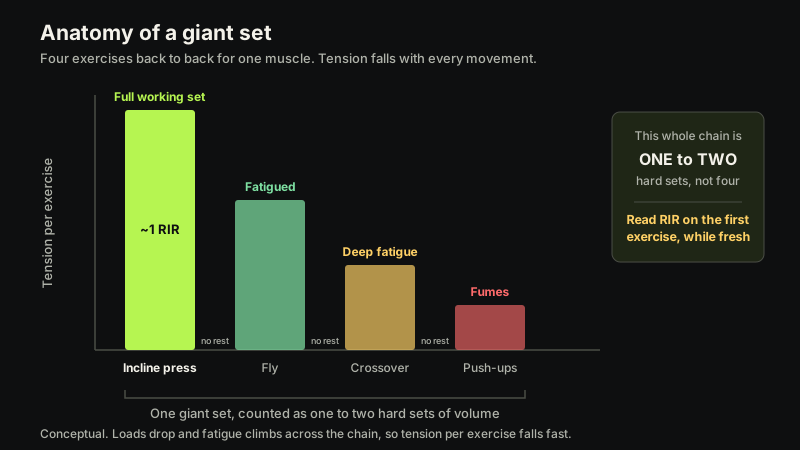
The first exercise is the closest thing in the sequence to a genuine hard set. Everything after it runs on a muscle that is already deep in fatigue, at a lighter load, so the mechanical tension (the thing that actually drives growth) falls with every movement. That shape, high tension up front and a rapid falloff after, is the whole story of what a giant set does and does not deliver.
Giant sets vs supersets, tri-sets, and circuits
Lifters lump all of these together, and they are related, but the distinctions change how you program and count them. The two variables that matter are how many exercises you chain and whether they hit the same muscle or different ones.
| Format | Exercises | Target | Main purpose |
|---|---|---|---|
| Superset (same muscle) | 2, back to back | One muscle | Extend a muscle past its first failure point |
| Superset (antagonist) | 2, back to back | Opposing muscles | Save time without much added fatigue per muscle |
| Tri-set | 3, back to back | Usually one muscle | A bigger same-muscle chain |
| Giant set | 4 or more, back to back | One muscle or region | Maximal local fatigue and metabolic stress in minimal time |
| Circuit | Several, back to back | Whole body, rotating | Conditioning and calorie burn, not hypertrophy focus |
An antagonist superset, pairing something like a row with a press, is the friendliest of these for growth because each muscle gets a real rest while the other works. A same-muscle giant set is the opposite extreme: every exercise piles onto a muscle with zero recovery, which is what makes it feel so brutal and what caps how much real stimulus the back half can deliver. A circuit is a different animal entirely, built for conditioning rather than muscle, so do not confuse "I did a giant set" with "I trained for growth" just because both leave you breathless.
Do giant sets build more muscle?
This is the claim the technique lives or dies on, and the honest answer is that there is almost no direct evidence giant sets build more muscle than the same exercises done as straight sets, and some good reason to think each individual exercise in the chain does less.
Almost no study has tested same-muscle giant sets head to head against traditional training for hypertrophy. The closest and most useful evidence comes from supersets, which are the two-exercise version of the same idea. A 2025 systematic review and meta-analysis in Sports Medicine by Zhang and colleagues found that supersets let lifters match traditional training for total reps and muscle growth in significantly less time, which is a real and worthwhile benefit. But it also found that "similar biomechanical" supersets, meaning same-muscle pairings like the ones a giant set is built from, produced significantly less volume load than straight sets, at a higher rating of perceived exertion and higher blood lactate. In plain terms: when you stack exercises on one muscle with no rest, you do less real work while it feels harder.
A giant set is that effect multiplied. You are not chaining two exercises on a fatigued muscle, you are chaining three or four, so the volume-load penalty and the fatigue both grow with each movement. The efficiency case is genuine, and it lines up with the broader research on time-efficient training, where techniques like supersets and reduced rest let time-crunched lifters hold onto their gains. The growth-hack case does not hold up. A giant set is a way to buy a lot of fatigue and burn in a short window, not a way to extract extra muscle from the same exercises.
The usual defense of giant sets leans on the "effective reps" idea, that the reps closest to failure are the ones that count, so chaining exercises stacks up more of those per minute. That story is intuitive, and it is roughly how the technique earns its keep, but hold it loosely. Stronger by Science has argued that the evidence for the effective-reps model is thinner than it sounds. What survives either way is simpler: get a muscle close enough to failure and growth follows, and a giant set is one of several ways to get there, not a uniquely powerful one.
What a giant set actually costs
Nothing about chaining exercises with no rest comes for free, and a giant set charges its bill in two places: fatigue, and the honesty of your effort read.
The fatigue cost is obvious the first time you try one. A four-exercise chain to failure is a colossal amount of local and cardiovascular fatigue for one muscle, which is why a giant set is a tool for one or two spots in a session, not a way to run the whole workout. Chain them across every muscle and you accumulate fatigue far faster than stimulus, and everything later in the session pays for it. Most of that back-half work is the low-tension kind that adds fatigue without adding much stimulus, which is a poor trade if growth is the goal.
The subtler cost is that a giant set wrecks your ability to read effort. On a clean straight set you can estimate how many reps you had left. Inside a giant set, the second, third, and fourth exercises all feel maximal because you are already exhausted, so a reps-in-reserve estimate on any of them means very little. This is the same reason a small buffer usually beats grinding every set to zero: the buffer keeps both the stimulus high and the reading trustworthy. With a giant set, the only exercise where your RIR call is still meaningful is the first one, while you are relatively fresh. Anchor your effort judgment there and treat the rest of the chain as bonus fatigue rather than data you can trust.
Do the four exercises count as four hard sets?
Here is the part almost no giant-set article addresses, and it is the part that quietly corrupts your training log.
When you finish a four-exercise giant set for chest, how many hard sets did you just do? You reached failure four times, so it is tempting to write down four. That inflates your volume and wrecks your bookkeeping. A giant set is not four independent hard sets. Only the first exercise runs on a relatively fresh muscle at a real working load. Each exercise after it happens on a deeply pre-fatigued muscle at a lighter load, carrying far less mechanical tension than a fresh set would, which is exactly what the meta-analysis showed as reduced volume load. Counting each exercise as a full hard set tells your weekly total you did several times more effective work than you actually did.
The conservative way to account for it is to treat a same-muscle giant set as roughly one to two hard sets for the target muscle on your weekly tally, not three or four. A four-exercise chest giant set counts as about one or two chest sets, not four. Get this wrong and your log will claim 24 sets a week for a muscle when the honest, effective number is closer to 12, and every progression call you make from that inflated number inherits the error. This is the same exercise-counting problem that shows up whenever you stack movements on one muscle: the set count only helps if it reflects real hard sets.
Read the right way, that undercount is what makes giant sets useful. They add a big dose of near-failure stimulus and metabolic stress to a muscle without adding much to your honest set count, which is genuinely handy late in a session when you want one more hard effort but you are near your per-session ceiling and cannot afford several full sets of fatigue.
How to program giant sets
Used deliberately, a giant set is a clean way to buy a lot of stimulus and burn in a short window. Used everywhere, it is a fatigue machine. A few rules keep it on the right side of that line.
- Bias them toward isolation and machine work. Flyes, lateral raises, leg extensions, leg curls, curls, and pushdowns let you fail safely and reload instantly. Keep giant sets off heavy free-weight squats, deadlifts, and bench, where technique fails before the muscle does and the safety cost is real.
- Order the chain from hardest to easiest. Put the exercise you most want to progress first, while you are fresh and your RIR read still means something, then let the load and complexity fall across the chain.
- Run one or two per session, not the whole workout. A giant set is a finisher for a lagging muscle or a way to compress a session when you are short on time, not a training style. Spend the fatigue cost sparingly.
- Count it as one to two hard sets, not one per exercise. Log it honestly toward your weekly volume so your bookkeeping does not lie to you six weeks later.
- Reach for them when the clock is the bottleneck. If your real constraint is time rather than stimulus, a giant set delivers a lot of work fast. If you have the time to do full sets with proper rest, that is usually the better stimulus per unit of fatigue.
A worked example on chest looks like this.
| Step | Exercise | Load | Reps | Rest before next |
|---|---|---|---|---|
| 1 | Incline dumbbell press | Your ~10-rep weight | To about 1 RIR | None |
| 2 | Dumbbell fly | Lighter | As many clean reps as possible | None |
| 3 | Cable crossover | Lighter still | To failure | None |
| 4 | Push-ups | Bodyweight | To failure | Rest 2 to 3 minutes, then done |
Four trips to failure, two or three minutes of work, and on your log it is one to two hard sets for chest, run as a giant set, not four.
How to log a giant set without inflating your volume
A giant set only helps if your record survives it, and the record is where this technique usually goes wrong. Enter it as four straight sets and you inflate your counted chest volume while hiding the fact that three of those "sets" were low-tension work on an exhausted muscle. Six weeks later your log says chest is drowning in volume when the effective number is a fraction of that, and you cannot tell the productive weeks from the padded ones. That is how a good reps-in-reserve habit gets quietly undermined by bad counting.
The fix is to record a giant set as what it is: a small number of honest hard sets for the target muscle, with the effort noted on the first exercise where your RIR read is still trustworthy. In RIRLift you log the priority exercise's load, reps, and RIR the way you log any set, and you keep the fatigued back-half work from masquerading as fresh working sets in your weekly total, so a giant set counts as one to two hard sets toward your weekly volume by muscle rather than four. The tally stays honest, and your progression decisions come from real numbers.
The mechanics matter too, because a giant set is a race with no built-in pauses. You cannot rack four exercises back to back and fumble with a phone in between. Running the session from your wrist keeps your hands near the weights and your head in the work: the RIRLift workflow is built so confirming a set is a tap or a turn of the Digital Crown, which is the difference between logging a giant set cleanly and abandoning the record halfway through because the phone got in the way. Like drop sets and other finishers, a giant set earns its place only if the number it leaves in your log is true.
The honest verdict on giant sets
A giant set is a scalpel, not a hammer. It is a time-efficient way to dump a large amount of near-failure work and metabolic stress onto one muscle, which makes it a strong finisher on isolation and machine movements and a poor way to run a whole session. Do not expect extra muscle from the burn, do not put it on your heavy compounds, and above all do not let a four-exercise chain count as four hard sets in your log.
Treat a giant set as one to two honest hard sets that happen to deliver a lot of fatigue and near-failure reps, place it where your recovery can afford it, and record it as such. Like every intensity technique, judge it by what your log says it did across a training block, not by how much it burned on the day.