
Blog
Lengthened partials: do half reps build more muscle?
Published August 4, 2026 · 12 min read
Somewhere around the end of 2023, half of lifting content on the internet decided that partial reps were no longer cheating. Not any partial rep, though. Specifically the ones performed at the bottom of a curl, the stretched half of a leg curl, the deep portion of a pulldown, with the target muscle held long. Do those, the videos said, and you grow more than you would from full reps.
It is a good story, and it is built on something real. The muscle does behave differently at long lengths, and the training research on range of motion has been pointing in that direction for years.
Then the best controlled test of the exact claim came back. Lengthened partials and full reps produced the same growth.
That result is more useful than either the hype or the backlash, because it tells you what the technique actually is. Lengthened partials are not a growth multiplier. They are a way to keep a set hard in the position where the muscle is best at being loaded, which matters on a specific and fairly short list of exercises. The catch, and the part nobody covers, is that a partial rep quietly breaks the two numbers you use to make training decisions: your effort estimate, and your weekly set count.
What are lengthened partials?
A lengthened partial is a repetition performed through only the stretched portion of an exercise's range of motion, stopping before the muscle reaches its shortened position. On a preacher curl that means the bottom half, arm nearly straight, never curling all the way up. On a lying leg curl it is the first part of the flexion, hamstring long. On a lat pulldown it is the top portion, arms overhead and lats stretched.
The technique goes by several names that mean the same thing: lengthened partials, long-length partials, or partials at long muscle lengths. They are the opposite of the classic gym partial, which is usually a shortened partial: quarter squats, the top half of a bench press, the last few inches of a curl where the weight is easy and the muscle is short.
| Full range of motion | Lengthened partial | Shortened partial | |
|---|---|---|---|
| Where the rep happens | Stretched to shortened | Stretched half only | Shortened half only |
| Muscle length under load | Whole range | Long | Short |
| Typical example | Full preacher curl | Bottom half of the curl | Top half of the curl |
| Evidence for hypertrophy | Strong baseline | Comparable to full ROM | Consistently worse |
| Usual reason lifters do it | Default | Deliberate technique | Ego, or chasing load |
That last row is the honest summary of the research. The partials that got a bad reputation are the shortened ones, and they deserve it. The lengthened variety is a different animal that happened to inherit the same name.
What the research actually found
The headline study is the one people cite without reading. In 2025, Wolf and colleagues published a trial comparing lengthened partial repetitions against full range of motion training in PeerJ. Thirty resistance-trained participants, eight weeks, two upper-body sessions per week, four exercises per session, four sets per exercise. One group trained the stretched half only. The other did complete reps.
Both groups gained muscle thickness. Both improved on a ten-rep-max lat pulldown test. The difference between them was not meaningful, and the Bayes factors reported by the authors gave moderate support to the conclusion that the two approaches produced equal improvement rather than merely failing to detect a difference. That is a stronger statement than a typical null result, and it is the most direct evidence available on the specific question.
Zoom out and the picture is consistent. Schoenfeld and Grgic's systematic review of range of motion concluded that full range of motion generally produces at least as much growth as partial work, with the notable exception of partials performed at longer muscle lengths, which can match or occasionally beat full reps.
The most striking single result in this area is not about partials at all. Maeo and colleagues found that training the triceps overhead rather than with the arm at the side produced substantially greater hypertrophy, with the long head growing roughly twice as much. Same exercise, same effort, same reps, different muscle length. That study is the clearest demonstration that where in the length range you load a muscle changes the outcome, and it explains why the lengthened-partial idea was worth testing in the first place.
So: long muscle lengths matter. Doing only the long-length portion of the rep does not beat doing the whole rep. Both things are true, and they are not in conflict.
Why the stretched half is the interesting half
If lengthened partials are not better, why do they hold up as well as they do while covering half the distance?
Because the stretched position is where most of the useful tension lives. A muscle produces its highest active force somewhere near the long end of its working range, and that is also where the passive structures start contributing. Meanwhile the shortened end of most exercises is where the leverage turns favourable and the load stops challenging the muscle at all. The top of a curl, the lockout of a leg extension, the squeeze at the end of a row: those inches feel like effort because you are near failure, not because tension is high.
This is the practical face of mechanical tension, the stimulus that actually drives growth. Cutting the shortened half of a rep removes distance, not stimulus. It is the same logic that explains why counting seconds under load is the wrong lever: the clock and the range both measure the rep, and the muscle responds to the tension inside it.
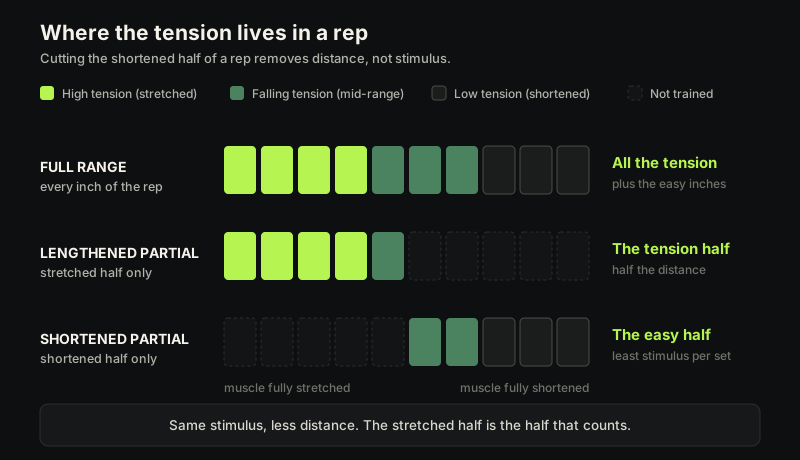
A caveat worth keeping: the muscle is one thing, the exercise is another. On a barbell squat or a bench press the stretched position is also where the joint stress and the stability demand peak, and a partial there is not a clean swap. The technique makes most sense where the resistance profile and the stretch line up, which is mostly machines, cables and isolation work.
The RIR problem nobody mentions
Here is where the coverage of this technique stops being useful and your log starts lying to you.
Effort is the variable that decides whether a set counted. Most evidence-based programming keeps working sets somewhere around one to three reps in reserve, and the proximity-to-failure literature suggests you do not need to reach failure to get most of the stimulus, provided you get close. That is a workable rule only if your estimate of "close" is accurate.
Your RIR estimate is a learned skill, and it is exercise-specific and range-specific. You know what two reps from failure feels like on a full preacher curl because you have done thousands of them and occasionally taken one to failure to calibrate. On a lengthened partial you have none of that. Failure arrives differently: the sticking point of a partial is not the sticking point of the full rep, the reps are faster, the burn is more concentrated, and the first time you try to stop two shy of failure you will almost certainly be wrong. Most lifters over-estimate their remaining reps in the first weeks, which means sets that look like they are at 2 RIR in the log are really at 4 or 5.
This is not a reason to avoid the technique. It is a reason to treat a partial variation as a new exercise for calibration purposes:
- Log lengthened partials as their own exercise entry, not as a note on the full-ROM lift. A partial preacher curl and a full preacher curl are different movements with different loads and different rep counts, and mixing them makes both progressions unreadable.
- Take one set to genuine failure in the first session, once, to anchor the scale. That is the same thing you would do with any unfamiliar movement, and our guide to reps in reserve covers how to build the estimate without flattering yourself.
- Expect your usable rep range to shift upward. The same load moved through half the distance will give you more reps, so a set that was eight full reps may be twelve or fourteen partial ones.
That last point matters more than it looks. A partial set in the twelve to fifteen range is still perfectly good hypertrophy work, since the rep range matters far less than the effort, but if you did not expect the shift you will read it as progress that has not happened.
How a partial set counts toward weekly volume
The second bookkeeping problem is volume. A hard set is the unit that weekly programming runs on, and most guidance lands each muscle somewhere in the region of ten to twenty hard sets per week. So what is a lengthened partial worth?
The defensible answer, given the evidence: one hard set, counted normally, provided it was taken close to failure. The Wolf trial equated sets, not reps or distance, and got equal growth. If four sets of partials produced the same result as four full sets, then a set of partials is a set.
Two things break that equivalence, and both are common:
- The partial set was not actually close to failure. This is the RIR calibration problem showing up as a volume error. A set logged at 2 RIR that was really at 5 is not a hard set, and it does not belong in your weekly total. This is what junk volume looks like from the inside: work that appears in the log and contributes little.
- The partials were bolted onto the end of a full set. Doing a full-ROM set to failure and then continuing with partials is not a lengthened-partial set. That is an intensity technique, closer to how myo-reps extend a single set, and the whole thing still counts as one hard set, not two.
The clean approach is to decide before the session which exercises run as partials for the block, and count them like any other set. Ambiguity here is what turns a reasonable technique into a quietly inflated weekly total.
Where lengthened partials actually earn a place
They are not a default. They are a tool for exercises where the stretched position carries the stimulus and the shortened position wastes your time, and for situations where full range is not available.
| Situation | Verdict | Why |
|---|---|---|
| Leg curl, leg extension, preacher or incline curl, pulldown, cable fly, seated calf raise | Good candidate | Resistance profile peaks near the stretch, shortened end is low tension |
| Barbell squat, deadlift, bench press | Poor candidate | Stretched position is also the highest-risk and most stability-limited part of the lift |
| A machine or bar you cannot get full range on (long torso, short arms, fixed path) | Good use | A lengthened partial is better than a shortened full rep |
| The last exercise of a session, as a finisher | Reasonable | High stimulus per unit of time and joint stress |
| Every exercise, all the time | No | You lose full-range strength expression and the evidence gives you nothing in exchange |
| An exercise where you have never trained to failure | Wait | Calibrate the effort scale on the full movement first |
The honest position on this technique is that it buys you options rather than growth. If you have a machine that turns to butter in the last third of the range, running that exercise as a lengthened partial keeps the whole set productive. That is a real gain, and it is smaller than the videos suggest.
How to run them, and how to know they worked
A workable protocol looks like this:
- Pick one or two exercises per session, from the good-candidate list, and keep them as partials for the whole block. Switching back and forth destroys the comparison.
- Use the range from full stretch to roughly the midpoint of the movement. Not a twitch, not two thirds. The rep should look deliberate.
- Keep the same effort target you use elsewhere, one to three reps in reserve on working sets. The technique changes the range, not the rule about how hard each set should be.
- Expect to reduce the load by roughly ten to twenty percent versus the full movement in the first session, then let the log correct you.
- Progress them normally, adding reps within your range before adding load.
Then check the log after three or four weeks. The signals you want are the boring ones: reps climbing at a fixed load while your logged RIR stays honest, and the weekly hard-set total for that muscle holding steady rather than quietly inflating. If your set count went up and your effort estimates drifted upward at the same time, the technique did not add stimulus, it added bookkeeping.
This is the part where load and reps alone cannot help you. Two sets can be identical on paper, eight reps at 40 kilos, and one of them was three reps from failure while the other was one. RIRLift logs reps in reserve per set from your wrist while you are still standing at the machine, keeps the partial variation as its own exercise with its own history, and totals your weekly hard sets by muscle so a change in technique shows up as a change in the numbers rather than a feeling. You can see how a session runs from your wrist if you want the full picture.
The verdict on lengthened partials
They work. They do not work better.
The best available trial found lengthened partials and full reps producing the same growth over eight weeks, and the broader range-of-motion literature says the same thing with more hedging: long muscle lengths are where the stimulus concentrates, and skipping the shortened half costs you very little. That makes lengthened partials a genuinely useful tool on machines and isolation work whose resistance curve falls apart near the top, and an unnecessary complication almost everywhere else.
Use them where the exercise justifies it, treat each partial variation as a new movement until your effort estimate catches up, count a hard partial set as exactly one hard set, and let the log tell you in a month whether the change bought anything. That is a smaller claim than "the world's smartest muscle building technique," and it is the one the evidence supports.