
Blog
RPE vs RIR: what's the difference, and which should you log?
Published August 13, 2026 · 11 min read
Open two training programs from two coaches and you will often find the same set written two different ways. One prescribes 3 sets of 8 at RPE 8. The other prescribes 3 sets of 8 at 2 RIR. Same exercise, same effort, two different labels, and the RPE vs RIR argument about which is "correct" has filled more forum threads than almost any other training-notation question.
Here is the short version before the long one. RPE and RIR are not rival systems. They are two dials showing the same reading: how close you took a set to failure. Across the working range they convert with a single line of arithmetic, and any program written in one can be rewritten in the other without losing a thing.
So why write a whole post about it? Because the small print is where the useful part lives. The two scales are not perfectly identical, they fit slightly different jobs, and, most importantly for anyone who actually records their training, one of them is easier to be honest about set after set. This is a comparison, a conversion chart, and a recommendation about which number to write down. If you want the deeper background on either scale on its own, we have a full breakdown of what RPE means in lifting and a pillar guide to reps in reserve; this post is about choosing between them.
What are RPE and RIR?
RPE stands for rating of perceived exertion. In lifting it is a 1 to 10 rating of how hard a set felt, where 10 means an all-out effort with nothing left and lower numbers mean more in the tank. The strength version is anchored to reps: an RPE 8 means you believe you had about 2 reps left.
RIR stands for reps in reserve. It is the number of clean reps you believe you could still have completed with good form at the end of a set. Stop a set thinking you could have done 2 more, and that set was 2 RIR.
Both are measures of one thing: proximity to failure. Failure is the shared zero point. RPE counts up to it (10 is failure), RIR counts down to it (0 is failure). That is the entire relationship, and it is why they translate so cleanly.
RPE vs RIR conversion chart
Because the lifting RPE scale is defined by reps in reserve, the conversion is just subtraction:
RPE = 10 minus RIR.
| RPE | RIR (reps in reserve) | What the set felt like |
|---|---|---|
| 10 | 0 | Failure. The next rep would not have moved, or you missed it. |
| 9.5 | 0 to 0.5 | No more reps at this load; maybe a hair more weight was possible. |
| 9 | 1 | One clean rep left. Bar speed has clearly slowed. |
| 8 | 2 | Two reps left. Hard, but rep quality is still good. |
| 7 | 3 | Three reps left. Working, but not near the edge. |
| 6 | 4 | Four reps left. A committed warm-up feel. |
| 5 and below | 5+ | Warm-up and technique work. Little growth stimulus per set. |
Read the two middle columns together and the whole thing collapses into that one sentence: your RPE is ten minus the reps you had left. An RPE 8 is 2 RIR. An RPE 9 is 1 RIR. An RPE 10 is 0 RIR, which is failure. Strength training mostly lives in the top of the scale, from about RPE 6 to 10, because sets much easier than that leave too much in reserve to drive much growth for a trained lifter.
That is where most comparisons stop. "They convert, they're the same, pick one." True, and incomplete. There is one place the two scales genuinely pull apart.
The one real difference
The clean version says RPE is nothing more than 10 minus RIR. In practice, the original idea behind RPE is a little broader than that, and the gap matters at the heavy end.
Reps in reserve asks a single, narrow question: how many more reps could you have done? Nothing else. It does not care whether the weight felt crushing or floaty, only how many were left.
RPE, as it came from its endurance roots, is a rating of overall perceived effort. On a rep-anchored strength scale those two things line up almost perfectly in the 8 to 15 rep range, where "how hard it felt" is basically "how many reps were left." But take a heavy triple on a deadlift. You might have had one rep left, which is a clean 1 RIR, and yet the set felt like a 10 out of 10 because the load itself was brutal and the last rep was a grind. The reps-left count and the felt effort can disagree when the weight is very heavy and the reps are very few.
This is not a reason to distrust either number. It is a reason to understand what each one is actually measuring:
- RIR is a count. It is blind to the load. Two reps left is two reps left whether the bar was heavy or light.
- RPE is a rating. It bundles reps-left together with the sheer physical toll of the weight, which is why heavy low-rep work can feel like a higher RPE than its rep count alone would suggest.
For hypertrophy, where most sets sit in the 6 to 20 rep range, the two are close enough to treat as interchangeable. The difference only becomes practical when you get into low-rep, near-maximal work, which is more of a strength-training concern. That is one of the quieter distinctions between training for size versus strength: the rep range you live in changes how well a pure reps-left count captures the effort.
When to use RPE vs RIR
Because of that difference, each scale has jobs it fits a little better.
| Situation | Better fit | Why |
|---|---|---|
| Heavy, low-rep compounds (squat, deadlift, bench triples) | RPE | Captures the grind and load toll a bare rep count misses. |
| Higher-rep accessory and isolation work (curls, extensions, machine rows) | RIR | Counting clean reps left is more concrete than scoring a feeling. |
| Most hypertrophy training (roughly 6 to 20 reps) | Either | They converge here; use whichever you will record honestly. |
| Teaching a newer lifter proximity to failure | RIR | "How many reps left?" is an easier first question than "rate the effort." |
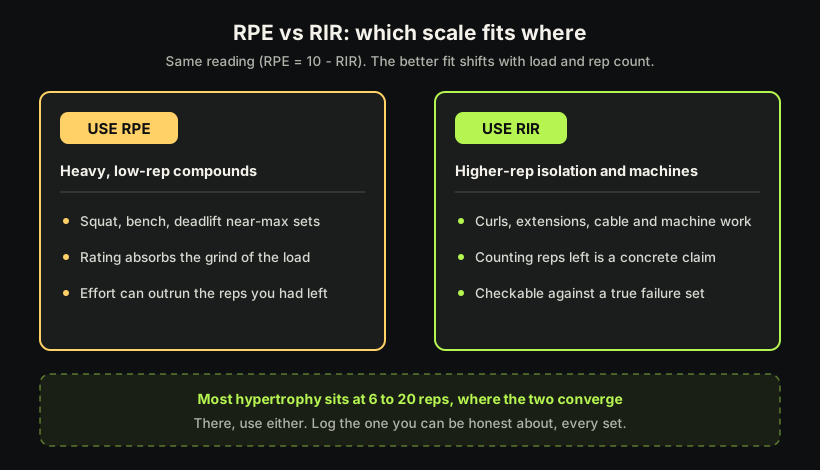
Notice the last two rows. For the bulk of muscle-building work, the honest answer to "which should I use" is "the one you will actually be consistent with," because in that rep range they carry the same information. The decision only gets interesting at the edges.
If you are running a block that mixes both, like a powerbuilding template with heavy top sets and higher-rep back-off work, it is completely reasonable to think in RPE on the heavy compound and RIR on the isolations, then convert to a single scale when you write it down. Speaking of writing it down, that is where the two scales stop being equal.
Which is easier to log honestly?
If RPE and RIR carry the same information across most of your training, the choice comes down to a practical question: which one produces a record you can trust weeks later?
Logging RPE asks you to score a sensation on a 1 to 10 scale. Logging RIR asks you to name a number of reps you had left. For most lifters the second question is more concrete, because it points at something countable rather than a feeling, and a more concrete question tends to produce a steadier record over time.
The reps-left version also has something the effort rating does not: it is checkable. Every so often you can take a comparable set all the way to failure and see whether the reps you thought you had left really matched your call. A set you logged at 2 RIR that turns out to have had 4 reps left is a calibration error you can see and fix. "RPE 8" gives you nothing to verify it against; it is a rating of a feeling, and feelings do not come with a receipt. This is the same reason we argue that how hard each set should be is a question you answer with logged data rather than memory.
That checkability is what turns a pile of numbers into a training signal. A plain log of load and reps cannot tell you whether a session got easier or you just added a rep. A log of effort can, but only if the effort numbers are consistent enough to trust from one week to the next. The drift you can see across a long session, where the first sets hit target and the last ones sag, is only visible if you recorded effort honestly, set by set.
This is the reasoning behind how RIRLift logs. You set a target RIR per exercise when you build a routine on your iPhone, then log actual load, reps, and RIR for every set from your Apple Watch, in the moment, with last time's numbers pre-filled. RPE and RIR are the same reading, and the app records the concrete one. Over a block that history becomes an effort-accuracy read: a planned 2 RIR that keeps coming in at 4 says add load, and a string of 0 RIR says back off before the fatigue piles up. That week-to-week logic is also how you autoregulate across a training block, where the same effort target creeps to heavier loads as you get fitter, then resets at a deload. If you want to see the mechanics, here is how a session runs from your wrist.
Is RIR better than RPE?
Not better, but usually easier to be accurate with, for two reasons. First, it asks a countable question ("how many reps left?") instead of a felt one ("how hard was that?"), and countable questions produce steadier records. Second, it is verifiable: you can occasionally push a set to true failure and check your estimate against reality, which is how the skill improves. RPE still wins for heavy, near-maximal work where the grind of the load matters as much as the reps left. For most hypertrophy training the two are close enough that the tiebreaker is simply which one you will record honestly every set. Once you have settled on RIR, applying it across a full session is its own small skill.
Does 0 RIR mean failure?
Yes. Zero reps in reserve means you had no clean reps left, which is the definition of momentary muscular failure, and it maps to RPE 10. There is a small wrinkle at the very top: RPE 9.5 is often used for "no more reps at this load, but slightly more weight might have moved," which is still effectively 0 RIR. For practical logging, treat 0 RIR and RPE 10 as the same thing: the set where the next rep would not have gone up.
Is 2 RIR good for hypertrophy?
For most working sets, yes, 2 RIR is a solid default. Evidence-based guidance for muscle growth generally lands on keeping the bulk of your sets around 1 to 3 RIR, which is RPE 7 to 9: close enough to failure that the reps count, with enough buffer that you can repeat the work across the week and recover from it. Training every set to 0 RIR does not reliably add growth, and it adds a lot of fatigue. The RIR-based RPE scale that underpins this recommendation was validated by Zourdos and colleagues in 2016, and Helms and colleagues laid out how to apply it for resistance training. The number matters less than the honesty behind it, which loops back to the whole point of this comparison.
The honest answer
RPE and RIR are two languages for the same sentence: how close did you take that set to failure. They convert with simple subtraction, they agree across the rep ranges most people train in, and the small place they disagree, heavy near-maximal work, is where RPE's broader effort read earns its keep.
For everything else, the deciding factor is not which scale is theoretically superior. It is which number you can write down honestly, set after set, and still trust when you read it back a month later. For most lifters that is reps in reserve, because "how many reps left" is a concrete, checkable claim in a way that "rate your effort" never quite is. Pick the one you can be most honest about, log it in the moment, and let a block of real data tell you what one afternoon's feeling never could.