
Blog
Training With DOMS? Let Your Warm Up Decide: Lift, Modify, or Rest
Published October 14, 2026 · 9 min read

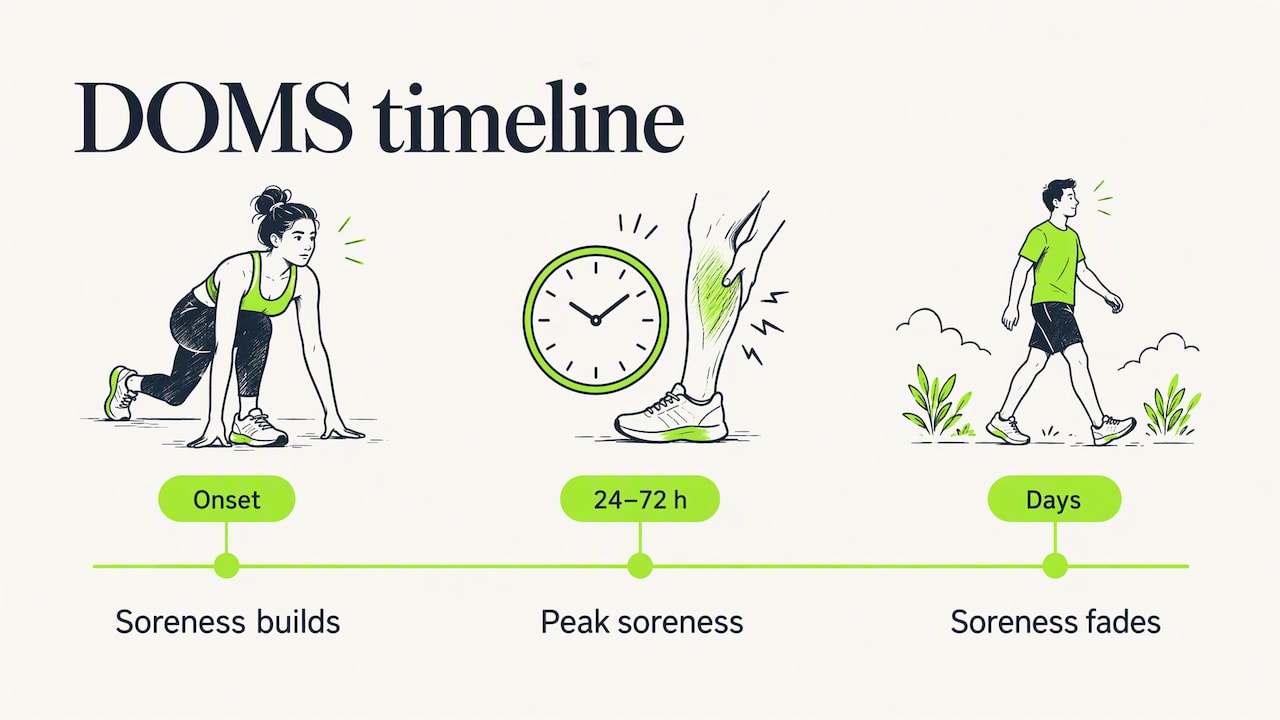
If you can move through a full range of motion and keep your usual form, you can usually train as planned. If soreness changes how you move, modify the session or rest. DOMS typically peaks 24 to 72 hours after unaccustomed or intense exercise, so feeling stiff on day two is normal, not a warning.
TL;DR:
- If soreness is dull and eases during warmups, train only while your normal range and form remain intact; modify or rest if either changes.
- If warmup weights feel unusually heavy, lower the load, cut sets, keep several reps in reserve, or replace heavy lifts with easier variations.
- Massage showed the strongest overall effect for reducing soreness; cold water, compression, and active recovery also helped, while stretching showed no consistent effect on DOMS.
- DOMS often peaks 24 to 72 hours after unfamiliar or intense exercise; introduce new exercises, volume, and longer lowering phases gradually to limit soreness.
- Dark urine, extreme swelling, numbness, sudden weakness, inability to bear weight, fever, or rapidly worsening pain warrants prompt medical care rather than training through soreness.
Table of Contents
- How do you decide what to do on a sore day?
- What should you change when you train through DOMS?
- What does the evidence say about easing DOMS?
- How long does DOMS last, and why does it fade with training?
- When is soreness not just DOMS?
- Why consistency and objective checks beat chasing soreness
- Can an app help you adjust training around soreness?
- FAQ
- Sources
How do you decide what to do on a sore day?
Run this check before you load the bar. It can help remove some of the guesswork.
- Pain type: dull, achy soreness that eases as you warm up is normal. Sharp, pinching or joint-centered pain is different from ordinary soreness. Seek immediate medical care if you are concerned about it.
- Range of motion: if you cannot hit your normal depth or lockout without a hitch, shorten the range or pick a lighter variation.
- Comparative strength: if your first working set feels far heavier than it should at the same effort, treat that as data and cut the day back.
- Compensation: limping, shifting your hips in a squat or flaring the elbows on bench means your form is paying for the soreness. Clinicians commonly advise that if you can move through full range without pain or compensatory patterns, training is likely safe, and if soreness breaks your form, you should modify or rest.
- Mild soreness: keep the weight close to normal, but leave more reps in reserve and drop a set or two.
Here is how that looks in practice. Sore quads on squat day: keep your usual bar speed but go to a box squat or a goblet squat and stop a few reps short of failure. Tight hamstrings and glutes before deadlifts: swap to a lighter Romanian deadlift or a trap bar pull with a controlled lowering phase. Sore chest and triceps before bench: use dumbbells, lighten the load and pause briefly on the chest to check your control.
Pro Tip: Log your first warm-up sets with weight, reps and RIR. If a weight that normally moves easily suddenly feels noticeably harder, you have an objective reason to scale the session back.
What should you change when you train through DOMS?
The goal is to keep the habit and some of the stimulus while lowering the risk of sloppy reps. These adjustments are practical coaching conventions rather than research-derived cutoffs, so use them as general guidance and tune them to how you feel.
- Lower the load if your warm-up sets feel heavy. Make a smaller adjustment if soreness is mild and a larger one if your warm-up sets feel heavy.
- Cut working sets if your form or effort is affected. Two quality sets beat four grinding ones.
- Leave several reps in reserve. Soreness blunts your ability to judge failure, so a larger buffer protects you.
- Swap heavy compounds for friendlier options. Think goblet squats, dumbbell presses, machine rows, single-joint work, slower tempo or technique drills with a light bar.
- Shorten the range only when you must. A slightly shallower squat with clean mechanics beats a full-depth rep that collapses.
- Warm up longer. Add extra ramping sets so the muscle loosens up gradually before the first working set.
If you want a ready-made fallback, use this maintenance template: a general warm-up, then a progressive ramp on each main lift, then a few light working sets per lift, leaving several reps in reserve. You leave the gym with the pattern practiced, the habit intact and little added soreness.
What does the evidence say about easing DOMS?
Several recovery methods reduce how sore you feel, though none is a magic fix. A systematic review and meta-analysis of sports massage found small but significant improvements in flexibility and reductions in DOMS. A separate meta-analysis of post-exercise recovery techniques found that active recovery, massage, compression garments, water immersion, contrast water therapy and cryotherapy all lowered DOMS to some degree, with massage the strongest overall.
Massage was reported as the most powerful technique overall for reducing DOMS and perceived fatigue in a meta-analysis of recovery methods, though effects across all methods ranged from small to large.
- Massage and percussive tools: the most reliable option for soreness relief. A few minutes on the sore area works.
- Cold-water immersion: reduces soreness and inflammation markers in many trials. Keep sessions short and use it when comfort matters more than adaptation.
- Compression and active recovery: small to moderate benefits. Easy cycling or walking is a low-effort way to stay moving.
- Foam rolling and vibration: helpful for how muscles feel, with mixed effects on soreness itself.
- Static stretching: a meta-analysis of randomized trials found no consistent effect on 24 to 72 hour DOMS or strength recovery, so do not rely on it.
A 2025 scoping review also suggested that combining therapies, such as percussive massage with other approaches, often beats any single one. Remember that feeling better is not the same as performing at full capacity. Relief from soreness does not mean the muscle has restored its strength, so keep the first session back conservative.
How long does DOMS last, and why does it fade with training?
Soreness usually builds after a new or hard session, peaks somewhere in the 24 to 72 hour window, then fades over the following days. If you want more detail on timing beyond a default number, our piece on why recovery timing varies goes deeper.
The reason it gets easier is the repeated-bout effect. After you do a damaging bout of eccentric-heavy work, your body adapts, and a systematic review and meta-analysis of multiarticular exercises shows reduced soreness and muscle damage markers in later sessions. How long that protection lasts depends on the protocol, so do not assume it never fades.
The practical takeaway: introduce new exercises, higher volumes or longer lowering phases gradually. Start a new movement with fewer sets, then build over a couple of weeks. That keeps soreness manageable and your training consistent. If you wonder whether soreness itself signals growth, we cover that in what DOMS actually tells you.
When is soreness not just DOMS?
Ordinary soreness is uncomfortable but self-limiting. Stop training and get medical care promptly if you notice any of these:
- Dark, cola-colored urine
- Extreme swelling in a limb
- If you experience numbness, tingling or sudden weakness, seek immediate emergency care.
- If you cannot bear weight on a leg, seek immediate emergency care.
- If you have a fever alongside muscle pain, seek immediate emergency care.
- If pain is rapidly getting worse instead of easing, seek immediate emergency care.
Rhabdomyolysis is muscle breakdown that releases myoglobin into the blood and can damage the kidneys, and it needs urgent treatment. If you suspect a serious condition such as compartment syndrome, seek immediate emergency care. Neither is something to train through or wait out.
Why consistency and objective checks beat chasing soreness
I coach soreness as a side effect, never as a score. A hard session that leaves you wrecked is not better than a clean one that leaves you fresh enough to train again soon. The real signal is whether your reps, weight and effort hold up when you test them. Writing down load and RIR for every set turns a fuzzy feeling into a number you can act on, so you stop arguing with yourself at the rack. Treat your first warm-up set as a quick performance test: if it moves slowly or feels off, scale the day.
— Guilherme
Can an app help you adjust training around soreness?
A set-logging app can help you track the checks above. When you record weight, reps and RIR every session, a drop in performance after a sore day can stand out. Here is how RIRLift can help:
- Log every set with weight, reps and RIR
- Review your workout history
- Use Coach to analyze logged data and recommend a load for your next session
Learn more about RIRLift or grab a copyable plan with demo videos to run on days you need a lighter session.
FAQ
Is it okay to work out through DOMS?
Yes, if you can move through your normal range with good form and the pain is dull rather than sharp. Lower the load, trim the sets and leave more reps in reserve. If soreness changes how you move, modify or rest, as clinicians generally advise.
Does DOMS get better the more you work out?
Yes, because of the repeated-bout effect. After a damaging session, later similar sessions produce less soreness and fewer muscle damage markers, according to a systematic review and meta-analysis. Adding new exercises or volume can bring soreness back.
Does DOMS mean you had a good workout?
No. DOMS is a response to unaccustomed or intense work, not a requirement for progress or a marker of a successful session. You can train effectively with little or no soreness, so judge workouts by performance instead.
Should you wait for DOMS to go away before working out again?
Not necessarily. If the soreness is mild and you pass the range-of-motion and form checks, a lighter session is fine, and you can train other muscle groups normally. Wait or rest if soreness limits your movement or you notice any red flags.