
Blog
Muscle recovery time: why 48 hours is only a default
Published August 10, 2026 · 11 min read
Two lifters train chest on Monday. Both come back Wednesday, exactly 48 hours later, and both run the same first exercise at the same weight.
The first one hits his working reps and finishes the set feeling like he had two more in the tank, which is what he planned. The second one grinds out the same reps and finishes with nothing left, on a set that is supposed to stop two reps short.
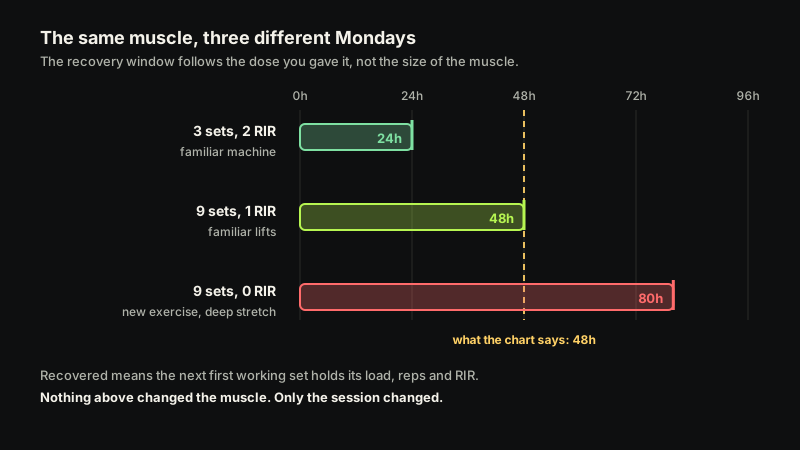
Same muscle. Same 48 hours. One recovered and one did not. No chart on the internet can tell you which is which, because every chart is keyed to the size of the muscle and neither of these lifters differs on that. They differ on what they did to it on Monday.
That is the whole problem with how muscle recovery time gets taught. It is presented as a property of the muscle, like a spec sheet: biceps 24 hours, quads 72. It is actually a property of the session.
What is muscle recovery time?
Muscle recovery time is the interval between a training session and the point at which the muscle can produce the same performance again. Not the point at which it stops being sore, and not the point at which it feels normal. The point at which it can do the work.
Performance is the only definition that is usable, because it is the only one that connects to why you care. You are not waiting for a feeling to pass. You are waiting until the next set of hard sets will actually be hard sets rather than degraded ones.
For most trained lifters doing normal hypertrophy work, that window runs somewhere between 24 and 72 hours. The range is wide because the inputs are wide, and the useful skill is knowing which input moved it, not memorising the midpoint.
Where the 24 to 72 hour muscle recovery time chart came from
The numbers are not invented. A 2024 narrative review on recovery in resistance-training microcycle construction collected the recovery literature and found a consistent split: lower-body work generally needs 48 to 72 hours before performance returns, while upper-body work often recovers in 24 hours or less.
So the popular chart is directionally real. Legs do take longer than arms. But look at what actually drives that difference and the muscle-size framing falls apart.
| What moves the window | Direction | Why |
|---|---|---|
| Number of hard sets for that muscle | More sets, longer window | Fatigue accumulates roughly with the dose you gave it |
| Proximity to failure | Closer to 0 RIR, longer window | Sets taken to failure cost disproportionately more recovery than sets left at 2 RIR |
| Exercise novelty | New exercise, much longer window | An unfamiliar movement produces damage a familiar one does not |
| Loaded stretch and range of motion | Deeper stretch, longer window | Long-length work under load is the most damaging shape of a rep |
| Systemic load of the session | Heavier session, longer window | Squats and deadlifts tax more than the muscle you were aiming at |
| Training age | More trained, shorter window | Repeated exposure blunts the damage response |
Every row on that table is something you chose on Monday. Not one of them is the size of the muscle. Legs take longer mostly because leg sessions are bigger, heavier, run through a deeper loaded stretch, and involve compound lifts that tax everything. A lifter who does three sets of leg extensions at 3 RIR has not created a 72-hour hole.
This is why "how long does it take for muscles to recover" has no fixed answer, and why the honest version of the chart has a column for what you did rather than a column for which muscle it was.
Soreness is not the recovery signal
The most common mistake is using soreness as the clock. It is intuitive, it is convenient, and it points in the wrong direction often enough to be actively misleading.
Soreness tracks novelty and damage far better than it tracks stimulus. Damas and colleagues found in a 2016 study in The Journal of Physiology that early in a training program, muscle protein synthesis is largely occupied with repairing damage, and it only starts corresponding to actual hypertrophy once that damage response has been attenuated by weeks of training. In other words, the phase of your training where you were most sore was the phase where soreness had the least to do with growth.
Once you are trained, the same session that used to wreck you for four days barely registers. Your recovery time got shorter and your growth did not stop. If soreness were the signal, that would read as a problem. It is not one. We have written about why soreness is a novelty detector rather than a scoreboard at more length, and the recovery version of that lesson is simple: a muscle that no longer hurts can still be underrecovered, and a muscle that is mildly sore is usually fine to train.
The test that actually works: read your first working set
Here is the version that survives contact with a real training week. You do not need a chart, because the muscle files a report every session. The report is your first working set.
Compare it to the same exercise last time. Same load, same rep target, and then look at what the effort cost.
| What your log shows | What it means | What to do |
|---|---|---|
| Same load and reps, same or better RIR | Recovered, and progressing | Add load or reps as planned |
| Same load and reps, worse RIR than planned | Not fully recovered | Keep the session, hold the load, add a day before this muscle repeats |
| Load or reps dropped at the same RIR | Clearly not recovered | Cut a set or two, and look at the last session's dose |
| Worse on everything for the second session running | Fatigue is accumulating across the block | Deload rather than push |
That middle row is the one people miss, and it is the reason logging effort matters. If you only record load and reps, an underrecovered session and a recovered one look identical on paper. Six sets of 8 at 80kg is six sets of 8 at 80kg. The difference is entirely in what those reps cost you, and that information exists only if you wrote down what your reps in reserve actually was at the time, in the moment, rather than reconstructing it from memory on the drive home.
RIRLift is built around exactly that read. Load, reps and RIR come pre-filled from the last time you did the exercise, so the comparison is sitting in front of you before you start the set, and confirming or dialling the values takes a tap on the wrist. Seeing how a session runs from your wrist is the difference between having this data and intending to have it.
Muscle recovery time is a dose you chose
Once you accept that the window follows the dose, the practical lever becomes obvious. If a muscle is not ready in the time your split allows, you have two options, and adding recovery products is not one of them.
Either give it a longer gap, or give it a smaller dose per session.
The second option is the one lifters ignore, and it is usually the better one. A muscle that gets 18 hard sets in a single session is being handed a recovery bill that no 48-hour window can pay. Spread across two sessions of 9, the same weekly volume comes with two much shorter windows. This is the same arithmetic that decides how many sets one session can actually hold before the later sets stop earning their keep.
It is worth being precise about what "too much" means here. Sets that land while the muscle is still degraded do not simply do nothing. They add fatigue, extend the window further, and push the next session into the same hole. That is the mechanism behind sets that add fatigue without adding stimulus, and recovery is where the bill arrives.
What this means for how often you train a muscle
The frequency question and the recovery question are the same question wearing different clothes, and the research has been fairly settled on it for a while.
A 2019 systematic review and meta-analysis by Schoenfeld, Grgic and Krieger found that when weekly volume is equated, training frequency has little independent effect on hypertrophy. Once a muscle gets its weekly hard sets, whether they arrive in one session or three matters much less than whether they arrive at all.
Read that alongside the recovery picture and it resolves cleanly:
- Frequency is not a recovery strategy. It is a distribution strategy.
- Higher frequency helps because it makes each session's dose smaller, which shortens each window, which protects the quality of every set.
- Training a muscle once a week is not "not enough recovery". It is fine on the recovery axis and difficult on the volume-per-session axis instead, because the entire weekly dose has to fit in one sitting.
So the practical planning default is 48 hours between sessions that hit the same muscle hard, treated as a starting guess rather than a law. Then you adjust it from your own log, in the direction the log points.
What actually shortens the window
"How to speed up muscle recovery" is one of the most searched follow-ups to this question, and the answers on offer are mostly products. The honest ranking looks different, because the biggest levers are the ones you already control.
- Train the exercise regularly. The single largest reduction in recovery time comes from the muscle having done that movement before. A familiar lift at a familiar depth costs a fraction of what a new one costs. This is also why chasing exercise variety for its own sake quietly lengthens every window you have.
- Stop a rep or two short. The jump in fatigue cost from 2 RIR to 0 RIR is much larger than the jump in stimulus. Leaving a small buffer on most working sets is the cheapest recovery intervention available.
- Split the dose. Nine hard sets twice beats eighteen once, on recovery grounds alone.
- Sleep and eat enough protein. Genuinely useful, genuinely necessary, and genuinely not able to rescue a session that was too big.
Notice that three of the four are training decisions. Recovery is mostly something you buy at the moment you write the session, not something you apply afterwards.
When the window keeps getting longer
Everything above assumes a stable picture: a dose, a window, a recovered muscle at the end of it. Across a training block that stops being true, and it stops being true on purpose.
Fatigue accumulates faster than it dissipates. Week 1 of a block, 48 hours is plenty. By week 5, the same 48 hours leaves you starting sessions at a deficit, RIR comes in worse than planned across several exercises, and the load you added in week 3 starts feeling like a mistake.
That pattern is not a recovery failure to be fixed with more sleep and more protein, though both help. It is the normal end of a block, and the fix is to plan for it. Dropping volume and backing off proximity to failure for a week clears the accumulated fatigue in a way that no between-session rest can, which is the entire point of a deload week. Your weekly hard sets per muscle are the number to pull down, and knowing where your volume is currently going is what makes that a decision rather than a guess.
The signal to watch for is not one bad session. It is the same muscle reporting worse effort at the same load for two sessions running, while nothing else in your life changed.
The short version
Muscle recovery time is real, it usually runs 24 to 72 hours, and the published range is not wrong. It is just answering a coarser question than the one you have.
You do not need to know how long a muscle "takes" in general. You need to know whether this muscle recovered from that session, and the answer is written on your first working set. Same load, same reps, same or better effort means the window closed. Worse effort at the same numbers means it did not, and the fix is either a longer gap or a smaller dose.
Which means the useful move is not memorising a chart keyed to muscle size. It is logging load, reps and RIR honestly enough that the chart becomes unnecessary, because you are reading the muscle in front of you instead of the average of a study population.
Your log already knows. It just has to be written down while the set is still in your hands.