
Blog
When to increase weight: the signals, how much, and how often
Published October 11, 2026 · 10 min read
Every lifter hits the same question within a few weeks of starting. The weight on the bar stopped feeling heavy. Do you add load now, or next week, or when? Add too soon and your form folds and your reps collapse. Wait too long and the set stops driving any adaptation, because a muscle only grows while the work stays close enough to failure to matter, and the evidence suggests growth drops off the further you stay from it.
The short answer: increase the weight when you can hit the top of your rep range on every working set, at your target effort, with a rep or two still in reserve. The useful answer is what each of those words means, how much to add when the moment arrives, how often that should happen, and how to read the signal off something more reliable than how the last set felt. That last part is where most advice quietly gives up, and it is the part a log is built for.
When to increase weight: the signals that actually mean "go up"
Four signals show up across every credible source. They are really four views of one thing: the load has become easy enough that it is no longer the hard part of the set.
You hit the top of your rep range on every set. If a lift is programmed for 8 to 12 reps and you complete 12 clean reps on all your working sets, not just the first, the load has been outgrown. This is the backbone of the double progression method: add reps inside the range first, then add load once you reach the ceiling. Hitting 12 on set one and fading to 9 by set three is not the signal; that is fatigue, and it means stay.
Your reps in reserve climbed at a fixed weight. Reps in reserve (RIR) is how many more reps you could have done before failure. If the same load that left you with one rep in the tank a month ago now leaves you with three, the lift got measurably easier, whether or not it "felt" easy. This is the cleanest signal there is, because it is a number you can compare week to week instead of a memory. If you are new to it, how to use RIR in your workouts walks through picking a target per set.
The 2-for-2 rule. A practical heuristic from strength coaching: when you can do two or more reps beyond your target on the last set for two consecutive sessions, add weight. It builds in the "every set, repeated" guardrails so you do not chase one good day.
Bar speed. On compound lifts the final reps used to grind; now they move fast and smooth with no slow-down. Useful as a confirmation, not as your only read, because speed is easy to misjudge mid-set.
Notice that effort sits inside all four. "It felt easy" on its own is not a progression rule, because effort compared to nothing is just a mood. We take that failure apart in the progressive overload workout plan; the fix is to anchor the judgement to a logged number, which is what the RIR signal above does.
How much weight should you add?
Smaller than you think. The goal is the smallest jump that still makes the set hard again, because a big jump buys you nothing extra and costs you reps and form.
| Lift type | Sensible increment | In practice |
|---|---|---|
| Upper body (press, row, curl) | 2.5% to 5% | The smallest plate pair you have, often 2.5 to 5 lb / 1 to 2.5 kg total |
| Lower body (squat, deadlift, leg press) | 5% to 10% | 5 to 10 lb / 2.5 to 5 kg, since bigger muscles tolerate bigger steps |
Two things follow from adding the smallest honest increment:
- Microplates are worth owning for isolation work. A standard 5 lb jump on a 20 lb lateral raise is a 25% increase, which is far too much. Fractional plates of 0.5 to 1.25 lb let a small lift keep progressing without stalling for months.
- Expect your reps to drop, and that is correct. Move from 12 reps at the old load to the new load and you might get 8. You have not gone backwards; you have reset to the bottom of your rep range and will climb back up over the coming sessions. This is the whole rhythm of progression, not a sign you added too much. If the new weight drops you below your rep range entirely, or your RIR craters to zero on set one, the jump was too large; take the smaller increment next time.
How often should you increase the weight?
Not on a schedule, and rarely every session once you are past your first few months. Progression is earned per lift, not granted by the calendar. A beginner can often add a little most weeks because adaptation is fast early on; an experienced lifter might hold the same working weight for several sessions, adding a rep here and there, before the load genuinely moves.
The mistake is forcing a jump every week because the plan has a column for it. If you add load before you have actually met the signal, you spend the next two sessions grinding under a weight you have not adapted to, your reps stay suppressed, and the lift stalls. Let each lift move on its own evidence. Our progressive overload guide covers how load and reps trade off across a block so the climb keeps going when weekly jumps run out.
When not to increase the weight
The signal can say go up and the answer can still be wait. Hold the load when:
- Form breaks down under the heavier weight. If the extra load only moves because you start swinging, bouncing, or cutting range of motion, you are training a worse version of the exercise. Keep the weight where you can own every rep.
- You feel joint pain, not muscle effort. A burn and a deep muscular fatigue are the job. Sharp or joint pain is a stop sign, not something to push through with more load.
- Recovery is poor this week. Short sleep, high stress, or under-eating all blunt your ability to adapt to a heavier stimulus. A down week is a bad time to test a new top weight. If fatigue has been building for weeks rather than days, that is a different fix; see the signs you need to run a deload.
- You are early in a training block. The start of a block is for accumulating quality reps at a manageable effort, not for maxing out the load. Save the jumps for when the easy reps tell you they are ready.
Add weight or add more reps?
This is the most common follow-up, and the rep range answers it for you. While you are still inside your range, add reps and keep the load fixed. Once you hit the top of the range on every set, switch to adding load and let the reps reset to the bottom. That is the entire logic of running a rep range rather than a single number: double progression adds the two variables in sequence instead of at once. Load is not automatically better than reps; the right one is whichever the range says you have not maxed out yet.
One caveat for the heaviest compound lifts. On a squat or deadlift you may reach the top of your rep range and still want to add load before pushing reps all the way up, because grinding very high reps on those lifts costs more fatigue than it returns. There the signal shifts earlier: once the top end is comfortable at your target RIR, take the jump rather than chasing two or three more reps. Isolation and smaller compound work is the opposite, where extra reps are cheap and worth banking before you add a plate.
Read it from your log, not a feeling
Every signal above depends on comparison. The top of the rep range, RIR that climbed, two sessions in a row: all of them ask "compared to last time," and last time is only knowable if you wrote it down, including the effort. Load and reps alone cannot tell you the difference between a set that left three reps in the tank and one that nearly failed. The RIR is the part that turns a list of numbers into a decision.
Here is the signal as it actually reads, one lift tracked at a fixed load:
| Session | Load | Reps | RIR | What it says |
|---|---|---|---|---|
| 1 | 60 kg | 8 | 1 | On target. Hold the load. |
| 2 | 60 kg | 9 | 2 | Getting easier. Hold, keep climbing. |
| 3 | 60 kg | 10 | 2 | Near the ceiling. Hold one more. |
| 4 | 60 kg | 12 | 3 | Top of range, reps to spare. Add load. |
| 5 | 62.5 kg | 8 | 1 | Reset to the bottom. The climb restarts. |
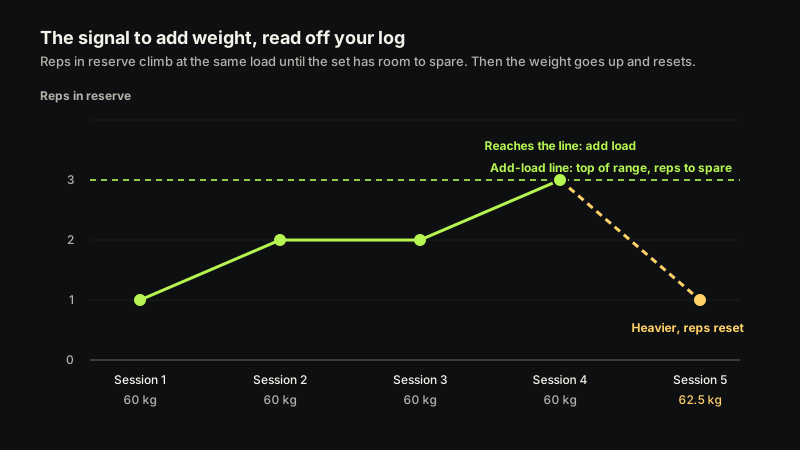
That is the pattern to watch for: RIR drifting up at an unchanged weight until it crosses the line, then resetting after the jump. The catch is that your estimate of reps in reserve is itself a skill, and lifters tend to drift toward leaving more in the tank than they think over time, which is exactly why a written RIR beats a remembered one. It is only visible if the target is on the screen before the set and the result goes down right after, which is the reason RIRLift keeps the RIR target on your wrist and takes the log there instead of on a phone you check later. How hard each set should sit in the first place is its own question, covered in RIR vs going to failure and the reps in reserve guide.
Done this way, "when to increase weight" stops being a judgement call you make under a bar while tired. It becomes a line in a table that either crossed the threshold or did not. If you would rather not run that arithmetic yourself, RIRLift reads your logged sets and prescribes the next weight for you, progressing a lift the session its RIR says it is ready and holding it when it is not.
Common questions
How do I know when to increase my weight when lifting? When you can complete the top of your rep range on all working sets at your target RIR, with reps still in reserve, for two sessions running. If your logged RIR at a fixed load has climbed from one or two up to three, the lift has earned the jump.
Is adding 5 lb a week too much? For an upper-body lift, usually yes once you are past the beginner stage; 5 lb can be a 5% to 10% jump on a press and more on an isolation move. Add the smallest plate that makes the set hard again, and do not treat "per week" as a quota.
Should I add weight if my form breaks down? No. If the heavier load only moves with worse technique, the current weight still has work to do. Own every rep first, then progress.
What if my reps drop after I add weight? Expected and correct. You have reset to the bottom of your rep range. Add reps session by session until you reach the top again, then add load once more.
How long should I stay at the same weight before increasing? As long as it takes to meet the signal, which is a count of sessions, not a fixed number of weeks. A lift you train twice a week might earn a jump in two to three weeks; a heavy lift you train once a week, or one that has been going a long time, can sit at the same working weight for a month or more while you add reps toward the top of the range. The weight moves when the evidence says so, not when the calendar does.