
Blog
Progressive overload workout plan: the part every plan skips
Published August 11, 2026 · updated September 8, 2026 · 16 min read
Two lifters start the same progressive overload workout plan. Same four days, same exercises, same instruction at the bottom of the page: add 2.5 kg when the last set feels easy.
Four weeks later both of them have added 5 kg to their bench press for the same three sets of eight. On paper the plan worked twice.
Except the first lifter's sets still finish with two reps left in the tank, exactly as they did in week one. The second lifter's sets now finish with nothing left at all. He is not lifting more because he got stronger. He is lifting more because he is willing to hurt more, and he has spent every rep of margin he started with to do it. Week five has nothing left to spend.
Both lifters followed the plan perfectly. The plan simply could not tell them apart, because it never said how hard a set was supposed to be.
What is a progressive overload workout plan?
A progressive overload workout plan is a training schedule built around a rule for making each exercise harder over time, rather than a fixed list of sets and reps you repeat. It has three parts:
- Exercise slots: which movements you run, on which days, for how many sets.
- A target effort: how close to failure each of those sets is supposed to finish.
- A progression trigger: the specific condition that tells you to add load or reps next session.
Almost every published plan gives you the first part in detail, hints at the third, and omits the second entirely. That omission is why so many plans stop working in week five and nobody can say why.
The principle underneath all this is not complicated, and our progressive overload guide covers it properly: to keep adapting, a muscle has to keep meeting a demand it has not already adapted to. The argument here is narrower and more practical. It is about what a plan has to write down for that principle to survive contact with a real training week.
Why "add weight when it feels easy" is not a progression rule
Go and read the plans that rank for this. Planet Fitness, Gold's Gym, PureGym, Gymshark: they converge on almost identical wording. Three sets of eight to twelve. Add 2.5 to 5 lb when you can complete all your reps easily.
Now look at what that rule actually asks you to measure. It asks whether the set felt easy. Compared to what? Not to a written record, because nothing about effort was written down. Compared to your memory of a set you did four to seven days ago, filtered through how you feel right now.
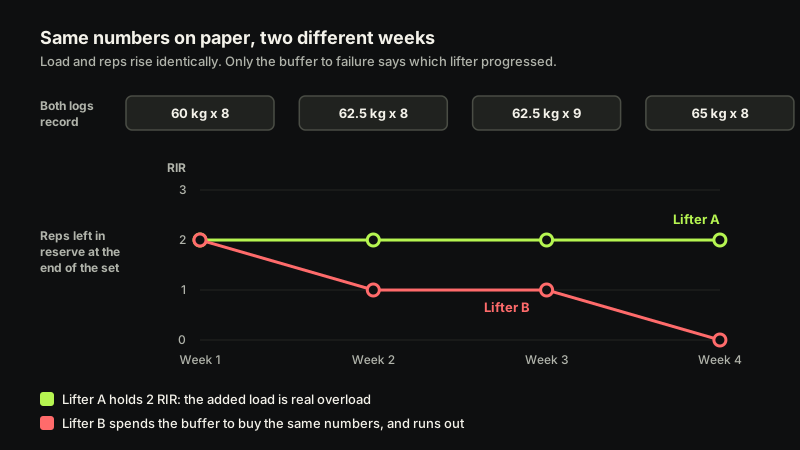
Here is the failure in a table. Two lifters, same lift, same plan, four weeks apart.
| Week | Lifter A load x reps | Lifter A RIR | Lifter B load x reps | Lifter B RIR |
|---|---|---|---|---|
| 1 | 60 kg x 8 | 2 | 60 kg x 8 | 2 |
| 2 | 62.5 kg x 8 | 2 | 62.5 kg x 8 | 1 |
| 3 | 62.5 kg x 9 | 2 | 62.5 kg x 9 | 1 |
| 4 | 65 kg x 8 | 2 | 65 kg x 8 | 0 |
Cover the RIR columns and the two lifters are identical. Every number a normal workout log records is the same. Lifter A added 5 kg while holding the same margin to failure, which is the definition of getting stronger. Lifter B added the same 5 kg by handing over his entire buffer, which is the definition of trying harder.
Lifter B's plan is not progressing. It is being funded by a reserve that runs out. And the moment it does, he hits what looks like a sudden inexplicable wall, because the decline was never visible in the only two numbers he recorded.
This is the hidden variable in every plan on page one of Google. Load and reps are two thirds of a measurement. The missing third is proximity to failure, usually written as reps in reserve, and without it your log cannot answer the one question the plan exists to answer.
What a plan has to state for each slot
Fix the omission and a plan slot stops being a suggestion and becomes something you can audit. Every exercise in your plan needs four values written down before you train, not three.
| Value | Example | Why it has to be in the plan |
|---|---|---|
| Sets | 3 | Sets are the unit weekly volume is counted in |
| Rep range | 8 to 12 | Gives progression somewhere to go before load has to move |
| Target RIR | 2 | Fixes the effort so load and reps become comparable across weeks |
| Progression trigger | Top of range at target RIR | Turns "feels easy" into a condition you can check |
The target RIR is the load-bearing addition. Once a slot says "3 x 8-12 at 2 RIR", every future session on that exercise is measured against a fixed effort, so a change in load or reps means what you want it to mean.
Choosing the number is not delicate. For most hypertrophy work, 1 to 3 RIR on your main sets is the whole usable range, and how to estimate RIR is a skill that calibrates within a few weeks of doing it honestly. Zourdos and colleagues, validating the RIR-based RPE scale in the Journal of Strength and Conditioning Research, found a strong inverse relationship between bar velocity and RIR-based effort ratings in both experienced lifters (r = -0.88) and novices (r = -0.77), and concluded the scale is practical for regulating training load day to day. The estimate is noisy at first. It is still incomparably better than nothing, because nothing is what the alternative records.
You also do not need to train closer to failure than that to grow. Refalo and colleagues' systematic review with meta-analysis in Sports Medicine found only a trivial hypertrophy benefit for training to momentary failure over stopping short of it, and proposed a non-linear relationship between proximity to failure and growth. Training at 2 RIR is not a compromise you make for recovery's sake. It is close to free, and it leaves you a margin you can actually read.
A four-day progressive overload workout plan
Here is a plan written the way this article argues plans should be written. It is an upper/lower split run four days a week, which is enough frequency to hit every muscle twice without the session lengths getting silly.
Day 1: Upper (push emphasis)
| Exercise | Sets | Reps | Target RIR |
|---|---|---|---|
| Barbell bench press | 4 | 6-8 | 2 |
| Chest-supported row | 4 | 8-10 | 2 |
| Seated dumbbell shoulder press | 3 | 8-12 | 2 |
| Lat pulldown | 3 | 10-12 | 1 |
| Cable lateral raise | 3 | 12-15 | 1 |
| Triceps pushdown | 3 | 10-15 | 1 |
Day 2: Lower (quad emphasis)
| Exercise | Sets | Reps | Target RIR |
|---|---|---|---|
| Back squat | 4 | 5-8 | 2 |
| Romanian deadlift | 3 | 8-10 | 2 |
| Leg press | 3 | 10-12 | 1 |
| Seated leg curl | 3 | 10-12 | 1 |
| Standing calf raise | 4 | 10-15 | 1 |
Day 3: Upper (pull emphasis)
| Exercise | Sets | Reps | Target RIR |
|---|---|---|---|
| Weighted pull-up or pulldown | 4 | 6-10 | 2 |
| Incline dumbbell press | 4 | 8-12 | 2 |
| Cable row | 3 | 10-12 | 1 |
| Machine chest fly | 3 | 12-15 | 1 |
| Rear delt fly | 3 | 12-20 | 1 |
| Dumbbell curl | 3 | 8-12 | 1 |
Day 4: Lower (hamstring emphasis)
| Exercise | Sets | Reps | Target RIR |
|---|---|---|---|
| Hip thrust or trap bar deadlift | 4 | 6-10 | 2 |
| Hack squat or leg press | 3 | 8-12 | 2 |
| Lying leg curl | 4 | 10-12 | 1 |
| Walking lunge | 3 | 10-12 each | 2 |
| Seated calf raise | 4 | 12-20 | 1 |
Two things about this plan are deliberate.
The heavy compound sits first in every session and carries the more conservative 2 RIR target. That is not tradition. The first slot gets the session's best available effort, and the exercises after it inherit whatever fatigue the first one produced, which is why putting the priority lift first changes what each movement delivers. Isolation work later in the session runs at 1 RIR because the RIR read is cleaner there and the fatigue cost is lower.
The set counts land each muscle at roughly 10 to 16 hard sets a week, which is the range most people should start in. If you want to move that number deliberately rather than by accident, how many sets per week for growth is the place to work it out. Warm-up sets are not in these tables and should never be counted toward those totals.
Swap any exercise for an equivalent your gym actually has. The exercise names are the least important thing on the page. The four columns are the point.
The progression rule, written so it can be audited
With a target RIR attached to every slot, the progression trigger becomes a condition rather than a feeling:
Hit the top of the rep range on every set, at or above the target RIR, and add load next session. Otherwise repeat the load and add reps.
That is the double progression method with an effort gate on it, and the gate is what makes it honest. Hitting 12 reps at 0 RIR when the slot says 12 reps at 2 RIR does not trigger a load increase. It triggers repeating the session and trying to reach the same reps with the margin intact.
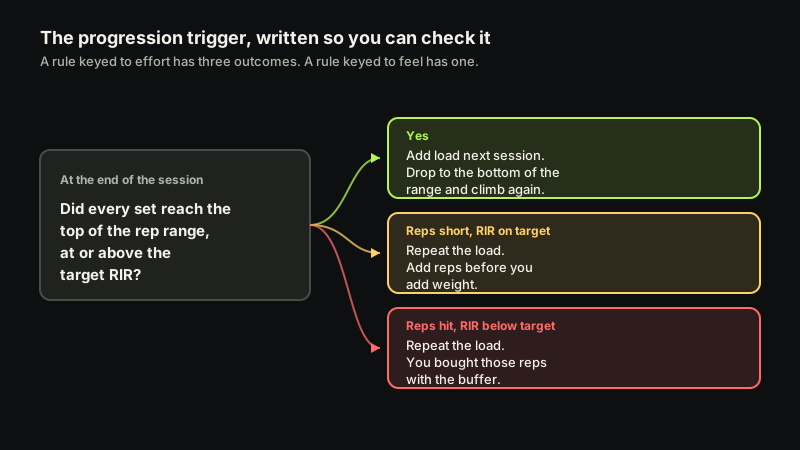
How much to add depends on the lift. Compound barbell lifts take 2.5 kg increments; dumbbells and machines often jump 5 kg or a whole plate, in which case you drop back to the bottom of the rep range and climb again.
And it is worth knowing that adding load is not the only valid way to progress, or even a superior one. Plotkin and colleagues ran exactly this comparison in PeerJ in 2022: one group progressed load while holding an 8 to 12 rep range, the other held load constant and progressed repetitions. Hypertrophy came out similar between groups. Load progression slightly favoured maximal strength, by an adjusted 2.0 kg, with a confidence interval that spanned zero. So a week where you added a rep at the same weight and the same RIR is a real week of progress, not a failed attempt at adding weight.
How often should you progressive overload?
Per exercise, the answer is: whenever the trigger fires, which for most slots means every one to three sessions early in a block and less often later.
Per plan, run it for four to six weeks before changing anything structural. That block is one mesocycle, and it helps to know how a week fits into a block and a season so the plan you just wrote has a place in the larger structure. That length is long enough for progression to show up on most slots and short enough that accumulated fatigue has not started masking your reads. When your RIR at a fixed load and rep count starts drifting downward across the whole plan rather than on one lift, the block is done and it is time to back off. How to run a deload week covers what backing off should actually look like; it is a planned drop in volume and effort, not a week off.
Changing the plan more often than that is the most common self-inflicted wound in this whole area. If you swap exercises every two weeks, no slot ever accumulates enough sessions for a trend to be visible, and you permanently lose the ability to tell whether anything is working. Novelty feels productive and measures as nothing.
When a progressive overload workout plan stalls
Every plan stalls. What separates a useful plan from a decorative one is whether the stall has a readable signature. There are three, and your log tells them apart.
| What your log shows | What it is | What to do |
|---|---|---|
| Reps stuck at the top of the range, RIR still at target | Load increment is too big for the lift | Use a smaller jump, or add a rep to one set at a time |
| Reps holding, RIR falling week over week on one lift | Buffer spend, not progress | Hold the load until you can hit the reps at target RIR again |
| Reps and RIR both degrading across most slots | Accumulated fatigue, block is over | Deload, then restart at slightly lower volume |
Only the first is a programming problem. The second is a measurement problem that the plan you copied from a gym chain's blog cannot even see. The third is a recovery problem and it is normal.
There is also a fourth case that is not a stall at all: you were a beginner, and the phase where load went up every single session ended. That transition catches almost everyone by surprise, and when session-to-session progression stops working is a change in what the plan should expect, not a sign it broke.
The plan is only as good as the record
Every rule in this article resolves to the same requirement. The progression trigger, the stall diagnosis, the decision to end a block: all three are comparisons between this session and the last one, on three values rather than two.
Which means the plan does not live on the page you copied it from. It lives in whatever you write down at the moment the set ends, when the effort is still an observation rather than a reconstruction. Reps in reserve estimated on the drive home is not data.
That is the workflow RIRLift is built around. Each exercise arrives pre-filled with the load, reps and RIR you logged last time, so the comparison the progression rule needs is sitting in front of you before the set starts, and confirming it costs a tap on your wrist rather than a trip to your phone. You can see how a session runs from your wrist if you want the shape of it.
Copy the four-day plan above if it fits your week. Copy any plan you like. Just do not run one that never tells you how hard a set is supposed to be, because a plan that cannot be checked is a plan you are following on faith.
Common questions
How do you write a progressive overload workout plan?
Write four values for every exercise, not three. Sets and a rep range set the volume and give progression somewhere to go, a target RIR fixes how close to failure each set should finish, and a progression trigger states the exact condition that earns more load next session. A slot written "3 x 8-12 at 2 RIR, add load at the top of the range" can be audited week to week. A slot written "3 x 8-12, add weight when it feels easy" cannot, because nothing about the effort was ever recorded.
Is progressive overload necessary to build muscle?
Yes, in the broad sense: a muscle keeps growing only while it keeps meeting a demand it has not already adapted to. What is not necessary is adding weight every session. Overload can come from adding a rep at the same load, or from doing the same load and reps at a genuinely harder effort, and Plotkin and colleagues found progressing reps drove hypertrophy on par with progressing load. The requirement is that the demand rise. The barbell is only one of the ways to raise it.
How much weight should you add each time?
Add load only when the trigger fires, which means hitting the top of the rep range on every set at or above the target RIR. When it does, compound barbell lifts take a 2.5 kg jump; dumbbells and machines usually move in 5 kg or whole-plate steps, so you drop back to the bottom of the rep range and climb again from there. If the reps stall at the top of the range while your RIR is still on target, the increment was too big for the lift, not a sign you failed to progress.
Can you do progressive overload every workout?
Early in a block, or as a beginner, the trigger fires often, so most slots move every one to three sessions. Later it fires less often, and that is normal, not a stall. Forcing a load increase every single session is how the second lifter in the opening example gets into trouble: the weight goes up while the reps in reserve quietly fall from two to zero, which reads as progress on the log but is really spent buffer, and the buffer runs out.
What should you do when the plan stops progressing?
Read the log before changing anything. Reps stuck at the top of the range with RIR still on target means the load jump is too big, so use a smaller increment. Reps holding while RIR falls week over week on one lift is buffer spend, not progress, so hold the load until you can hit the reps at target RIR again. Reps and RIR both degrading across most slots at once is accumulated fatigue, and the fix is a deload rather than more effort. Only the first of the three is a programming problem, which is why the diagnosis has to come from a record that includes effort, not just load and reps.