
Blog
FBEOD split: full body every other day, done right
Published October 20, 2026 · 10 min read
The appeal of the FBEOD split, full body every other day, is obvious the first time you see it on your feed: a short session, every muscle, come back in 48 hours and do it again. No two-hour leg day, no muscle sitting untrained for a week, no guilt about a missed "arm day" because arms are in every day. For a lot of lifters that rhythm is the first split they actually stick to.
What the clips never show is the arithmetic that decides whether it works. FBEOD deliberately trims each session to one or two sets per exercise, because you are back under the same bar in two days. Cut the per-session volume too far and the week never accumulates enough to grow a muscle. Leave the effort vague and the high frequency turns into high fatigue. The split lives or dies on two numbers you cannot see from inside a single workout: how many hard sets each muscle gets across the week, and how close to failure each of those sets actually was. This is how to run FBEOD so both land where they should.
What is the FBEOD split?
FBEOD stands for full body every other day: you train your whole body in one session, keep the per-exercise volume low (often one or two hard sets), and repeat every 48 hours, so each muscle is trained 3 to 4 times a week. It is a full-body split run at high frequency and low per-session volume, and it spread through the science-based-lifting corner of TikTok and Reddit as an alternative to the traditional push/pull/legs and upper/lower rotations.
The structure is simpler than almost any other split, which is part of why it caught on.
| Variable | FBEOD prescription |
|---|---|
| Sessions per week | 3 to 4, every other day (a Monday/Wednesday/Friday or Monday/Wednesday/Friday/Sunday pattern) |
| Muscles per session | All of them, in one full-body circuit |
| Sets per exercise per session | 1 to 2 hard sets |
| Target effort | 1 to 2 RIR (reps in reserve) on most working sets |
| Weekly frequency per muscle | 3 to 4 (one exposure per session) |
| Session length | Roughly 60 to 90 minutes |
Read as a list it looks like nothing more than "do a bit of everything, often." The design decision hiding in it is the low per-session volume, and that decision is the whole reason the frequency is safe to run. You are not doing five sets of squats today and five again in 48 hours; you are doing one or two, which recovers in time for the next exposure. Everything useful and everything risky about FBEOD comes from that trade, so the rest of this is about getting it right.
Why every other day changes the volume math
On a conventional split you think in sessions: chest day is five or six sets of chest work, and that is most of your chest for the week. FBEOD breaks that habit. One or two sets of a chest movement on its own looks like almost nothing, and if you judge the session the way you judge a chest day, you will conclude you are undertraining and start piling on sets, which defeats the point.
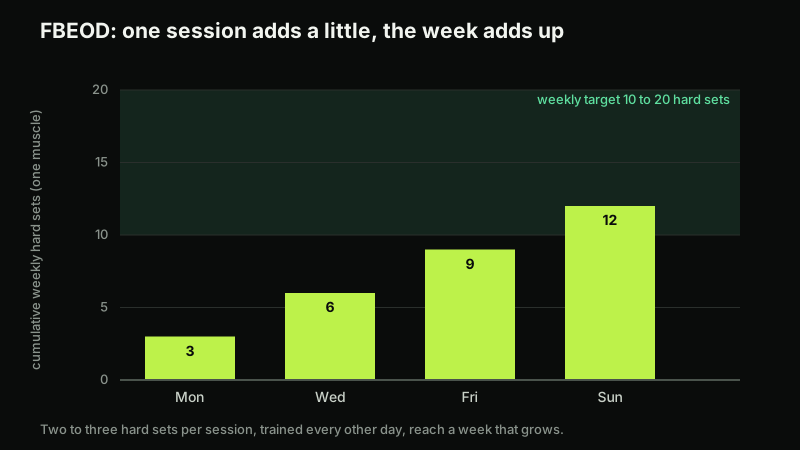
The right unit is the week, not the workout. Frequency is a delivery mechanism for weekly volume, not a substitute for it: training a muscle more often only helps because it lets you spread the same weekly sets across more sessions, each one fresher and more productive. Two hard sets of a chest movement in each of four sessions is eight weekly sets, and a second chest movement on a couple of those days puts you well inside the 10-to-20 range most lifters grow on. Those same sets crammed into one Monday session would leave the last few junk-tired; split across four days they are all quality. Schoenfeld, Ogborn and Krieger's dose-response meta-analysis ties more weekly hard sets to more growth within reason, and "weekly" is the operative word. FBEOD is a bet that frequency, not session size, is the better way to buy those sets.
That bet only pays off if you actually count. The number that matters is how many hard sets each muscle gets per week, summed across every session, and for most muscles the useful range runs from about 10 to 20 sets. A good FBEOD template lands there by design; a bad one looks busy and delivers six. This is the same arithmetic as any weekly volume target by muscle, just distributed differently, and it is the first thing to check before you worry about anything else.
A sample FBEOD week
The cleanest way to run it is a small menu of full-body sessions you rotate, each hitting every major muscle with one or two movements, and the emphasis shifting so no muscle gets only its weakest exercise. Here is a four-day week that lands most muscles around 8 to 12 weekly sets.
| Session (rotate) | Movements (1 to 2 hard sets each) |
|---|---|
| Day A | Squat, bench press, row, overhead press, Romanian deadlift, biceps curl |
| Day B | Deadlift, incline press, lat pulldown, leg curl, lateral raise, triceps extension |
| Day C | Leg press, dip, chest-supported row, hip thrust, rear-delt fly, hammer curl |
| Day D | Front squat, overhead press, pull-up, calf raise, cable fly, face pull |
Run A, B, C, D on Monday, Wednesday, Friday, Sunday, then start the next week on the day after. Three-day weeks drop one session and rotate the menu across the calendar instead of the week, so over two weeks every session still runs. Keep the heaviest compound of each day first while you are fresh, then work down to isolation. The movements are examples, not gospel: swap any of them for an equivalent that hits the same muscle, which matters more on FBEOD than on other splits because you repeat the menu so often that a taken machine on Day B derails you twice a week unless you adapt.
Notice what the table does not say: it does not prescribe a rep count, because that is the part the clips get wrong by making it look fixed. One or two sets per movement means each set has to count, and "count" is a question of effort, not of hitting a magic number.
Keeping effort honest at 48-hour frequency
Low per-session volume has a sharp edge. When a muscle only gets one or two sets today, each of those sets has to be hard enough to be a real growth stimulus, or the frequency is just frequent easy work. So the instinct is to grind every set to failure. On FBEOD that instinct is a trap, because you are training the same muscle again in two days, and a set taken to true failure drags a tail of fatigue that is still there when you come back.
The resolution is the same one most evidence-based lifting lands on: leave 1 to 2 reps in reserve on your working sets. Close enough to failure that the set is a genuine stimulus, far enough from it that you recover in 48 hours. This is not a compromise that costs you growth. A meta-analysis by Refalo and colleagues found no meaningful hypertrophy penalty for stopping a rep or two short of failure rather than going all the way, which is exactly how hard most working sets should sit on any program and doubly so on one that reloads the same muscle every other day.
The problem is that RIR is easy to say and hard to hold. On a rotation this dense, a set you remember as "2 RIR" was often really 0, and a week of secretly-failure training on FBEOD is how people end up blaming the split for a stall that is actually accumulated fatigue. The fix is not willpower; it is a record. When you log the actual load, reps, and RIR for every set from your wrist, the drift shows up: if your rated RIR keeps reading 2 while your reps fall session over session, you were closer to failure than you thought, and the frequency is the thing giving it away.
FBEOD versus PPL and upper/lower
FBEOD is usually weighed against the splits most lifters already run, and the honest comparison is about fit, not a winner. A push/pull/legs rotation, or an upper/lower, concentrates a muscle's weekly work into fewer, bigger sessions, which lets you pile on multiple sets per muscle per workout and makes each session feel substantial. FBEOD spreads the same weekly sets thin across more days, so each session is short and no single one feels like much.
The trade is straightforward. FBEOD suits lifters who recover well, prefer short frequent sessions, and will not skip, because on an every-other-day plan one missed session costs every muscle a little rather than wiping out a whole body part for the week. It suits worse the lifter who trains hard on inconsistent days, or who likes the psychological weight of a dedicated leg day. The low per-session volume is also a feature for anyone prone to junk volume: it is hard to pad a session with useless sets when the session only has one per movement by design. Pick FBEOD because the rhythm fits your week and your recovery, not because a clip called it the best split.
How to tell FBEOD is working
Because everything happens across sessions rather than within them, FBEOD is unusually hard to judge by feel and unusually easy to judge from a log. Two readings tell you almost everything.
The first is weekly volume by muscle. Add up the hard sets each muscle got across the week and check it against your target. This is the single check FBEOD is most likely to fail quietly, because any one session looks too light to worry about. When you watch the week add itself up per muscle instead of reconstructing it from memory, an undertrained muscle is obvious: chest at six weekly sets while everything else sits at ten is a prescription problem, not a recovery one, and you fix it by adding a movement, not by grinding harder.
The second is the trend in reps at a fixed load and RIR. On a frequency this high, real progress shows up fast: the same weight that was 2 RIR for eight reps last week is 2 RIR for nine or ten this week, or clears the same reps at a lower rated effort. When those numbers stall or slide while your RIR stays pinned at 2, you are either under-recovering, which means the per-session volume crept too high, or not pushing hard enough, which the rep counts will tell apart from the effort ratings. Either way the log names the problem, where the feeling in the gym just says "tired."
The bottom line
FBEOD works for the same reason it is easy to get wrong: it moves all the important decisions out of the individual workout and into the week. Run it with low per-session volume so the 48-hour frequency is survivable, keep your working sets at 1 to 2 RIR so each of those few sets earns its place, and the split delivers a well-distributed weekly volume that is genuinely hard to beat. Skip the counting and it turns into a lot of short, vague sessions that feel like training and add up to too little. The difference is entirely in the two numbers, weekly hard sets per muscle and honest RIR, and both of them live in the record, not the memory. Keep that record and FBEOD stops being a feed trend and becomes a plan you can read.