
Blog
Full body workout split: the arithmetic no template runs
Published August 9, 2026 · updated September 18, 2026 · 16 min read
Ask what to run on three days a week and the answer comes back instantly. Full body. It is the consensus recommendation across coaching articles, forum threads, and just about every video on the subject, and it is a reasonable one.
Then you open the templates. Squat, bench, row, overhead press, curl, pushdown, three sets each, three times a week. Every one of them looks sensible. Every one of them quietly hands you six weekly sets for your chest and calls it a hypertrophy program.
The gap between "full body is a good structure" and "this particular full body routine will grow you" is arithmetic, and it is the one thing no template does for you. A full body session has to serve every muscle you own. Nine or so groups, in one sitting, three times a week. That constraint is not a detail. It is the entire personality of the split, and it decides which version of full body works and which version quietly stalls.
What is a full body workout split?
A full body workout split is a training routine where every session trains all the major muscle groups, so each muscle is trained as many times per week as you train, usually two to four. Instead of dividing the body across days, a full body split divides your weekly volume across sessions that each touch everything.
A standard 3 day full body workout split looks like this.
| Day | Session | Muscles trained |
|---|---|---|
| Monday | Full body A | Everything |
| Tuesday | Rest | |
| Wednesday | Full body B | Everything |
| Thursday | Rest | |
| Friday | Full body C | Everything |
| Weekend | Rest |
The A, B and C sessions usually differ by exercise selection rather than by muscle. Session A might squat, session B might use a leg press, session C might use split squats, but all three still claim to cover the whole body.
That claim is where the trouble starts.
The arithmetic nobody runs
Count what "everything" actually contains. Chest, back, quads, hamstrings, glutes, side and rear delts, biceps, triceps, calves. Nine groups, and that is already generous with the grouping.
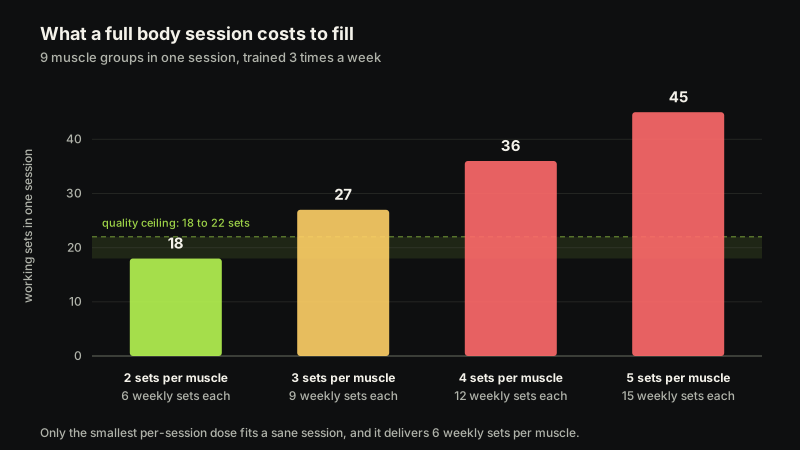
Now give each of them a per-session dose and multiply.
| Sets per muscle per session | Session total (9 muscles) | Weekly sets per muscle (3 days) |
|---|---|---|
| 2 | 18 | 6 |
| 3 | 27 | 9 |
| 4 | 36 | 12 |
| 5 | 45 | 15 |
Read the middle column, because that is the one you have to actually perform. Two sets per muscle is an 18-set session, which is entirely reasonable, and it delivers six weekly sets per muscle. Most evidence-based volume guidance treats six as a maintenance-to-low dose, not a growth target.
Push to a comfortable 10 to 12 weekly sets and you are at 30-something working sets in a single session, before warm-ups. At a pace that protects the quality of each set, that is a two-hour training day. Three times a week.
This is the constraint that makes full body what it is, and it does not appear in a single template on the first page of results. The templates resolve it silently, by giving you three sets of six exercises and letting you assume the coverage is complete. Six exercises cannot cover nine muscle groups. Something is getting nothing, and the template never tells you which.
Frequency is the delivery, not the bonus
The usual defence is that full body's three-times-a-week frequency makes up for the small per-session dose. That defence used to be much stronger than it is now.
Schoenfeld, Grgic and Krieger's 2019 meta-analysis applied volume-equated inclusion criteria across 25 studies and found no significant hypertrophy difference between higher and lower weekly training frequencies once total weekly sets were held constant. The Sports Medicine dose-response meta-regression lands in the same place: weekly volume drives the response, and frequency is mostly how that volume gets delivered.
Read that in full body's favour first, because it genuinely is a point in its favour. Three sessions a week is a perfectly good delivery mechanism, and nothing about the structure is inefficient.
Then read it the other way, which is the part that gets skipped. If frequency is delivery rather than stimulus, then training a muscle three times a week earns you nothing on its own. Six weekly sets spread across three sessions is still six weekly sets. The frequency is not a multiplier that rescues a thin dose. It is just the shape of the container.
There is one real advantage hiding in here. A meta-regression on per-session set volume modelled the returns on sets performed for one muscle inside a single workout and found clear diminishing returns, with the point of undetectable outcome superiority landing near 11 fractional sets per session. That paper is a preprint rather than a peer-reviewed publication, and its data at very high per-session volumes is thin, so treat the number as a rough landmark.
Even as a rough landmark, it says something useful. Full body never gets anywhere near the region where extra sets stop paying. Every set you perform on a full body split lands in the steep, productive part of that curve. This is the exact opposite of the bro split, where a muscle's entire weekly volume has to fit into one session and the last several sets are buying very little.
So full body wastes nothing. It simply cannot fit very much in.
The failure mode that belongs to full body alone
Every split has a characteristic way of going wrong. The bro split's is the per-session ceiling. The upper/lower split's is a crowded upper day. Full body's is different and much less discussed: it has no redundancy.
On a four-day upper/lower, missing a Thursday costs your upper body half its weekly volume and leaves your legs untouched. On a three-day full body split, missing one session costs every muscle in your body a third of its weekly volume at once.
That matters more than it sounds, because six weekly sets dropping to four is not a small trim. It is the difference between a low dose and a dose below most maintenance recommendations, applied to everything simultaneously. Two missed sessions in a month, which is a normal month for anyone with a job, and the block you thought you ran is not the block you ran.
The split with the thinnest per-session dose is also the one least able to absorb a missed session. That combination is worth knowing before you commit to it, and it is a much better reason to choose or reject full body than anything about muscle protein synthesis windows.
In what order should a full body workout be done?
Train the two or three muscles you are prioritising this session first, while your output is highest, and leave the small muscles and the maintenance work for the end. Order is the other cost, and full body has the worst version of it of any split.
A session trains its muscles in sequence, and quality declines along that sequence. On an upper/lower split, five muscle groups queue up and the last two get a compromised set. On a full body day, eight or nine queue up. The tail is not a couple of exercises. It is a third of the session.
Run the usual order. Squat, bench, row, overhead press, leg curl, then whatever is left. Calves, arms and rear delts are structurally last, in all three sessions, every week of the block. Same as on any other split, but for a longer stretch and with more of your body sitting in it.
Most guidance places working sets at one to three reps in reserve, and the stimulus depends on the sets that count actually getting close to failure. By set 20 of a full body day, you have squatted, pressed and pulled. The curl ends and you honestly log 2 RIR.
It probably was 2 RIR. That is what makes it slippery. The estimate is accurate and the set is still worth less than it looks, because it is 2 RIR against a heavily fatigued version of you, on a load well below what you would have handled fresh. Systemic fatigue ended that set, not your biceps. Those are sets that stopped contributing what you assume they contribute, and they are invisible in a log that records only sets and reps.
The full body workout split that actually works
Every problem above comes from the same mistake: treating "full body" as a promise to train all nine muscle groups meaningfully in every session. Drop that promise and the split becomes excellent.
Rotate priority instead of spreading thin. Give each session two or three muscles the early slots and a real dose of four to five sets, and let the rest take one or two maintenance sets. Across three sessions every muscle gets one fresh, high-quality outing per week plus incidental volume from the other two. This is what good full body routines have always done, usually without explaining it.
| Session | Priority (4 to 5 sets, early) | Maintenance (1 to 2 sets, late) |
|---|---|---|
| A | Quads, chest, biceps | Back, hamstrings, delts, triceps, calves |
| B | Back, hamstrings, side delts | Chest, quads, arms, calves |
| C | Chest, glutes, triceps | Back, quads, hamstrings, delts, calves |
Lean on compounds harder than on any other split. A full body day cannot afford nine isolation exercises. Compound movements credit several muscles per set, which is the only reason nine groups fit into 18 to 22 sets at all. A row that credits back and biceps is doing the job of two exercises you do not have room for.
Cap the session before it caps you. Around 18 to 22 working sets is where most people's set quality holds. If the plan says 30, it is not a three-day plan.
Add days before adding sets. A 4 day full body workout split beats a three-day one with longer sessions, because it buys volume with frequency instead of with the compromised tail. A 2 day full body workout split is the honest minimum, and at two sessions the priority rotation stops working, so treat two days as maintenance rather than growth.
Never fix low volume by adding a tenth exercise. It lengthens the tail and puts the new sets in the least productive position in the session. Add a set to something that already runs early.
A 3 day full body workout split, run at full detail
Here is the priority rotation as an actual week. Each session gives its two or three lead muscles the early slots and a real dose, and lets everything else take a maintenance set or two late. Reps are a range; the column that matters is the RIR target, because that is what decides whether the set counted.
Session A: quads, chest and biceps lead
| Exercise | Sets x reps | Target RIR |
|---|---|---|
| Back squat | 4 x 6 to 8 | 2 |
| Incline dumbbell press | 4 x 8 to 12 | 1 to 2 |
| Chest-supported row | 3 x 8 to 12 | 2 |
| Romanian deadlift | 2 x 8 to 10 | 2 |
| Incline dumbbell curl | 3 x 10 to 15 | 1 |
| Lateral raise | 2 x 12 to 20 | 0 to 1 |
| Standing calf raise | 2 x 8 to 12 | 1 |
Session B: back, hamstrings and side delts lead
| Exercise | Sets x reps | Target RIR |
|---|---|---|
| Romanian deadlift | 4 x 6 to 10 | 2 |
| Weighted pull-up | 4 x 6 to 10 | 1 to 2 |
| Overhead press | 3 x 6 to 10 | 2 |
| Leg press | 2 x 10 to 15 | 2 |
| Lateral raise | 3 x 12 to 20 | 0 to 1 |
| Face pull | 3 x 12 to 20 | 1 |
| Standing calf raise | 2 x 8 to 12 | 1 |
Session C: chest, glutes and triceps lead
| Exercise | Sets x reps | Target RIR |
|---|---|---|
| Flat barbell bench press | 4 x 6 to 10 | 1 to 2 |
| Hip thrust | 4 x 8 to 12 | 2 |
| Bulgarian split squat | 3 x 8 to 12 per leg | 2 |
| Lat pulldown | 3 x 8 to 12 | 2 |
| Overhead triceps extension | 3 x 10 to 15 | 1 |
| Lateral raise | 2 x 12 to 20 | 0 to 1 |
| Seated calf raise | 2 x 12 to 20 | 1 |
Each session is 20 to 21 working sets, inside the budget where set quality holds. Now do the part the templates skip and total what the week actually delivers to each muscle. Compounds credit two muscles, because a row that trains back and biceps is doing the job of two exercises there is no room to run separately.
| Muscle | Weekly hard sets | Where they land |
|---|---|---|
| Chest | 8 | A press, C bench |
| Back | 10 | A row, B pull-up, C pulldown |
| Quads | 9 | A squat, B leg press, C split squat |
| Hamstrings | 6 | A and B Romanian deadlift |
| Glutes | 11 | A squat, B hinge, C hip thrust and split squat |
| Biceps | 10 | A row and curl, B pull-up, C pulldown |
| Triceps | 9 | pressing, plus C extension |
| Side delts | 7 | lateral raise every session |
| Calves | 6 | one calf raise every session |
Every muscle lands between six and eleven weekly hard sets, which is the productive band, and no session runs past twenty-one. That is the number the six-exercise template hides. Watch each muscle's weekly hard sets add up as you log, and the difference between the coverage you assumed and the coverage you performed stops being a guess.
Running full body on 2 or 4 days
The three-day version is the reference, but the arithmetic shifts with the day count, and the searches for a 4 day full body workout split or a 2 day one are asking the wrong question if they expect the same routine stretched or trimmed.
A 4 day full body workout split is the upgrade path, and it beats a longer three-day week because it buys volume with frequency rather than with a compromised tail. Four eighteen-set sessions deliver more usable weekly volume than three twenty-six-set ones, because sets twenty-two through twenty-six of a session are the ones performed in a fog. Run the same priority rotation across four sessions and each muscle picks up one extra quality outing; the 4 day workout split covers how to divide the week once you cross that line.
A 2 day full body workout split is the honest minimum. At two sessions the priority rotation stops working, because two lead slots per muscle a week is maintenance, not growth. Treat two days as holding ground: lean entirely on compounds, keep every set at 1 to 2 RIR, and accept that you are preserving muscle rather than adding it. It is a genuinely good use of two days. It is not a hypertrophy block.
Full body vs split workout: what actually differs
| Full body (3 days) | Upper/lower (4 days) | Push/pull/legs (6 days) | Bro split (5 days) | |
|---|---|---|---|---|
| Frequency per muscle | 3x | 2x | 2x | 1x |
| Muscle groups per session | 8 to 9 | 4 to 5 | 2 to 3 | 1 to 2 |
| Sets per muscle per session | 2 to 3 | 3 to 6 | 5 to 8 | 12 to 20 |
| Realistic weekly sets per muscle | 6 to 9 | 8 to 14 | 10 to 16 | 12 to 20 |
| Cost of one missed session | Everything loses a third | Half the body | One third of a rotation | One muscle loses its week |
| Main weakness | Per-session dose runs out | The upper day's tail | Needs six days | The per-session ceiling |
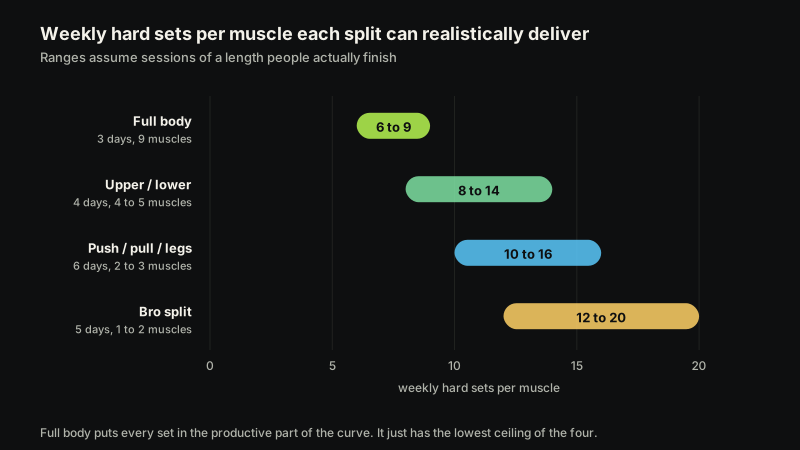
Is full body better than a split for muscle gain? On volume-equated evidence, no structure wins on its own, which is the same conclusion the research keeps reaching and the reason the choice of split matters less than lifters expect. What changes is the ceiling each one places on your weekly volume and the failure mode it hands you.
Full body's ceiling is the lowest of the four, and that is genuinely fine for a lot of people. Six to nine hard weekly sets per muscle, performed well and progressed honestly, grows muscle. It is a better outcome than 16 planned sets where the last eight were performed in a fog. The mistake is running full body while believing you are getting a volume you are not.
If you want more than full body's ceiling allows, the answer is not a longer session. It is a structure that gives fewer muscles more room per session, or an honest look at how many sets one workout can actually hold.
Count the sets that actually happened
Full body earns its reputation. It puts every set in the productive part of the curve, it fits three days a week without rearranging your life, and the research gives it no disadvantage once weekly volume matches.
It just runs on a tighter budget than any other split, and the budget is invisible in the template. Nine muscles, one session, and a per-session dose that decides your weekly total before you have lifted anything.
Two numbers settle it. Your actual weekly hard sets per muscle, and where in the session each of those sets happened while your effort estimate was still worth trusting.
RIRLift totals hard sets per muscle across the week automatically, so the difference between the 12 weekly sets your plan implied and the 6 your rotation delivered shows up as a number rather than a hunch. Logging load, reps and RIR per set as the session runs is what exposes the tail, because the decay lives in the sequence and not in the total. You run the whole session from your wrist without reaching for a phone between sets, which matters on a day carrying twenty of them. For setting the weekly targets in the first place, the training volume guide covers where those numbers should land.
Run full body. Just run the arithmetic first, and let the priority rotate.