
Blog
PPL split: the number push pull legs leaves out
Published August 10, 2026 · updated September 19, 2026 · 12 min read
Two lifters tell you they run push pull legs. One trains chest 52 times this year. The other trains it 104 times. Both are describing the same split, and neither of them is wrong.
That is the strange thing about the PPL split. Every other common split carries its frequency inside its name. A bro split means once a week per muscle. A four-day upper/lower means twice. Three-day full body means three times. "Push pull legs" tells you how the exercises are grouped and says nothing at all about how often the group comes back around, which is the training frequency that actually decides how much muscle you build.
Look at what people search alongside it and the pattern is obvious: 3 day, 4 day, 5 day, 6 day, PPL routine PDF. Nobody is confused about which exercises go on a push day. They are hunting for the number the split forgot to specify.
What is a PPL split?
A PPL split, short for push pull legs, is a three-session rotation that groups exercises by movement pattern: pressing muscles on the push day (chest, shoulders, triceps), pulling muscles on the pull day (back, rear delts, biceps), and the lower body on the leg day. The rotation can be repeated at any frequency from three to six sessions a week, and that repetition rate, not the grouping, is what sets your weekly volume.
The grouping itself is sound. Muscles that share fatigue get trained on the same day, so your triceps take their pressing work and their direct work in one sitting instead of getting hammered on Monday and again on Thursday. That is the genuine advantage of a PPL over a body-part split, and it is why the format survived decades of gym-floor evolution.
But the grouping is the easy half. The repetition rate is where PPL routines quietly diverge into two different programs wearing the same name.
The number the name leaves out
Run the arithmetic and the gap stops being philosophical.
Say you want 14 hard sets a week for chest, which sits comfortably inside common weekly volume landmarks. The number is not arbitrary: Schoenfeld, Ogborn and Krieger's dose-response meta-analysis found roughly a 0.37% gain in muscle size for each additional weekly set, so the count you actually accumulate is the variable worth defending. Here is what each PPL schedule has to deliver to get there.
| Schedule | Sessions per week | Times each muscle trained | Chest sets needed per session | Verdict |
|---|---|---|---|---|
| 3 day PPL (Mon/Wed/Fri) | 3 | 1x | 14 | Not realistic in one session |
| 4 day PPL (rolling) | 4 | ~1.3x | 11 | Still front-loaded, uneven week to week |
| 5 day PPL + upper | 5 | ~1.7x | 8 | Workable, rotation drifts |
| 6 day PPL (two full rotations) | 6 | 2x | 7 | Comfortable, needs six gym days |
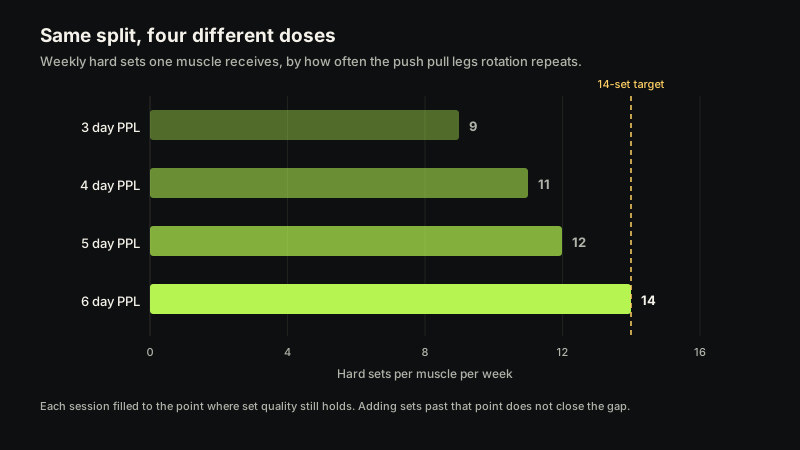
A three-day PPL is not a lighter version of a six-day PPL. It is a different training dose. Getting 14 chest sets out of a single weekly push day means stacking them behind shoulder and triceps work in one session, and the last few of those sets arrive with your pressing muscles already spent. The per-session set ceiling is the thing that breaks first, well before your willingness to keep going does.
So the honest read is that a three-day PPL delivers roughly 8 to 10 quality sets per muscle per week. For a beginner that is plenty. For an intermediate chasing a specific weekly target, it is a ceiling, and no amount of adding sets to the end of the push day moves it.
Does push pull legs work for muscle growth?
Yes, and the evidence is less exciting than either side of the frequency argument wants it to be.
Schoenfeld, Ogborn and Krieger's 2016 meta-analysis in Sports Medicine found that training a muscle group twice a week produced superior hypertrophy to training it once a week, and recommended that major muscle groups be trained at least twice weekly. On that finding alone, six-day PPL beats three-day PPL.
Then the same group ran the comparison again with total volume held constant. Their 2019 review in the Journal of Sports Sciences concluded that resistance training frequency does not significantly or meaningfully impact hypertrophy when volume is equated. Frequency was not doing the work. Frequency was how the higher-frequency groups managed to accumulate more volume in the first place.
Put those two results next to each other and the practical rule falls out cleanly. Frequency matters because of what it lets you fit, not because of what it does. Six-day PPL wins over three-day PPL when it delivers more hard sets per muscle. If you somehow squeezed the same weekly sets into three sessions without the quality falling apart, the research says the outcomes would be close to identical.
This is the same conclusion the best workout split for muscle growth question keeps landing on from every direction: the split is a container. What you put in it is the training.
What each PPL day is actually grouping
The three days are not equally easy to fill.
Push day carries chest, front and side delts, and triceps. Three muscle groups, all of them involved in pressing. Your triceps have already done meaningful work by the time you reach a direct triceps movement, and so have your front delts. This is efficient, and it is also why the last two exercises on a push day always read differently in a log than the first two.
Pull day carries the back (which is really several muscles), rear delts, and biceps. Same story, one layer worse: rows and pulldowns pre-fatigue the biceps before any curl happens.
Leg day carries quads, hamstrings, glutes and calves, and it is the day people quietly shorten. Calves are last on the list on the day that is already the longest, which is a large part of why calves are the muscle most lifters undertrain without noticing.
Two consequences fall out of this that the template pages skip.
First, the muscles that always go last (triceps, biceps, calves, rear delts) get their entire weekly volume in the pre-fatigued slot. Not one session in three. Every session, permanently, because the running order of a PPL day is fixed by its own logic. This is the general case of the discount the second muscle in a pairing pays, and a synergist-grouped split is where it applies most consistently.
Second, your RIR estimate reads differently on a pre-fatigued muscle. Two reps in reserve on a fresh bench press and two on a triceps extension after four pressing exercises are not the same distance from failure in any physiological sense, even when they feel identical. Effort estimates drift late in a session, and on a PPL push day the drift is systematic rather than random.
The fix is not to abandon the grouping. It is to rotate which arm or delt movement gets the good slot, and to accept that the second half of a push day is where your set count is least trustworthy.
When your training week stops being a week
Here is the failure mode that belongs to PPL alone, and it is not in any of the templates on page one.
Experienced PPL lifters rarely run a fixed Monday-to-Saturday schedule. They run a rolling rotation: three days on, one day off, repeat. Push, pull, legs, rest, push, pull, legs, rest. It is a better program than the calendar version because rest lands where fatigue lands rather than where Sunday lands.
It also drifts off the week. A four-day cycle does not divide into seven days, so a muscle gets trained once every four days, which is 1.75 times per seven days rather than twice. Over a month that is seven push sessions rather than eight.
The measurement problem is worse than the small shortfall. Your Monday-to-Sunday total does not hold still. Three weeks out of four contain two push days and the fourth contains one, so a chest number that reads 14, 14, 14, then 7 describes a perfectly consistent program, not a week you slacked off in. If you react to the 7 by adding sets, you are correcting a calendar artifact.
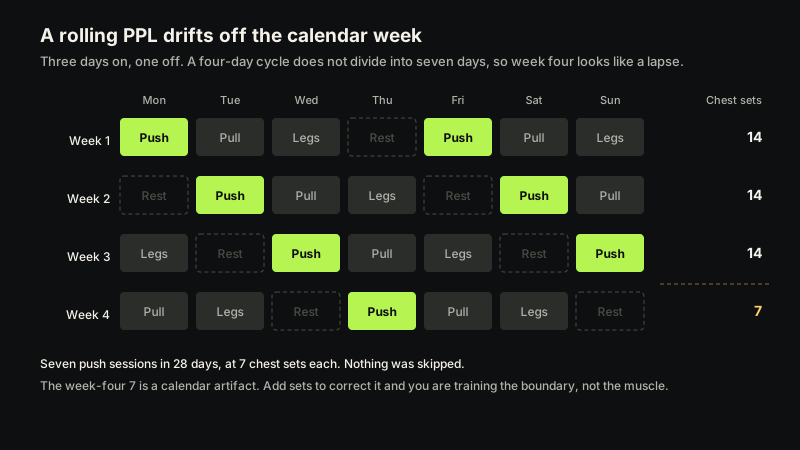
This is worth stating plainly because weekly hard sets per muscle is the right scoreboard for hypertrophy and a rolling split is the one case where the weekly frame lies to you. RIRLift keeps a running per-muscle count of the week's hard sets and shows it against a target, which makes the alternation visible rather than mysterious. The read you want from it on a rolling PPL is the two-week average, or better, the trend across the training block. Judge a rolling rotation over a block and the number holds still.
If that sounds like too much bookkeeping, run the six-day calendar version instead. It gives up the fatigue-aligned rest day and buys back an honest weekly total, which is a reasonable trade for most people.
Push pull legs vs upper/lower
These two splits get compared constantly because they solve the same problem at different resolutions, and the growing search interest in the comparison suggests most people are choosing between exactly these two.
| 6 day PPL | 4 day upper/lower | |
|---|---|---|
| Sessions a week | 6 | 4 |
| Frequency per muscle | 2x | 2x |
| Muscle groups per session | 3 to 4 | 5 or more |
| Session length | Shorter | Longer |
| Cost of missing one session | One muscle group loses half its week | Half your body loses half its week |
| Main constraint | Days available | Room inside the session |
Both deliver twice-weekly frequency. PPL spends six days to do it and keeps each session short; the upper/lower split does it in four days and pays for the compression on the upper day, where five muscle groups compete for slots and the arms always close.
So the choice is not really about muscle growth. It is about which constraint binds first for you. If you can reliably train six days, PPL gives you more room per session and a lower cost per missed day. If you can train four, upper/lower delivers the same frequency and PPL cannot, because a four-day PPL leaves one of the three days short every week. If you can train five, the push pull legs upper lower hybrid reaches twice-weekly frequency by adding an upper and a lower day to the three PPL sessions.
And if you can train three days, neither of these is the right answer. A three-day full body split hits every muscle three times a week on the same three days that a three-day PPL hits each muscle once.
Is push pull legs good for beginners?
It is fine, and it is usually not the best available option.
A beginner's binding constraint is not weekly volume. Early progress comes cheaply and a modest set count works, which is exactly what a three-day PPL delivers. The problem is the other thing beginners need, which is repetition of the movement patterns. Three-day PPL gives you one squat session, one bench session and one row session a week. Full body gives you three of each, and technique is a practice effect.
The version of PPL that genuinely suits a beginner is the six-day one, and six gym days a week is a demanding first commitment. If you want the PPL structure early, run it as a rolling rotation and accept the drifting week, or run full body until the movement patterns are automatic and switch to PPL when you can hold six days.
Whichever you pick, the progression rule is the same. Add reps inside your rep range before you add load, and only count the rep if your effort estimate held. That is double progression, and it is what turns a split into a program.
How to run push pull legs without lying to your log
Five rules, in order of how often they get broken.
- Pick the frequency first, then build the sessions. Decide whether you are running 3, 4, 5 or 6 days, look up the weekly sets per muscle that implies, and fill the sessions to hit it. Most PPL programs are built in the opposite order and discover the volume they produce by accident.
- Cap the session, not the week. If your target needs 14 chest sets and your schedule gives one push day, the target is wrong for that schedule. Lower the target or add the day. Do not stack the difference onto the end of the session, where the extra sets buy fatigue instead of stimulus.
- Rotate the last slot. Whichever movement closes your push and pull days is the one running on the least gas. Change which one it is every few weeks so the deficit does not land on the same muscle for a whole block.
- Log RIR per set, and expect it to drift late. On a push day, a 2 RIR on the fifth exercise is a softer 2 than the one on the first. Logging it honestly is what lets you see the drift instead of averaging it away.
- Judge volume over two weeks on a rolling rotation. One calendar week is the wrong window for a four-day cycle. Watch the two-week or block average and let the weekly bar chart alternate in peace.
None of this requires a spreadsheet, but it does require that your log records effort per set rather than just weight and reps. Planning the split on iPhone and running each session from the watch is the version of this that survives a real training week, because the RIR entry happens while the set is still in your hands rather than from memory that evening.
The two numbers that settle it
Stop asking whether push pull legs is a good split. It is a grouping, and the grouping is fine.
Ask the two questions the name leaves open instead. How many days a week will you actually be in the gym, and how many hard sets per muscle does that give you once the sessions are filled honestly? A six-day PPL and a three-day PPL answer those questions so differently that treating them as one program is the real mistake.
Get the frequency right and the split takes care of itself. Get it wrong and no amount of exercise selection on the push day will fix it.