
Blog
German volume training: does 10x10 actually build more muscle?
Published August 4, 2026 · 13 min read
You load the bar with roughly 60 percent of what you could lift once, and you do ten sets of ten. One hundred reps of the same movement, ninety seconds of rest between sets, and by set seven your forearms are gone and your technique is a negotiation. It is a genuinely hard hour, and the soreness the next day is spectacular.
German volume training has survived four decades on exactly that feeling. The protocol is simple enough to explain in one sentence, brutal enough to feel like it must be working, and it comes with the reassuring folklore that lifters used it to gain ten pounds in six weeks.
There is one study that put GVT head to head against half of GVT. The group doing five sets grew more.
That result is not a curiosity. It is the clearest available demonstration of something most training advice still gets backwards: a set only counts when it is hard, and adding sets that are not hard adds fatigue instead of muscle.
What is German volume training?
German volume training is a hypertrophy protocol built on ten sets of ten repetitions of a single exercise, performed with roughly 60 percent of your one-rep max and 60 to 90 seconds of rest between sets. You run one such 10x10 movement per major pattern in a session, usually paired antagonistically (a press with a row), then add one or two lighter accessory exercises at three sets each.
The method is usually credited to Rolf Feser, a German national weightlifting coach, and it reached English-speaking lifters through strength coach Charles Poliquin in the 1990s. The load prescription is the part people forget. Sixty percent of your one-rep max is a weight you could grind for something like 20 reps if you had to. That gap between what you are lifting and what you could lift is the whole story of this article.
The progression rule is neat: when you complete all ten sets of ten, you add roughly four to five percent to the bar next time. Until then, the weight stays put and you chase the rep count.
| Variable | GVT prescription |
|---|---|
| Sets x reps | 10 x 10 on the main lift |
| Load | About 60 percent of 1RM (a weight you could do roughly 20 times) |
| Rest | 60 to 90 seconds |
| Main lifts per session | One per movement pattern, often paired antagonistically |
| Accessory work | One or two exercises at 3 sets each |
| Frequency | Each muscle roughly every fifth day |
| Progression | Add 4 to 5 percent once all 100 reps are completed |
Does German volume training actually work?
It works in the sense that any hard, structured, progressive program works. The better question is whether the tenth set earns its place, and there is a direct answer.
In 2017 a research group at the University of Sydney ran a six-week comparison of a modified German volume training program in nineteen trained men. Both groups lifted three times a week on a split routine with identical exercises, loads, and rest. The only difference was set count: one group did the full ten sets per exercise, the other did five.
| Outcome after 6 weeks | 10-set group | 5-set group |
|---|---|---|
| Trunk lean mass | Smaller increase | Significantly greater (p = 0.043) |
| Arm lean mass | Smaller increase | Favoured (p = 0.083) |
| Leg lean mass | No significant difference between groups | No significant difference between groups |
| Muscle thickness | No significant increase | No significant increase |
| Bench press strength | Smaller gain | Significantly greater (p = 0.014) |
| Lat pull-down strength | Smaller gain | Significantly greater (p = 0.003) |
Doubling the sets did not double the growth. It did not produce any additional growth. On two of three lean-mass regions and on both tested lifts, the half-volume group came out ahead. The authors' recommendation was blunt: four to six sets per exercise, with gains plateauing beyond that range.
Nineteen men over six weeks is one study, and it should not be the last word on anything. But it is the only controlled test of the specific claim GVT makes, and it points the same direction as the mechanism, which is the part worth understanding.
Why the extra five sets did not pay
The dose-response evidence on training volume is real. Schoenfeld, Ogborn and Krieger's meta-analysis found each additional weekly set associated with roughly 0.37 percent more muscle gain. More volume does tend to mean more growth.
The catch is what the studies in that analysis counted as a set. They counted hard sets: working sets taken somewhere near failure. A set performed at 60 percent of your max, ten reps deep into a twenty-rep capacity, is not that. It is a warm-up with a rep target.
Walk through a GVT set sequence honestly and you can see where the stimulus actually lives:
| Set | Roughly how it feels | Estimated reps in reserve |
|---|---|---|
| 1 to 3 | Easy. The bar moves fast, you are counting rather than working | 8 to 10 |
| 4 to 5 | Warm. Breathing picks up, still nowhere near failure | 6 to 8 |
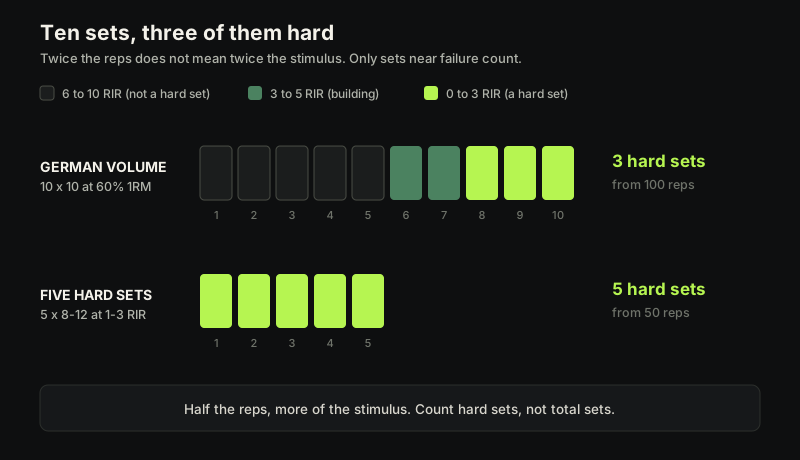
| 6 to 7 | Working. Fatigue is accumulating, reps slow down | 3 to 5 |
| 8 to 10 | Hard, often failing the rep target | 0 to 2 |
The first half of a 10x10 is not a stimulus. It is the fatigue you generate in order to make the second half hard. That is a legitimate way to arrive at a productive set, and it is precisely how a light set gets there at all, but it is an expensive route. You paid fifty reps of connective tissue load, systemic fatigue and clock time to earn three or four genuinely stimulating sets.
Reduce the set count and raise the effort, and you buy those same hard sets directly. This is the difference between total volume and effective volume, and it is exactly what junk volume means in practice: work that shows up in your log, adds to your recovery bill, and contributes very little to growth.
It also explains something that confuses people about the failure literature. Refalo and colleagues' meta-analysis of proximity to failure found no meaningful hypertrophy advantage to hitting momentary failure over stopping a rep or two short. That is not permission to train easy. The comparison in those studies is between zero and roughly three reps in reserve, not between three and ten. Below a certain effort threshold, sets simply stop counting, which is the same conclusion from the other direction: how hard each set should be is the variable that decides whether volume is doing anything at all.
Ten sets on one exercise blows your session budget
There is a second problem with the 10x10 that has nothing to do with effort, and it is arithmetic.
Most evidence-based programming lands each muscle somewhere around 10 to 20 hard sets per week, spread across two or more sessions. A GVT session spends ten sets on one movement for one primary muscle before the accessory work starts. If those ten sets counted as hard sets, you would have spent between half and all of a muscle's weekly budget in a single exercise, in a single hour, at a load too light to develop much strength.
They do not all count, which is why the program does not immediately break people. But it does mean the honest accounting of a GVT session is roughly "three to five hard sets, plus fifty reps of fatigue," and that is a poor trade against what a session can actually hold. The per-session ceiling for one muscle is not a rule someone invented. It is the point where effort starts drifting and the sets after it stop paying, and a 10x10 crosses it by design.
The short rest interval compounds it. Sixty to ninety seconds between sets of a compound lift is not enough for a trained lifter to recover force output, so later sets are limited by residual fatigue rather than by the target muscle. If you have ever noticed how much rest length protects the quality of the next set, GVT is what the opposite looks like: reps that end because you are still breathing hard from the last set.
Is GVT good for strength or hypertrophy?
Neither, cleanly, and the load prescription is why.
Sixty percent of a one-rep max is well below the range where maximal strength adapts efficiently. Strength is partly a skill expressed at heavy loads, and you cannot practise a skill you never perform. The Sydney study found the five-set group gaining more on both bench press and lat pull-down, which is what you expect when the ten-set group spends its energy budget on submaximal reps.
For hypertrophy the load is defensible. Light loads taken close to failure build muscle comparably to heavy ones. The problem is not the 60 percent, it is that 60 percent for ten reps is not close to failure. GVT sets the load for a rep target rather than for an effort target, so the effort ends up as an accident of accumulated fatigue rather than something you control.
This is the practical version of the difference between training for size and training for strength. Size wants hard sets and enough weekly volume. Strength wants heavy loads and quality reps. A 10x10 at 60 percent is optimised for neither, which is a strange place for a program with this much reputation to land.
What German volume training gets right
It would be lazy to write the whole thing off. GVT persists because parts of it are genuinely good, and they are worth stealing.
- It forces you to submit to a plan. Ten sets of ten with a fixed load and a fixed progression removes every decision from the session. Lifters who program by feel and drift between exercises every week often make their best progress the moment something takes the steering wheel away.
- It builds exercise competence fast. A hundred reps a session on one movement is a lot of practice. Technique on that lift usually improves sharply.
- The progression rule is clean. Complete all the reps, then add load. That is double progression with a very wide rep target, and the logic is sound even where the numbers are not.
- It is an honest ceiling test. If you have never found the point where volume stops helping, a block of GVT will introduce you to it quickly.
None of that requires ten sets. All of it survives a rewrite.
A smarter version of the same idea
Keep the structure, fix the effort. The changes are small and each one is supported by the study that found five sets outperforming ten.
| Variable | Classic GVT | The version worth running |
|---|---|---|
| Sets on the main lift | 10 | 5 to 6 |
| Load | About 60 percent of 1RM | Whatever puts the set at the target effort, usually 70 to 80 percent |
| Reps | 10, fixed | 8 to 12, within a range |
| Effort target | None stated | 1 to 3 reps in reserve on every working set |
| Rest | 60 to 90 seconds | 2 to 3 minutes on compounds |
| Progression | Add 4 to 5 percent once all 100 reps are done | Add reps within the range at fixed load, then add load |
| Weekly accounting | 10 sets, unknown number of them hard | 5 to 6 sets, all of them hard |
You end up doing roughly half the reps, all of them productive, in less time, with a recovery bill you can actually pay across a training week. That is not a compromise version of GVT. On the only evidence available, it is the version that grew more muscle.
If you want the effort target to mean something, you have to record it. Reps in reserve is the workable estimate: how many more reps you could have completed with good form when you racked the weight. Our guide to reps in reserve covers how to estimate it without deceiving yourself, which takes a few weeks of practice and is the single highest-leverage habit in a hypertrophy log.
How to tell from your own log whether the volume is working
You do not have to take a six-week study's word for it. A block of high-volume work leaves fingerprints, and they are visible in a log that records effort and not just numbers.
Three signals, in order of usefulness:
- RIR drift within a session. If your first sets sit at 8 or 9 reps in reserve and only the last two or three land under 3, you have found your junk volume. The fix is fewer sets at more weight, not more sets.
- Estimated 1RM going flat while set count climbs. If your total weekly sets on a lift are rising and your estimated 1RM has not moved in a month, the added sets are not producing adaptation. They are producing fatigue.
- Weekly hard sets by muscle, not total sets. Count only the sets you finished at 3 reps in reserve or closer. If that number is 8 for chest while your log says 26 sets, the log is flattering you. This is the accounting our training volume guide is built on, and it is the number that predicts growth.
This is where a paper notebook and most logging apps fail you. They record load and reps, which tells you what happened but not how hard it was, and without effort there is no way to separate a hard set from a warm-up in the same rep range.
RIRLift logs reps in reserve per set on your wrist, in the moment, then totals your weekly hard sets by muscle so you can see how many of them actually counted. If you run a high-volume block, you will know inside two weeks whether the extra sets are showing up as progress or only as fatigue. You can see how a session runs from your wrist if you want the full picture.
The verdict on 10x10
German volume training is a hard, well-structured program built on a premise that has not aged well: that the number of sets is the stimulus. It is not. Sets taken close enough to failure are the stimulus, and everything else is bookkeeping.
Run five or six hard sets instead of ten mediocre ones, keep every one of them within a couple of reps of failure, rest long enough to make that possible, and log the effort so you can prove it happened. That is the training principle GVT was groping toward in the 1970s, and the only evidence we have points at the smaller number.