
Blog
GZCLP program: how the stall ladder shows a drop coming
Published October 18, 2026 · 12 min read
Most beginner programs handle a missed session the blunt way: hit your reps or do not, and when you stall enough times, cut the weight and start the climb again. GZCLP does something cleverer, and the cleverness is the reason it keeps getting recommended to new lifters. When you miss your target on a main lift, you do not reset right away. You keep the same weight and shift to an easier rep scheme, then an easier one again, and only then, if all of those fail, do you cut the load. Three rungs down before a reset.
That ladder looks like a complicated failure protocol, and most people run it on autopilot: hit the wall, drop a rung, shrug. It is not a failure protocol. It is a slow-motion warning system, and if you log two numbers while you run it, the next drop is visible a session before it happens. The program that looks like it only reacts to a miss is actually telling you a miss is coming. This is how to read it.
What is GZCLP?
GZCLP is a three-day-a-week novice linear progression program built on three tiers of work per session, where the main lift uses a built-in rep-scheme ladder (5x3+, then 6x2+, then 10x1+) before you ever reset the weight. The name stands for GZCL Linear Progression. It is the beginner on-ramp to the broader GZCL method created by powerlifter and coach Cody LeFever, and it spread through the lifting internet, especially Reddit's r/fitness and r/gzcl, as a more structured alternative to the older novice templates.
Every session has three tiers. Tier 1 (T1) is a heavy primary compound done for five sets of three, with the last set taken as an AMRAP, as many reps as possible. Tier 2 (T2) is a secondary compound done for three sets of ten to build volume. Tier 3 (T3) is accessory work done for three sets of fifteen or more. You rotate four workouts, A1, B1, A2 and B2, across three sessions a week, so the squat, bench, overhead press and deadlift each get their turn as the heavy T1 lift.
| Variable | GZCLP prescription |
|---|---|
| Tier 1 (primary) | 5 sets of 3, last set AMRAP, on a heavy compound |
| Tier 2 (secondary) | 3 sets of 10 on a complementary compound |
| Tier 3 (accessory) | 3 sets of 15 or more on isolation work |
| Sessions per week | 3, rotating workouts A1, B1, A2, B2 |
| Load added when you clear a tier | About 2.5 to 5 lb upper body, 5 to 10 lb lower body |
| T1 stall handling | 5x3+ misses, drop to 6x2+; that misses, drop to 10x1+; that misses, reset about 10 percent |
Written out like that it reads like any other linear progression with an unusually elaborate way of handling a bad day. The part worth an article is what that elaborate ladder is actually doing, and what you can see coming if you watch it closely.
The three tiers do three different jobs
The first thing to understand about GZCLP is that the tiers are not just big, medium and small lifts. They are three different training goals stacked in one session, and they ask for three different levels of effort.
T1 is the strength tier. Five sets of three at a heavy load, finishing with an AMRAP, is a near-maximal effort by design, and the last set is where the program takes its reading. T2, at three sets of ten, is the hypertrophy workhorse: lighter, higher reps, more total work, the sets that actually drive most of the size you build on this program. T3, at three sets of fifteen or more, is accessory volume for the smaller muscles the big lifts miss, like arms, rear delts and the mid-back.
That matters for one reason that the program never spells out: the weekly muscle-building volume lives in T2 and T3, not T1. Schoenfeld, Ogborn and Krieger's dose-response meta-analysis associates more weekly hard sets with more growth, within reason, and on GZCLP the bulk of those hard sets are the tens and the fifteens, not the heavy triples. If you want to know whether the program is delivering enough stimulus for a given muscle, you count the T2 and T3 sets it reaches across the week, which is the same arithmetic as working out how many sets per workout each muscle actually needs. The T1 AMRAP gets all the attention, but it is a strength test first and a growth set second.
The stall ladder is a controlled descent
Here is the mechanism that makes GZCLP worth writing about. On most novice programs, a stall on your main lift is a cliff: you miss, you miss again, you deload. GZCLP turns the cliff into a staircase.
When you fail to hit the target on T1, you do not touch the weight. You change the rep scheme instead. Five sets of three with a final AMRAP (5x3+) becomes six sets of two with a final AMRAP (6x2+) at the same load. If that fails, it becomes ten singles with a final AMRAP (10x1+), still at the same load. Only when the singles fail do you reset the weight by about ten percent and build back up.
Each rung keeps the total work roughly similar while making every individual set easier to complete, which lets you keep grinding productive reps at a weight you have not actually outgrown yet. A stall at 5x3 does not always mean the weight is too heavy. Sometimes it means three reps per set is too many reps per set for that load right now, and two is fine. The ladder squeezes the remaining progress out of a load before giving it up, which is exactly why lifters stay on GZCLP longer than on a program that resets at the first missed session.
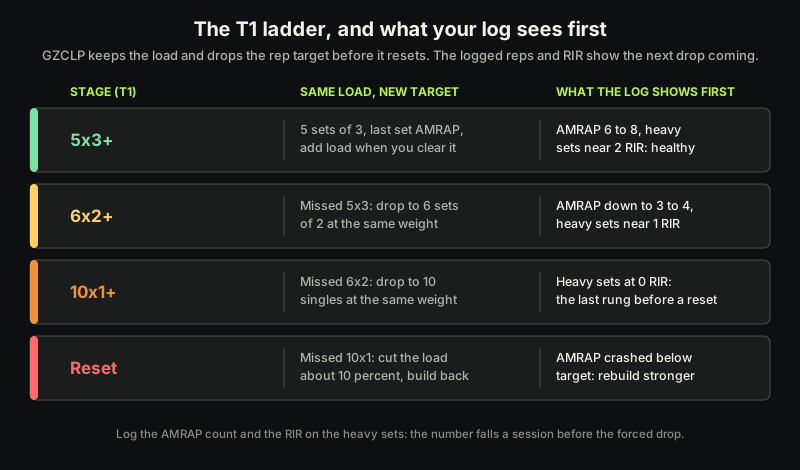
The descent has a floor built in. Ten singles at a load you were doing for triples a few weeks ago is a lot of near-maximal work, and the AMRAP is still there asking for more. When even the singles stop clearing, the load really has been outgrown, and the reset is no longer premature. The ladder is a way of being sure you have earned the reset before you take it.
Your log sees the next drop one session early
The ladder reacts to a miss. Your log can predict one. The trick is to record two numbers every T1 lift, not one.
The first number is the AMRAP count, the reps you hit on the last set. Like the top set on any program that ends with an open set, it is an inverse reading of effort against a fixed load. This is the same quantity as reps in reserve, measured instead of estimated, because you kept going until there were none left. An AMRAP of eight means the triples before it were comfortable. An AMRAP of three means you are close to the edge of this load.
The second number is the reps in reserve you leave on the fixed sets, the ones before the AMRAP. This is the reading almost nobody takes, and it is the one that sees the future. When your heavy sets of three are sitting at two or three reps in reserve, the load is well within you and a good AMRAP is almost guaranteed. When those same sets creep to one rep in reserve and then zero, you are about to miss the target, and the AMRAP will fall first. The forced drop from 5x3+ to 6x2+ is visible in the fixed-set effort a session before the program makes you take it.
Read together, the two numbers turn the ladder from a thing that happens to you into a thing you can see coming. That is worth doing because it changes your decision. If the AMRAP is strong, add load aggressively while you can, the way a new lifter genuinely can session to session. If the fixed sets have gone to zero reps in reserve, hold the load one more session rather than forcing a jump, and you often clear the target you would otherwise have missed. To read any of this you have to log the AMRAP count and the reps in reserve on the two heavy sets from your wrist, because the gap between a stimulus that has stalled and a body that is just tired this week is a gap you see in the record, not one you feel in the moment.
The AMRAP also keeps the stimulus honest without forcing you to grind every heavy set to a ragged failure. The research on proximity to failure is reassuring here: a meta-analysis by Refalo and colleagues found no meaningful hypertrophy penalty for stopping a rep or two short of failure rather than going all the way. So a clean AMRAP taken to the point where the next rep would be a genuine grind is both the honest measurement and a productive set, which is how hard most of your working sets should sit anyway.
GZCLP next to the other novice programs
GZCLP is usually chosen over the older novice staples, and it is worth being clear about the difference rather than restating it. Greyskull LP reads its next move from a single final AMRAP set and resets the whole lift when that set misses. GZCLP spreads the same idea across three tiers and, instead of resetting on a miss, walks down the rep ladder first. The two are close cousins: both end the heavy work with an open set that measures effort, and both are far more informative than a program that only ever gives you a pass or a fail.
The common question, whether GZCLP is better than Starting Strength, has a boring and honest answer. For most beginners the difference in results is small, because any sensible novice linear progression works while you are new. GZCLP's edge is not a bigger number at the end of twelve weeks. It is that the ladder and the AMRAP make the program legible, so you spend those twelve weeks learning to read your own effort instead of just hitting prescribed reps. That reading is the skill you keep.
When the ladder runs out
No novice program lasts forever, and the ladder only buys you time. Adding weight every session is possible because a new lifter's early progress is a mix of real tissue growth, skill and neural adaptation, and that engine slows down. When it does, the reset stops working, because you climb back to the same sticking point and stall again at the top of the ladder. Understanding why newbie gains feel like a cliff is understanding why GZCLP has an expiry date.
Your log tells you the day has come before the program does. On a program that is still working, your AMRAP reps are stable or climbing at each new load and the fixed-set effort stays moderate. When linear progression is ending, the AMRAP falls session over session at loads you used to clear, the fixed sets live at zero reps in reserve, and no reset holds for long. That is the cue to stop adding load every session and move to a scheme that progresses over weeks instead of workouts, usually double progression, where you add reps inside a range at a fixed load and only add weight once you top the range. It is the natural next step precisely because you already know the signals that a weight has been outgrown from reading your tiers, and because the slower logic of progressive overload has to take over once the per-session jumps dry up.
Why you still log RIR on a program that never asks for it
GZCLP never tells you to record reps in reserve. The AMRAP is supposed to make effort self-evident: you went until you stopped, so of course it was hard. But the AMRAP is one set out of five in T1, and the four fixed sets before it are where the early warning lives. The program hides that signal by only asking whether you cleared the target.
Log the AMRAP count and your reps in reserve on the fixed sets and three things become visible that the program alone conceals. You see the AMRAP trending down before you ever miss, so the drop to 6x2+ stops being a surprise. You see whether a bad T1 came after easy heavy sets, which is a real ceiling, or after brutal ones, which is fatigue, and those two problems have opposite fixes. And you see, across a few weeks, whether your jumps have been too aggressive, because the AMRAP crashes right after a load increase instead of settling. None of that needs a spreadsheet, but all of it needs effort recorded per set, which a paper logbook and most tracking apps never capture.
RIRLift logs reps in reserve on every set, so the effort is recorded while you are still catching your breath rather than reconstructed from memory later. Because the record is per set, the AMRAP trend and the fixed-set effort are both waiting when you open the next session, so you can put last session's T1 numbers on the watch face before you load the bar instead of trusting your memory of whether it felt heavy.
The verdict
GZCLP earns its reputation on one design choice: it refuses to reset a weight until it has walked down a ladder that proves the weight was truly outgrown, and it ends the heavy work with a set that measures rather than a set that checks a box. Run it as written, drop a rung when you miss, reset when the singles fail. But log the AMRAP count and the reps in reserve on the heavy sets, because those two numbers show the next drop a session early and tell you whether a bad day is a ceiling or just fatigue. A beginner program that teaches you to read your own effort is worth far more than the weeks of linear gains on the label, because the reading is the skill you carry into every program after it.