
Blog
Machines vs free weights: which builds more muscle?
Published August 6, 2026 · updated September 7, 2026 · 13 min read
The machines versus free weights argument has been running since roughly the invention of the machine, and it has produced a remarkable amount of confident nonsense in both directions. Free weights are for real lifters, machines are for people who do not know better. Or: machines isolate properly, barbells are just an ego contest with a spotter.
Meanwhile the gym settles it for you every week. The squat rack has a queue, so you use the hack squat. The one working cable station is taken, so the dumbbells get the session. Nobody actually trains inside the ideology.
Which is fine, because the growth question has a fairly boring answer: for building muscle, the two are close enough that picking a side is not where your results come from. The interesting question is the one the debate never asks. The implement you choose changes what makes the set stop, and that changes whether the numbers you write down afterward mean anything.
What is the difference between machines and free weights?
A free weight is a load you support and stabilise yourself, like a barbell, dumbbell or kettlebell. A machine constrains the path of the load through a fixed track or lever, so you supply force along that path but not stability. Cables sit between the two: the path is not fixed, but the load direction is set by the cable, and you are not balancing the weight itself.
That single difference (who handles stability) is what produces every downstream difference between the two.
| Free weights | Machines | Cables | |
|---|---|---|---|
| Who stabilises the load | You | The machine | Partly you |
| Path of movement | Open | Fixed | Guided by line of pull |
| Skill needed to load hard | High | Low | Moderate |
| Safe to train near failure alone | Often not | Yes | Usually |
| Resistance profile | Set by gravity and leverage | Set by the cam or lever arm | Fairly constant |
| Typical failure point | Stability, grip or technique | Target muscle | Target muscle |
| Setup cost per set | Plates, collars, bench, spotter | Pin and seat height | Pin and attachment |
That last-but-one row is the one this article is really about, and it is the one the usual coverage skips entirely.
Do machines build as much muscle as free weights?
Broadly, yes. Haugen and colleagues' 2023 systematic review and meta-analysis compared free-weight against machine-based resistance training across the available controlled trials and found no meaningful difference in muscle hypertrophy between the two. Both modalities grew muscle, and neither held a reliable advantage.
Strength was the more interesting outcome. Gains there tended to favour whichever modality was used for testing: train on free weights, test better on free weights; train on machines, test better on machines. That is a specificity result rather than a superiority result, and it is exactly what you would expect given that a barbell squat is partly a skill.
So the honest summary is narrow and useful. If your goal is size, the implement is not the variable that decides the outcome. If your goal is a bigger barbell squat, you should probably be squatting with a barbell, because you are training a skill as well as a muscle.
This is the same conclusion the evidence keeps producing on every "which version builds more muscle" question, whether it is compound versus isolation exercises or rep ranges. The variables that actually move hypertrophy are effort, weekly hard sets and progression over time. Equipment is downstream of all three.
Why the growth comes out even
It comes out even because muscle does not know what is holding the load.
Growth is driven primarily by mechanical tension in the working fibres, accumulated across reps that are hard enough to recruit and fatigue high-threshold motor units. A fibre near failure in a leg press does not receive a discount for the fact that a sled was guiding the movement. Tension is tension.
What genuinely differs is the shape of the resistance across the range of motion. A dumbbell lateral raise is nearly weightless at the bottom and brutal at the top, because the resistance comes from gravity acting on a lever arm that changes as you move. A cable lateral raise loads the bottom too. A well-designed machine uses a cam to keep resistance closer to the strength curve of the joint.
That matters for hypertrophy mainly through muscle length. Loading a muscle while it is long appears to be disproportionately productive: Maeo and colleagues found that training the triceps overhead rather than with the arm at the side produced roughly twice the growth in the long head, same exercise, same effort. This is the same mechanism that makes lengthened partials hold up as well as they do. Some machines and cables load the stretched position better than the free-weight equivalent, and some do the reverse. It is an exercise-by-exercise question, not a category-wide one.
Which means "machines vs free weights" is the wrong unit of comparison. A chest-supported row and a barbell row are different exercises. So are a hack squat and a back squat. Compare the exercises, not the categories.
The part nobody covers: what ends the set
Here is the difference that actually shows up in your training log.
Most evidence-based hypertrophy programming asks you to take working sets close to failure, somewhere around one to three reps in reserve. The proximity-to-failure research suggests you capture most of the available stimulus without needing to hit true failure, provided you get genuinely close. That rule only works if your estimate of "close" refers to the target muscle.
On a machine, it almost always does. A leg extension ends when your quads can no longer extend the knee. There is nothing else in the system to give out first. Your RIR estimate is a reasonably direct read on the muscle you are trying to grow, and you can push to one rep shy of failure with no spotter and no consequences beyond having to stand up afterward.
On a heavy free-weight compound, it often does not. A barbell squat set can end because your brace failed, or your bar path drifted, or your upper back rounded. A dumbbell row can end because your grip went. A bench press set can end because you are alone and the honest choice at 1 RIR is to rack it. In every one of those cases you stopped, but not because the target muscle was near failure.
Both sets get written down as 1 RIR. Only one of them is telling the truth about your quads, lats or chest.
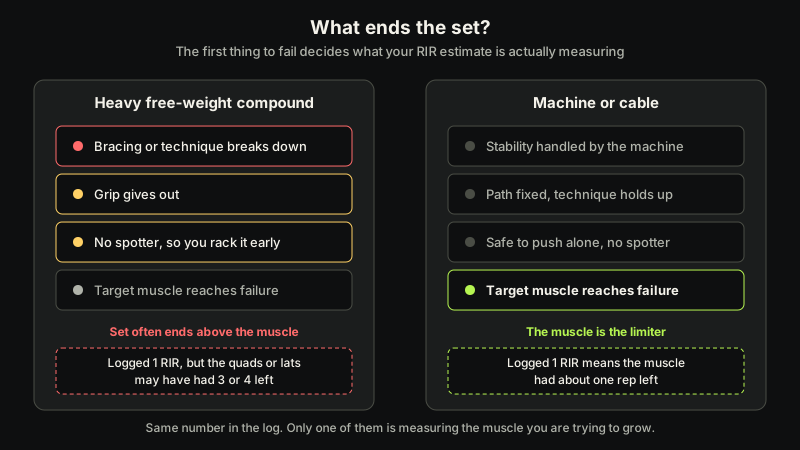
This is not an argument against free weights. Stability and technique are trainable, the limiter recedes as you get stronger at the movement, and heavy compounds remain the most efficient way to distribute a hard set across a lot of muscle at once. It is an argument for knowing which kind of set you just logged. Our guide to reps in reserve covers how to build an estimate you can actually trust, and the honest version of that skill is exercise-specific: your RIR sense on a hack squat and your RIR sense on a back squat are two separate calibrations.
It also explains a pattern most lifters notice and misread. Your machine work progresses smoothly and your free-weight compounds stall in ways that feel unrelated to fatigue. Often the compound has not stalled at all. The limiter has just moved somewhere other than the muscle.
Roles, not sides
The useful way to run this is to stop asking which is better and start asking what you need each set to do.
| Job in the session | Better tool | Why |
|---|---|---|
| Load a lot of muscle per set, efficiently | Free-weight compound | One set credits several muscles at once |
| Build strength on a tested lift | Free weights | Strength gains are largely specific to the modality |
| Train close to failure without a spotter | Machine or cable | Nothing fails before the target muscle |
| Fill a specific per-muscle volume gap | Machine or cable | Clean isolation, easy to slot in |
| Get a clean RIR read | Machine or cable | The muscle is the limiter |
| Keep training around a niggle | Machine | Fixed path lets you avoid the aggravating range |
| Late-session work when technique is fading | Machine or cable | Fatigue degrades a barbell set faster than a pinned one |
| Load the stretched position hard | Depends on the exercise | Resistance profile, not category |
Read down that list and the practical answer falls out on its own. Free weights early, when you are fresh and technique is intact and you want maximum muscle worked per unit of time. Machines and cables later, when you want to take specific muscles genuinely close to failure without the set ending for a reason that has nothing to do with them.
That ordering also happens to be what most well-built hypertrophy sessions look like already, which is a decent sign it is not a novel idea so much as an under-explained one.
Choosing per muscle, not per session
The other thing worth dropping is the idea that you owe any muscle a particular implement.
Some muscles are just easier to load well with a machine. Hamstrings via a lying leg curl, rear delts on a reverse pec deck, lats on a chest-supported row: in each case the machine removes a stabiliser that would otherwise be the limiter, and the target muscle gets the whole set. Others are hard to beat with free weights, because the free-weight version loads the stretch better or the machine version does not exist in your gym.
Your weekly volume target does not care which you used. A hard set is a hard set for the muscle it trained, and what counts as a hard set is about effort and the muscle worked, not the equipment. When you are deciding how many exercises to run per muscle group, the honest filter is whether each movement loads the target muscle well and lets you read your effort, not whether it involves a barbell.
The one genuine tiebreaker: if a movement consistently ends for a reason other than the target muscle, and you cannot fix that with technique work or by lowering the load, replace it. That is a bad exercise for that muscle, regardless of how respectable the implement is.
What about the Smith machine?
The Smith machine gets its own reputation, mostly undeserved and mostly beside the point. It is a machine that fixes the bar path in one plane while leaving you to handle the rest, so it lands between the two categories. For hypertrophy it is a perfectly reasonable tool, and it solves the spotter problem on pressing and squatting patterns, which is precisely the "train near failure alone" case above. The usual caution applies: it is a different exercise from the barbell version, so calibrate your effort estimate on it separately and progress it on its own terms.
The gym you actually walked into
None of this survives contact with a busy gym unless you can adapt without losing the plot.
The realistic failure mode is not choosing wrong in principle. It is planning a barbell Romanian deadlift, finding the platform occupied, doing something vaguely similar, and having no record of what you swapped or what it cost you. Three weeks later your hamstring progression is unreadable, and the reason is not training, it is bookkeeping.
The fix is to treat a swap as a deliberate substitution rather than an improvisation. Match the target muscle, match roughly where in the range it loads the muscle, keep your rep range and RIR target, and log it as the exercise you actually did.
Common questions
Are machines as good as free weights for building muscle?
For hypertrophy, yes. The systematic review discussed above found no reliable difference in muscle growth between machine-based and free-weight training. Size is driven by effort, weekly hard sets and progression, and a machine can deliver all three. The one place free weights pull ahead is testable strength on a specific lift, which is partly a skill you have to practise on the implement you test.
Should a beginner use machines or free weights?
Both, for different reasons. Machines let a beginner reach a genuinely hard set safely and read effort honestly, because the set ends on the target muscle rather than on shaky technique. Free weights teach the coordination and bracing that a barbell strength lift depends on. A sensible start is to learn effort on machines and cables while building movement skill on a few key free-weight patterns, rather than treating either as off limits.
Can you build muscle using only machines?
Yes. Nothing about growth requires a barbell. If your gym is all machines and cables, you can cover every muscle, take each set close to failure, and progress load or reps over time, which is the whole recipe. You give up some carryover to free-weight strength tests and some loaded-stretch positions that a dumbbell does better, but neither is a requirement for size.
Are free weights better than machines for strength?
For strength on a tested free-weight lift, yes, because strength gains are largely specific to how you train and test. If you want a bigger barbell squat, you have to squat with a barbell. For general strength you never plan to test under a bar, the difference mostly disappears, and machines let you load hard without a spotter.
Do free weights work more muscles than machines?
A free-weight compound recruits more stabilising muscles per set, which is why it is efficient for spreading a hard set across a lot of muscle at once. But extra stabiliser involvement is not extra growth for the muscle you are targeting. It often just means the set ends on your grip, lower back or balance before the target muscle is done, which is exactly why a machine can give that muscle a cleaner, harder dose.
Logging it so the comparison stays honest
This is where the whole argument lands in practice.
RIRLift logs load, reps and RIR for every set on your wrist, so the effort estimate goes in while the set is still fresh rather than being reconstructed from memory at the end of the session. That matters most on exactly the sets discussed above, where the difference between "my quads were done" and "my brace gave out" is real information that vanishes within about ninety seconds.
When a machine is taken, you can swap the exercise mid-session and keep your programming intent: pick a replacement by target muscle and equipment, and the swap carries your set count, rep range, rest timer and RIR target across. Afterward you choose whether it was a today-only substitution or a permanent routine change. The weekly muscle volume totals keep adding up either way, because they count hard sets by muscle, not by implement.
And because effort is logged per set rather than assumed, the pattern becomes visible over a block. If your logged RIR on barbell rows sits at 2 every week while the load never moves, that is a limiter somewhere other than your lats. If your machine row at the same nominal effort keeps adding reps, that tells you something the barbell set could not. Deciding when a small buffer beats going to failure is much easier when you know which of your sets were actually measuring the muscle.
Machines or free weights is not the question. What ended the set, and did you write it down, is the question.