
Blog
Mind-muscle connection: does it actually build muscle?
Published August 12, 2026 · 11 min read
Two lifters run the same set of dumbbell curls. One stares at his biceps, slows every rep down, and squeezes hard at the top so he can feel the muscle working through the whole range. The other just moves the weight, hits the same number of reps at the same effort, and racks it. The first one swears the mind-muscle connection is why his arms grew. The second one grew about the same and never thought about it once.
The mind-muscle connection is one of the few pieces of gym lore that turns out to be real when you check it against the research. Focusing on the target muscle genuinely changes what that muscle does during a set, and over a training block it can add a bit of growth. The problem is what lifters build on top of that finding. It gets sold as a secret, a substitute for hard training, or proof that a set "counts" because you felt it. None of that holds. The connection is a cue for pointing tension at the right muscle, not a mechanism that builds it, and its value depends heavily on what you are lifting and why.
This is worth getting right, because "feeling the muscle" is one of the easiest things in training to mistake for progress. It feels productive in the moment and leaves nothing behind you can check.
What is the mind-muscle connection?
The mind-muscle connection is the deliberate act of focusing your attention on a target muscle so that it, rather than the surrounding muscles, does the work during an exercise. Sports science calls it an internal focus of attention: your mind is on the body part producing the movement. Its opposite is an external focus, where your attention is on the outcome, the weight, or a point in space, not on the muscle itself.
That distinction is the whole ballgame. "Squeeze your chest and drive your hands together" is an internal cue. "Push the bar to the ceiling as fast as you can" is an external one. They describe the same bench press, but they direct your nervous system differently, and the difference shows up in what the working muscle actually does.
An internal focus tends to raise activation in the muscle you are thinking about. That is not a vague claim about willpower. It is a measurable shift in how the movement gets distributed across the muscles that could perform it.
Does the mind-muscle connection actually work?
Yes, within limits that matter more than the headline. Two findings frame it.
The first is about activation. In a well-cited study of the bench press by Calatayud and colleagues, trained lifters could selectively increase electrical activity in the pecs or the triceps just by focusing on that muscle, at loads up to about 60 percent of their one-rep max. At 80 percent, the effect disappeared. When the weight got heavy enough, the body recruited whatever it needed to move the bar and stopped taking requests.
The second is about growth over time. In an eight-week training study by Schoenfeld and colleagues, untrained men who focused internally on the working muscle gained more elbow-flexor thickness than a group who focused on the outcome of the lift: 12.4 percent versus 6.9 percent. That is a real difference, and it is the strongest single piece of evidence that the connection can do something for hypertrophy.
Read together, they tell a specific story rather than a heroic one:
| Study | What it measured | Finding | The catch |
|---|---|---|---|
| Calatayud 2016 | Muscle activation (EMG) during bench press | Internal focus raised activation in the target muscle at light to moderate loads | The effect vanished at 80% 1RM |
| Schoenfeld 2018 | Muscle thickness over 8 weeks of curls and leg extensions | Internal focus grew the biceps more than external focus | Untrained subjects, isolation and single-joint work, arms responded more clearly than legs |
So the connection is real, it is modest, and it is load-dependent and exercise-dependent. It shows up best on lighter isolation work, in less-experienced lifters, on muscles like the biceps that are easy to feel. It fades on heavy loads, where recruitment is already maxed out and there is no spare capacity to redirect. That is a useful tool with a clearly marked range, not a growth hack.
Where internal focus helps and where it hurts
The part most articles skip is that internal focus is not free, and it is not always what you want. On a heavy compound lift, the goal is to produce as much force as possible and move the load safely. For that, an external focus usually wins. Gabriele Wulf's review of fifteen years of motor-learning research found that focusing on the outcome (drive the floor away, throw the bar up) consistently produces more force and cleaner movement than focusing on the muscles doing it. Think about your pecs mid-heavy-squat and you will not squat more; you will squat worse.
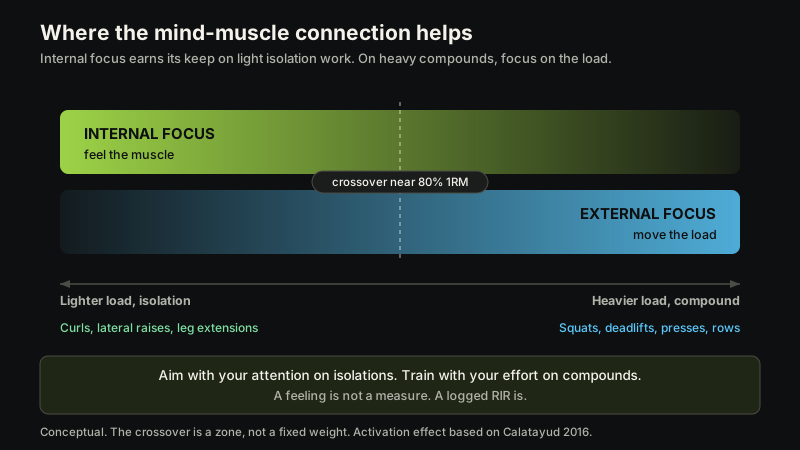
That gives a clean rule of thumb by context:
| Context | Better focus | Why |
|---|---|---|
| Light or moderate isolation work (curls, lateral raises, leg extensions) | Internal ("feel the target muscle") | Spare capacity exists to bias the work toward the muscle you want |
| Heavy compounds (squat, deadlift, bench, row) | External ("move the load, own the position") | You want maximal force and safe mechanics, not a distracted lift |
| Training for strength or a one-rep max | External | Force output and skill at the movement are the goal |
| A muscle a compound tends to under-hit (rear delts, upper back) | Internal, on an isolation for it | Fixes a distribution problem the compound will not |
This maps onto something lifters already know from how compound and isolation exercises load a muscle. On a big compound, several muscles share the set and stronger ones can quietly take over. On an isolation, the target muscle is mostly on its own, which is exactly where a deliberate internal focus has room to do its work. It is also why an isolation gives you a cleaner effort read: fewer muscles are competing to end the set first.
The goal split matters too. If your session is about adding load to a heavy lift, chasing the feeling can cost you the thing you came for. That tension between training for size and training for force is the whole subject of hypertrophy versus strength training, and attentional focus is one more place the two goals ask for different behavior.
Feeling the muscle is not the same as an effective set
Here is the trap. Because an internal focus produces a strong, obvious sensation, it is easy to treat that sensation as the point. It is not. The connection helps by delivering tension to the target muscle. The growth still comes from the tension, not from the feeling of it.
Muscle growth is driven primarily by mechanical tension: force the muscle produces against resistance, concentrated in the hard reps near failure. A strong mind-muscle connection is one way to make sure that tension lands on the muscle you are trying to train instead of leaking into synergists. That is genuinely useful. But a huge pump, a deep burn, or a vivid squeeze are not measures of tension, and they are not measures of a productive set. You can generate all three with a light weight, high reps, and short rest, and produce very little growth stimulus.
This is the same error as reading soreness as a scoreboard. As covered in why soreness is not a growth signal, a strong sensation tells you a muscle did something unfamiliar or worked hard locally, not that the set moved you forward. Sensation is a cue you can use. It is a terrible metric to train by.
The honest summary: the mind-muscle connection is a way to aim a stimulus, not a way to create one. Aiming matters. It does not replace the stimulus.
How to improve your mind-muscle connection
If you want to sharpen it on the lifts where it helps, a few things reliably work. None of them involve counting seconds or grinding tempos.
- Drop the load and slow down slightly. The connection is strongest at light to moderate loads, so a weight you fully control lets you direct the work. This is a cue tool, not a maxing tool.
- Pause briefly in the hard position and squeeze. A short pause at peak contraction on an isolation forces the target muscle to hold the load rather than bouncing through it.
- Do the isolation first, or pre-exhaust the muscle. A muscle you have already primed is easier to feel on the next movement. Putting the isolation early, when you are fresh, also fits how exercise order changes what a lift delivers.
- Use a light warm-up set to find the feel. One easy set spent locating the muscle before your working sets is worth more than fighting for it under a heavy load.
- Touch the muscle or watch it. A hand on the working muscle or an eye on it in the mirror is a legitimate tactile cue, and it is why single-joint machine work is the easiest place to build the skill.
And the boundary that keeps this from backfiring: use it on isolation and lighter work, and let it go on your heavy compounds. On those, focus on moving the load with clean mechanics and take the set close enough to failure that the last reps are genuinely hard. Effort, not attention, is doing the heavy lifting there.
What to actually measure
The awkward thing about the mind-muscle connection is that the part you can feel is the part you cannot record. There is no field on any logging screen for how connected a set felt, and there should not be, because the feeling does not travel. It is not comparable week to week and it cannot tell you whether to add load.
What you can record are the two numbers that actually proxy for a productive set: how close to failure it was, and how many such sets each muscle got this week. Proximity to failure is best captured as reps in reserve, the buffer you had left at the end of the set. It reflects the recruitment and effort that generate tension far better than a sensation does. Weekly hard sets per muscle counts how often you reached the productive zone. Between them, they turn a training block into something you can audit.
That is a logging problem, and it is the one RIRLift is built around. You set a target RIR per exercise when you build a routine, then log actual load, reps, and RIR for every set while the set is still fresh, so your effort record is a measurement instead of a memory. Those logged efforts roll up into weekly volume by muscle, which answers the question the mind-muscle connection cannot: is this muscle actually getting enough hard work, or does it just feel worked in the moment?
Capturing that only helps if it does not interrupt the set, which is why the whole session runs from your wrist. Load, reps, and RIR pre-fill from last time, so confirming a set is a tap or a turn of the Digital Crown, and the rest timer starts itself. See how a session runs on iPhone and Apple Watch and the pattern is clear. You can keep your attention on the muscle during the set, then record what it actually did in a second, without pulling a phone out to break the very focus you were building.
The mind-muscle connection helps you put the work in the right place. An honest log tells you whether it added up.
The honest verdict
The mind-muscle connection is real, and it earns a spot in your toolkit. Focusing on a target muscle genuinely biases the work toward it, and on light isolation exercises that can mean a little more growth over a block. Use it there. Skip it on your heavy compounds, where an external focus on moving the load produces more force and a safer lift.
What it is not is a driver of growth or a stamp of quality on a set. Feeling a muscle work is a cue that the tension landed where you wanted, not evidence that there was enough of it. The stimulus still comes from taking hard sets close to failure and accumulating a sensible number of them per muscle each week.
So aim with your attention, then train with your effort. Point the tension at the muscle you care about, take the set near enough to failure that the last reps are slow, and write down the two things that actually proxy for a set that counted: how close to failure it was, and how many of those your muscle got this week. The feeling fades by the time you leave the gym. The log is what you get to reason from.