
Blog
Exercise order: why the last exercise pays for the first
Published August 10, 2026 · 12 min read
Two lifters run the same six exercises, the same sets, the same rep ranges, in the same gym, on the same day. One of them ends the year with noticeably better lateral raises. The other ends the year with noticeably better rows. Nothing separates their programs except the order the exercises were written in.
That is a strange result if you believe exercise order is a matter of etiquette. It is an obvious result once you notice what a session actually is: a fixed budget of quality effort, spent in sequence, by a body that gets worse at producing effort as the sequence goes on.
Search for exercise order and you get two confident and incompatible answers. The textbook camp says power first, then compounds, then isolations, large muscles before small. Another camp says the whole question is overblown and order does not matter. Both are describing something real, and neither one tells you what to do on Tuesday.
What is exercise order?
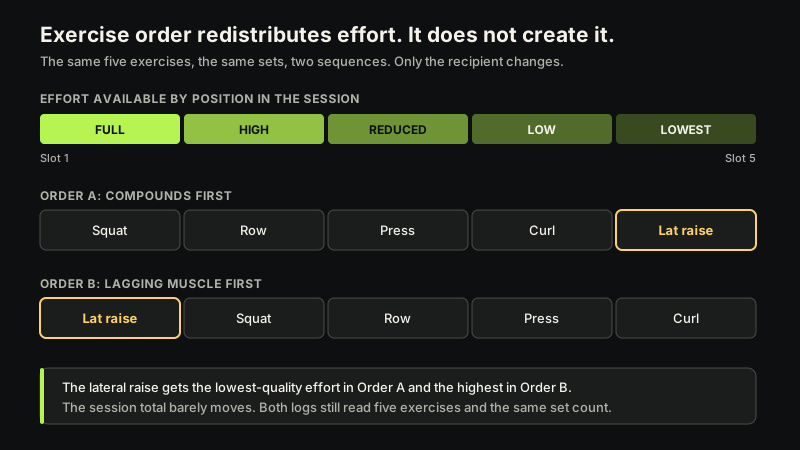
Exercise order is the sequence you perform the movements in during a single training session. It does not change how much total stimulus the session can deliver. It changes how that stimulus is distributed, because every exercise placed later inherits the fatigue of everything before it.
That distinction is the whole topic. Moving squats from first to last does not delete stimulus from your week. It moves stimulus off your quads and onto whatever now goes first. The session is a pie, not a faucet. Order is how you slice it.
Which means "does order matter?" is the wrong question. Order matters enormously for individual exercises and barely at all for the session total. Once you separate those two claims, the two camps on the internet stop contradicting each other.
Does exercise order matter?
Yes, for the exercise. Roughly no, for the workout.
The people who say order does not matter are usually looking at total session volume or overall growth across a whole program, and at that altitude they are close to right. If you do 20 hard sets in a session, you will do something near 20 hard sets whichever way you shuffle them, and across a full body the differences wash out.
The people who say order matters are looking at one exercise at a time, and at that altitude they are clearly right. The lift you do first gets your best available force output, your cleanest technique, and your most reliable effort estimate. The lift you do last gets whatever is left.
Both are true at once because order is a redistribution, not a multiplier. And redistribution is exactly what you should care about, because you do not train "a session". You train specific muscles that you want to grow at specific rates.
What the research actually found
Simão and colleagues ran the cleanest version of this experiment. In a 12-week trial in untrained men, two groups performed the same exercises in exactly opposite sequences, one working from large muscle groups down to small, the other from small up to large. Strength gains tracked position in the sequence rather than the exercise itself: whichever lifts sat early in a group's order improved more for that group. Muscle thickness rose in both groups, and the trial did not separate the orders on that measure over 12 weeks.
Their later review in Sports Medicine collected the acute side of the same effect across studies. The consistent finding is unglamorous and reliable: exercises performed later in a session are completed with fewer reps at a given load, and the deficit grows the further down the list a movement sits. It is not a small effect on the tail end of a long session.
Put the two together and you get a practical rule with an actual mechanism behind it. Position predicts performance. Performance over months predicts adaptation. So position, applied consistently for months, quietly decides which lifts progress.
| What moves when an exercise goes from first to last | Direction | Why it happens |
|---|---|---|
| Reps completed at the same load | Down | Accumulated fatigue from every prior set |
| Load you can use for the same reps | Down | Reduced force output, not reduced motivation |
| Weekly volume credit for that muscle | Roughly unchanged | The sets still happened and still count |
| Quality of each of those sets | Down | Lower load and reps at the same effort |
| Reliability of your RIR estimate | Down | Systemic fatigue reads like local fatigue |
Notice the third row. This is why order effects hide so well. Your weekly training volume for that muscle looks identical whether the exercise ran first or last, because hard sets are counted, not weighed. The log says four sets either way. The stimulus was not the same either way.
The rule everyone quotes: compounds before isolations
"Compounds first, isolations last" is the most repeated piece of advice on this topic, and it is a decent default. Multi-joint lifts carry more load, demand more technique, and lose more when you are tired, so putting them first protects the thing with the most to lose.
But it is a heuristic standing in for the real rule, and the substitution fails in two common cases.
Case one: the compound is not your priority. If your rear delts are the lagging muscle and you open every pull day with heavy rows, your rear delts spend a year eating leftovers. The rule told you to protect the row. Nothing checked whether the row was what you wanted to protect.
Case two: the compound is not a good measuring stick for the muscle you care about. A set of rows ends when your grip, your lower back or your bracing gives out, which may be well before your lats are done. Compound and isolation exercises do not read the same way, and a compound placed first is not automatically a better dose for any specific muscle in it.
The rule that survives both cases is simpler: put first whatever you most want to improve. Compounds usually win that contest, which is why the heuristic works often enough to become folklore. Just make it lose when it should.
Pre-exhaustion: the order trick that does the opposite of what it promises
Pre-exhaustion inverts the standard order deliberately. Do leg extensions to fatigue the quads, then immediately squat or leg press, on the theory that the quads will now be the limiting factor and get a harder dose.
The theory is elegant. The measurement disagrees. When Augustsson and colleagues tested it directly, quadriceps activation during the leg press was lower after pre-exhaustion, not higher, and leg press performance dropped. The body did what bodies do under fatigue: it shifted the work onto the synergists that were still fresh. You fatigued the target muscle and then gave it an exercise it was now less able to contribute to.
This is the clearest available demonstration that order is not a lever for adding stimulus. It is a lever for moving stimulus, and it moves stimulus in directions you did not necessarily intend. The same caution applies to pairing movements back to back in general: a superset changes what the second exercise is measuring even when it saves you time.
If a muscle needs a bigger dose, give it more hard sets or a better exercise. Reordering the session to trick it does not create anything.
Why the last exercise also corrupts your effort read
Here is the part almost nothing on this topic covers, and it is the part that costs lifters the most.
Fatigue does not only reduce what you can do. It changes what "close to failure" feels like. Late in a session, systemic fatigue, elevated breathing and general discomfort all arrive early and all feel like the local sensations you use to judge proximity to failure. A set that stops at what feels like 2 reps in reserve may genuinely have 4 left in the muscle you are trying to train, because what you actually noticed was a whole-body signal.
So the last exercise takes a triple loss. Lower load. Fewer reps. And an effort estimate that is systematically biased toward overstating how hard the set was. The first two show up in the numbers. The third does not, which is what makes it dangerous: your log records a 2 RIR set that was really a 4, and you carry that fiction forward into next week's load selection.
This is the same mechanism behind sets that quietly stop counting late in a workout, and it is the reason the practical ceiling on how many sets a session can hold is lower than the arithmetic suggests. It also explains why a long ramp costs you: burn four working-quality efforts warming up and your first real set already arrives with an exercise's worth of fatigue on it.
The fix is not to stop training when tired. It is to record effort per set, honestly, and expect the number to drift as the session runs. Once RIR is in the log next to weight and reps, the drift becomes visible instead of hypothetical: same weight, same reps, one RIR harder, three exercises later. That is exercise order showing up in your data. Reading it well is what estimating RIR is for.
How to order exercises in a workout
Four decisions, in this order.
1. Choose the priority, then place it first. Not the heaviest lift, not the biggest muscle. The one you most want to be better at in three months. Everything else in this list is downstream of getting that single choice right.
2. Put technically demanding and heavily loaded work early. Once priority is settled, this is where "compounds first" earns its keep. A lift that punishes fatigue with bad reps or genuine risk belongs before a lift that does not.
3. Let exercises that share a muscle group sit together, and accept the tax. Your triceps will be worse after pressing. There is no arrangement that avoids this. What you can control is whether the tax lands on the movement you care about least, which starts one level up, at which muscle groups you pair into a session in the first place.
4. Put the tolerant work last. Machines, cables, and single-joint movements are more forgiving of a tired body, both because they need less coordination and because they still read reasonably well for effort, since nothing fails before the target muscle. Ending on them is a feature.
| If the session is for | Open with | Close with |
|---|---|---|
| A lagging muscle | Direct work for that muscle, even if it is an isolation | The compounds that would otherwise have gone first |
| General hypertrophy across a day | The heaviest compound for the largest muscle in the session | Arms, rear delts, calves, single-joint work |
| Strength on a specific lift | That lift, warmed up but not pre-fatigued | Accessory work in any order |
| A crowded upper day | The muscle with the fewest weekly sets elsewhere | Whatever gets direct work on another day too |
That last row is the one people get wrong most often, and it compounds across a week. When an upper day starts running out of room, the muscles at the end of the list lose the same amount every single session, which is a structural deficit rather than a bad day.
Rotate the last slot
The tail of your session is not evenly bad. It is reliably bad for whichever muscle keeps landing there.
So rotate it. Every few weeks, move the exercise that has been closing the session to the front, and let something else take the tail. You are not chasing novelty and you are not confusing the muscle. You are refusing to let one movement absorb the accumulated fatigue cost of every session in a block.
Two practical notes. Rotate at block boundaries rather than session to session, so you can still compare like with like when you look at whether a lift progressed. And when you do rotate, expect the newly promoted exercise to jump: it will look like a sudden strength gain and it is mostly a change in the conditions it was tested under.
Planning the sequence is a desk job, and running it is not. Building the session on iPhone and executing it from the watch is the version that survives a real training week: the RIR for the last exercise gets recorded while the set is still in your hands rather than reconstructed from memory two hours later, which is precisely when the drift would have been invisible.
Order is an allocation decision
Exercise order is not a rule to obey and it is not a myth to dismiss. It is a budget.
Every session contains a finite amount of high-quality effort. The sequence you write decides which muscles get paid first and which ones get what is left. Both of the loud answers online are describing one half of that: the session total really does barely move, and the individual exercises really do move a lot.
So stop asking whether order matters and start asking who you are spending the good part of the session on. Put your priority first on purpose. Rotate what sits last so the cost circulates. And log effort per set, because the deficit at the end of a workout is invisible in weight and reps and obvious the moment RIR is written down next to them.
The exercises at the top of your list are the ones that will be better in six months. Choose them like you mean it.