Blog
Muscle confusion: why it is a myth, and what variation actually does
Published November 21, 2026 · 12 min read

Scan with your phone camera
You have been doing the same program for six weeks. The weights are going up, slowly, and the workouts feel familiar. Then someone tells you the problem: your body has adapted, your muscles know what is coming, and you need to confuse them. New exercises every session, new rep schemes, never the same workout twice.
It sounds like sports science. It is closer to marketing. Muscle confusion is the idea that muscles stop growing once they "figure out" a routine, so you have to keep surprising them. Muscles do not figure anything out. They respond to load, effort and volume, and they keep responding for as long as those keep rising.
But the myth survives because it is wrapped around something true. Variation does matter, sometimes. This post separates the two: what the research on exercise variation actually found, why constant change tends to slow you down, and how to vary your training in a way that adds to your progress instead of erasing the record of it.
What is muscle confusion?
Muscle confusion is a training philosophy that says you should change your exercises, rep ranges or workout structure frequently, often every session or every week, so your muscles never adapt and "plateau". The term was popularised by home-workout programs in the 2000s, P90X being the best known, and it is still a staple of fitness marketing because "your body is used to it" is an easy explanation for any stall.
The claim has two parts, and only one of them holds up:
- Adaptation is real. Your body adapts to whatever stress you give it. If the stress stops rising, the adaptation stops too.
- Surprise is not the fix. What restarts adaptation is more stress (more load, more reps at the same effort, more hard sets), not different stress for its own sake. A new exercise feels harder because you are bad at it, not because it is a better stimulus.
That is the whole argument in one line: the cure for adaptation is progressive overload, and muscle confusion mostly gets in its way.
Why muscle confusion feels like it works
People who try it usually report that it works, at least for a while. There are three honest reasons for that, and none of them are confusion.
You get sore again. A new movement, especially one with a hard lowering phase, brings back the deep soreness you stopped feeling on your regular lifts. It feels like proof the session counted. It is not: soreness tracks novelty, not growth, and it fades with repeated exposure while the muscle keeps growing. The long version is in does soreness mean muscle growth?.
You are a beginner. In the first months of lifting almost any program produces gains, varied or not. If muscle confusion is your first structured training, it gets credit that belongs to newbie gains.
You feel more motivated. This one is real and measurable, and it comes up in the research below. Novelty makes training more interesting. Interest makes you show up. Showing up builds muscle. The confusion is not doing the work; the attendance is.
What the research on exercise variation actually shows
There is a small but useful body of studies that compare fixed exercise selection against varied selection. They do not support muscle confusion as marketed, but they do not say "never change anything" either.
Planned variation can help regional growth. In a 12-week study, Fonseca and colleagues split participants into groups that kept the same exercise (the squat) or rotated through squat, leg press, deadlift and lunges on a planned schedule, with constant or varied intensity. Whole-quadriceps growth was similar across the training groups, roughly 9 to 12%. The difference was where it showed up: the varied-exercise groups grew in all four quadriceps heads, while the squat-only constant-intensity group did not show significant growth in the vastus medialis and rectus femoris. The constant-intensity, varied-exercise group also gained the most squat strength. Variation here was a fixed, deliberate rotation, not random change.
Random daily variation matched fixed training for growth. Baz-Valle and colleagues had trained men run 8 weeks of either a fixed program or one where an app randomly changed the exercises each session. Strength and quadriceps thickness improved similarly in both groups. The varied group reported a moderate improvement in intrinsic motivation; the fixed group's motivation dipped slightly. So random variation did not produce better muscle, but it did not ruin it over 8 weeks either, and people enjoyed it more.
A systematic review drew the line clearly. Kassiano and colleagues reviewed eight studies (241 young men) and concluded that some systematic variation seems to improve regional hypertrophy and strength, while excessive, random rotation, or swapping between exercises that give a redundant stimulus, may actually hinder gains.
| Approach | What changes | Effect on muscle | Effect on tracking progress |
|---|---|---|---|
| Fixed program | Nothing, except load and reps | Good, may underdevelop some regions of a muscle | Easy: every week is comparable to the last |
| Planned variation | A few exercises, on a schedule (every block) | Equal or better, more complete regional growth | Easy within a block, deliberate reset between blocks |
| Random variation (muscle confusion) | Exercises and rep schemes every session | Similar at best over short studies, may hinder with excessive rotation | Hard: almost nothing repeats often enough to compare |
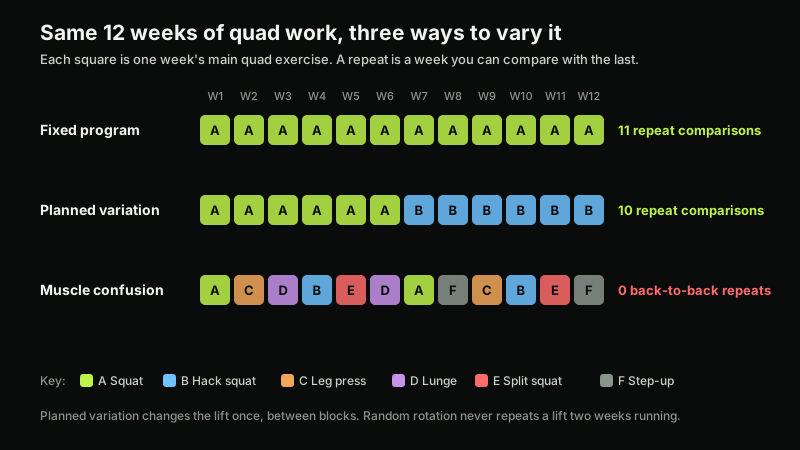
The pattern is consistent. The question was never "variation or no variation". It is how often, and on purpose or at random.
The real cost of constant change: you cannot see progress
The studies above measure muscle thickness with ultrasound. You do not have an ultrasound. What you have is your training log, and that is where muscle confusion does its real damage.
Progressive overload is a comparison. To know whether you are progressing, you need to compare this week's set with last week's set on the same exercise: same movement, similar reps, similar effort. Did the load go up? Did you get one more rep at the same reps in reserve? If yes, the muscle is being asked for more, and over months that is what growth looks like.
Change the exercise every session and that comparison disappears. A 60 kg Bulgarian split squat on Tuesday tells you nothing about a 140 kg leg press on Friday. You might be progressing, stalling or regressing, and you have no way to tell. Each session is a first attempt, so each session is mostly spent learning the movement instead of pushing it.
There is also a skill cost. Strength on a lift is partly technique and coordination, and that improves with repetition. A lifter who repeats the same squat for twelve weeks gets better at squatting, which lets them load the muscle harder. A lifter who rotates constantly never gets far enough up the learning curve on any one movement to load it hard.
This is the point where a log earns its keep. When the same lift comes back every week, the record of your last sets tells you what to do next. RIRLift does this per set: it suggests the next weight from the load, reps and RIR of your last set, which only works when there is a last set on the same exercise to read.
How to use variation without the confusion
The research points to a simple rule: keep the core lifts stable long enough to progress them, and change things on a schedule, for a reason.
- Keep your main lifts for a whole block. Pick one or two primary movements per muscle group and keep them for at least 4 to 8 weeks, the length of a typical mesocycle. Progress them with a clear rule such as double progression: work up the rep range at a fixed load, then add weight.
- Vary the accessories with intent. If a muscle has regions a single exercise misses, cover them with a second movement that trains it differently, for example a lengthened-position exercise alongside a shortened one. That is the systematic variation the review describes. Swapping a cable fly for a pec deck is not; that is a redundant stimulus.
- Change exercises between blocks, not between sessions. At the end of a block, or after a deload week, it is a sensible time to rotate an accessory or try a variation of a main lift. The new exercise then gets its own full block to progress.
- Change for a reason you can name. Joint discomfort, a genuine stall, a muscle that is lagging, equipment you no longer have, or simple boredom that is costing you sessions. "My muscles are used to it" is not on the list.
- Treat a stall as a programming problem first. If a lift has not moved in three or four weeks, check effort, volume, recovery and load progression before you blame the exercise. How to break a lifting plateau walks through that order.
A practical template:
| Exercise role | How long to keep it | When to change it |
|---|---|---|
| Main compound lift (squat, bench, row, deadlift) | Several blocks, often months | Pain, a long stall, or a new goal |
| Secondary compound (leg press, incline press, pulldown) | One block (4 to 8 weeks) | Between blocks, to cover a different angle |
| Isolation and accessory work | One block | Between blocks, or to target a lagging region |
| Rep ranges and intensity | Planned across the block | On the schedule the block sets, not by mood |
When switching exercises mid-session is fine
Sometimes the change is not a choice. The rack is taken, the cable station is broken, the gym does not have the machine your program calls for. Swapping in a similar exercise for one session is not muscle confusion; it is just training in a real gym.
What matters is that the swap keeps the intent of the original: the same muscle, a similar rep range, the same target effort. Then the session still counts toward the week, and next week you go back to the original lift and your comparison is intact. If you log the swap as what it was, your history stays honest. In RIRLift, swapping an exercise mid-session starts you from the weight of the lift you swapped out, so a busy gym does not reset the session to guesswork.
How to tell if your program needs variation
Most of the time, the answer is no. Your program needs more consistent progression. Here is a quick check before you change anything:
- Is the lift still moving? If load or reps at the same effort went up in the last few weeks, the exercise is working. Keep it.
- Is effort high enough? Sets that end four or five reps short of failure are easy to repeat forever without progress. Most hypertrophy work should end around 1 to 3 reps in reserve.
- Is volume adequate and recovered? Too few hard sets per muscle per week, or too many to recover from, both stall progress regardless of exercise choice.
- Is something hurting? Persistent joint pain on a movement is a good reason to swap it for a variation that loads the muscle without the irritation.
- Are you skipping sessions out of boredom? If yes, some planned variety is worth the small cost in comparability. Consistency beats optimisation.
The verdict on muscle confusion
Muscle confusion is a myth in the form it is sold: muscles do not need to be surprised, and changing everything constantly does not produce better growth. Over short studies it does about as well as a fixed program for muscle size, while making progress almost impossible to track and wasting sessions on learning new movements.
Variation itself is not the enemy. A small amount of planned, systematic change, mostly in accessories and mostly between blocks, can build a more complete muscle and keep training interesting. The difference is that planned variation keeps a stable core you can progress, while muscle confusion throws away the comparison that progressive overload depends on.
Keep the lifts long enough to beat your last set, change them on purpose, and let the log tell you when something has actually stopped working.
Frequently asked questions about muscle confusion
Is muscle confusion real?
No, not as a mechanism. Muscles cannot be confused; they adapt to the load and effort you give them. What is real is that adaptation slows when the stimulus stops increasing, and the fix for that is progressive overload, not constant novelty.
Should I change my workout every week?
Not the main lifts. Changing exercises every week makes it hard to progress any of them and hard to see whether you are progressing at all. Keep core lifts for at least a 4 to 8 week block, and rotate accessories between blocks if you want variety.
How often should you change exercises for hypertrophy?
For most lifters, every 4 to 8 weeks for accessories, and much less often for main compound lifts. Research on exercise variation suggests planned rotation can improve regional muscle growth, while excessive random rotation may hinder gains.
Why do I get sore when I change my workout?
Soreness comes mostly from unaccustomed work, especially new movements with a hard lowering phase. It fades as you repeat the exercise, even while the muscle keeps growing, so new soreness is a sign of novelty, not of a better workout.
Did P90X muscle confusion work?
When it worked, the likely reasons are the ordinary ones: it was a structured, demanding schedule, and anyone who followed it was training hard and regularly, often for the first time. None of the studies on exercise variation show the variety itself adding growth beyond that.