
Blog
Newbie gains: how to tell when yours have actually ended
Published August 9, 2026 · 13 min read
Nobody notices the last week of their newbie gains. There is no failed session, no injury, no obvious cliff. You just add the same five pounds you have added every week for eight months, and this time the reps do not come. You assume it was a bad night. The next session goes the same way.
Two months later you are still running the program that stopped working in March, and the conclusion you have quietly reached is that you wasted the good phase.
You almost certainly did not. What ended was not your ability to build muscle. It was the validity of the progression scheme you were using to measure it, and those are very different problems with very different fixes.
What are newbie gains?
Newbie gains are the unusually fast strength and size improvements an untrained lifter makes in roughly the first six to twelve months of consistent resistance training, before the rate of progress settles into the much slower pattern that holds for the rest of a training career. The phrase describes a rate, not a mechanism.
That distinction matters more than it sounds, because the rate is driven by three separate things that end on three separate schedules. Most articles treat newbie gains as one phenomenon that switches off. It is closer to three overlapping curves, and understanding which one flattened tells you what to do next.
Are newbie gains real, and why do newbie gains happen?
They are real, and they are also partly an illusion. Both statements hold at once.
Strength comes first, and early on it is mostly neural. Del Vecchio and colleagues tracked motor unit behaviour across four weeks of strength training and found the force increase was mediated by changes in motor unit recruitment and rate coding rather than by changes in the muscle itself. Your nervous system gets better at using the muscle you already have. That adaptation is fast, it is large, and it is nearly exhausted within a few months.
Early size change is partly swelling. Damas and colleagues measured vastus lateralis cross-sectional area in untrained men at baseline, at three weeks, and at the end of a ten-week program. Cross-sectional area was up about 2.7% by week three, but the authors concluded that early increases in untrained individuals are not purely hypertrophy, because edema-induced swelling from muscle damage is riding along with it. Their recommendation was that early cross-sectional area increases should not be called hypertrophy without measuring edema alongside them.
Actual hypertrophy is the slow curve underneath. It starts modest, it becomes the dominant contributor once the neural and swelling effects settle, and it never gets dramatically faster than it is at month four.
So the beginner's experience is a fast strength curve plus a temporarily inflated size curve sitting on top of an ordinary muscle curve. When the two fast curves flatten, the drop feels like a collapse. Underneath, the muscle curve is doing roughly what it was always going to do.
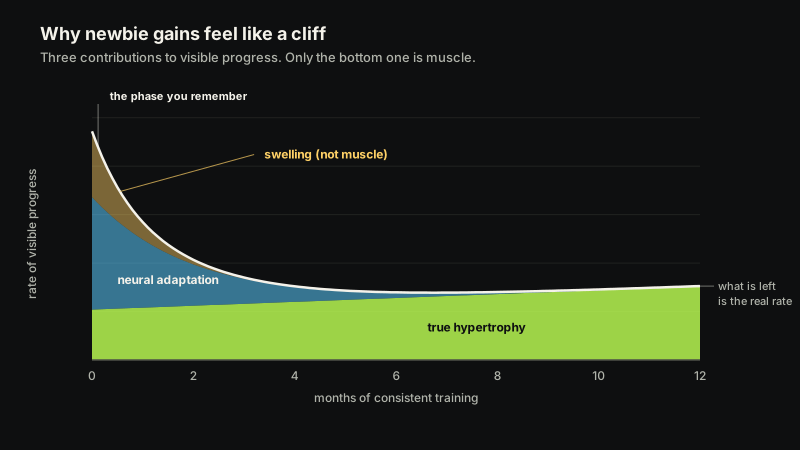
This is why the phase feels like it ends abruptly when the underlying process did not change abruptly at all.
How long do newbie gains last?
The honest answer is that the calendar is the weakest predictor available, and every page that leads with "six to twelve months" is answering an easier question than the one you asked.
Training age is a decent rough guide, so here is the rough guide.
| Training age | What is still fast | What has already flattened | Typical experience |
|---|---|---|---|
| Weeks 0 to 6 | Neural adaptation, early swelling | Nothing yet | Load jumps almost every session |
| Months 2 to 6 | Neural adaptation slowing, hypertrophy building | Swelling contribution | Load still moves weekly, soreness fades |
| Months 6 to 12 | Hypertrophy only | Neural adaptation largely spent | Weekly load jumps become fortnightly, then stop |
| Year 1 onward | Hypertrophy only, at its normal rate | Everything else | Progress is measured over blocks, not sessions |
The spread around those bands is enormous, and it is driven by things the calendar cannot see. Someone training three well-programmed sessions a week with adequate food and sleep exhausts the beginner phase far sooner than someone training inconsistently for two years. Training age counted in months is really a proxy for accumulated quality sessions, and it is a poor one.
Which is why the useful question is not how long newbie gains last. It is how you detect that yours have ended.
When do newbie gains stop? The signal is in your log
Here is the rule that actually works.
Your newbie gains have ended when you can no longer add load or reps from one session to the next while holding the same proximity to failure. Not when the sessions get hard. Not when you stop being sore. When session-to-session progression stops being repeatable at a constant effort.
Every word in that sentence is doing work, and the last clause is the one people drop.
A beginner can add load every session because their true capacity is rising faster than the increment. The bar goes up five pounds, and their actual strength went up more than five pounds' worth, so the set still feels the same. That is what progressive overload looks like when the underlying adaptation is outrunning your loading increments.
The phase ends when capacity starts rising slower than the smallest increment you can add. At that point you can still add weight. The set just gets harder every time you do it. Load keeps climbing on paper while effort climbs with it, and eventually you miss reps and call it a stall.
That is the trap. Load alone cannot tell you the difference between getting stronger and just working harder. A log with only weight and reps in it shows a smooth line right up until the day it breaks, because the thing that was degrading, your buffer to failure, was never recorded.
Log an effort estimate per set and the transition becomes visible weeks before it bites. It looks like this:
| Week | Working set | Effort logged | What it means |
|---|---|---|---|
| 1 | 135 x 8 | 3 RIR | Capacity ahead of the increment |
| 3 | 145 x 8 | 3 RIR | Still ahead. Newbie gains intact |
| 5 | 155 x 8 | 2 RIR | Increment starting to outrun capacity |
| 7 | 160 x 8 | 1 RIR | Same load progression, higher cost |
| 9 | 165 x 7 | 0 RIR | The "sudden" stall, four weeks after it began |
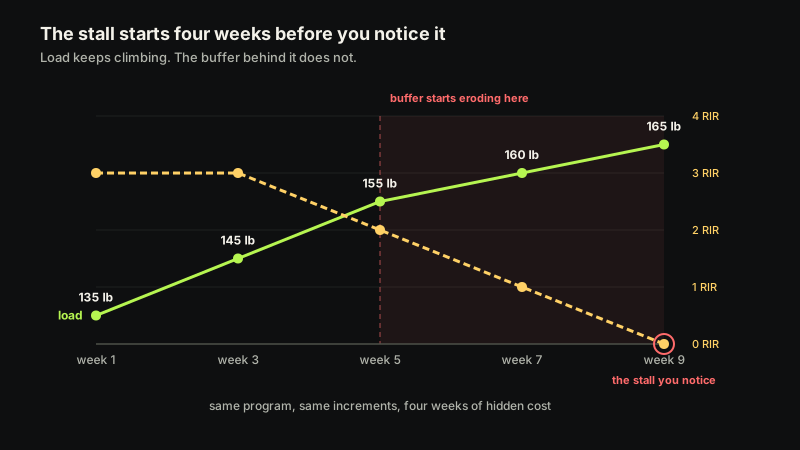
Nothing sudden happened at week nine. The buffer had been eroding since week five, and a log that recorded only load and reps would have shown four weeks of clean progress followed by an inexplicable wall. If you are new to estimating that buffer, our reps in reserve guide covers how to read it and how wrong beginners tend to be at first.
Two other signals get misread as the end of newbie gains, and neither one is.
Soreness fading is not the phase ending. Soreness fades because the repeated bout effect makes a familiar movement less damaging, which is also why the swelling contribution disappears early. It tracks novelty, not stimulus. We wrote about why soreness is a novelty detector rather than a progress signal, and beginners are the group most likely to read its absence as failure.
A stall under accumulated fatigue is not the phase ending either. Several hard weeks in a row will flatten your numbers regardless of training age. If the numbers recover after a planned drop in volume and effort, you were fatigued, not graduated. If they come back and immediately stall again at the same place, the phase is genuinely over.
What to change the day it ends
The mistake is not that people fail to notice. It is that they respond by changing the wrong variable. The usual reaction is to change exercises, add a fourth training day, or buy a more advanced-looking program. None of those addresses what actually broke.
What broke is that session-to-session linear progression is no longer a valid measurement instrument. Replace it, and keep almost everything else.
Switch to progression across weeks instead of sessions. Work inside a rep range and earn the load increase rather than scheduling it. Hit the top of the range at your target effort across all your sets, then add weight and drop back to the bottom of the range. This is the double progression method, and it is the standard tool for exactly this transition because it lets reps absorb the progress that load can no longer show. If you would rather start from a finished template than retrofit the routine you already have, here is a progressive overload workout plan built around that trigger.
Start counting weekly hard sets per muscle. As a beginner this genuinely did not matter, which is why so many bad beginner programs work. Once the easy adaptation is spent, total weekly volume becomes the main lever you control. Schoenfeld, Ogborn and Krieger's meta-analysis found a graded dose-response relationship across 15 studies, with each additional weekly set associated with roughly a 0.37% greater gain in muscle. That number is a population-level average from a 2017 dataset rather than a promise about your quads, but the direction is well supported and it is the lever that replaces the one you lost. Our training volume guide covers where to set those weekly targets.
Make effort the controlled variable rather than the accidental one. As a beginner, effort drifted all over the place and you still grew. After the transition, the sets have to actually get close enough to failure to count. Most guidance puts working sets in the one to three reps in reserve band, and where you sit in that band relative to true failure becomes a decision you make rather than something that happens to you.
Here is the whole shift in one table.
| Beginner phase | After the transition | |
|---|---|---|
| Progression unit | Session to session | Week to week, inside a rep range |
| Main lever | Adding load | Weekly hard sets per muscle |
| Effort | Whatever happened | Controlled, one to three RIR on working sets |
| What limits growth | Almost nothing | Volume, recovery, and effort quality |
| How you know it worked | Load went up | Load went up at the same or lower effort |
| Useful timescale | Days | Blocks of four to six weeks |
Notice what is not on that list. Exercise selection barely changes. Training frequency barely changes. The split you were running is probably still fine. What changes is how you measure progress and which variable you push, which is why a new program so rarely fixes this and a new measurement almost always does.
Can you waste your newbie gains?
Partly, and less than the phrase implies.
You can waste them in the ordinary ways: training inconsistently, never getting close enough to failure for the sets to count, eating far too little to support tissue growth, or running so little volume that the stimulus never arrives. Someone who trains twice a month for a year does not bank a year of newbie gains, and the elevated-response window does not politely wait for them.
What you cannot do is use them up by choosing a suboptimal program. The beginner phase is forgiving by definition. Nearly any structure that has you training a few times a week, close enough to failure, with load going up over time, captures most of what is available. The people worrying about wasting their newbie gains on the wrong split are almost always capturing them fine.
The far more common waste is at the other end, and nobody calls it that: spending six months running a beginner progression scheme after it stopped working, mistaking that for a plateau in your body rather than a plateau in your method.
Do you get newbie gains again after a long break?
You get something that looks like them, and it is a different thing.
Coming back after a layoff, previously trained lifters regain lost size and strength considerably faster than they built it originally. The neural adaptations return quickly, and the tissue you already built comes back on a shorter timeline than it took to make. That is a regain curve, and it feels like the beginner phase because the numbers move weekly again.
It ends when you reach your previous best, and it does not carry past it. The moment you are back at your old numbers, you are exactly where you left off: an intermediate lifter, progressing at the slow rate, needing the same double progression and the same weekly volume accounting you needed before the break. Treat the return as a regain rather than a second beginner phase and you will not be surprised when it stops.
Count what actually changed
Newbie gains are real, mostly not what they look like while they are happening, and impossible to date from a calendar. The first months hand you a fast strength curve that is largely neural and a size curve that is partly water, sitting on top of the ordinary muscle curve that will still be there in year five. If you are trying to work out how much of that early weight is actually muscle, the scale will not tell you; your strength trend and a tape measure will.
The phase ends quietly, which is the entire problem. There is no signal in a log that records only load and reps, because the variable that decays first is the one such a log never captured. By the time weight on the bar stops moving, the buffer behind it has been shrinking for a month.
Two numbers settle it. Whether the load on your working sets is still climbing, and whether your effort at that load is holding steady or creeping up to pay for it.
RIRLift records load, reps and RIR per set as the session runs, so the second number exists at all. Estimated one-rep max per exercise moves with real capacity rather than with how hard you were willing to grind, which is what separates a lifter who is still progressing from one who is just working harder for the same result. Weekly hard sets per muscle total automatically, which is the lever that matters the day the easy phase closes. You can see how a session runs on iPhone and Apple Watch if you want the whole workflow.
Your newbie gains were never going to last. The measurement you replace them with is what decides whether the next four years look like progress or like a plateau.