
Blog
Tempo Training: How to Read, Choose and Track Lifting Tempo
Published November 6, 2026 · 14 min read
Tempo training means deciding, in seconds, how fast you lower, pause and lift on every repetition, and it is written as a four-digit code such as 3-1-2-0. For most lifters the useful starting point is a controlled 2 to 4 second lowering phase and a fast, intentional lift, then adjusting the numbers to your goal, your exercise and how close to failure you train.
This guide is about tempo in the weight room, not tempo runs. It covers how to read the notation, what the research supports, which tempos suit hypertrophy, strength and power, and how to change your load and log your sets when you start slowing reps down.
TL;DR
- A tempo code has four numbers: seconds lowering, seconds paused at the bottom, seconds lifting, seconds paused at the top. An X means lift as fast as you can with good mechanics.
- For muscle growth, research reviews find neither slow nor fast tempos win alone. The best-supported pairing is a slower lowering phase with a faster lifting phase.
- Slower tempos need lighter loads, so expect your weights to drop when you add a 3 to 5 second eccentric.
- Training close to failure matters more than the exact number. Reps in reserve (RIR) tells you whether a tempo set was hard enough.
- Log the tempo next to the weight, reps and RIR, so you can compare like with like from week to week.
Table of Contents
- What tempo training actually is
- How to read lifting tempo notation
- Why tempo works, and where it does not
- Choosing a tempo by goal
- Tempo by experience level and situation
- Adjusting load, reps and progression with tempo
- Using RIR to keep tempo sets honest
- Common tempo mistakes
- Perspective
- Put your tempo work on the record
- FAQ
- Sources
What tempo training actually is
Every repetition has phases: you lower the weight (the eccentric phase), you may pause, you lift it (the concentric phase), and you may pause again at the top. Tempo training means deliberately controlling the speed of each phase to target a particular adaptation, such as hypertrophy, strength or power. Instead of telling yourself to go slow and controlled, which means different things to different people, you write the number down.
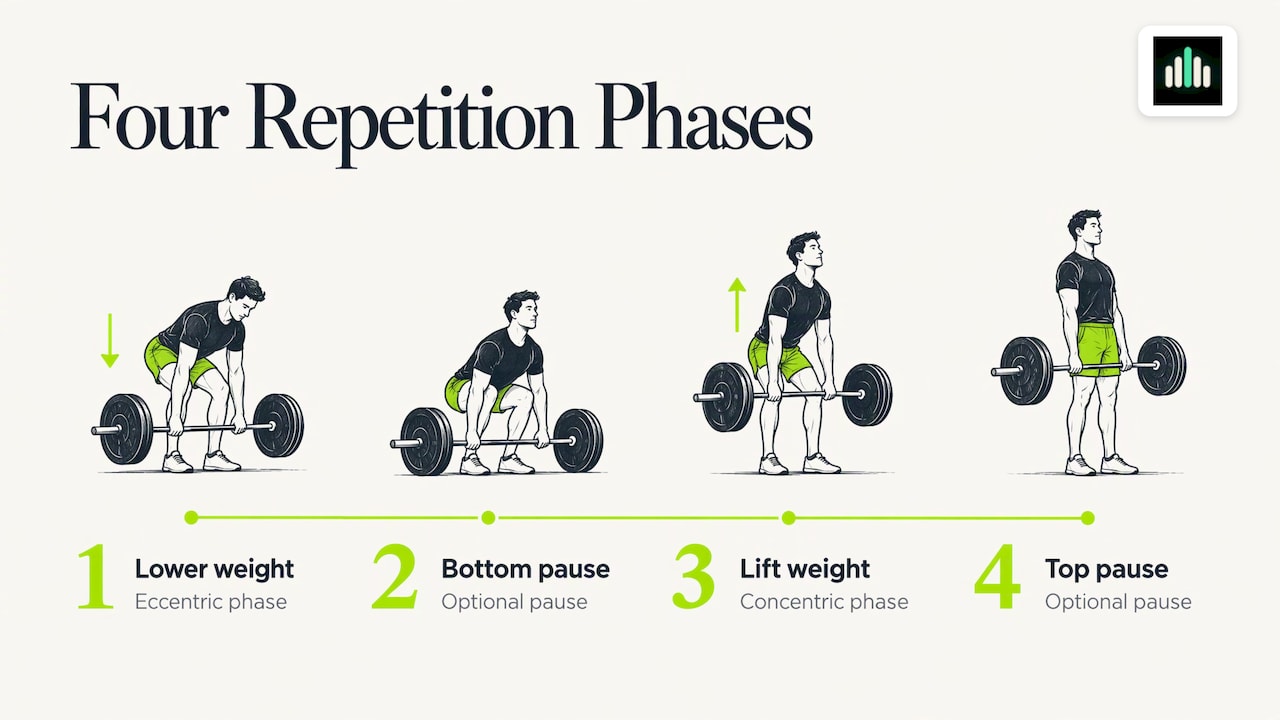
That precision is the real value. Two lifters can both think they are lifting under control while one lowers for one second and the other for four. The notation removes the guesswork, makes a session repeatable, and gives you a variable you can change on purpose when load increases are not practical.
How to read lifting tempo notation
The most common format is a four-digit code. Each digit is a number of seconds, and the order is fixed:
| Position | Phase | Example in a squat |
|---|---|---|
| 1st digit | Lowering (eccentric) | Descending into the hole |
| 2nd digit | Pause at the bottom | Holding in the lowest position |
| 3rd digit | Lifting (concentric) | Standing up |
| 4th digit | Pause at the top | Standing tall before the next rep |
Take 3-1-2-0 on a squat: three seconds down, a one-second pause at the bottom, two seconds to stand, and no pause at the top, according to NASM's tempo guide.
What the X means
An X in the third position means lift explosively: move the weight as fast as you can while keeping good mechanics. It is not zero seconds. GQ's explainer describes 31X1 the same way: three seconds down, a one-second pause at the bottom, an explosive drive up, then a one-second pause at the top before the next rep.
A quick reading checklist
- Read the digits in order: down, pause, up, pause.
- Treat the written order as a list of phases. For a deadlift, the first action is actually the lift off the floor, so check which phase starts the rep.
- A zero means no deliberate pause, not a bounce. Keep the reversal smooth and controlled.
- When no tempo is written, a common rule of thumb is a fast lift, little or no pause, and about two seconds lowering, as one notation guide for programs puts it.
Why tempo works, and where it does not
Time under tension and the eccentric phase
Slowing a rep increases the time the muscle works. BarBend's example compares six reps at about five seconds each (30 seconds of tension) with ten reps at two seconds each (20 seconds). The eccentric phase is where muscle produces the most force: NASM notes that muscle can handle roughly 20 to 40 percent more load while lengthening than while shortening, and that a 3 to 5 second eccentric increases mechanical tension and connective tissue loading. If you want the deeper mechanism, our pieces on time under tension and mechanical tension go further.
What the reviews conclude for hypertrophy
A 2021 review by Wilk, Zajac and Tufano in PMC found that neither isolated slow nor fast tempos are more effective for muscle hypertrophy, but that the most favorable combination is a slower eccentric with a faster concentric. The same review points out that slower tempos require a lower external load, yet combined with greater time under tension they can still provide an adequate stimulus for hypertrophy and strength.
The ACSM Health & Fitness Journal's 2023 guide gives a practical range: for hypertrophy, a single rep can effectively last anywhere from 0.5 to 8 seconds, provided you train close to momentary muscular failure. In other words, tempo is a tool for making a set honest, not a replacement for effort.
The trade-offs to plan around
Suchomel and colleagues note that slowing the eccentric may reduce concentric force, velocity and power output, and may limit the contribution of the stretch-shortening cycle. They also report greater perceived effort and lactate accumulation with slower eccentrics, so slow-tempo blocks fit best at certain points in the training year rather than all year. For athletes, that means you schedule tempo work in a building phase and move to faster, more explosive reps closer to competition.
Choosing a tempo by goal
The table below pulls together the prescriptions in the sources above. Treat them as starting points, then adjust to how the sets feel.
| Goal | Example tempo | Typical use | Source |
|---|---|---|---|
| Hypertrophy | 3-1-2-0 squat, 4-0-2-0 dumbbell press, 3-1-2-0 Romanian deadlift | Moderate loads, sets taken close to failure | NASM |
| Strength | 2-1-X-0 or 31X1 | Heavier loads, fewer reps | NASM, GQ |
| Power | 2 second eccentric, then X | Maximal-speed lifting phase | ACSM |
| Muscular endurance | 53X1 | About five reps at no more than 50% of your one-rep max, three sets | GQ |
| Breaking a plateau | 5-0-1-0 or 3-3-1-0 | Short-term variation | NASM |
For strength, GQ suggests starting with three reps at 31X1 around 75% of your one-rep max for three sets. If you do not know your max, our rep max calculator estimates it from a single hard set. For a fuller picture of how the two goals differ, see hypertrophy vs strength training.
A default for most lifters
If you want one tempo to use without thinking, ACE's April 2025 article describes a commonly recommended six seconds per repetition: one to three seconds lifting and two to four seconds lowering, while noting that other controlled tempos from two to eight seconds can be equally effective. That is wide enough to cover most of the lifts you will do.
Tempo by experience level and situation
New lifters
ACE's Pete McCall recommends that a new client use a slow-to-moderate tempo from 3:1:2 to 4:2:3 to recruit motor units, starting with one to two sets per exercise. Once initial strength gains arrive, he suggests speeding up to 2:1:1 or 1:1:1. He also warns that long eccentric phases can contribute to delayed onset muscle soreness, so beginners should build up gradually rather than starting every exercise with a 5 second descent.
Older adults and people with heart conditions
The ACSM guide reports that for older adults, 3/3 and 3/X second tempos can improve strength, power and physical function, with 3/X the most effective. For people in cardiac rehabilitation or with cardiovascular disease, the same guide advises keeping time under tension short, using faster tempos such as 1/1 rather than 2/2 seconds. If you have a heart condition, ask your cardiologist or rehab team before changing how you lift.
Lifters stuck on load
When adding weight is no longer practical, for example because of a cranky joint, a slower eccentric or a bottom pause can keep the stimulus rising. The key is to change one variable at a time so you can tell what worked.
Adjusting load, reps and progression with tempo
The biggest surprise for most lifters is how much lighter the bar gets. A set of 8 at a 4 second eccentric will not match the weight you used at a casual one-second drop. Plan for it.
The 2020 JSCR mini-review suggests that coaches test maximal strength and maximum reps at each tempo they plan to use, otherwise programming different tempos becomes trial and error. Few of us have time to test every combination, so a practical version is:
- Pick the tempo and a target rep range, say 8 to 10.
- Start lighter than your usual load, around 10 to 20 percent lighter on the first session. This is a practical starting point, not a research figure.
- Take each set to a fixed effort, for example 2 reps in reserve, and note how many reps you got.
- Next session, if you beat the top of the range at the same tempo and effort, add weight. If not, repeat.
The same review notes that a fast but controlled eccentric of about 2 seconds supports time-efficient sessions, while lengthening the eccentric and cutting reps at the same time will not stretch the session unduly. If your workouts are running long, trade a rep or two for a slower lowering phase rather than adding sets, and keep an eye on rest between sets.
A 12-week tempo block
NASM outlines a simple structure you can borrow:
| Weeks | Tempo | Purpose |
|---|---|---|
| 1 to 4 | 2-0-2-0 | Standard tempo to set a baseline |
| 5 to 8 | 4-0-2-0 at reduced load | Extended eccentric for tension and control |
| 9 to 12 | 2-1-X-0 | Explosive lifting phase for rate of force development |
The block structure works because each phase has one clear job, and the load gets re-established after each change.
Using RIR to keep tempo sets honest
Slow reps feel hard even when you are far from failure, because lactate and perceived effort rise with slower eccentrics. That makes feel a poor judge. Reps in reserve gives you a calmer check: after each set, estimate how many more clean reps you could have done at that same tempo. If you finish a 3-1-2-0 set and honestly had five left, the set was probably too light or too short to count as a hard one. Our RIR calculator can help you calibrate that estimate.
This fits the ACSM point that proximity to failure is the key to hypertrophy at any tempo. Aim for roughly 1 to 3 reps in reserve on most working sets, and stop a set when the tempo breaks down, not just when the rep count is reached.
Common tempo mistakes
- Counting too fast. Count in your head, "one-Mississippi" style, or use a metronome or timer. A three-second lowering is longer than it feels.
- Keeping your usual weight. If the eccentric slows and the load does not drop, form breaks and reps shrink.
- Slowing everything. Keep your heaviest strength work and power work fast on the lifting phase.
- Bouncing out of the bottom. A zero in the second digit means no hold, not a rebound off your joints or the floor.
- Changing three things at once. Change tempo or load or reps in a given week, then compare.
Perspective
Most of the tempo advice you will find stops at the code. The code is the easy part. The hard part is the week-to-week bookkeeping: you lower your load to fit a 4-0-2-0 eccentric, you take a set to 2 reps in reserve, and three weeks later you cannot remember whether the 10 pounds you added was at the old tempo or the new one.
That is why we built RIRLift around logging every set with weight, reps and RIR, and why our AI Coach reads that log to recommend your next load. Tempo changes what a given weight means. Coach works from your own training data rather than a generic template, so when you slow a lift down and the numbers shift, the recommendation follows what you actually did.
Our view is simple: use tempo as one more controlled variable, keep effort measured with RIR, and let a clean record tell you what is working. On the Apple Watch you can log those sets without pulling your phone out between reps.
Guilherme
Put your tempo work on the record
If you are going to run a tempo block, the log is what makes it useful. RIRLift is an iPhone and Apple Watch app for logging sets with weight, reps and RIR, with Coach recommending loads from your sessions. The core features are free, and Pro is $9.99 per month or $79.99 per year. See the Free and Pro plans.

Write the tempo in your notes or exercise name, so every set can be compared with the next one at the same tempo.
FAQ
What does 31X1 tempo mean?
It means three seconds lowering, a one-second pause at the bottom, an explosive lift as fast as you can while keeping good form, and a one-second pause at the top. The X is not zero seconds, it is maximal intent. It is a common choice for strength work with moderate to heavy loads.
What is the best tempo for building muscle?
There is no single best number. The 2021 PMC review found slower eccentrics paired with faster concentrics to be the most favorable combination, and ACSM's 2023 guide gives 0.5 to 8 seconds per rep as the effective range when sets are taken close to failure. Starting at about 3 seconds down and 1 to 2 seconds up is a sensible default.
Does tempo training make you stronger?
It can, but the effect depends on the tempo. Controlled tempos with a fast lifting phase, such as 2-1-X-0 or 31X1, are used for strength, while very slow eccentrics can reduce lifting speed and power, as Suchomel and colleagues note. Many lifters use slower tempos in a building phase and faster ones as strength peaks.
How much lighter should I go with a slow tempo?
Slower tempos need lower external loads, and the research does not give a universal percentage. In practice, start lighter than usual, take your sets to a set RIR target, and let the first session show you the right weight for that tempo.
Sources
- NASM: Tempo Training: Using Lifting Tempo to Drive Adaptation
- GQ: Why Slower Lifts Could Lead to Bigger Gains
- Roam Strong: How to Write and Read Workout Programs
- BarBend: How Tempo Training Can Progress Your Workouts
- PMC: The Influence of Movement Tempo During Resistance Training
- ACSM Health & Fitness Journal: The Ultimate Guide for Selecting Repetition Tempos
- PMC: Implementing Eccentric Resistance Training, Part 2
- ACE: Repetition Tempo and Muscular Development
- ACE: Weight Lifting Tempo and Sets
- JSCR: The Influence of Movement Tempo on Acute Neuromuscular, Hormonal, and Mechanical Responses