
Blog
Texas Method: reading the week that decides the weekly jump
Published October 27, 2026 · 11 min read
The Texas Method is almost always taught as a schedule. Squat five sets of five on Monday, back off light on Wednesday, work up to a single heavy set of five on Friday, add five pounds the next week, repeat. The schedule is real and it is the easy part. What actually runs the program is the relationship between those three days, and specifically whether Monday's volume is building something that Friday can realize. Most lifters read that relationship by feel, which works until it quietly stops, and then they spend weeks grinding a weekly jump the week was never going to support. The relationship is readable. It is sitting in the rep counts and the effort you recorded, if you recorded them.
What is the Texas Method?
The Texas Method is an intermediate strength program built around a weekly linear progression on the main barbell lifts, trained three days a week. It was created by Glenn Pendlay at the Wichita Falls Athletic Club and later popularized through Mark Rippetoe's Practical Programming, aimed at lifters who have finished a novice program and can no longer add weight to the bar every session. Instead of progressing per workout, it progresses per week, and it splits the week into three jobs:
- Monday is volume day. The classic prescription is five sets of five on the squat at roughly ninety percent of your Friday five-rep max, with the press and bench alternating week to week, plus a heavy set of deadlifts or power cleans. This is the stimulus. It is the hardest day and it is meant to be.
- Wednesday is light day. Two sets of five on the squat at around eighty percent of Monday's weight, the pressing lift you did not train heavy on Monday, and some chins and posterior-chain accessory work. The job here is recovery and movement practice, not stress.
- Friday is intensity day. You work up to one heavy set of five, aiming for a new five-rep record. This is the realization, the day the program tests whether the week's volume turned into strength.
If you hit the Friday single, you add five pounds to next Friday's target, and Monday and Wednesday scale up proportionally. That weekly five pounds is the entire progression. It is slower than a novice program's per-session jumps and faster than the monthly jumps of a program like the 5/3/1 template, which spaces the same decision out across a four-week cycle. The pace is the whole reason the Texas Method exists: it is the bridge between adding weight every workout and adding it every month.
The week is one progression, not three workouts
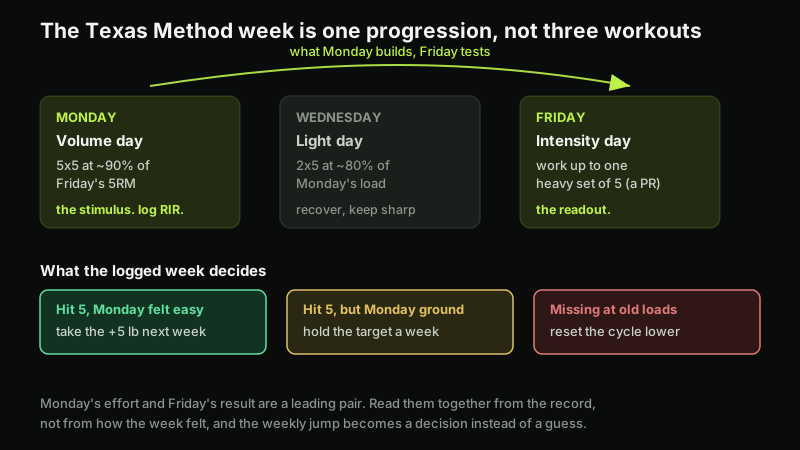
The mistake that sinks most Texas Method runs is treating Monday, Wednesday, and Friday as three separate sessions that happen to share a bar. They are one unit. Monday's five sets of five is not a workout with its own goal; it is the input to Friday. Friday's single is not a max-out; it is the readout of whether Monday did its job. The whole reason the progression moved from the session to the week is recovery: an intermediate can no longer bounce back from a heavy session in forty-eight hours the way a novice can, so the heavy stimulus and the heavy test have to sit a full week apart. Wednesday exists so the first two can both happen in the same week without adding stress of its own.
That is why the program is so sensitive to load selection on Monday. Set the volume day too light and Friday has nothing to realize, so the weekly jump stalls even though every session felt fine. Set it too heavy and you do not recover by Friday, so the single misses for a reason that has nothing to do with your actual strength. The signal that tells those two failures apart is not the weight on the bar. It is how hard Monday's sets actually were, which is to say the reps you had left in reserve when each set of five finished. A Monday five-by-five that left three reps in the tank on every set and a Monday five-by-five that was a genuine grind by the last set are completely different stimuli at the same load, and they predict completely different Fridays.
The weekly structure, and what to read on each day
| Day | Main work | Load | What it is for | What to record |
|---|---|---|---|---|
| Monday (volume) | Squat 5x5, press/bench 5x5, deadlift 1x5 | ~90% of Friday 5RM | The growth and strength stimulus | Load, reps, and RIR on each set |
| Wednesday (light) | Squat 2x5, alternate press, chins + accessories | ~80% of Monday | Recovery and movement quality | Load and reps; note if it felt heavy |
| Friday (intensity) | Work up to a single heavy 5RM | A new five-rep record | Realizing the week's adaptation | Whether you hit five, and how the last rep moved |
The percentages are fixed by the template. The only things that vary, and the only things worth watching across weeks, are the effort on Monday and the outcome on Friday. Everything else is scaffolding.
Friday decides, but Monday is the evidence
Friday gives you a yes or a no: you either got five at the new weight or you did not. That is a clean result, but by the time you have it, the week is over. The useful information arrives earlier, on Monday, and it is the effort on the volume sets. A Monday where all five sets of five moved with a couple of reps to spare is a Monday that has set Friday up to succeed. A Monday where the bar speed fell off a cliff and the last set was a near-miss is a warning that Friday will be a grind or a miss, regardless of what the plan says the weight should be.
This is the part no schedule can capture, because it is not in the schedule. It is in the gap between what the program prescribed and what actually happened in the sets. Reading that gap well means having Monday's effort and last Friday's result in front of you when you load Monday's bar, not reconstructing them from how the week felt. The honest move is to see what last Monday's volume sets were, and how close to failure they ran, at the moment you set up for this Monday, so the load you pick is a decision about evidence rather than a guess anchored on the number the spreadsheet printed.
Reading the progression: push, hold, or reset
One week is a data point. The trend across several weeks is the decision, and there are three patterns worth knowing. All three are read from the record, not the feeling.
- Friday fives landing and Monday staying submaximal. The progression is healthy. Take the weekly five pounds. If Monday's five-by-five is routinely leaving three or more reps in reserve, you may even be able to push the volume-day load up slightly faster than the default, and the RIR you logged on those sets is what tells you there is room.
- Friday fives landing but Monday turning into a grind. The jump is still working, but the stimulus is getting expensive. This is the week to stop assuming the next five pounds is free. Hold the Friday target for a week, let Monday's effort settle back, and watch whether the volume sets recover their reps in reserve before you add again.
- Friday fives starting to miss at loads Monday used to support. The weekly jump has outrun your recovery. This is not a cue to try harder; it is the program telling you the cycle needs a reset. Pulling the loads back and climbing again from a lower, truer base is the same logic as a deload that you only notice is working when you skip it.
Making that call from memory is where it goes wrong, because the thing you need to compare is specific and small: how many reps you had in reserve on Monday three weeks running, and whether Friday's single is still climbing. That is exactly the judgement of when a weight has genuinely been outgrown versus when it has just been a bad day, and on a weekly program the evidence is spread across days you have already half-forgotten by the time the decision lands.
When the weekly jump dies: triples, doubles, singles
Eventually the five pounds a week stops being recoverable with sets of five. The standard Texas Method answer is to keep the weekly progression but shorten the intensity-day reps: Friday's single set of five becomes a triple, then a double, then a heavy single, which lets you keep adding small amounts of load after five-rep PRs are no longer on offer. This is a sound mechanic, but it is also a decision about timing, and the timing is a logged one. The right moment to drop from fives to triples is not a date on a calendar. It is the point where the Friday fives have been missing or grinding for long enough that the record shows a plateau rather than a bad week.
The same reasoning runs underneath every intermediate program. A novice linear progression adds weight every session until it cannot; GZCLP stretches that phase with a stall ladder that drops reps in a fixed order; the Texas Method moves the jump to the week and then shortens the reps when the week can no longer carry it. All of them are the same idea, progressive overload applied at the fastest pace your recovery still allows, with the clock running at a different speed. What changes is how often you decide, and every one of those decisions reads better off a record than off a memory.
Why log effort on a program that only asks for a rep count
The Texas Method, as written, asks you to record the weight and whether you hit your reps. That is enough to run the schedule and not enough to run the program well, because a made rep count and a missed rep count each hide the information that actually matters. Five grinding reps on Monday and five easy reps on Monday produce the same entry if all you log is "5x5, made it," and they predict opposite Fridays. The effort is what separates a stimulus that is working from a body that is simply tired this week, and it is also roughly the thing that keeps most of your training sets productive without burying you.
None of this means grinding the volume day to failure to get a reading. A meta-analysis by Refalo and colleagues found no meaningful hypertrophy cost to stopping a rep or two short of failure rather than training all the way to it, so the honest volume day is the one where you log how many reps you had left, not the one where you prove you had none. And because the growth on a program this squat-heavy still comes from accumulated work rather than the Friday single, the thing worth counting over a block is the same as on any program: the weekly hard sets each muscle actually receives once the main lifts and accessories are added up, a total the classic dose-response work from Schoenfeld, Ogborn and Krieger ties to how much you grow.
That is the case for logging the reps in reserve alongside the rep count on every working set. RIRLift does not run the Texas Method for you; it is the fastest place to log the program you already run. It records RIR as a first-class value on every set, pre-fills last session's load, reps, and target so this week's numbers sit next to last week's, and surfaces your estimated max during rest. The point is to log the load, the reps, and the reps in reserve from your wrist while the set is still fresh, between sets, rather than rebuilding the week that evening from a feeling that has already blurred.
The verdict
The Texas Method works because it is the right pace for a lifter who has outgrown per-session jumps but is nowhere near needing monthly ones. The cost of that middle pace is that the program is quiet: the schedule tells you what to lift, but not whether the week is still supporting the jump. The answer to that is not a better schedule. It is a record of Monday's effort and Friday's result, read together, week over week. Keep that record and you will know when to take the five pounds, when to hold it, and when to reset the cycle, long before a missed Friday single makes the decision for you.