
Blog
Train to Failure: Calibrate RIR, Don’t Push Every Set
Published November 5, 2026 · 16 min read

Training to failure is not required for strength or muscle growth when your total volume is matched, but it can be a useful tool. Use it on purpose, such as on a final set of a low-risk exercise, rather than on every set. Below we summarize what the evidence says and give you safe, practical ways to apply it.
TL;DR:
- When weekly volume is matched, reviews find no consistent strength or muscle growth advantage from failure; study definitions and volume comparisons complicate results.
- Failure causes greater acute fatigue, slower movement, higher effort ratings, and more muscle damage, which can reduce later set quality and recoverable weekly volume.
- Keep most working sets at 1 to 3 reps in reserve, and reserve failure for a final set on a safe isolation exercise.
- Occasionally test your rep reserve on a safe exercise to calibrate effort; estimates tend to be more accurate in sets of 12 reps or fewer.
Table of Contents
- What does it mean to train to failure?
- What does the research say about muscle growth and strength?
- What does training to failure cost you in fatigue and recovery?
- How should you use training to failure in your program?
- How do you stay safe when you push close to failure?
- How can you calibrate RIR without hitting failure every time?
- A coach's view: favor near-failure most of the time
- FAQ
- Sources
What does it mean to train to failure?
Most of the confusion around this topic comes from loose wording, so here are the terms as researchers and coaches use them.
Momentary muscular failure is the point in a set where you cannot complete another full repetition through the concentric (lifting) phase, no matter how hard you try. The bar slows to a crawl or stops, and your form would have to change to move it further. That is different from the casual use of "failure," which often means "the set felt too hard to continue" or "I stopped because it burned." A set can feel miserable at three reps in reserve and still be far from true failure.
Near-failure simply means stopping short of that point. The practical way to describe how close you stopped is reps in reserve (RIR): the number of clean reps you believe you could have done before failing. If we explain RIR in more detail elsewhere, it is in our guide on how to use reps in reserve in your workouts.
Here is how RIR maps onto a typical set:
- At failure: You cannot complete another full repetition with clean form.
- Near failure: You could have completed only a few more clean reps.
- Farther from failure: You had several reps left, and the set was closer to a warm-up than a hard working set.
Take a set of 10 on the leg press. If you stop at rep 10 and could have squeezed out 3 more, that was a 3 RIR set. If you stop at rep 10 and a rep 11 would not have moved, that was a 0 RIR set.
The catch is that people are imperfect judges of their own effort. Many lifters underestimate how many reps they have left, especially early in training or on sets of higher reps, where discomfort arrives long before the muscle is actually spent. That gap is why a calibration habit matters, and we cover it later in this article.
What does the research say about muscle growth and strength?
The short version: across several systematic reviews and meta-analyses, failure training has not shown a consistent edge for strength or hypertrophy when the comparison is fair.
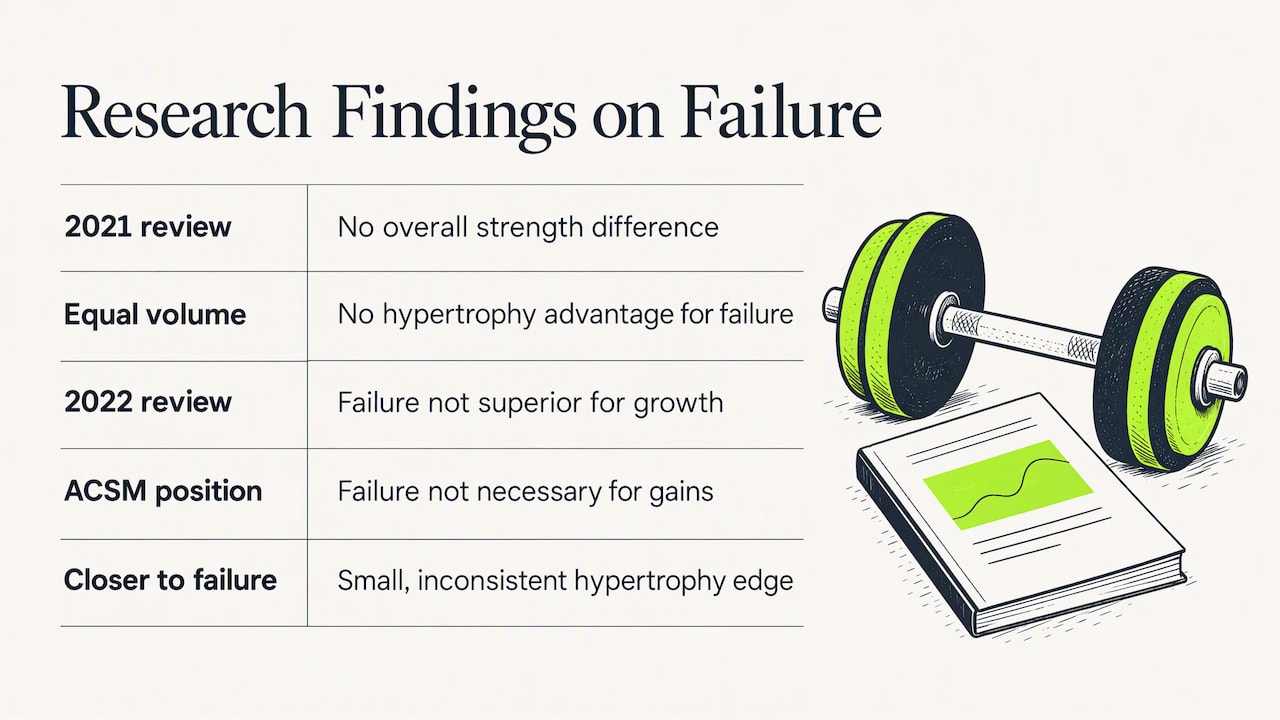
A 2021 systematic review with meta-analysis comparing training to failure with not to failure found no overall difference in maximal strength between the two approaches when volume was equated. It also found no hypertrophy advantage for failure when volume was equalized. Differences only showed up when volume was not matched, which tells you the comparison often depends on how the studies were designed rather than on failure itself.
Resistance training performed to failure or not to failure showed no overall difference in maximal strength, and no hypertrophy advantage when volume was equalized.
That quote paraphrases the review's own conclusion, and it lines up with the broader picture. A 2022 systematic review on proximity to failure and hypertrophy found no evidence that momentary muscular failure is superior to non-failure training for muscle growth. The authors also noted that the relationship between how close you train to failure and how much you grow may not be a straight line, and that it is hard to pin down because studies define failure differently.
The most authoritative statement comes from the American College of Sports Medicine. Its position stand on resistance training prescription, an overview of reviews, concluded that completing sets to momentary muscular failure does not consistently enhance gains in strength, hypertrophy or power, and that it is not necessary when other training variables are appropriately programmed.
The consensus from the reviews above: failure is not necessary for gains when your other training variables are programmed well.
So why does the idea persist that you must go to failure? Part of it is that some analyses do find a small hypertrophy advantage for sets taken closer to failure. The results are inconsistent, and the effect tends to be small, but it is real enough that we would not tell you failure is useless. The honest read is that pushing close to failure matters, and pushing all the way to failure usually adds little on top.
Why the studies disagree
Before you treat any single result as the final word, keep these caveats in mind:
- Definitions of failure vary. Some studies mean true momentary failure, others mean "the participant stopped," and others use a target rep count. These are not the same thing.
- Volume equating is tricky. If the failure group does fewer sets because each set is harder, you are comparing different training stimuli. If you let both groups do the same sets, the failure group may be more fatigued.
- Training status matters. Beginners respond to almost anything, so differences between methods are hard to detect. Trained lifters may behave differently, but there are fewer studies on them.
- Heterogeneity is high. Populations, exercises, rep ranges and study lengths differ widely, which makes pooled estimates less precise than they look.
Moderator analyses add one more wrinkle. A meta-analysis of moderators of strength and hypertrophy found that training factors like frequency, load and volume influence outcomes, and that in some groups, such as older adults, non-failure training produced greater strength effect sizes than failure training. Taken together, the studies point the same direction: manage volume and effort sensibly, and failure becomes optional.
What does training to failure cost you in fatigue and recovery?
Gains are one side of the ledger. The other is what failure takes out of you. A systematic review and meta-analysis on acute fatigue found that resistance training to failure produces greater acute fatigue than not-to-failure training. Specifically, it reported larger decreases in biomechanical properties such as movement velocity, a higher metabolic response, greater muscle damage markers (creatine kinase is the common one), and higher ratings of perceived exertion (RPE).
Failure reliably leaves you more fatigued, more sore and more perceptually drained than stopping short.
Here is what that means in practice:
- You lose velocity and quality. Reps slow down and get sloppier, which means the last reps carry more technical risk.
- You have less left for the next sets. If set one goes to failure, sets two and three will usually drop in reps or load. That can shrink the total productive volume you complete in the session.
- You may need longer to recover. Higher muscle damage markers and perceived exertion often translate into more soreness and a longer wait before that muscle trains well again.
- Your session feels harder than the plan says. Because RPE climbs, regular failure can make a training week feel heavier even when the programmed numbers look modest.
This matters because the thing that most reliably drives progress is the amount of hard work you can recover from and repeat. If failure on every set quietly cuts your weekly volume or forces extra rest days, you can end up doing less effective training than someone who stops a rep or two short.
For programming, three habits help. First, space hard sessions for the same muscle with enough rest that performance returns to normal; our piece on muscle recovery time explains why a fixed number of hours is only a default. Second, autoregulate: if your reps or bar speed fall off from the previous week, back off the effort rather than pushing through. Third, protect your weekly volume. If you add failure sets, make sure total hard sets for the week do not shrink because you are too tired to complete them.
How should you use training to failure in your program?
Treat failure as a tool you pick up on purpose, not a default setting. Here is a simple way to place it.
Good places to use failure:
- The final set of an exercise, after earlier sets stay at 2 to 3 RIR
- Low-risk isolation movements such as cable curls, leg extensions or lateral raises
- Short experimental blocks to see how your body responds
- Occasional calibration sets to check how accurate your RIR estimates are
Places to avoid it:
- Heavy compound lifts without a spotter or safety setup, such as squats or bench press
- High-volume blocks where recovery is already stretched
- Weeks when sleep, stress or soreness are working against you
As a rough frequency guide, most lifters do well using failure on a small share of their sets. If your weekly volume for a muscle is moderate, occasional failure sets may be enough. If your volume is high, use it even less, because the fatigue stacks quickly. This is a practical guideline, not a research-derived number, so adjust it to how you recover.
To combine RIR targets with failure sets without wrecking your volume, follow this sequence:
- Set your normal working sets at 2 to 3 RIR so most of your volume stays high quality.
- Choose one safe, stable exercise per muscle group for the failure set.
- Take only the last set of that exercise to failure, and keep the earlier sets as planned.
- Log the reps you hit and how you felt, then compare it to your next session.
- If your performance on the following session drops, reduce the number of failure sets or space them further apart.
Pro Tip: If you want to know whether failure is worth it for you, run it on one muscle for a few weeks and keep everything else the same. Compare your logged reps, load and recovery, not just how the workouts felt.
The reasoning behind this approach matches what the ACSM overview states: sets near the hard end, not necessarily at failure, are enough to drive adaptation when the rest of the program is sound. Practitioners at Stronger by Science describe the same idea, noting that an adequate stimulus can come from sets targeting 2 to 3 reps in reserve rather than absolute failure, and that failure works best when used strategically.
How do you stay safe when you push close to failure?
Hard sets are productive, but the last rep of a heavy set is also where most avoidable mistakes happen. These rules keep it controlled.
- Use a spotter or safeties. For squats, bench press and similar lifts, set the rack safety pins just below your lowest rep position, or have a spotter who knows how to help without taking over.
- Pick the right exercises. Machines, cables and single-joint moves are the safest places to chase failure because a failed rep does not trap you under a bar. Examples include leg presses with proper stops, pec decks, cable rows and curls.
- Avoid maximal free-weight singles and Olympic lifts at failure. Those lifts depend on speed and precision, and pushing them to the point of breakdown increases the chance of a bad bail.
- Stop when form breaks, not when effort peaks. If your back rounds, your hips shoot up, or the bar path changes, the set is over even if you felt you had a rep left. Form failure comes before muscle failure for a lot of people, and respecting it is the whole point.
- Know your exit plan. Before any hard set, decide how you will put the weight down if a rep stalls.
Different lifters need different margins. Beginners often have the least accurate sense of effort and the shakiest technique, so they gain more from leaving a few reps in reserve and building clean form first. Older lifters may recover more slowly and, as noted earlier, some analyses show non-failure training produced greater strength effects in older adults. Anyone with a medical condition, joint problems or a history of injury should check with a qualified professional before taking sets to failure.
Pro Tip: Film a hard set from the side. Seeing where your form starts to drift is far more reliable than trusting how the set felt, and it gives you a visual stopping point for next time.
How can you calibrate RIR without hitting failure every time?
If RIR is your main effort tool, the skill that matters is knowing how close to failure you really are. These are the routines coaches use to sharpen that sense.
- Predict, then test. On a safe exercise, pick one set per session to take to failure. Before you start, write down your predicted RIR at a few points, for example "I think I have 3 left after rep 6." Then continue to failure and note how many reps you actually had left.
- Use shorter sets for practice. Prediction tends to be more accurate on lower-rep sets, so practice with sets of 12 reps or fewer. Long, burning sets of 20 or more make it hard to separate real fatigue from discomfort.
- Compare logs over time. Check whether your RIR guesses are consistently too optimistic or too cautious. If you often finish a "2 RIR" set and find you could have done five more, you are under-reaching. If you hit a wall at what you called 3 RIR, you are over-reaching.
- Cross-check with progress. If you claim to train at 1 to 2 RIR but your load and reps are not rising over several weeks, your effort may be lower than you think.
This is how failure becomes a calibration tool instead of a requirement. You use it occasionally to keep your estimates honest, then spend the rest of your training at controlled, repeatable effort. If you want a deeper comparison of the two approaches, we cover it in RIR vs going to failure, and our broader research-based guide to training to failure goes further into the evidence.
Logging makes this much easier, because you can compare your predictions to results across weeks instead of relying on memory. In RIRLift, you record weight, reps and RIR for every set, and our Coach uses that data to suggest your next load, which is the same feedback loop this drill depends on. You can see how it works at Rirlift.
A coach's view: favor near-failure most of the time
Here is where we land after reading the evidence and working with real training logs. Most of your hard sets should sit at roughly 1 to 3 reps in reserve. That is hard enough to drive growth, easy enough to recover from, and flexible enough to repeat week after week. Failure is a spice, not the main dish.
A simple cue for adding it safely: on an isolation movement, occasionally take the final set to failure, and leave every other set where it is. Then watch what happens. If your next session's performance holds or improves, keep it. If your reps slip or you feel beaten up, back off.
The mistake we see most often is treating failure as proof of effort. It is not. Consistency, sensible volume and progressive loading do more for you than any single set pushed to the limit. Track your sessions, trust your data over your ego, and let recovery tell you when you have done enough.
— Guilherme
FAQ
Does training to failure actually work?
It can work, but it is not required. Systematic reviews, including a meta-analysis on strength, hypertrophy and power, found no overall advantage for failure when volume was equated. Stopping a rep or two short usually gives you similar results with less fatigue.
What does training to failure feel like?
Failure feels like the bar slows sharply, your muscles burn and shake, and you simply cannot finish the next rep even though you are trying hard. It is more than discomfort: the movement stalls or your form breaks down. If you can still grind out a rep with clean technique, you were not there yet.
Is stopping 4 reps short of failure too little?
Several reps in reserve may be on the light side for a working set. It can suit warm-ups or high-fatigue weeks, but for most productive sets, 2 to 3 reps in reserve is a supported target. Keep in mind that lifters often underestimate how many reps they have left, so your true reserve may be smaller than you think.
Should you train to failure every workout?
No, there is little reason to. The American College of Sports Medicine concluded in its position stand that failure is not necessary when other variables are programmed well. Occasional failure on safe exercises is plenty for most people.
Sources
- Effects of Resistance Training to Muscle Failure on Acute Fatigue: A Systematic Review and Meta-Analysis
- Effects of Resistance Training Performed to Failure or Not to Failure on Muscle Strength, Hypertrophy, and Power Output: A Systematic Review With Meta-Analysis - PubMed
- American College of Sports Medicine Position Stand. Resistance Training Prescription for Muscle Function, Hypertrophy, and Physical Performance in Healthy Adults: An Overview of Reviews - PMC
- Influence of Resistance Training Proximity-to-Failure on Skeletal Muscle Hypertrophy: A Systematic Review with Meta-analysis