
Blog
Warm-up sets: how many you need before working sets
Published August 5, 2026 · updated September 13, 2026 · 12 min read
You ramp up to your top set on the bench. Bar for ten, then a plate, then two, then a single at almost your working weight. You sit down for the set that was supposed to matter, and it comes in three reps lighter than last week. Nothing went wrong with your program. You spent the set on the way to it.
Or the opposite happens. Fourth exercise of the session, cable flyes, and you run two build-up sets on a weight you could nap under, because that is what the app template said to do.
The short answer to how many warm-up sets you should do: three to four before the first heavy compound of the session, one to two for a second lift on the same muscle, and zero to one for anything later once the muscle is already warm. The table further down sets that out by situation. That number is the easy part, and the top results all give roughly the same answer. The parts that actually change your training are the ones nobody writes about. Warm-up sets quietly break two numbers you make decisions from: your weekly hard-set count, and your effort estimate on the first set that counted.
What are warm-up sets?
A warm-up set is a submaximal set performed before your working sets, using a lighter load, to prepare the joint and the movement pattern without accumulating meaningful fatigue. It is deliberately easy. If it was hard, it was not a warm-up.
The distinction is not about the weight on the bar. It is about intent and proximity to failure. A working set is taken close enough to failure to drive growth. A warm-up set is stopped nowhere near it.
| Warm-up set | Working set | |
|---|---|---|
| Load | 40 to 90 percent of working weight | Your prescribed load |
| Reps | 1 to 10, always well short of failure | Your target rep range |
| Proximity to failure | 5-plus RIR, usually much more | Typically 0 to 3 RIR |
| Purpose | Prepare the pattern, find the groove | Produce the growth stimulus |
| Rest after | 30 to 60 seconds | Your full programmed rest |
| Counts toward weekly volume | No | Yes |
That last row is the one lifters get wrong, and it is worth more than the percentage table.
How many warm-up sets should you do?
The honest answer is that it depends on two things: how heavy the working load is relative to your maximum, and how much of the involved musculature is already warm from earlier in the session.
A workable default for most hypertrophy training:
| Situation | Warm-up sets | Example ramp to a 100 kg working weight |
|---|---|---|
| First heavy compound of the session | 3 to 4 | 20 kg x 8, 60 kg x 5, 80 kg x 3, 90 kg x 1 |
| Second compound, same muscle group | 1 to 2 | 60 percent x 5, 80 percent x 2 |
| Machine or cable work later in the session | 0 to 1 | one feeler set of 5 to 8 easy reps |
| Isolation work after the same muscle was trained | 0 | go straight into the working set |
| A movement you have not done in weeks | Add 1 | for the pattern, not the muscle |
Notice the shape. The ramp is front-loaded and it collapses fast. Most of what a warm-up set achieves for set number five was already achieved by sets one through four.
Two practical adjustments. Heavier relative loads need more steps, so a set of 5 needs a longer ramp than a set of 15. And single-joint work needs less than a loaded spinal or hip pattern, because the risk and the coordination demand are lower.
Do warm-up sets count toward your weekly volume?
No, and this is where a tidy-looking log starts lying to you.
Weekly volume for hypertrophy is counted in hard sets: sets taken close enough to failure to contribute stimulus. The dose-response relationship between weekly sets and growth that the research describes, including Schoenfeld and colleagues' meta-analysis of training volume, is built on that kind of set. A submaximal ramp set is not one, and no amount of logging it makes it one.
Do the arithmetic on a normal push day. Bench press with 4 warm-ups then 3 working sets, overhead press with 2 then 2, dips with 1 then 1. Six sets did the work and 7 were ramps. If your app counts every row, the day reads as 13 hard sets when 6 were real. Repeat that across a week and your muscle map says you are comfortably at your volume target while the stimulus behind it is closer to half.
This is the same failure mode as sets that add fatigue without adding stimulus, just running in reverse. Junk volume is real sets that stopped counting. Miscounted warm-ups are non-sets that started counting. Both leave you making programming decisions from a number that does not describe your training, and both are invisible unless the log distinguishes effort per set.
The fix is boring and it works: warm-ups are not logged as working sets, or they are logged in a way that keeps them out of the hard-set total. What matters is that what counts as a hard set stays a defensible number.
There is a related trap in how the ramp itself is written. An ascending scheme where each set gets heavier can blur the line entirely, which is exactly the problem with the early sets of an ascending pyramid: they sit in a grey zone where they are too heavy to be a clean warm-up and too far from failure to be a real working set.
Should you warm up for every exercise?
No. This is the most common wasted effort in an intermediate lifter's session.
By the time you reach the third or fourth exercise for a muscle group, the tissue is warm, the pattern is rehearsed, and the joints have been through their range under load repeatedly. A ramp there buys you very little, and it is not free. Every submaximal set adds a small amount of fatigue and a meaningful amount of time.
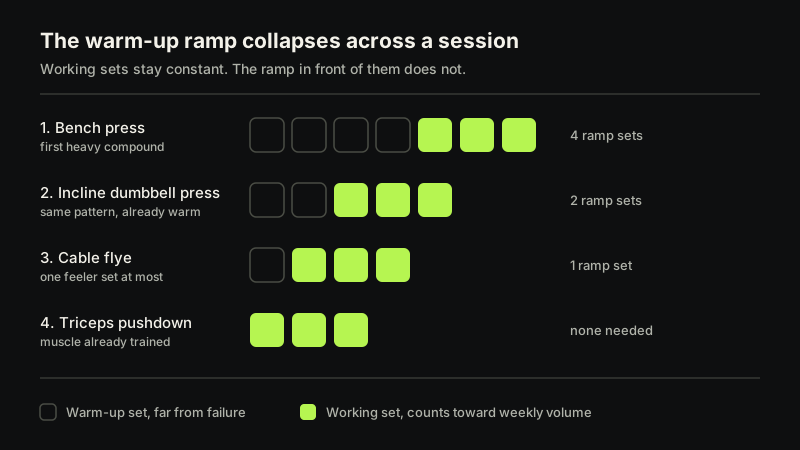
Warm up properly for:
- The first compound movement of the session.
- Any lift where the working load is a high percentage of your maximum.
- A new exercise, or one you have not run in a training block.
- Any pattern where the stretched position is loaded and unfamiliar.
Skip or minimise for:
- Isolation work on a muscle you have already trained that session.
- Machines with a fixed path, once you know the seat setting.
- The second and third exercises of the same movement pattern.
The time saving is not trivial. Six unnecessary warm-up sets at roughly a minute each, including the rest, is most of the reason a session that should take 55 minutes takes 75. That interacts with how many sets a session can actually hold before effort starts drifting.
How to warm up without spending the top set
The failure mode that ruins working sets is a ramp that behaves like training.
Keep the reps low as the load climbs. There is no reason to do eight reps at 80 percent of your working weight; you have just done a hard set and called it a warm-up. 1 to 3 reps is plenty once the load is meaningful.
Keep the rest short early and normal late. Thirty to sixty seconds between light ramp sets is fine. After the last ramp set, before the first working set, take close to your full programmed rest. That final gap is not a warm-up rest, it is the recovery that protects the first set, and the same logic covers how much rest each set needs throughout the session.
Never take a warm-up set anywhere near failure. If you are estimating 2 or 3 reps in reserve on a ramp set, the ramp is too heavy or the reps are too high.
And keep the total short. The purpose of the warm-up is to arrive at the first working set able to do more, not less.
This matters most when your first working set is also your heaviest. Schemes that start with the heaviest set of the day leave the top set fully exposed to a bad ramp: too little preparation and you under-perform it, too much and you have already spent the freshness the structure exists to protect.
What the evidence actually supports
Warming up before training is well supported, though the literature is broader than the specific question of ramp sets.
A systematic review and meta-analysis by Fradkin and colleagues found that warming up improved performance in the large majority of the outcomes examined, with very few cases where it hurt. The mechanisms are covered in McGowan and colleagues' review of warm-up strategies in Sports Medicine: raised muscle temperature, plus a set of non-temperature effects including elevated oxygen uptake kinetics, post-activation potentiation, and psychological readiness.
One caveat worth carrying into the gym. Long bouts of static stretching immediately before lifting can reduce force output, as Behm and Chaouachi's review of acute stretching effects describes, with the risk concentrated in prolonged holds rather than the short, comfortable ones. Brief mobility work inside a fuller active warm-up is a different thing and is not the concern.
What the evidence does not support is a precise universal ramp. The percentage tables in circulation are reasonable coaching heuristics, not findings. Treat them as a starting point and adjust from what the first working set tells you.
That first working set is the real feedback signal. If it consistently comes in below your rep target at your usual load, you are over-warming. If it feels ragged or your technique is off on rep one, you are under-warming. Both readings only exist if you are logging the reps and the effort honestly, because the load alone cannot tell you which one happened. It is the same reason mechanical tension has to be inferred from effort rather than measured directly.
Common questions
How many warm-up sets should you do before bench press?
Treat the bench as the first heavy compound of the session and ramp with three to four sets: an empty or near-empty bar, then roughly 60 percent, then 80 percent, then a single near your working weight. Keep the reps low as the load climbs so you arrive fresh for the set that matters. If you have already trained chest earlier in the session, one or two feeler sets are enough.
How many warm-up sets do you need for hypertrophy?
The same shape as for strength: three to four before your first heavy compound, tapering to zero or one on later exercises for a muscle that is already warm. What matters more for hypertrophy is that none of those ramp sets get counted as hard sets, because your weekly volume target is built on sets taken close to failure, not on the ramp.
Is two warm-up sets too much?
For a first heavy compound near your working max, two is usually too few; three to four lets the load climb without any single jump being large. For a second or third exercise on a muscle that is already warm, two can be one more than you need. The number follows the lift's position in the session and how heavy it is, not a fixed rule.
How many reps should a warm-up set be?
Start higher and drop fast as the weight climbs: eight to ten reps on the first very light set to move the joints, five or six in the middle, then one to three once the load is meaningful. Doing eight reps at 80 percent of your working weight is a hard set you have mislabelled as a warm-up.
How long should you rest between warm-up sets?
Thirty to sixty seconds between the light ramp sets is plenty. The rest that matters is the last one: after your final ramp set and before your first working set, take close to your full programmed rest, because that gap protects the set that actually counts.
Logging warm-up sets honestly
The whole problem is an accounting one, so it gets solved where the accounting happens.
In RIRLift you log load, reps, and RIR for every set as you do it, from your wrist. A ramp set logged at 8 RIR reads as exactly what it was, and a working set logged at 1 RIR reads as a hard set. Your weekly hard-set totals per muscle come from the sets that actually earned the label, which is the only version of that number worth planning from.
That per-set honesty is also what makes the first working set interpretable. When you can see that last week's opener came in at 10 reps and 2 RIR and today's came in at 8 reps and 0 RIR at the same load, you know something upstream changed, and the ramp is one of the first suspects. Estimating that buffer well is a skill in itself, which is what our guide to reps in reserve is for.
Warm-up sets are not training. They are the cost of admission to the sets that are. Keep the ramp short, keep it far from failure, keep it out of your volume totals, and judge the whole thing by one question: did the first set that counted go better? You can see how a session runs from your wrist, ramp sets and all, without pulling your phone out between them.