
Blog
Reverse pyramid training: heaviest set first, and the volume trap
Published August 11, 2026 · 15 min read
There is a moment in every set of five that makes reverse pyramid training sound obviously correct. You have warmed up, the bar is loaded, and you are as fresh as you will be all session. Why would you spend that freshness on a light set of twelve? Do the heavy work now, while your nervous system is sharp and nothing hurts yet, then strip plates and chase reps on the way down.
That logic is sound, and it is why reverse pyramid training has survived decades of fashion cycles. But if you read the forums where lifters actually argue about it, the same objection keeps surfacing and never quite gets answered: reverse pyramid training looks great for strength and thin for muscle. The people raising it are right, and the reason is not a physiological mystery. It is arithmetic, and almost nobody does the arithmetic out loud.
What is reverse pyramid training?
Reverse pyramid training (often shortened to RPT) is a set structure where you perform your heaviest, lowest-rep set first, while you are unfatigued, then reduce the load by roughly 10 to 15 percent on each following set and add reps. The first set is the top set. Everything after it is a back-off set.
A typical bench press looks like this: warm up thoroughly, then 5 reps at 100 kg, drop to 90 kg for 7 reps, drop to 80 kg for 9 reps. The load falls, the reps rise, and the shape the numbers make is a pyramid standing on its head. It is also known as the Oxford technique, and it is the structural opposite of the ascending pyramid most gyms default to.
| Structure | First set | Load across sets | Reps across sets | Where the hard work sits |
|---|---|---|---|---|
| Straight sets | Working weight | Constant | Constant target | Spread evenly, hardest at the end |
| Ascending pyramid | Lightest | Rises | Falls | Last set or two |
| Reverse pyramid (RPT) | Heaviest | Falls 10 to 15% per set | Rises 1 to 3 per set | First set, while fresh |
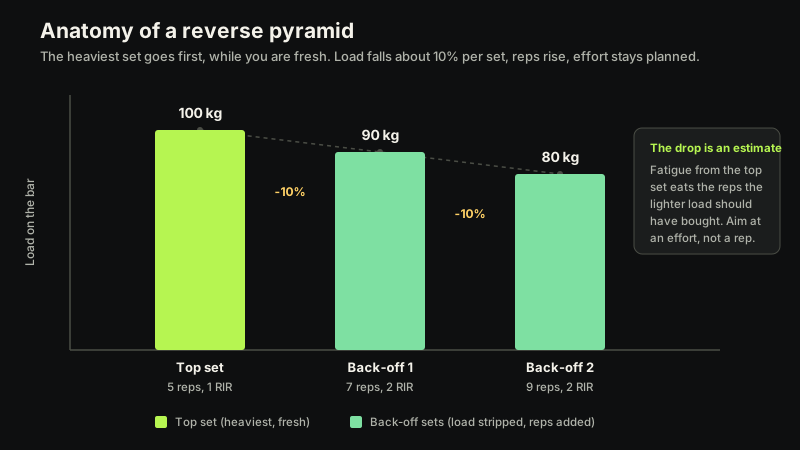
The distinction that matters is not the shape. It is which set you expect to be your best, and reverse pyramid training is unusual in being honest about it. The top set is the point of the exercise. The back-off sets exist to add volume around it.
The case for going heaviest first
The argument for RPT is fatigue management, and it holds up better than most training folklore.
In an ascending pyramid, your heaviest set is your last set, which means it arrives after two or three sets have already drained you. You are lifting your top weight in your worst condition. Flip the order and the heavy set happens first, so the load you handle on it reflects your actual strength rather than your strength minus accumulated fatigue. For a lifter whose priority on a given lift is getting stronger, that is a real advantage, and it is the same reasoning behind putting your most important exercise first in the session.
The freshness argument also explains why RPT is strict about rest. This is not a circuit. The whole method assumes you recover enough between sets that the back-off sets are limited by the muscle rather than by breathlessness, which lines up with what the research says about longer rests. In a well-known trial in resistance-trained men, three-minute rest intervals beat one-minute rests for both strength and muscle thickness over eight weeks. If you compress RPT's rest periods to keep the session short, you are removing the mechanism that makes it work.
The other requirement is a warm-up that prepares you without costing you anything. Because the top set is the first working set, it is fully exposed to a bad ramp. Too little and your heaviest set of the day is also your least prepared. Too much and you have spent the freshness the method exists to protect. Getting your warm-up sets right is not a detail in RPT, it is load-bearing.
What the evidence does not support is the stronger claim that reverse pyramids grow more muscle than other structures. When volume is equated and sets are taken close to failure, set structure washes out. A 12-week study in well-trained men found near-identical increases in muscle cross-sectional area across traditional straight sets, a pyramid scheme, and drop sets. A Stronger by Science review of pyramid training reaches the same conclusion across the pooled literature: viable, not superior. The advantage of going heaviest first is about expressing strength on the top set, not about a special growth mechanism. This is the same verdict that applies to pyramid sets in general, and it is worth internalising before you rebuild your program around a set shape. The same logic extends to wave loading, which stacks heavy top sets in waves and runs into the same weekly-volume shortfall.
The volume trap
Here is the objection nobody closes out. Reverse pyramid training, as it is usually written, produces very few hard sets per muscle per week.
The classic template runs two or three sets per exercise on a short list of big compounds, often two or three times a week. That is a deliberate choice: heavy top sets are expensive, and the method leans on intensity rather than accumulation. But muscle growth has a dose-response relationship with weekly volume. The Schoenfeld, Ogborn and Krieger meta-analysis found that each additional weekly set was associated with roughly 0.37 percent more growth, with higher volumes outperforming lower ones. There is a point of diminishing returns, but three sets a week is nowhere near it.
Run the numbers for a chest that is trained with bench press only, RPT style, once a week.
| Setup | Sets per exercise | Chest sessions per week | Weekly hard sets for chest |
|---|---|---|---|
| Classic RPT, bench only, once a week | 3 | 1 | 3 |
| RPT, bench only, twice a week | 3 | 2 | 6 |
| RPT, bench plus an incline movement, once a week | 3 + 3 | 1 | 6 |
| RPT, bench plus incline, twice a week | 3 + 3 | 2 | 12 |
| RPT top set plus 3 back-offs, two movements, twice a week | 4 + 4 | 2 | 16 |
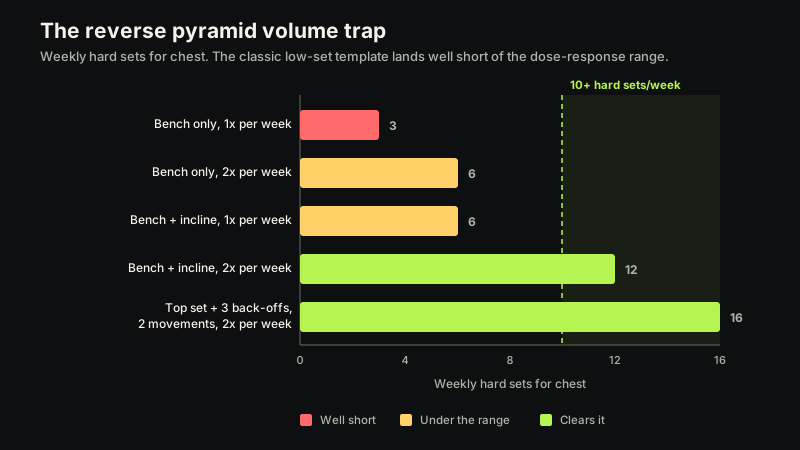
Three hard sets a week is not a hypertrophy program. It is a strength maintenance program that happens to make you sore. The commonly cited working range for growing a muscle group sits closer to ten or more hard sets per week, which is the territory the training volume guide walks through in detail. Two of the five setups above clear it and three do not.
This is why the forum consensus lands where it does. Reverse pyramid training is not worse for hypertrophy because of the descending load. It is worse for hypertrophy as usually programmed, because the usual programming is low volume. The fix is not to abandon the structure. It is to add exercises and frequency until the weekly count reaches a sensible number, and then keep the RPT shape inside each exercise.
The trap has a second jaw, and it closes when you fix the first one carelessly. If you pad the weekly total with soft back-off sets taken five reps from failure, you have added log entries and fatigue without adding much stimulus. That is junk volume with better branding. A back-off set only counts if it is genuinely hard, which brings us to the thing the whole method quietly depends on.
Reverse pyramid training runs on RIR, whether you admit it or not
Read any RPT guide and you will find percentages: heaviest set first, drop 10 to 15 percent, add reps. It reads like a load-based system. It is not. It is an autoregulated system wearing a percentage costume, and it fails in specific ways when you do not notice that.
Three decisions in RPT are effort judgements, not load calculations.
Choosing the top-set weight. Nobody tests a true one-rep max before every bench session. You pick a weight you believe you can get for your target reps with a rep or two left over. That belief is a proximity-to-failure estimate, which is exactly what reps in reserve formalises. If you habitually pick a top set you could have done three more reps with, you are running the method at the wrong intensity and the back-off loads inherit the error.
Deciding when to add weight. RPT's progression rule is elegant: when the top set hits the top of its rep range, add load next session. But that rule only works if the top set ends at a consistent effort every week. Hit six reps at 3 RIR one week and six reps at 0 RIR the next and your log says you repeated yourself while the truth is that you got substantially weaker. The rule is a clean expression of progressive overload only when effort is held roughly constant, and effort is not something the plate math can see.
Judging whether the back-off sets counted. A back-off set at 10 percent less load is not automatically a hard set. Whether it counts depends on where it finished relative to failure, and nothing about the load drop guarantees that.
The RIR framework exists precisely because lifters need a repeatable way to record this. The scale was validated in a 2016 study that found a strong inverse relationship between how fast the bar moved and the rated exertion, which is the empirical basis for treating a lifter's proximity-to-failure estimate as usable data rather than a vibe. It is not perfect, and it is less accurate in novices, but it is the right instrument for a method whose every decision is an effort judgement.
Why the 10 to 15 percent drop misfires
The standard advice is to cut 10 to 15 percent and expect two or three extra reps. The rough rule behind it is that a small change in load buys you a predictable change in reps. On a fresh muscle, that is approximately true.
Your back-off sets are not performed on a fresh muscle. They are performed on a muscle that just did a maximal-effort top set. The fatigue from that top set eats into the reps the lighter load should have bought you, so the drop does not preserve your effort level. It usually undershoots it.
Concretely: you bench 100 kg for 5 reps at 1 RIR. You drop 10 percent to 90 kg. On a fresh muscle, 90 kg might be good for 8 reps at 1 RIR. After a hard top set and three minutes of rest, you get 7, and that 7 is at 0 RIR, not 1. You went to failure without deciding to. Do that on the second back-off set too and the session is a lot more fatiguing than the plan implied.
This has two practical consequences.
- Rest length changes the correct drop. Three minutes and 90 seconds are not the same set. The shorter the rest, the bigger the drop needs to be to land at the same effort.
- The rep target should follow the effort, not the other way around. Deciding in advance that the back-off set is "8 reps" and grinding to reach it is how a planned 2-RIR set becomes a failure set. Set the load, target an effort, and let the rep count land where it lands.
The honest version of the 10 to 15 percent rule is that it is a starting estimate for the load, not a promise about the reps. What you actually control is which effort you stop at. That is the number worth recording.
A reverse pyramid week that actually grows muscle
Putting the pieces together: keep the descending structure, fix the volume, and hold effort constant. Here is a chest and back example across two sessions, built to clear a reasonable weekly hard-set count.
| Day | Exercise | Top set | Back-off 1 | Back-off 2 | Hard sets |
|---|---|---|---|---|---|
| Mon | Bench press | 5 reps, 1 RIR | -10%, 2 RIR | -10%, 2 RIR | 3 chest |
| Mon | Incline dumbbell press | 7 reps, 2 RIR | -10%, 2 RIR | -12%, 1 RIR | 3 chest |
| Mon | Weighted pull-up | 5 reps, 1 RIR | -12%, 2 RIR | -12%, 2 RIR | 3 back |
| Thu | Overhead press | 5 reps, 1 RIR | -10%, 2 RIR | -10%, 2 RIR | (shoulders) |
| Thu | Dip | 6 reps, 1 RIR | -12%, 2 RIR | -12%, 2 RIR | 3 chest |
| Thu | Barbell row | 6 reps, 1 RIR | -12%, 2 RIR | -12%, 2 RIR | 3 back |
That is nine hard sets for chest and six for back across two sessions, with the heaviest work always first and every set carrying a target effort rather than a target rep count. Add a third session or a fourth movement and back clears ten too.
Two rules keep it honest over a training block. Progress the top set when it hits the top of its range at the intended RIR, not merely when you hit the reps. And if the back-off sets consistently land a full rep or two below where you planned, your top set was too heavy, not your back-offs too light.
Who should run reverse pyramid training
| Your situation | Verdict | Why |
|---|---|---|
| Strength on a few big lifts is the priority | Strong fit | Heaviest set first, fresh, is the cleanest way to express strength. |
| Limited time, few sessions per week | Mixed | Time-efficient per exercise, but the low set count is exactly the volume trap. |
| Hypertrophy is the main goal | Workable with edits | Keep the structure, add movements and frequency until weekly hard sets are sufficient. |
| Newer lifter, still calibrating effort | Poor fit | Every decision in RPT is an RIR judgement, and that judgement is least reliable early on. |
| Cranky joints that need a gradual ramp | Poor fit | The heaviest set arrives first; an ascending structure warms the joint inside the exercise. |
| You want the simplest possible volume count | Poor fit | Straight sets are far easier to tally honestly. |
The newer-lifter row is the one people ignore. Reverse pyramid training is often recommended to beginners because it is simple to describe. It is not simple to execute, because it asks you to accurately judge how close a heavy set came to failure before you have any experience of what failure feels like on that lift.
How to log reverse pyramid training
RPT generates a specific record-keeping problem. Every set in an exercise has a different load, a different rep count, and a different intended effort, and the relationship between them is the entire point. A log that says "bench: 3 sets" has thrown away all the information you needed.
What you want to see six weeks later is whether the top set moved at a constant effort, and whether the back-off sets landed where you aimed. That requires recording load, reps, and RIR for every individual set, which is how logging works in RIRLift: each set is its own entry with its own effort rating, so a 1-RIR top set and a 2-RIR back-off stay visibly different instead of collapsing into a set count. The weekly muscle totals then reflect sets that actually reached a working effort, which is the number the volume trap above turns on.
The mechanics matter too, because RPT means changing the load between every single set and resting three minutes while you do it. Running the session from your wrist keeps the loop tight: a session on Apple Watch puts the previous set's load, reps and RIR in front of you while you decide the next drop, and the rest timer runs itself. You get to make the one judgement the method actually requires, then get back under the bar.
The bottom line
Reverse pyramid training earns its reputation on one specific claim: your heaviest set should happen while you are freshest. That is true, and if strength on a handful of compounds is what you care about, the structure is a good fit.
It does not build more muscle than any other set structure at matched volume, and the version most people copy runs so few sets per muscle per week that hypertrophy is left on the table. Keep the shape, add the movements and the frequency, and make sure the back-off sets are hard enough to count.
Underneath all of it, RPT is an effort-driven method dressed up as a load-driven one. The top-set weight, the progression trigger, and the value of every back-off set are all proximity-to-failure judgements. Record them as such and the method has a feedback loop. Record only the plates and you are guessing with extra steps.