Apple Watch gym workout: three sessions you run from your wrist

For a gym workout on Apple Watch, run the session in a lifting app on the Watch: Apple's own Workout app records time and calories, not the weight and reps of each set. In RIRLift you start today's routine on your wrist, log weight, reps and reps in reserve after each set, and the rest timer starts by itself while the phone stays in your locker. The session is saved to Apple Health as Traditional Strength Training. Copy one of the three sessions below: a barbell day, a 40-minute machine day, or the dumbbell version for when every rack is taken.

  1. Barbell Back Squat Quads, Glutes, Adductors
  2. Barbell Bench Press Chest
  3. Romanian Deadlift Hamstrings, Glutes
  4. Lat Pulldown Lats
  5. Leg Press Quads, Glutes
  6. Seated Cable Row Upper Back, Lats
  7. Bulgarian Split Squat Quads, Glutes
Barbell lifts at the rack

The heaviest work of the week. Load the bar, lift, and log the set on your wrist before you sit down to rest. With Pro, the plates for each side show under the weight on the Watch.

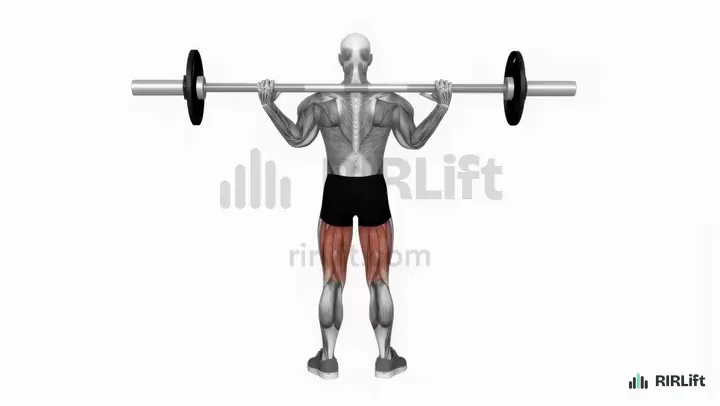
Quads and glutes, barbell squat

Barbell Back Squat

Quads, Glutes, Adductors

The main leg lift of the barbell day. Three working sets of 5 to 8 are heavy enough to build strength and short enough to log between breaths.

How to do it

  1. Set the bar across your upper back below the neck, hands just outside your shoulders, and unrack it.
  2. Stand with your feet about shoulder-width apart, toes turned out a little.
  3. Breathe in, tighten your stomach as if bracing for a punch, and sit down between your heels.
  4. Stand back up keeping your chest and hips rising together.

Cues

  • Breathe and brace
  • Chest and hips rise together
  • Whole-foot pressure

Common mistakes

  • Hips shooting up first out of the bottom: lighten the bar and keep your chest rising with them.
  • Letting the stomach go soft between reps: re-brace at the top of each one.

Swap for: Front Squat, Box Squat

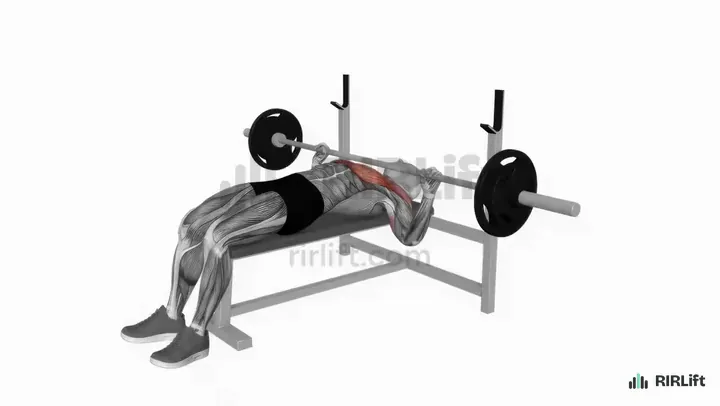
Chest, shoulders and triceps, barbell press

Barbell Bench Press

Chest

The upper-body press the rest of the day is built around. Log the set before you leave the bench, while the reps are still exact.

How to do it

  1. Lie on the bench with your eyes under the bar, feet planted, and squeeze your shoulder blades back and down into the pad.
  2. Grip the bar a little wider than shoulder width, unrack it, and hold it over your shoulders with locked elbows.
  3. Lower the bar to your lower chest, around nipple height, with your elbows angled roughly 45 to 70 degrees from your sides.
  4. Touch your chest without bouncing, then press the bar up and slightly back until it is over your shoulders again.

Cues

  • Shoulder blades stay pinned
  • Bar to the nipple line
  • Drive your feet into the floor

Common mistakes

  • Flaring the elbows straight out to the sides: let them sit a bit closer to your ribs so your shoulders stay comfortable.
  • Lifting your hips off the bench to finish a rep: keep your glutes down and count that rep as your last.

Swap for: Flat Dumbbell Press, Smith Machine Bench Press, Machine Chest Press

Hamstrings and glutes, barbell hinge

Romanian Deadlift

Hamstrings, Glutes

Trains the back of the legs through a long stretch without pulling from the floor, so it recovers in time for the next session.

How to do it

  1. Stand with a barbell at your thighs, hands just outside your legs, feet under your hips.
  2. Soften your knees and push your hips back, sliding the bar down your thighs.
  3. Stop when your hamstrings are fully stretched, usually just below the knee, with your back flat.
  4. Push your hips forward to stand up, glutes tight at the top.

Cues

  • Hips back
  • Bar stays on your legs
  • Back flat

Common mistakes

  • Bending the knees into a squat: keep them soft and still.
  • Reaching for the floor: stop where your back would round.

Swap for: Weighted Back Extension

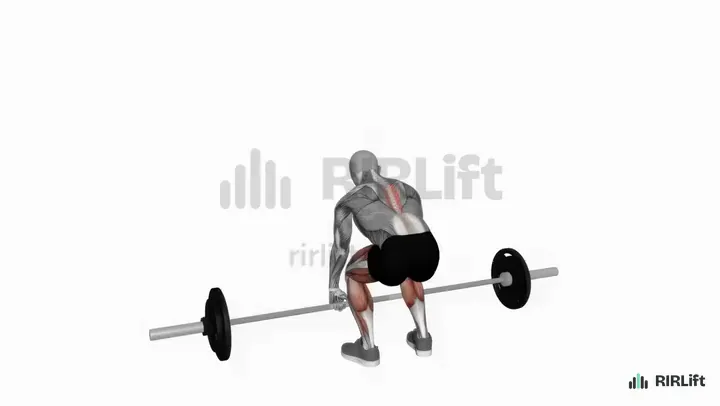
Upper back and lats, barbell row

Barbell Row

Upper Back, Lats

The barbell pull that balances the bench. If your torso starts rising to finish reps, the set is over: log the reps you got.

How to do it

  1. Hold the bar at your thighs, hinge forward until your torso is near 45 degrees, back flat.
  2. Row the bar to your lower ribs with the elbows tucked near your sides.
  3. Lower to straight arms and keep the torso angle.

Cues

  • Brace before every rep
  • Bar to the belly button

Common mistakes

  • Standing taller each rep as it gets heavier: if the hinge goes, the set is over.

Swap for: Pendlay Row, Dumbbell Bent-Over Row, T-Bar Row

Machines and cables for a busy floor

A pin and a seat setting make these fast to load, so they suit a short session or a crowded gym. Log the number on the stack.

Quads and glutes, machine press

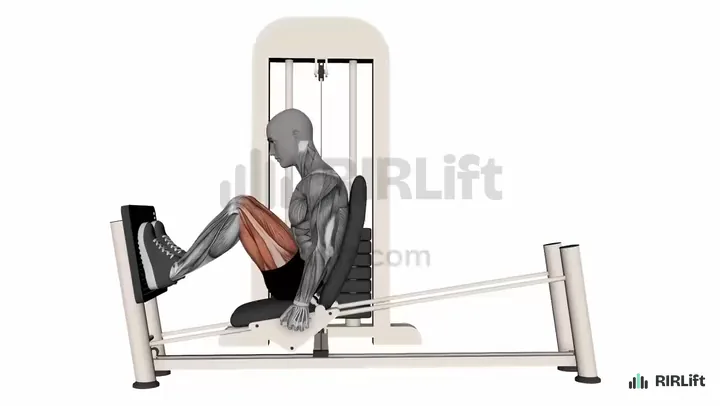
Leg Press

Quads, Glutes

Loads your legs hard with no balance to manage, which makes it the first lift of a short machine day.

How to do it

  1. Sit in the machine with your whole back against the pad and your feet hip-width on the platform.
  2. Release the safety handles and bend your knees, bringing the platform toward you under control.
  3. Lower until your knees are bent to about 90 degrees or a little deeper, without your lower back curling off the pad.
  4. Press the platform away until your legs are nearly straight, and repeat.

Cues

  • Lower back stays on the pad
  • Whole foot pushes
  • Stop just short of locking out

Common mistakes

  • Going so deep that your hips roll up off the seat: stop where your back stays flat.
  • Snapping the knees straight at the top: keep a soft bend.

Swap for: 45-Degree Leg Press, Hack Squat, Barbell Back Squat

Chest and triceps, machine press

Machine Chest Press

Chest

A press you can push close to failure with no spotter. Note the seat height in the exercise notes so every session starts the same.

How to do it

  1. Raise or lower the seat until the handles line up with the middle of your chest, then sit with your back on the pad.
  2. Take the handles with straight wrists and your shoulder blades pressed back.
  3. Push forward until your arms are nearly straight.
  4. Return slowly until your hands are level with your chest, then press again.

Cues

  • Handles at mid-chest
  • Back stays on the pad
  • Slow on the way back

Common mistakes

  • Seat too high, so your shoulders take over: lower it until the handles meet your mid-chest.
  • Stopping the handles short of your chest: let them come all the way back each rep.

Swap for: Flat Dumbbell Press, Incline Push-Up, Dumbbell Floor Press

Hamstrings, machine curl

Seated Leg Curl

Hamstrings

Isolates the hamstrings in a few minutes, and it pairs well with an upper-body machine in a superset.

How to do it

  1. Set the backrest so your knees line up with the machine's pivot, and lock the thigh pad down firmly.
  2. Rest the lower pad just above your heels with legs straight.
  3. Curl your heels down and back under the seat as far as they go.
  4. Let the pad rise slowly until your legs are straight again, and repeat.

Cues

  • Thigh pad snug
  • Pull heels under the seat
  • Two seconds on the way up

Common mistakes

  • Lifting your hips off the seat to finish the rep: tighten the thigh pad and lighten the stack.
  • Letting the stack crash between reps: control it all the way to straight legs.

Swap for: Lying Leg Curl, Romanian Deadlift, Nordic Hamstring Curl

Lats, cable pulldown

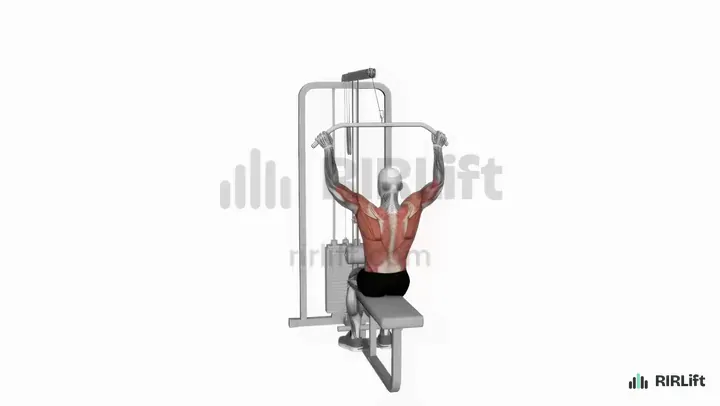
Lat Pulldown

Lats

The vertical pull of a gym session. The stack makes it easy to load exactly, so small steps up are easy to take.

How to do it

  1. Set the thigh pad so your legs are locked under it, then stand up and take the bar a little wider than your shoulders, palms forward.
  2. Sit down with your arms fully stretched overhead and lean back only slightly.
  3. Pull the bar to your upper chest by driving your elbows down toward your hips.
  4. Let the bar rise until your arms are straight and your shoulders lift toward your ears, then pull again.

Cues

  • Elbows to your back pockets
  • Bar to the top of the chest
  • Let the stack lift you at the top

Common mistakes

  • Leaning far back and rowing the bar to your stomach: stay nearly upright so it remains a vertical pull.
  • Stopping with the arms still bent at the top: the stretch overhead is half of what makes the pulldown work.

Swap for: Pull-Up, Neutral-Grip Lat Pulldown, Single-Arm Lat Pulldown

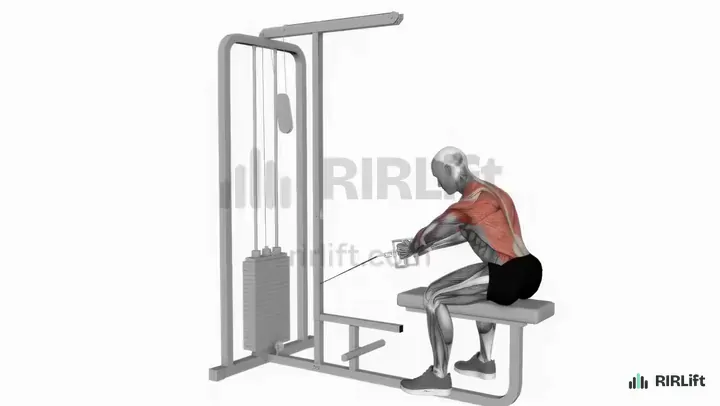
Upper back, cable row

Seated Cable Row

Upper Back, Lats

A horizontal pull with steady tension through the whole rep. It fills in for the barbell row when your lower back is tired.

How to do it

  1. Sit at the cable row with your feet on the platform and knees slightly bent, holding a close-grip handle with your arms straight.
  2. Sit tall with your chest up and let the cable pull your shoulder blades forward a little.
  3. Row the handle to your lower ribs, driving your elbows back past your torso.
  4. Return it under control until your arms are straight and your shoulders reach forward, then repeat.

Cues

  • Sit tall, no rocking
  • Handle to the belly button
  • Shoulders reach at the front

Common mistakes

  • Rocking back and forth to move the stack: your torso should stay close to upright throughout.
  • Shrugging the handle up toward your neck: pull your shoulders down before the elbows bend.

Swap for: Chest-Supported Row, Single-Arm Cable Row, Barbell Row

Side shoulders, cable raise

Cable Lateral Raise

Shoulders

Short rests and high reps suit it, so it fits at the end of any day without stretching the session.

How to do it

  1. Set both pulleys of a crossover at the bottom and stand between them, feet about shoulder width.
  2. Cross your arms low in front of your thighs: your right hand holds the left handle, your left hand the right one.
  3. Stand tall and raise both arms out to the sides, elbows slightly bent, until your hands reach shoulder height.
  4. Lower slowly until the handles cross again in front of your thighs. On a single pulley, do the same one arm at a time.

Cues

  • Lead with the elbow
  • Push the handle out, not up
  • Shoulder height and stop

Common mistakes

  • Heaving the weight up with a lean and a shrug: if your torso moves, drop the pin a step.
  • Raising past shoulder height: the traps take over above that point.

Swap for: Leaning Cable Lateral Raise, Dumbbell Lateral Raise, Cable Y Raise

Triceps, cable pressdown

Cable Triceps Pressdown

Triceps

A finisher for the presses. Keep the elbows pinned and log the last rep you got with clean form.

How to do it

  1. Attach a bar or rope to a high pulley and grip it with your elbows at your sides.
  2. Push down until your elbows are straight.
  3. Let the handle rise until your forearms are just past parallel, then push again.

Cues

  • Elbows stay pinned
  • Lock out at the bottom

Common mistakes

  • Letting the elbows rise and flare: keep them glued to your sides.

Swap for: Cable Cross Pushdown, Overhead Cable Triceps Extension, Close-Grip Push-Up

Dumbbells when the rack is taken

These stand in for the barbell lifts at the same effort. Swap one in from the Watch and its first weight is worked out from the lift it replaces.

Quads and glutes, rear foot elevated

Bulgarian Split Squat

Quads, Glutes
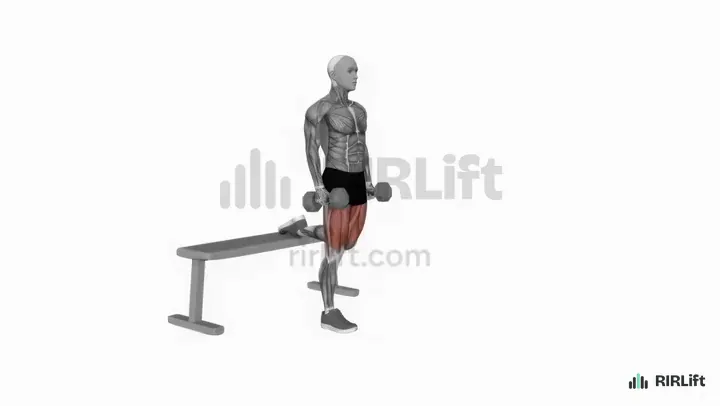
Replaces the back squat when the racks are full. One leg at a time works hard with dumbbells you can carry to any bench.

How to do it

  1. Set the top of your back foot on a bench and place your front foot a long stride ahead.
  2. Hold a dumbbell in each hand at your sides, and keep your front foot flat.
  3. Drop your back knee straight toward the floor until the front thigh is close to level.
  4. Press through the front foot to rise, then finish all reps before switching legs.

Cues

  • Go deep for the inner thigh
  • Front foot flat
  • Rear foot is just a kickstand

Common mistakes

  • Pushing up with the back leg: let it relax and make the front leg do the work.
  • Front knee collapsing inward: keep it pointed the same way as your toes.

Swap for: Dumbbell Split Squat, Step-Up, Reverse Lunge

Upper chest and shoulders, dumbbell press

Incline Dumbbell Press

Chest

The bench press stand-in. Dumbbells need only a free bench and let each arm press its own path.

How to do it

  1. Set the backrest to about 30 to 45 degrees and sit with the dumbbells on your thighs.
  2. Lean back and bring the weights to the outside of your shoulders as your back meets the pad.
  3. Squeeze your shoulder blades back and keep your hips on the seat.
  4. Press up and slightly in until your arms are straight over your upper chest.
  5. Lower under control until your elbows are just below the bench line.

Cues

  • Low incline, not a shoulder press
  • Wrists stacked over elbows
  • Touch the stretch, then press

Common mistakes

  • Setting the bench steeper than about 45 degrees: the front delts take over. Drop it a notch if you mostly feel your shoulders.
  • Lifting your hips off the seat to finish a rep: that turns it back into a flat press.

Swap for: Single-Arm Incline Dumbbell Press, Incline Dumbbell Squeeze Press, Incline Barbell Bench Press

Lats and upper back, one-arm row

One-Arm Dumbbell Row

Lats, Upper Back

Replaces the barbell row with a heavier dumbbell than you would expect, one side at a time.

How to do it

  1. Put one hand and the same-side knee on a bench, or your hand on a chair seat with both feet on the floor, so your back is flat.
  2. Hold a dumbbell in the other hand with your arm hanging straight.
  3. Pull your elbow back toward your hip until the dumbbell reaches your ribs.
  4. Lower it until your arm is straight again, finish all reps, then switch sides.

Cues

  • Elbow to your hip
  • Back flat as a table
  • Full stretch at the bottom

Common mistakes

  • Twisting your chest open to lift the dumbbell higher: keep both shoulders level.
  • Shrugging the shoulder up toward your ear: pull the elbow back, not the shoulder up.

Swap for: Band Bent-Over Row, Dumbbell Bent-Over Row, Seated Cable Row

Put them together: example sessions

Each session below picks from the exercises above for one situation, with the sets, reps, rest and RIR filled in.

Session 1

Barbell days, phone in the locker

  • Workouts3× a week
  • Working sets36 a week
  • Per workout~35 min
  • EquipmentBarbells, Flat Bench, Lat Pulldown, Adjustable Cable +1

You train three times a week in a full gym and want the bar, the plates and the log on your wrist, with nothing in your pocket.

Two full-body days alternate through the week: a squat and bench day, and a hinge and row day. Each has 12 working sets in the 5 to 15 rep ranges, with long rests on the barbell lifts so they can stay heavy.

Day A: Squat and bench
ExerciseSets × repsRIRRest
Barbell Back Squat2 warm-up sets first 3 × 5–8 2 3 min
Barbell Bench Press1 warm-up set first 3 × 5–8 2 2:30 min
Lat Pulldown 3 × 8–12 2 90 s
Cable Lateral Raise 3 × 12–15 1 1 min
Day B: Hinge and row
ExerciseSets × repsRIRRest
Romanian Deadlift1 warm-up set first 3 × 6–10 2 2:30 min
Barbell Row 3 × 6–10 2 2 min
Leg Press 3 × 10–15 2 2 min
Cable Triceps Pressdown 3 × 10–15 1 1 min
How to run it
Alternate A and B, three days a week: A, B, A one week and B, A, B the next. Start the day's routine on the Watch, log each set before you rest, and use the +15 s button when a squat set needs longer.
How to progress
Double progression, judged on your weakest set. Squat at 185 lb with a target of 7: you log 8, 8, 7, the weakest set hit 7, so next time the bar stays at 185 lb and the target is 8. Log 8, 8, 8 and every set is at the top of 5 to 8, so the next session opens at 190 lb for 5. If a lift goes three sessions without a new rep, the recap offers a lighter week; you choose.

Session 2

40-minute lunch hour, machines and cables only

  • Workouts2× a week
  • Working sets34 a week
  • Per workout~25 min
  • EquipmentLeg Press, Chest Press, Seated Leg Curl, Lat Pulldown +2

You have 40 minutes between meetings and no time to wait for a rack or change plates.

Every exercise loads with a pin. The two supersets pair a leg machine with an upper-body machine, so one rest covers two sets and the session fits 17 working sets into 40 minutes.

Machine day
ExerciseSets × repsRIRRest
A1 Leg Press 3 × 10–15 2 90 s
A2 Machine Chest Press 3 × 8–12 2 90 s
B1 Seated Leg Curl 3 × 10–15 1 75 s
B2 Lat Pulldown 3 × 8–12 1 75 s
Seated Cable Row 3 × 10–12 1 75 s
Cable Lateral Raise 2 × 12–20 1 45 s
How to run it
Twice a week with a day between. On the Watch a superset reads "Superset 1 of 2 · Round 1 of 3": log the leg press, walk to the chest press, log it, and the rest timer starts after the second set of the pair.
How to progress
Each machine moves on its own. Leg press at 230 lb for 15, 15, 15 tops the 10 to 15 range, so the next session opens at 235 lb for 10. Chest press at 120 lb for 12, 10, 9: the weakest set is inside the range but short of the top, so the weight holds.

Session 3

Every rack is taken: the dumbbell day

  • Workouts1× a week
  • Working sets11 a week
  • Per workout~30 min
  • EquipmentDumbbells, Incline Bench, Seated Leg Curl

Peak hour: the squat racks and benches have a queue and the dumbbell area is open.

The same week of training without a barbell: split squats for legs, an incline press, a one-arm row and a leg curl, 11 working sets in about 30 minutes. You keep the lifts moving instead of waiting.

Dumbbell day
ExerciseSets × repsRIRRest
Bulgarian Split SquatPer leg. 3 × 8–12 2 90 s
Incline Dumbbell Press 3 × 8–12 2 2 min
One-Arm Dumbbell RowPer arm. 3 × 8–12 2 75 s
Seated Leg Curl 2 × 10–15 1 1 min
How to run it
Use it in place of Day A or B whenever the queue is longer than your rest. When a routine needs equipment the gym is missing, the Watch offers replacements before the session starts and can remember the choice for that gym.
How to progress
Dumbbells are logged per hand. Incline press with 50 lb dumbbells for 12, 12, 12 is the top of 8 to 12 on every set, so next time it is 55 lb for 8. The first time you swap in a dumbbell lift, its starting weight comes from your barbell numbers, adjusted for the equipment.

Make it fit you

Questions

What workout do I choose on Apple Watch for the gym?

For lifting, Apple's type is Traditional Strength Training. When you run the session in RIRLift you do not choose: any session with a lift in it is saved to Apple Health as Traditional Strength Training.

Can Apple Watch track a gym workout?

Apple's Workout app records time and calories. To track the weight and reps of every set you need a lifting app on the Watch; RIRLift logs weight, reps and reps in reserve per set and records heart rate while the session runs.

Do I need my phone at the gym?

No. The session runs on the Watch and each set is saved there as you log it, so a phone left in the locker costs you nothing. Everything syncs back to the iPhone afterward.

What if I add a treadmill run after lifting?

Apple Health stores one type per workout, so a lifting session that ends with a run is saved as Traditional Strength Training. A session that is only the run is saved as running.

Is it free?

Logging, the rest timer, swaps and the next weight on the Watch are free on iPhone and Apple Watch. Pro adds the plates per side on the Watch and your own plates and bar.