Bodyweight exercises: the 18 that build muscle, by muscle group

The best bodyweight exercises are the push-up and its angles for chest, shoulders and triceps, the pull-up and chin-up for your back, one-leg squats, reverse lunges and the Nordic hamstring curl for your legs, and the dead bug and hanging knee raise for your core. Pick one exercise per pattern, do 2 to 4 sets that end 1 or 2 reps short of failure, and move to a harder variant once you pass 15 to 20 clean reps. The three sessions below are built for what you actually have: a floor, a pull-up bar, or a floor and enough strength to need harder moves.

  1. Push-Up Chest
  2. Pull-Up Lats
  3. Bodyweight Squat Quads
  4. Reverse Lunge Quads, Glutes
  5. Pike Push-Up Shoulders
  6. Chin-Up Lats
  7. Nordic Hamstring Curl Hamstrings
  8. Skater Squat Quads, Glutes
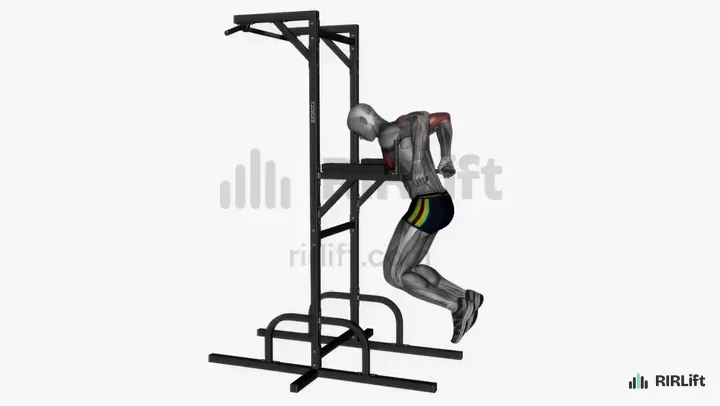
  9. Chest Dip Chest, Triceps
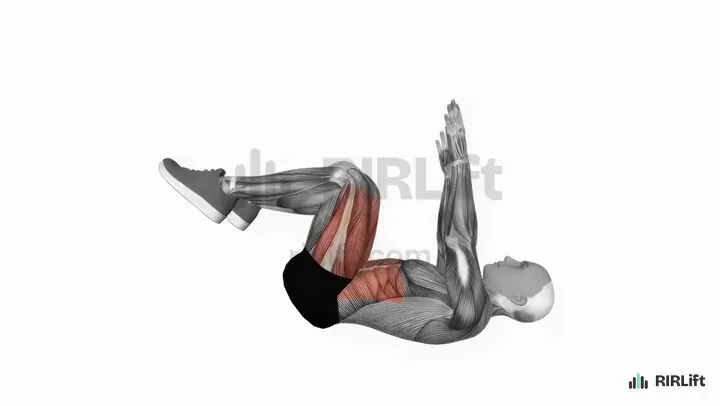
  10. Dead Bug Abs

Bodyweight push exercises: chest, shoulders and triceps

Every push here is a push-up with the angle or the hand position changed. Hands up on a counter makes it easier, feet up on a chair makes it harder, hips in the air turns it into a shoulder press, and hands close together shifts it to your triceps. Pick the version that lands you between 6 and 20 reps, and move to the next one up when you pass 20.

Chest, horizontal press

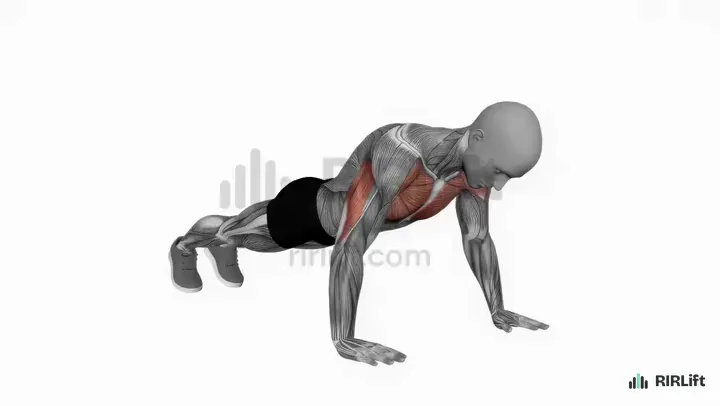
Push-Up

Chest

The push-up trains your chest, front delts and triceps through the same range as a bench press, and it scales in both directions by changing the angle. It's the one exercise on this page everyone should be able to do for 20 clean reps before moving on.

How to do it

  1. Set your hands a little wider than your shoulders, fingers forward, and step your feet back so your body is one straight line from head to heels.
  2. Squeeze your glutes and tuck your ribs so your hips don't sag.
  3. Lower until your chest is a fist's height from the floor, elbows angled about 45 degrees from your sides.
  4. Press the floor away until your arms are straight, then start the next rep.

Cues

  • Body one straight line
  • Elbows at 45 degrees, not flared
  • Chest to the floor, not chin

Common mistakes

  • Hips sagging or piking as the set gets hard: the rep count stops where the straight line breaks.
  • Half reps that stop a foot above the floor: lower until your chest nearly touches, or switch to the incline push-up so you can.

Swap for: Incline Push-Up, Kneeling Push-Up, Wide Push-Up

Build a session with Push-Up

Chest, easier press

Incline Push-Up

Chest

Putting your hands on a counter, bench or the third stair takes a chunk of your bodyweight off your arms, so you can do full-range reps from the first session. Lower the surface every time you pass 15 reps, and you walk straight into floor push-ups.

How to do it

  1. Place your hands on a stable surface at about hip height, a little wider than your shoulders.
  2. Walk your feet back until your body is straight from head to heels, arms locked.
  3. Bend your elbows at about 45 degrees from your sides and lower your chest to the edge.
  4. Push back to straight arms without letting your hips drop.

Cues

  • Lower the surface, not the reps
  • Chest to the edge every rep
  • Hips stay in line

Common mistakes

  • Staying on a high counter for months: when you hit 15 reps on all sets, drop to a lower step.
  • Letting your head lead and your hips trail: move your whole body as one plank.

Swap for: Kneeling Push-Up, Push-Up, Wide Push-Up

Upper chest and shoulders, harder press

Decline Push-Up

Chest

Feet on a chair tips more of your weight onto your hands and shifts the work toward your upper chest and front delts, like an incline bench press. It's the first step up once floor push-ups pass 20 reps.

How to do it

  1. Put your feet on a chair or bench and your hands on the floor under your shoulders.
  2. Brace so your body is straight from heels to head, no sag at the hips.
  3. Lower until your forehead is just above the floor, elbows about 45 degrees from your sides.
  4. Press back to locked arms, keeping your hips from rising first.

Cues

  • Higher feet, harder rep
  • Forehead toward the floor
  • Press the floor away

Common mistakes

  • Piking your hips to make the press easier: if the straight line goes, use a lower chair.
  • Letting your shoulders ride up to your ears at the bottom: keep them pulled down and back.

Swap for: Push-Up, Archer Push-Up, Weighted Push-Up

Shoulders, vertical press

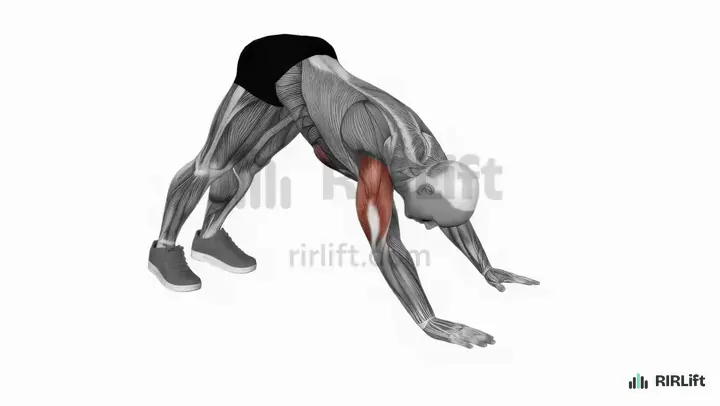
Pike Push-Up

Shoulders

With your hips high and your head aiming at the floor, the push-up becomes an overhead press for your front and side delts and triceps. It's the only bodyweight move that presses straight up, so it earns a place on any shoulder day without weights.

How to do it

  1. Start in a push-up position, then walk your feet toward your hands until your hips are high and your body makes an upside-down V.
  2. Keep your arms and legs straight and look at a spot between your hands.
  3. Bend your elbows and lower the top of your head toward the floor, just in front of your hands.
  4. Press back up until your arms lock, keeping your hips high the whole set.

Cues

  • Hips high, head to the floor
  • Elbows track forward, not out wide
  • Feet on a chair when 12 reps feel easy

Common mistakes

  • Turning it into a sloppy decline push-up by letting the hips drop: keep the V shape or the shoulders stop doing the work.
  • Touching the floor with your nose by sliding forward: your head should land in front of your hands, not between your feet.

Swap for: Handstand Push-Up, Decline Push-Up, Handstand Hold

Triceps, press

Close-Grip Push-Up

Triceps, Chest

Hands under your shoulders and elbows pinned to your ribs moves most of the work to your triceps, which is what chair dips are supposed to do without the shoulder stress. Do it after your chest push-up, when 8 to 15 reps is a real set.

How to do it

  1. Set your hands directly under your shoulders, fingers forward, body straight from head to heels.
  2. Lower with your elbows brushing your ribs the whole way down.
  3. Stop when your chest is a fist's height from the floor.
  4. Press back to full lockout and squeeze your triceps at the top.

Cues

  • Elbows brush your ribs
  • Full lockout at the top
  • Slow on the way down

Common mistakes

  • Elbows drifting out as you tire: that turns it back into a normal push-up, so end the set when they flare.
  • Hands too narrow with thumbs touching: shoulder-width is enough; a diamond just hurts your wrists.

Swap for: Floor Triceps Dip, Push-Up, Bench Dip

Chest and triceps, heavy press (dip bars)

Chest Dip

Chest, Triceps

Between two bars your entire bodyweight sits on your chest and triceps, so dips get hard at 6 to 12 reps while push-ups need 20. If you have dip bars or a pair of parallel rails, this is the heaviest press you can do without weights.

How to do it

  1. Grip the bars with straight arms and lift your feet off the floor, crossing your ankles behind you.
  2. Lean your chest forward about 30 degrees and keep your shoulders down.
  3. Lower until your upper arms are about parallel to the floor and you feel a stretch across your chest.
  4. Press back up to straight arms without rocking forward or back.

Cues

  • Lean forward for chest
  • Upper arm to parallel
  • Shoulders down, not shrugged

Common mistakes

  • Dropping far below parallel to feel a bigger stretch: parallel is the depth; past it the set ends.
  • Staying bolt upright with elbows tucked: that's a triceps dip, which is fine, just not the chest version.

Swap for: Decline Push-Up, Close-Grip Push-Up, Bench Dip

Build a session with Chest Dip

Bodyweight pull exercises: back and biceps

Pulling is where bodyweight runs out first: without something to hang from, there is nothing to pull against. A doorway pull-up bar fixes it in one purchase, and the pull-up and chin-up then load your back and biceps with your whole body. Until you have one, the bodyweight bicep curl keeps your biceps working, and the home workout plans linked below show how bands fill the rest of the gap.

Lats, vertical pull

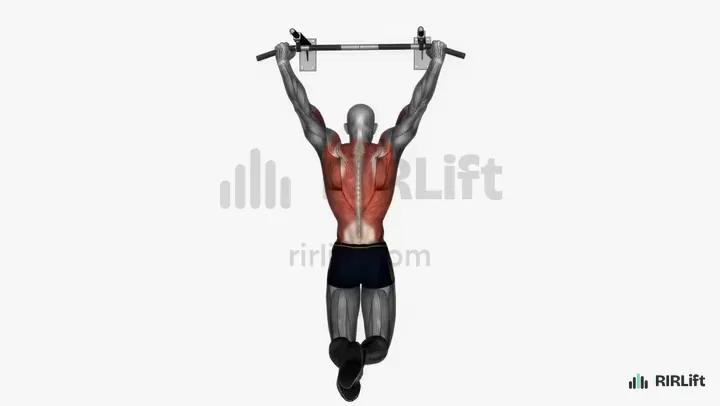
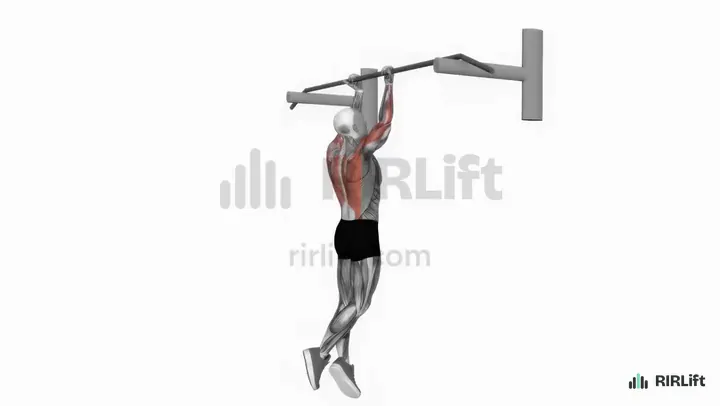
Pull-Up

Lats

The pull-up loads your lats and biceps with your full bodyweight through a long range, and the demand doesn't fade the way push-ups do: 4 to 10 reps stays a hard set for years. A doorway bar is the single most useful piece of bodyweight equipment because of this one exercise.

How to do it

  1. Grab the bar palms away, hands a little wider than your shoulders, and hang with straight arms and still legs.
  2. Pull your shoulder blades down first, then drive your elbows toward your back pockets.
  3. Keep pulling until your chin clears the bar.
  4. Lower over about two seconds to a full hang before the next rep.

Cues

  • Shoulders down before you bend your elbows
  • Elbows to back pockets
  • Full hang every rep

Common mistakes

  • Kicking or swinging to get the last reps: the set ends when you need momentum.
  • Reps that start from bent elbows: only count the ones that begin from a dead hang.

Swap for: Chin-Up, Neutral-Grip Pull-Up, Band-Assisted Pull-Up

Build a session with Pull-Up

Lats and biceps, vertical pull

Chin-Up

Lats

Palms facing you puts your biceps in their strongest position, so most people get a few more reps than on the pull-up and their arms do more of the work. It's your bodyweight biceps exercise as much as a back exercise, which is why it headlines the second bar day below.

How to do it

  1. Grab the bar palms facing you, hands about shoulder-width apart, and hang with straight arms.
  2. Start each rep by drawing your shoulder blades down, before your elbows bend.
  3. Drive your elbows down to your sides until your chin is above the bar.
  4. Lower under control to a full hang.

Cues

  • Elbows to your sides
  • Chin over, chest up
  • Slow lowering builds the biceps

Common mistakes

  • Shrugging up into your ears at the top: keep your shoulders down so your lats finish the rep.
  • Dropping fast out of the top: the lowering half is where the biceps grow, so take two seconds.

Swap for: Pull-Up, Neutral-Grip Pull-Up, Close-Grip Chin-Up

Build a session with Chin-Up

Biceps, no bar needed

Bodyweight Bicep Curl

Biceps

Gripping a door frame and leaning back turns your own weight into a curl, so your biceps get direct work on days you have no bar. It's a stand-in: when you can do 20 reps, the fix is a pull-up bar, not more reps.

How to do it

  1. Stand in a doorway and grip both sides of the frame at about hip height, palms facing in.
  2. Step one foot forward and lean back until your arms are straight and holding your weight.
  3. Curl your body toward the frame by bending your elbows, keeping them pointed down.
  4. Lower back to straight arms under control; step your feet further forward to make it harder.

Cues

  • Lean back until the arms work
  • Elbows stay pointed down
  • Feet forward for harder reps

Common mistakes

  • Pulling with your back by driving the elbows behind you: keep them in front of your body like a curl.
  • Standing too upright so the reps are free: if 20 is easy, walk your feet forward.

Swap for: Chin-Up, Close-Grip Chin-Up, Neutral-Grip Pull-Up

Bodyweight leg exercises: quads, glutes, hamstrings and calves

Two-legged squats get easy within weeks, so the leg list leans on one leg at a time: reverse lunges, then skater squats, then pistol squats to a chair. Your hamstrings only get real work from the Nordic curl, which is hard enough that 3 to 8 reps is a full set, and your calves take one leg at a time off a step.

Quads and glutes, squat

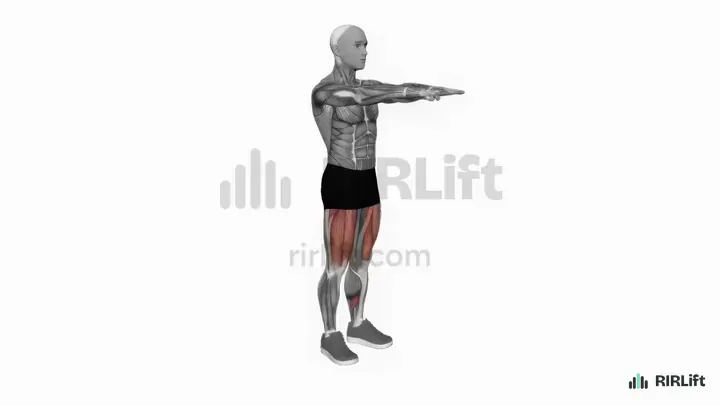
Bodyweight Squat

Quads

The squat is the pattern every leg exercise on this page grows out of, and the one to own first: full depth, heels down, knees tracking over your toes. It stops being hard around 25 reps, which is your cue to move to lunges and one-leg squats.

How to do it

  1. Stand with your feet about shoulder-width apart, toes turned out slightly, arms out in front for balance.
  2. Push your hips back and bend your knees, keeping your heels flat and your chest up.
  3. Lower until your thighs are at least parallel to the floor, deeper if your heels stay down.
  4. Drive through your whole foot to stand tall, then go straight into the next rep.

Cues

  • Heels glued to the floor
  • Knees over toes
  • Thighs to parallel or lower

Common mistakes

  • Knees caving in on the way up: push them out over your little toes.
  • Quarter squats to hit a rep count: a full-depth set of 12 beats a shallow set of 30.

Swap for: Reverse Lunge, Wall Sit, Jump Squat

Quads and glutes, split stance

Reverse Lunge

Quads, Glutes

Stepping back puts most of your weight on the front leg, so each rep is roughly a one-leg squat without the balance problem of a pistol. It's the first move to switch to when two-legged squats pass 25 reps.

How to do it

  1. Stand tall with your feet hip-width apart.
  2. Step one foot back and lower until your back knee hovers just above the floor and your front shin is roughly vertical.
  3. Drive through your front heel to stand back up, bringing your feet together.
  4. Do all reps on one leg, then switch; sets are per leg.

Cues

  • Front shin vertical
  • Back knee kisses the floor
  • Push through the front heel

Common mistakes

  • Leaning forward and pushing off the back foot: the front leg should do the work, so stand up through that heel.
  • Short steps that jam the front knee past your toes: step back far enough that the front shin stays upright.

Swap for: Skater Squat, Cossack Squat, Bodyweight Squat

Quads and glutes, one-leg squat

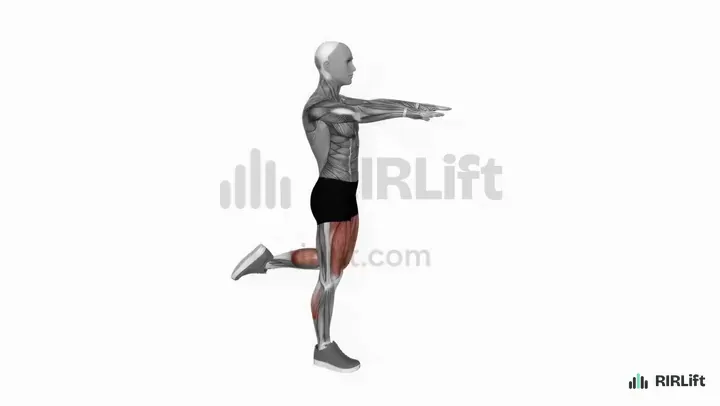
Skater Squat

Quads, Glutes

Standing on one leg with the other bent behind you, you lower until the back knee nearly touches, which is a pistol squat without the hamstring flexibility problem. Holding your arms out in front keeps you balanced, and it stays hard at 5 to 12 reps for a long time.

How to do it

  1. Stand on one foot and bend the other knee so that foot is behind you, arms straight out in front as a counterweight.
  2. Push your hips back and lean your chest forward as you bend the standing knee.
  3. Lower until the back knee is just above the floor.
  4. Drive through your standing foot to stand tall; sets are per leg.

Cues

  • Arms forward as the counterweight
  • Chest leans, back stays flat
  • Back knee to a folded towel

Common mistakes

  • Only going down a few inches: put a folded towel or cushion where your knee should land and touch it every rep.
  • Letting the standing knee collapse inward: track it over your toes, and slow the lowering if it wobbles.

Swap for: Pistol Squat, Reverse Lunge, Cossack Squat

Quads and glutes, hardest one-leg squat

Pistol Squat

Quads, Glutes

A full one-leg squat with the other leg held out in front loads your quads with your whole bodyweight, so 4 to 10 reps is a serious set. Sitting back to a chair, as in the clip, lets you control the depth and build toward the full version.

How to do it

  1. Stand on one leg in front of a chair or box, the other leg straight out in front and arms reaching forward.
  2. Push your hips back and bend the standing knee, lowering slowly toward the seat.
  3. Touch the chair lightly, without sitting your weight down, and keep the front leg off the floor.
  4. Drive through the standing heel to stand all the way up; sets are per leg.

Cues

  • Touch the chair, don't sit
  • Reach forward to stay balanced
  • Lower the chair as you get stronger

Common mistakes

  • Dropping onto the seat and bouncing back up: control the lowering and barely touch, or raise the seat.
  • Heel popping up at the bottom: shift your weight to mid-foot and use a higher box until it stays down.

Swap for: Skater Squat, Reverse Lunge, Sissy Squat

Hamstrings, knee flexion

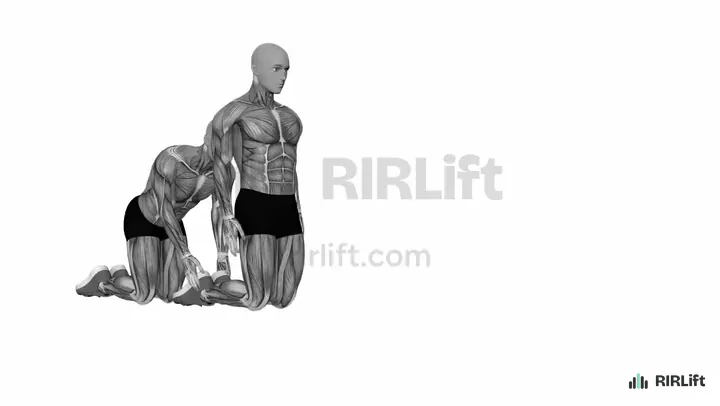
Nordic Hamstring Curl

Hamstrings

Squats and lunges leave your hamstrings mostly untrained, and the Nordic curl is the one bodyweight move that loads them hard: you lower your whole torso against their pull. Most people manage 3 to 5 reps at first, and that's enough.

How to do it

  1. Kneel on a cushion with your ankles pinned under a couch, or held by a partner, and your body upright from knees to head.
  2. Squeeze your glutes and lower your torso forward as slowly as you can, bending only at the knees.
  3. When your hamstrings can't hold you, catch yourself with your hands on the floor.
  4. Push off the floor lightly and pull with your hamstrings to come back up to kneeling.

Cues

  • Hips stay open, no folding
  • Lower as slowly as possible
  • Hands catch, then help up

Common mistakes

  • Bending at the hips to make the lowering easier: keep a straight line from knees to shoulders.
  • Flopping to the floor after a few inches: fight it the whole way down; the slow lowering is the rep.

Swap for: Single-Leg RDL, Band Good Morning, Superman

Calves, isolation

Single-Leg Calf Raise

Calves

Two-legged calf raises are too easy to count, but one leg off the edge of a step doubles the load and lets you get a full stretch at the bottom. Hold the step with one hand and work in the 10 to 25 range.

How to do it

  1. Stand with the ball of one foot on the edge of a step, the other foot lifted, one hand on a wall or rail for balance.
  2. Let your heel drop below the step until your calf is fully stretched.
  3. Push up onto the ball of your foot as high as you can and hold for a second.
  4. Lower over two seconds; sets are per leg.

Cues

  • Heel below the step
  • Pause at the top
  • Two seconds down

Common mistakes

  • Bouncing out of the bottom: pause for a beat in the stretch before each rep.
  • Pulling yourself up with the hand on the wall: it's for balance only.

Swap for: Dumbbell Standing Calf Raise, Kettlebell Calf Raise, Standing Calf Raise

Bodyweight core exercises

Push-ups, pistols and pull-ups already brace your trunk, so core work is two or three sets at the end, not a separate day. The dead bug trains you to keep your lower back flat under moving limbs, the side plank covers your obliques, and once you have a bar the hanging knee raise is the one that gets hard enough to progress.

Abs, anti-extension

Dead Bug

Abs

Lying on your back with your lower back pressed to the floor while you reach an arm and leg away teaches your abs to resist arching, the same job they do under a squat or push-up. It's the core exercise every plan on this page starts with because it's hard to do wrong.

How to do it

  1. On your back, reach both arms at the ceiling and float your knees up so your shins are level with the floor.
  2. Press your lower back into the floor and keep it there.
  3. Lower one arm overhead and the opposite leg toward the floor until just before your back wants to arch.
  4. Return to the start and switch sides; one rep is both sides.

Cues

  • Lower back glued down
  • Exhale as the limbs go out
  • Stop before the arch

Common mistakes

  • Letting your ribs flare and your back lift as the leg goes down: shorten the range until it stays flat.
  • Rushing: each rep should take about four seconds.

Swap for: Reverse Crunch, Lying Knee Raise, Long Lever Plank

Build a session with Dead Bug

Obliques, anti-lateral flexion

Side Plank

Abs

Holding your body straight on one elbow works the obliques and the deep side muscles that nothing else on this page reaches. Build toward 45 seconds a side; after that, stack your feet or raise the top leg instead of holding longer.

How to do it

  1. Lie on your side with your elbow directly under your shoulder and your legs straight, top foot in front of the bottom foot.
  2. Lift your hips until your body is one straight line from head to heels.
  3. Hold, breathing normally, with your top hand on your hip or reaching up.
  4. Lower under control and repeat on the other side.

Cues

  • Hips up and forward
  • Elbow under shoulder
  • Breathe through the hold

Common mistakes

  • Hips sagging toward the floor as the hold goes on: end the set the moment the line bends.
  • Rolling your chest toward the floor: stack your shoulders and hips over each other.

Swap for: Copenhagen Plank, Long Lever Plank, Dead Bug

Abs, hip flexion (pull-up bar)

Hanging Knee Raise

Abs

Hanging from the bar and curling your knees to your chest loads your abs through a full range, and when it gets easy you straighten your legs instead of adding reps. It also doubles as grip work for your pull-ups.

How to do it

  1. Take a shoulder-width grip on the bar and let your body go still before the first rep.
  2. Tuck your pelvis and lift your knees toward your chest, letting your lower back round.
  3. Pause for a second at the top.
  4. Lower your legs slowly until they hang straight, without swinging.

Cues

  • Tuck the pelvis, don't just lift the legs
  • Pause at the top
  • No swing between reps

Common mistakes

  • Swinging to generate momentum: let the body stop between reps, even if that means fewer of them.
  • Lifting only the thighs with a flat back: the rep counts when your hips curl up toward your ribs.

Swap for: Lying Knee Raise, Reverse Crunch, Captain's Chair Knee Raise

Put them together: example sessions

Each session below picks from the exercises above for one situation, with the sets, reps, rest and RIR filled in. Open one in the session builder to change a pick, price it from a recent set, and add it to RIRLift.

Session 1

Nothing but a floor and a doorway

Open in the session builder
  • Workouts3× a week
  • Working sets48 a week
  • Per workout~40 min
  • EquipmentBodyweight

You have floor space, a chair and a door frame, no bar, and you want one session you can repeat three times a week.

With no bar there is no way to hang, so the pulling muscles get the bodyweight bicep curl and everything else comes from the floor: a push-up, a squat, a lunge, calves and a core move. Sixteen sets in one session, repeated three days a week, gives your chest and biceps 9 hard sets a week and your quads 18, which is plenty while the exercises are new. Every set ends 1 or 2 reps short of failure, because bodyweight only builds muscle when the set gets close to the limit.

Floor Full Body
ExerciseSets × repsRIRRest
Bodyweight Squat1 warm-up set firstFull depth, heels down. Past 25? Lunges only 3 × 12–25 1 90 s
Push-UpUnder 6 reps? Hands on a counter 3 × 6–20 1 90 s
Reverse LungeSets are per leg. Back knee to the floor 3 × 8–15 1 90 s
Bodyweight Bicep CurlFeet further forward when 20 is easy 3 × 8–20 1 1 min
Single-Leg Calf RaisePer leg. Heel below the step, pause at top 2 × 10–25 1 1 min
Dead BugLower back stays glued to the floor 2 × 6–12 2 1 min
How to run it
Do the session three days a week with a rest day between, for example Monday, Wednesday and Friday. If floor push-ups give you fewer than 6 clean reps, swap in the incline push-up with your hands on a counter and lower the surface as you get stronger.
How to progress
Beat last session's reps. When every set reaches the top of its rep range, make the move harder instead of adding reps: push-ups go to the decline push-up, squats become reverse lunges only, and the bodyweight bicep curl gets your feet further forward. That is the moment to add a pull-up bar and move to the next session.

Session 2

Floor plus a pull-up bar or dip bars

Open in the session builder
  • Workouts3× a week
  • Working sets48 a week
  • Per workout~45 min
  • EquipmentPull-Up Bar, Dip Bar

You have a doorway pull-up bar, maybe a pair of dip bars, and you can do at least 3 strict pull-ups.

A bar changes the whole plan: pull-ups and chin-ups take over from the bodyweight bicep curl, so your back finally gets loaded, and dips become the heaviest press you can do. Both days open with the pull while you're fresh, and the two days split the one-leg work so that the skater squat and the Nordic curl get a day to themselves. Pulls sit at 4 to 12 reps with longer rests because your full bodyweight is on the bar every rep.

Bar Day A
ExerciseSets × repsRIRRest
Pull-Up1 warm-up set firstFull hang each rep. Add weight past 3x10 4 × 4–10 1 2:30 min
Chest DipLean forward. No bars? Decline push-up 3 × 6–12 1 2 min
Skater SquatPer leg. Back knee touches a towel 3 × 5–12 1 2 min
Nordic Hamstring CurlLower as slowly as you can 3 × 3–8 2 2:30 min
Hanging Knee RaiseNo swing. Straighten legs when 15 is easy 3 × 8–15 1 1 min

Open Bar Day A in the session builder

Bar Day B
ExerciseSets × repsRIRRest
Chin-Up1 warm-up set firstTwo seconds down every rep 4 × 5–12 1 2:30 min
Decline Push-UpFeet on a chair. Higher feet = harder 3 × 6–20 1 90 s
Reverse LungePer leg. Push through the front heel 3 × 8–15 1 90 s
Pike Push-UpHips high, head to the floor 3 × 5–15 1 2 min
Single-Leg Calf RaisePer leg. Pause at the top 3 × 10–20 1 1 min

Open Bar Day B in the session builder

How to run it
Alternate Bar Day A and Bar Day B, three sessions a week with a day between, so you do A, B, A one week and B, A, B the next. No dip bars? Do the decline push-up in place of the chest dip on Day A and keep the rest unchanged.
How to progress
Add one rep to a set each session until you reach the top of every range, then make the exercise harder: raise your feet higher on push-ups, straighten your legs on the knee raise, and once pull-ups hit 3 sets of 10, hang a weight from a belt or a backpack. Build the Nordic curl by lowering slower before you chase reps.

Session 3

Past 20 push-ups, still no bar

Open in the session builder
  • Workouts3× a week
  • Working sets54 a week
  • Per workout~50 min
  • EquipmentBodyweight

You can do 20 or more clean push-ups and 25 squats, you train with no equipment, and the basic moves stopped feeling like training.

Once the basics pass 20 reps, more reps mostly build endurance, so this session swaps every exercise for a harder variant that puts you back in the 3 to 15 range: feet up for the chest, hips up for the shoulders, one leg for the quads and the Nordic curl for the hamstrings. The only equipment is a chair for the decline push-up and the pistol squat, plus something to hook your heels under for the Nordic curl. Rests are longer than the floor session because each set is heavier.

Harder Variants Full Body
ExerciseSets × repsRIRRest
Pistol Squat1 warm-up set firstPer leg. Touch the chair, don't sit 3 × 4–10 2 2 min
Decline Push-UpFeet on the chair. Forehead to the floor 3 × 6–15 1 2 min
Nordic Hamstring CurlAnkles under the couch. Slow down 3 × 3–8 2 2:30 min
Pike Push-UpFeet on the chair when 12 is easy 3 × 5–12 1 2 min
Close-Grip Push-UpElbows brush your ribs 2 × 8–15 1 90 s
Skater SquatPer leg. Slow lowering 2 × 6–12 1 90 s
Dead BugFour seconds per rep 2 × 8–12 1 1 min
How to run it
Do the session three days a week with a day between. If the pistol squat to a chair is too hard, use the skater squat in its place for a month, then come back to it with a higher seat.
How to progress
When a set reaches the top of its range, change the variant, not the rep target: a higher chair for the decline push-up, feet on the chair for the pike push-up, a lower seat for the pistol, and a slower lowering on the Nordic curl. When these also pass their ranges, the next step is a pull-up bar and the session above.

Make it fit you

Questions

What are bodyweight exercises?

Exercises where your own body is the resistance: push-ups, pull-ups, squats, lunges, dips and core moves like the dead bug. They build muscle the same way weights do, as long as the set gets within a couple of reps of failure, and you progress by switching to a harder variant instead of adding weight.

Can you build muscle with only bodyweight exercises?

Yes. Light loads build about as much muscle as heavy ones when the set ends close to failure, and a push-up or pull-up taken to 1 or 2 reps in reserve does that. The limit is your pull: without a bar there is nothing to hang from, so a doorway pull-up bar is the one purchase that matters.

What are the big 5 bodyweight exercises?

Push-up, pull-up, squat, lunge and dip cover every major muscle except your hamstrings, which need the Nordic curl. The pull-up bar session is built from all of them plus a core move; the floor sessions cover everything but the pull.

What are some good bodyweight push exercises?

The push-up for your chest, the decline push-up with your feet on a chair for your upper chest and shoulders, the pike push-up for a pressing motion straight overhead, the close-grip push-up for your triceps, and the chest dip if you have bars. Pick the version that gives you 6 to 20 reps.

What are good leg exercises I can do at home without equipment?

Bodyweight squats until they pass 25 reps, then reverse lunges, skater squats and pistol squats to a chair for your quads and glutes, the Nordic hamstring curl with your ankles under a couch for your hamstrings, and single-leg calf raises off a step. The harder-variants session above is exactly that list.

Will 100 push-ups a day get you in shape?

It will make you good at push-ups and build some chest and triceps for the first few weeks, then stall, because sets of 30 and 40 train endurance more than size. Three sets of a harder variant that stops you at 8 to 15 reps, three days a week, builds more muscle than 100 easy reps, and it leaves room for the squats, pulls and hinges that 100 push-ups skip.

How many days a week should I do bodyweight exercises?

Three full-body sessions a week with a day between is the default on this page. Your weekly hard sets per muscle are what drive growth, and two, three or four sessions build muscle at least as well as each other when the weekly sets match, so pick the frequency you can keep.

Is it OK to do bodyweight exercises every day?

Easy sets, yes; hard sets, no. Sets taken within 1 or 2 reps of failure need about 48 hours before you repeat them for the same muscle, so alternate muscle groups or leave a day between full-body sessions. Daily training at a low effort mostly builds the habit, not the muscle.