Cable exercises by muscle, with sessions for the cables you have

The cable exercises worth learning first are the lat pulldown, seated cable row, cable fly, cable lateral raise, face pull, triceps pressdown and cable curl. Cables beat free weights where a dumbbell goes slack: the stretch of a fly, the bottom of a lateral raise or curl. Pick by what your gym has: one adjustable column covers raises, pulls, arms, legs and core, while a crossover and a pulldown station add the chest and back.

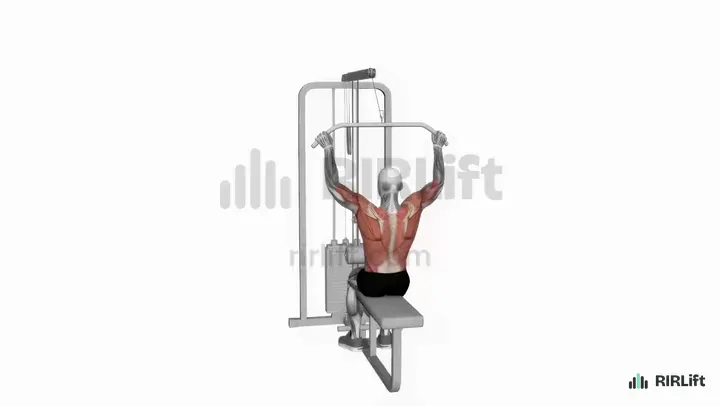
  1. Lat Pulldown Lats
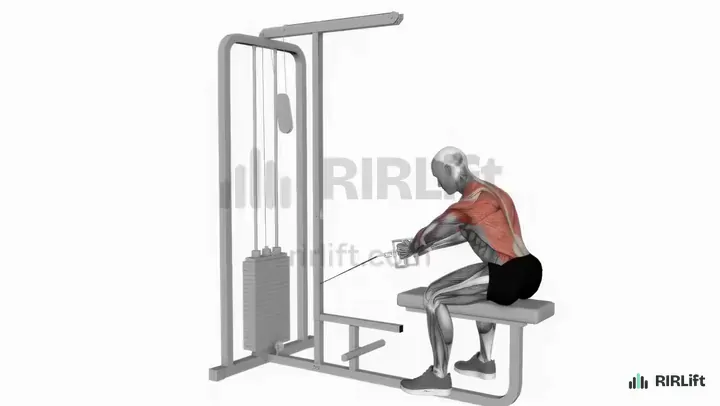
  2. Seated Cable Row Upper Back, Lats
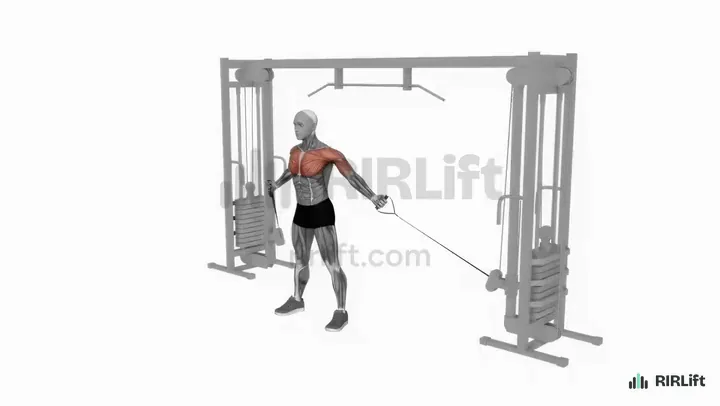
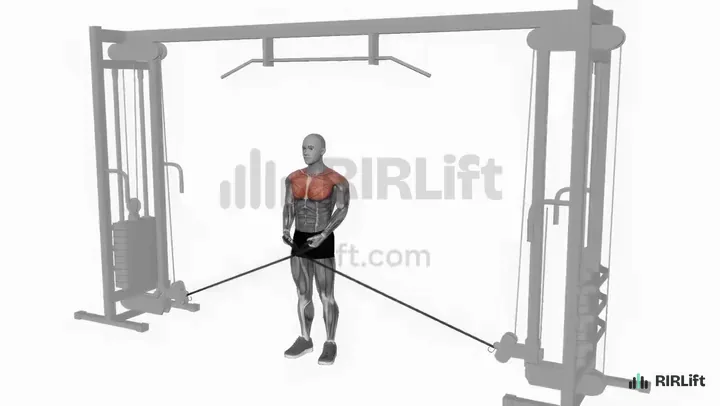
  3. Cable Fly Chest
  4. Cable Lateral Raise Shoulders
  5. Face Pull Shoulders, Upper Back
  6. Cable Triceps Pressdown Triceps
  7. Cable Curl Biceps
  8. Cable Pull-Through Glutes, Hamstrings

Cable chest exercises

Cable flies need a crossover with two pulleys. Pulley height sets the angle: shoulder height for the whole chest, low to high for the upper chest, one arm at a time when the second pulley is busy.

Chest, fly at mid height

Cable Fly

Chest

The crossover keeps the chest loaded at the point where a dumbbell fly goes slack: arms nearly together in front of you. Set the pulleys at shoulder height and it trains the whole chest in one angle.

How to do it

  1. Set both pulleys at about shoulder height and take a handle in each hand.
  2. Step forward until the stacks lift, one foot ahead of the other, chest up.
  3. With a soft bend in your elbows, open your arms until you feel a stretch across your chest.
  4. Sweep the handles together in a wide arc until your hands meet in front of your sternum, then open slowly.

Cues

  • Hug a big tree
  • Elbows stay soft and fixed
  • Squeeze for a second where the hands meet

Common mistakes

  • Bending and straightening your elbows each rep: that turns the fly into a press. Lock the elbow angle and move only at the shoulder.
  • Standing so close that the weight stack rests at the open position: step forward until the cables pull back on you at full stretch.

Swap for: High-to-Low Cable Fly, Single-Arm Cable Fly, Dumbbell Chest Fly

Build a session with Cable Fly

Upper chest, rising fly

Low-to-High Cable Fly

Chest

Pulling from the low pulleys up to face height puts the work on the upper chest, the part flat pressing tends to leave behind.

How to do it

  1. Set both pulleys at the bottom and hold a handle in each hand, palms facing forward.
  2. Take a step forward, staggered stance, arms down and slightly behind your hips.
  3. Keeping your elbows softly bent, sweep the handles up and in until they meet at chin height.
  4. Lower back along the same arc until your arms are just behind your body again.

Cues

  • Scoop up and in
  • Ribs down, chest proud
  • Hands finish at chin height, not overhead

Common mistakes

  • Shrugging the handles up with your traps: keep your shoulders down and let the arc come from the chest.
  • Leaning back to finish the rep: if you need to, the weight is too heavy.

Swap for: Cable Fly, Incline Cable Fly, Incline Dumbbell Press

Chest, one side at a time

Single-Arm Cable Fly

Chest

One arm at a time lets you cross past the midline for a harder squeeze and shows you which side is weaker. It is also the fly you can do when the second pulley is taken.

How to do it

  1. Set one pulley at shoulder height and stand side-on to it, handle in the near hand.
  2. Step away until the stack lifts and your arm is out to the side with a soft elbow.
  3. Sweep the handle across in front of your body until your hand passes your midline.
  4. Return slowly until you feel the stretch, finish the reps, then switch sides.

Cues

  • Free hand on your chest to feel it work
  • Turn only at the shoulder
  • Reach past the middle

Common mistakes

  • Twisting your torso to move the handle: square your hips and shoulders to the front and keep them there.
  • Letting the cable yank your arm back at the stretch: control the opening as slowly as the squeeze.

Swap for: Cable Fly, Low-to-High Cable Fly, Pec Deck Fly

Cable back exercises

Pick one vertical pull and one row, then add the straight-arm pulldown if your arms tire before your back. The pulldown and row each need their own station; the single-arm row also works from any pulley set at chest height.

Lats, vertical pull

Lat Pulldown

Lats

The pulldown is the cable version of the pull-up, with a pin you can move by small steps. That makes it the most reliable way to build up to and past your bodyweight.

How to do it

  1. Set the thigh pad so your legs are locked under it, then stand and take the bar a little wider than your shoulders.
  2. Sit down with arms straight and lean back slightly, chest up.
  3. Pull the bar to your upper chest by driving your elbows down toward your back pockets.
  4. Let the bar rise until your arms are straight and your shoulders lift, then pull again.

Cues

  • Elbows to back pockets
  • Chest meets the bar
  • Full stretch at the top every rep

Common mistakes

  • Swinging your torso back to finish the rep: a slight lean is fine, a rowing motion means the weight is too heavy.
  • Stopping the bar halfway up: the stretch at the top is where the lats work hardest.

Swap for: Neutral-Grip Lat Pulldown, Single-Arm Lat Pulldown, Pull-Up

Mid back and lats, horizontal pull

Seated Cable Row

Upper Back, Lats

The seated row trains the upper back and lats with your chest supported by nothing but your own posture, and the cable keeps tension at the stretch where a dumbbell row goes light.

How to do it

  1. Sit at the row station with your feet on the platform and knees slightly bent.
  2. Grab the handle, sit tall with arms straight and let your shoulders reach forward.
  3. Pull the handle to your lower ribs, elbows close to your sides, squeezing your shoulder blades together.
  4. Let the handle travel back until your arms are straight and your shoulder blades spread, without rounding your lower back.

Cues

  • Sit tall, then pull
  • Elbows past your ribs
  • Reach forward with the shoulders, not the spine

Common mistakes

  • Rocking your torso back and forth to move the weight: your trunk stays near upright and only your arms and shoulder blades move.
  • Shrugging the handle toward your neck: pull to your ribs and keep your shoulders down.

Swap for: Wide-Grip Cable Row, Single-Arm Cable Row, Chest-Supported Row

Lats and mid back, one side

Single-Arm Cable Row

Upper Back, Lats

Rowing one arm at a time gives each lat a longer reach forward and a deeper pull back, and it evens out a side that lags on two-handed rows.

How to do it

  1. Attach a single handle at the row station or a pulley set at chest height.
  2. Hold the handle in one hand, arm straight, and let your shoulder reach toward the pulley.
  3. Pull your elbow back past your side, keeping your chest square to the front.
  4. Return until the arm is straight and the shoulder reaches forward again, then switch sides.

Cues

  • Elbow to hip
  • Reach long, pull long
  • Keep your chest facing the stack

Common mistakes

  • Turning your whole torso away to finish: a little rotation at the end is fine, turning sideways means the load is too heavy.
  • Pulling with the hand and biceps: think about the elbow, not the handle.

Swap for: Seated Cable Row, Single-Arm Lat Pulldown, One-Arm Dumbbell Row

Lats, isolation

Straight-Arm Pulldown

Lats

With straight arms the biceps drop out, so this is the lat exercise for when your arms give out before your back does, or a light finisher after rows.

How to do it

  1. Set a straight bar or rope on a high pulley and stand a step back, holding it at arm's length.
  2. Hinge forward slightly at the hips with your arms straight up in front of you.
  3. Sweep the bar down in an arc until it reaches your thighs, arms straight throughout.
  4. Let it rise back to eye level slowly, keeping the slight hinge.

Cues

  • Arms are levers, shoulders do the work
  • Push the bar to your thighs
  • Keep the hinge fixed

Common mistakes

  • Bending the elbows to press the bar down: that turns it into a triceps pushdown. Keep a fixed, slight bend.
  • Bobbing your torso with each rep: hold the hinge still and move only your arms.

Swap for: Lat Pulldown, Dumbbell Chest Pullover, Single-Arm Lat Pulldown

Cable shoulder exercises

Cables are at their best on the small shoulder muscles: the lateral raise loads the side delt from the bottom, and the face pull and rear delt fly cover the back of the shoulder.

Side delts, isolation

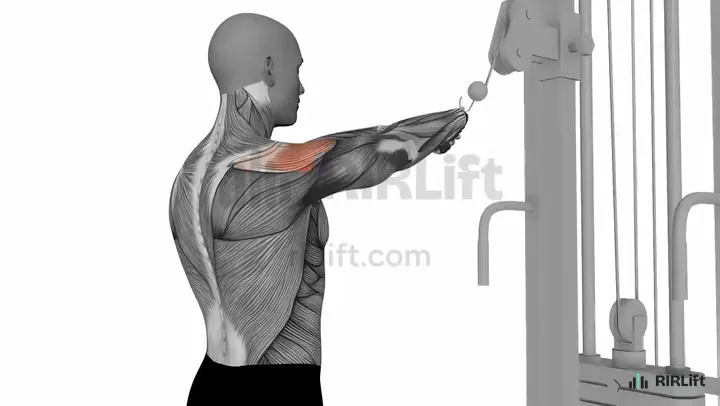
Cable Lateral Raise

Shoulders

A low pulley pulls across your body, so the side delt is loaded at the bottom of the raise, where a dumbbell lateral raise does almost nothing. Done one arm at a time, it is the best side-delt exercise most gyms have.

How to do it

  1. Set a pulley at the bottom and stand side-on, holding the handle in the far hand across your body.
  2. Stand tall with your free hand on the machine for balance.
  3. Raise your arm out to the side, elbow slightly bent, until your hand reaches shoulder height.
  4. Lower slowly until the handle is back in front of your hip, finish the reps, then switch sides.

Cues

  • Lead with the elbow
  • Push the handle out, not up
  • Shoulder height and stop

Common mistakes

  • Heaving the weight up with a lean and a shrug: if your torso moves, drop the pin a step.
  • Raising past shoulder height: the traps take over above that point.

Swap for: Leaning Cable Lateral Raise, Dumbbell Lateral Raise, Cable Y Raise

Rear delts and upper back, high pull

Face Pull

Shoulders, Upper Back

The face pull trains the rear delts and the muscles that pull your shoulder blades back, which most pressing-heavy weeks leave short. It works from a single pulley with a rope.

How to do it

  1. Set a rope on a pulley at about forehead height and grab both ends with your thumbs facing you.
  2. Step back until your arms are straight and the stack lifts, feet staggered.
  3. Pull the rope toward your eyes, splitting the ends apart and driving your elbows out and back.
  4. Pause with your hands beside your ears, then let the rope return until your arms are straight.

Cues

  • Pull the rope apart
  • Elbows high and wide
  • Finish with hands by your ears

Common mistakes

  • Pulling to your chest with low elbows: that becomes a row. Keep your elbows at shoulder height or above.
  • Leaning back to move more weight: this is a light, controlled exercise; stand still.

Swap for: Rear Delt Cable Fly, Band Face Pull, Cable Y Raise

Build a session with Face Pull

Rear delts, isolation

Rear Delt Cable Fly

Shoulders

Crossing the cables and pulling each handle out to the opposite side isolates the rear delts with no arm bend to cheat with.

How to do it

  1. Set both pulleys at shoulder height and stand in the middle of the crossover.
  2. Take the left cable in your right hand and the right cable in your left hand, hands crossed in front of you.
  3. With straight arms, pull the handles out and back until your arms are in line with your body.
  4. Return slowly until your hands cross again.

Cues

  • Reach for the walls
  • Arms long, shoulders down
  • Stop when your arms line up with your shoulders

Common mistakes

  • Squeezing your shoulder blades hard together: that shifts the work to the upper back. Let the arms move and the blades stay quiet.
  • Too much weight: the rear delt is small; if your elbows bend to finish, go lighter.

Swap for: Face Pull, Dumbbell Rear Delt Fly, Reverse Pec Deck

Cable arm exercises

One curl and two triceps angles cover the arms. Pair the pressdown with the overhead extension so the triceps are trained both short and stretched.

Biceps, curl

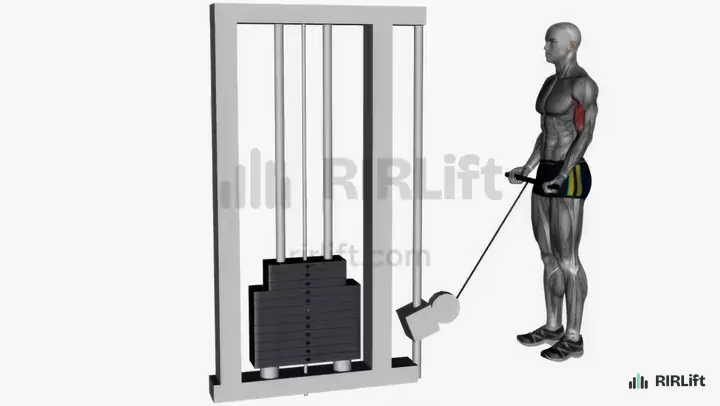
Cable Curl

Biceps

The cable keeps your biceps loaded at the bottom of the curl, where a dumbbell hangs straight down and does nothing. The pin also gives you smaller jumps than a dumbbell rack.

How to do it

  1. Attach a straight bar or rope to a low pulley and hold it with palms up, arms straight.
  2. Stand a short step back, elbows at your sides.
  3. Curl the handle toward your shoulders without moving your elbows forward.
  4. Lower until your arms are fully straight before the next rep.

Cues

  • Elbows pinned to your sides
  • Squeeze at the top
  • Straighten fully at the bottom

Common mistakes

  • Swinging your hips to start the rep: if you need momentum, the weight is too heavy.
  • Letting your elbows drift forward at the top: that takes the load off the biceps.

Swap for: Cable Twisting Curl, Overhead Cable Curl, Dumbbell Curl

Triceps, pushdown

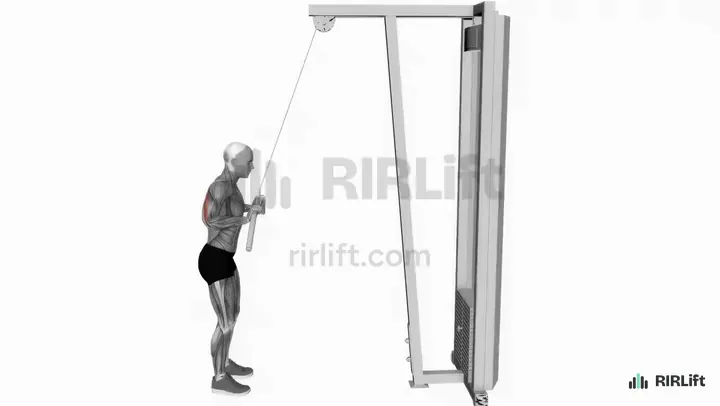
Cable Triceps Pressdown

Triceps

The pressdown is the triceps exercise that is easiest to load and progress, and it leaves your shoulders and elbows comfortable at high reps.

How to do it

  1. Attach a rope or straight bar to a high pulley and grab it with your elbows bent.
  2. Stand close, slight forward lean, elbows tucked at your sides.
  3. Push the handle down until your arms are straight, spreading the rope ends at the bottom.
  4. Let the handle rise until your forearms are just above parallel to the floor.

Cues

  • Elbows glued to your ribs
  • Only the forearms move
  • Lock out hard at the bottom

Common mistakes

  • Letting your elbows flare and your shoulders roll forward to push: that turns it into a press. Keep the elbows still.
  • Cutting the top short: let the forearm rise until the triceps are stretched.

Swap for: Cable Cross Pushdown, Overhead Cable Triceps Extension, Close-Grip Push-Up

Triceps, long head stretch

Overhead Cable Triceps Extension

Triceps

With your arms overhead the long head of the triceps is stretched under load, which pushdowns cannot do. It is the triceps exercise to pair with the pressdown.

How to do it

  1. Attach a rope to a low pulley, take it in both hands and turn away from the machine.
  2. Step forward with the rope behind your head, elbows pointing up, staggered stance.
  3. Extend your arms forward and up until they are straight, spreading the rope ends.
  4. Bend your elbows to lower the rope behind your head until your triceps are fully stretched.

Cues

  • Elbows point forward, not out
  • Deep stretch behind your head
  • Only the forearms move

Common mistakes

  • Letting your elbows flare wide as you push: keep them close to your head.
  • Arching your lower back to get under the rope: brace and lean forward from the hips instead.

Swap for: Cable Triceps Pressdown, Seated Dumbbell Overhead Triceps Extension, Cable Cross Pushdown

Cable leg and glute exercises

A cable rarely carries enough weight for a heavy two-legged squat, so leg work here is a hinge, one leg at a time, or a glute isolation. All three need only a low pulley.

Glutes and hamstrings, hinge

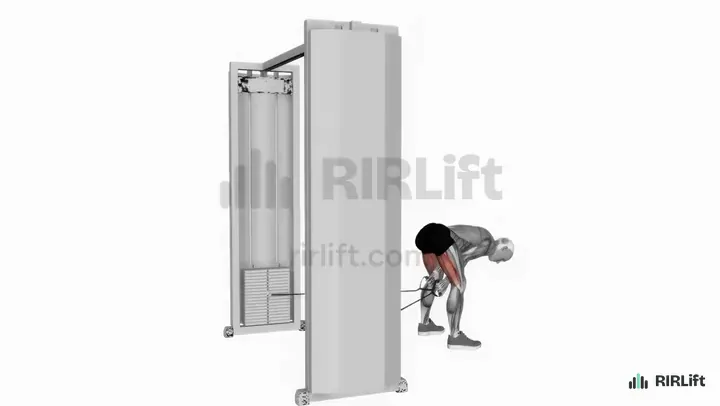
Cable Pull-Through

Glutes, Hamstrings

The pull-through teaches the hip hinge with the load pulling you backward, so you have to drive your hips through to stand. It is a glute and hamstring builder that does not need a barbell.

How to do it

  1. Attach a rope to a low pulley, turn your back to the stack and take the rope ends between your legs.
  2. Walk forward until the stack lifts, feet a bit wider than hips.
  3. Hinge back, letting the rope pull your hands between your thighs, back flat and knees softly bent.
  4. Drive your hips forward to stand tall and squeeze your glutes at the top.

Cues

  • Hips back, then hips through
  • Arms just hold the rope
  • Squeeze your glutes to finish

Common mistakes

  • Squatting down instead of hinging: your shins stay near vertical and your hips move back.
  • Pulling with the arms or leaning back at the top: stand tall and stop.

Swap for: Dumbbell Romanian Deadlift, Kettlebell Swing, Hip Thrust

Quads and glutes, one leg

Cable Split Squat

Quads, Glutes

Holding a low cable gives you a loaded split squat with the weight hanging close to your body, and the pin moves in small steps that a dumbbell rack cannot match.

How to do it

  1. Set a pulley at the bottom with a single handle, stand facing the machine and hold the handle in one hand.
  2. Take a long split stance, back heel up.
  3. Lower your back knee toward the floor until your front thigh is about parallel.
  4. Drive through your front foot to stand, finish the reps, then switch legs and hands.

Cues

  • Straight down, straight up
  • Front heel heavy
  • Torso tall

Common mistakes

  • A stance so short your front knee travels far past your toes and your heel lifts: lengthen the stance.
  • Pushing off the back foot: it is there for balance, the front leg does the work.

Swap for: Cable Goblet Squat, Dumbbell Split Squat, Bulgarian Split Squat

Glutes, isolation

Cable Glute Kickback

Glutes

The kickback works one glute at a time with almost no load on your back, so it is the glute exercise you can add at the end of any day.

How to do it

  1. Strap an ankle cuff to a low pulley and attach it to one ankle.
  2. Face the machine, hold the frame and hinge forward slightly.
  3. Kick the cuffed leg straight back, leading with the heel, until your hip is fully open.
  4. Return slowly until your foot is beside the other one, finish the reps, then switch.

Cues

  • Heel back, not up
  • Squeeze at the end, hold one second
  • Hips stay square

Common mistakes

  • Arching your lower back to get the leg higher: the rep ends when your hip is straight, not when your foot is high.
  • Swinging the leg: control the return as slowly as the kick.

Swap for: Hip Thrust, Cable Pull-Through, Glute Bridge

Cable core exercises

One flexion exercise you can load and one that resists twisting. Put them last in a session.

Abs, loaded crunch

Cable Crunch

Abs

The cable crunch lets you load the abs like any other muscle and progress by the pin, rather than adding endless reps.

How to do it

  1. Attach a rope to a high pulley and kneel facing the machine, holding the rope by your ears.
  2. Hinge slightly at the hips so the stack lifts.
  3. Curl your ribs toward your hips, rounding your spine, elbows toward your thighs.
  4. Uncurl slowly back to the start without letting your hips move.

Cues

  • Ribs to hips
  • Round your back, don't bow at the hips
  • Hands stay by your head

Common mistakes

  • Sitting back onto your heels to pull the weight: the hips stay still; only your spine curls.
  • Pulling with your arms: the rope just rides with your head.

Swap for: Pallof Press, Decline Crunch, Cable Woodchop

Core, anti-rotation

Pallof Press

Abs

The Pallof press trains your trunk to resist being twisted, which crunches do not. It is light, easy to learn and fits at the end of any session.

How to do it

  1. Set a pulley at chest height, stand side-on and hold the handle against your chest with both hands.
  2. Step out until the cable pulls, feet shoulder-width apart, knees soft.
  3. Press the handle straight out in front of your chest and hold it there for two seconds without turning.
  4. Bring it back to your chest, finish the reps, then face the other way.

Cues

  • Don't let it turn you
  • Ribs down, glutes on
  • Press straight, pause, return

Common mistakes

  • Rotating toward the machine as you press: step closer until you can hold square.
  • Rushing the reps: the pause with your arms straight is the exercise.

Swap for: Cable Woodchop, Dead Bug

Put them together: example sessions

Each session below picks from the exercises above for one situation, with the sets, reps, rest and RIR filled in. Open one in the session builder to change a pick, price it from a recent set, and add it to RIRLift.

Session 1

One adjustable cable station

Open in the session builder
  • Workouts3× a week
  • Working sets44 a week
  • Per workout~30 min
  • EquipmentAdjustable Cable

You have a single cable column with a pulley that slides from floor to overhead, at home or in a small gym, and no crossover or row seat.

A single column covers every exercise on this page that runs from one adjustable pulley: a one-leg squat, a hinge, a high pull, raises, curls, pushdowns and core work. Flies, pulldowns and seated rows need a second pulley or a dedicated station, so they are left out; the face pull is the pull in both routines. Two routines alternate so each muscle gets trained without repeating the same session back to back.

Full Body A
ExerciseSets × repsRIRRest
Cable Split Squat1 warm-up set firstPer leg. Handle in the hand opposite the front leg 3 × 8–12 2 90 s
Cable Lateral RaisePer arm. Stop at shoulder height 3 × 12–15 1 1 min
Face PullPulley at forehead height 3 × 12–15 1 1 min
Cable Triceps PressdownElbows pinned 3 × 10–15 1 1 min
Pallof PressPer side. Two-second hold 2 × 8–12 2 1 min

Open Full Body A in the session builder

Full Body B
ExerciseSets × repsRIRRest
Cable Pull-Through1 warm-up set firstHips back, then through 3 × 10–15 2 90 s
Cable Glute KickbackPer leg 2 × 12–15 1 1 min
Cable CurlFull stretch at the bottom 3 × 10–15 1 1 min
Face PullPulley at forehead height 2 × 12–15 1 1 min
Overhead Cable Triceps ExtensionDeep stretch behind the head 2 × 10–15 1 1 min
Cable CrunchHips stay still 3 × 10–15 1 1 min

Open Full Body B in the session builder

How to run it
Alternate A and B three days a week with a day off between. You need the column, a single handle, a rope and an ankle cuff.
How to progress
Add a rep per set until every set reaches the top of its range at the target reps in reserve, then move the pin one step and start again at the bottom of the range.

Session 2

Full gym: crossover and lat pulldown

Open in the session builder
  • Workouts4× a week
  • Working sets70 a week
  • Per workout~40 min
  • EquipmentLat Pulldown, Cable Row, Cable Crossover, Adjustable Cable

You train in a gym with a cable crossover, a lat pulldown and a seated row, and you want sessions built mostly from cables.

With a crossover and dedicated stations, the back and chest get their own exercises: a pulldown and a row for the lats and mid back, two fly angles for the chest. Routine A is upper body; routine B pairs the lower-body cable lifts with one-arm back and chest work and the rear delts, so each muscle is trained twice a week.

Upper
ExerciseSets × repsRIRRest
Lat Pulldown1 warm-up set firstFull stretch at the top 3 × 8–12 2 2 min
Seated Cable RowPull to the lower ribs 3 × 8–12 2 90 s
Cable FlyPulleys at shoulder height 3 × 10–15 1 1 min
Low-to-High Cable FlyFinish at chin height 2 × 12–15 1 1 min
Cable Lateral RaisePer arm 3 × 12–15 1 1 min
A1 Cable Curl 2 × 10–15 1 1 min
A2 Cable Triceps Pressdown 2 × 10–15 1 1 min

Open Upper in the session builder

Lower and Back
ExerciseSets × repsRIRRest
Cable Split Squat1 warm-up set firstPer leg 3 × 8–12 2 90 s
Cable Pull-ThroughSqueeze the glutes to finish 3 × 10–15 2 90 s
Single-Arm Cable RowPer arm. Elbow to hip 3 × 10–12 2 1 min
Single-Arm Cable FlyPer arm. Reach past the middle 2 × 12–15 1 1 min
Rear Delt Cable FlyArms long 3 × 12–15 1 1 min
Cable Crunch 3 × 10–15 1 1 min

Open Lower and Back in the session builder

How to run it
Run A, B, A, B across four days, with at least one day off after the second pair. Blocks with the same superset letter are done back to back, then you rest.
How to progress
Use double progression: when every set reaches the top of the range at the target reps in reserve, move the pin one step. On the pulldown and row, add a warm-up set before each pin increase if the first set feels heavy.

Session 3

Cables after a free-weight day

Open in the session builder
  • Workouts2× a week
  • Working sets20 a week
  • Per workout~20 min
  • EquipmentAdjustable Cable, Lat Pulldown

Your main lifts are barbell or dumbbell work, and you can finish at a free cable stack.

Cables earn their place here on the small muscles free weights load poorly: the side and rear delts, the lats without the biceps, and loaded abs. These four add shoulder and core volume without tiring you for the next heavy day. Rest is short because nothing here is heavy.

Cable Finisher
ExerciseSets × repsRIRRest
Cable Lateral RaisePer arm 3 × 12–20 1 45 s
Face PullElbows high 3 × 12–20 1 45 s
Straight-Arm PulldownArms straight, bar to thighs 2 × 12–15 1 1 min
Cable Crunch 2 × 10–15 1 1 min
How to run it
Do this after any two training days a week, once your main lifts are done. Count these sets in your weekly total for shoulders and back so you do not double up.
How to progress
Add reps first; move the pin only when every set reaches the top of its range at the target reps in reserve.

Make it fit you

Questions

Can you build muscle with cables only?

Yes. Muscle grows from hard sets, not from a type of equipment. A cable gym covers every muscle on this page, and the full-gym session trains each one twice a week. Legs are the limit: a cable stack rarely loads a squat as heavily as a barbell, so heavier lifters may need a leg press or barbell squats for quads.

What are good cable back exercises?

The lat pulldown, seated cable row, single-arm cable row and straight-arm pulldown. Pick one vertical pull and one row each session, and add the straight-arm pulldown when your biceps tire before your back.

Why are cable exercises harder?

The cable pulls along its own line, so the muscle stays loaded through parts of the rep where a dumbbell goes light, such as the bottom of a curl or lateral raise. The pin number is also not comparable to a dumbbell weight, because pulleys change the ratio. Start lighter than you expect and log reps per set.

What is better, dumbbells or cables?

Neither builds more muscle on its own. Cables win on flies, lateral raises, curls and pushdowns, where they load the bottom or the stretch. Dumbbells win on presses, rows and lunges you can load heavily and do anywhere. Most programs use both: free weights first, cables after.

What are the best cable exercises for beginners?

The lat pulldown, seated cable row, triceps pressdown, cable curl and face pull. Each has one joint path, a pin you change in small steps, and a start position you can set up without help.

How many cable exercises should I do in a workout?

Four to seven, depending on how many muscles you train. The single-station sessions above use five or six, the full-gym ones six or seven, and the finisher four after free-weight work.