
Cable leg exercises for quads, glutes, hamstrings and calves
Published October 19, 2026
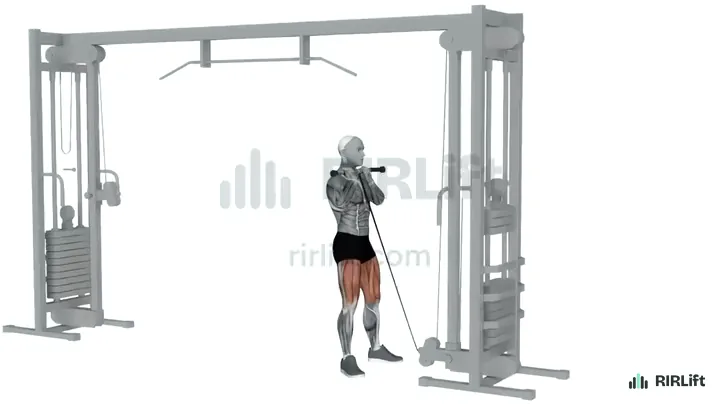
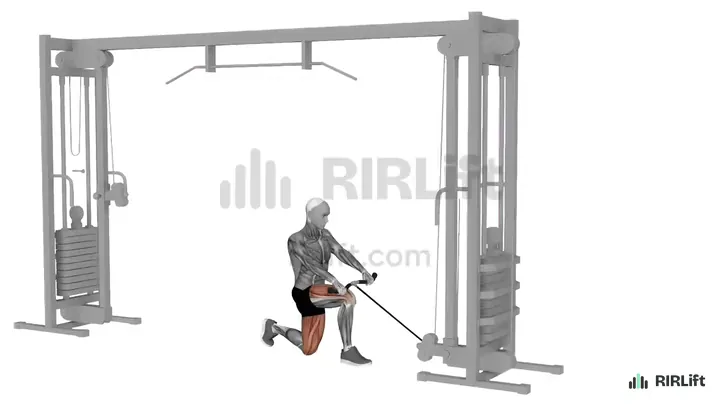
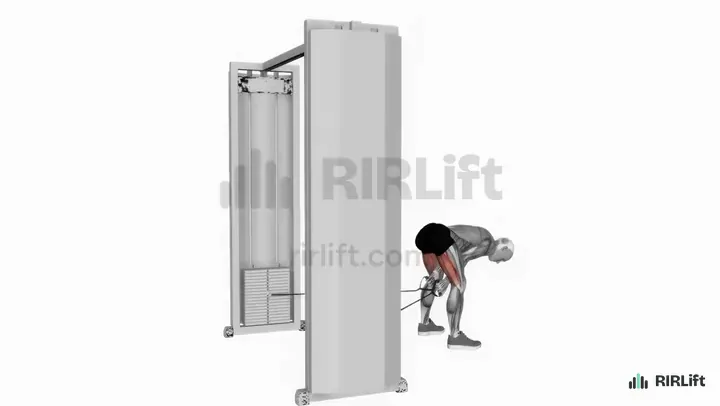
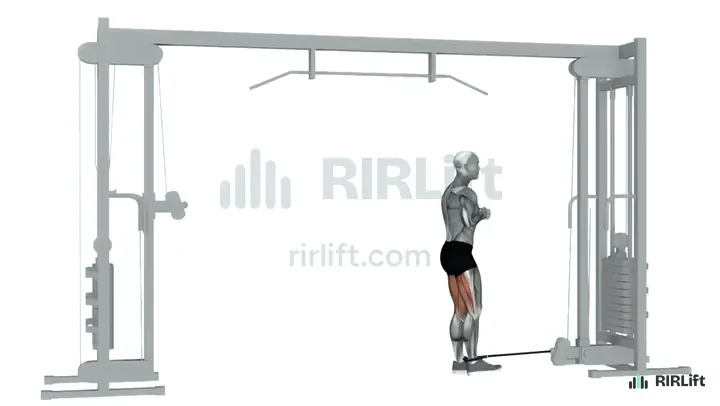
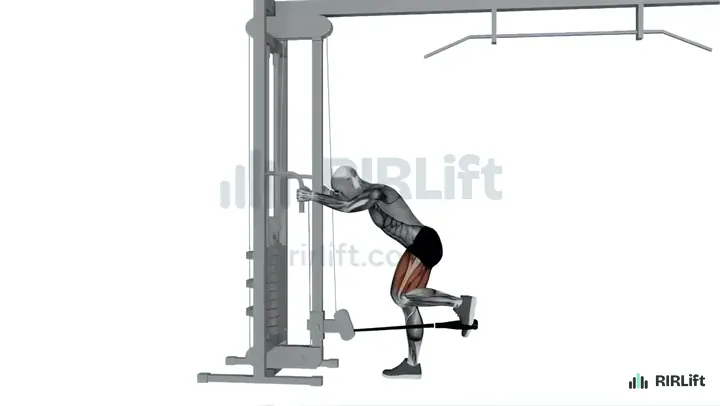
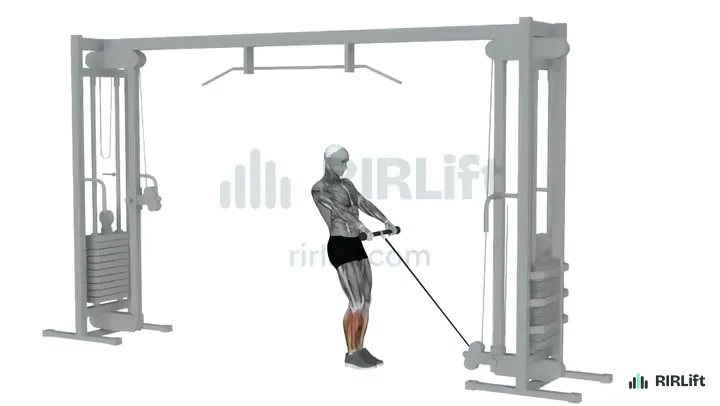
The best cable leg exercises are the cable goblet squat and cable split squat for your quads, the pull-through and glute kickback for your glutes, the standing cable leg curl for your hamstrings, and the cable calf raise for your calves. A cable keeps tension on the muscle through the whole rep and lets you change the load in small steps, which makes it ideal for one-leg work and for finishing a leg day after heavy squats. Pick one squat, one hinge or kickback, the curl and the calf raise, and four exercises cover the whole leg.
- Cable Goblet Squat Quads
- Cable Split Squat Quads, Glutes
- Cable Pull-Through Glutes, Hamstrings
- Cable Leg Curl Hamstrings
- Cable Glute Kickback Glutes
- Cable Calf Raise Calves
Put them together: example sessions
Each session below picks from the exercises above for one situation, with the sets, reps, rest and RIR filled in. Open one in the session builder to change a pick, price it from a recent set, and add it to RIRLift.
-
Session 1
A cable station is your whole leg day
You train in a gym where the cable towers are free but the racks and leg machines are not, or you simply prefer cables to a barbell.
2× a week · 27 sets a week · ~35 min
-
Session 2
Finisher after barbell squats or leg press
You already squat or leg press, and you want 15 minutes of cable work at the end to cover glutes and hamstrings.
2× a week · 16 sets a week · ~15 min
-
Session 3
A home cable tower or functional trainer, single-leg focus
You train at home on a functional trainer or cable tower with a light weight stack, and two-leg squats run out of load quickly.
3× a week · 32 sets a week · ~25 min
Session 1
A cable station is your whole leg day
- Workouts2× a week
- Working sets27 a week
- Per workout~35 min
- EquipmentAdjustable Cable
You train in a gym where the cable towers are free but the racks and leg machines are not, or you simply prefer cables to a barbell.
Without heavy squats, the cable split squat and goblet squat carry the quad work, so they come first while you are fresh and run at 1 to 2 reps in reserve. The pull-through and leg curl split the hamstring work between hip and knee, and the calf raise closes each session. Day B adds the kickback for one more glute exercise. The isolations go to 0 to 1 reps in reserve because a cable makes them safe to push. That is 14 hard sets per session.
| Exercise | Sets × reps | RIR | Rest |
|---|---|---|---|
| Cable Goblet Squat1 warm-up set firstTwo steps back from the pulley. | 4 × 8–12 | 2 | 2 min |
| Cable Pull-ThroughSqueeze 1 s at the top. | 3 × 10–15 | 1 | 90 s |
| Cable Leg CurlPer leg. Thigh still. | 3 × 10–15 | 1 | 1 min |
| Cable Calf RaiseOn a plate. Pause at the bottom. | 4 × 10–15 | 0 | 1 min |
Open Legs A in the session builder
| Exercise | Sets × reps | RIR | Rest |
|---|---|---|---|
| Cable Split Squat1 warm-up set firstPer leg. Weaker side first. | 4 × 8–12 | 1 | 90 s |
| Cable Glute KickbackPer leg. 1 s hold. | 3 × 12–15 | 1 | 1 min |
| Cable Leg CurlPer leg. 3 s lowering. | 3 × 12–20 | 0 | 1 min |
| Cable Calf Raise2 s hold at the top. | 3 × 12–20 | 0 | 1 min |
Open Legs B in the session builder
- How to run it
- Do Legs A and Legs B on two days each week with at least two days between them. Warm up with one light set of the first exercise.
- How to progress
- When every set hits the top of its rep range at the target reps in reserve, move the pin down one plate. For the one-leg exercises, start every set with your weaker side and match those reps on the other.
Session 2
Finisher after barbell squats or leg press
- Workouts2× a week
- Working sets16 a week
- Per workout~15 min
- EquipmentAdjustable Cable
You already squat or leg press, and you want 15 minutes of cable work at the end to cover glutes and hamstrings.
After a heavy squat, your quads have had their work, and what is usually missing is direct hamstring curling and glute lockout. So this plan skips the cable squats and uses three exercises your squat leaves undertrained, each paired into a superset to save time. Two to three sets each at 1 rep in reserve is enough on top of a full leg day.
| Exercise | Sets × reps | RIR | Rest |
|---|---|---|---|
| A1 Cable Pull-ThroughSuperset with the leg curl. | 3 × 10–15 | 1 | 1 min |
| A2 Cable Leg CurlPer leg. | 3 × 10–15 | 1 | 1 min |
| Cable Glute KickbackPer leg. Light and strict. | 2 × 12–20 | 1 | 45 s |
- How to run it
- Run it at the end of every leg day. Do the pull-through and leg curl back to back as a superset, rest, and repeat; then do the kickbacks.
- How to progress
- Add reps to the pull-through and curl until both reach 15, then move the pin. Keep the kickback light and add a 2-second hold before you add weight.
Session 3
A home cable tower or functional trainer, single-leg focus
- Workouts3× a week
- Working sets32 a week
- Per workout~25 min
- EquipmentAdjustable Cable
You train at home on a functional trainer or cable tower with a light weight stack, and two-leg squats run out of load quickly.
A home stack often tops out before two-leg squats get hard, so this plan trains each leg on its own: the split squat for quads, the kickback and leg curl for glutes and hamstrings, and the hip flexion to balance the hip. The pull-through stays because a two-leg hinge still challenges a light stack. One-leg sets run high in reps and finish at 0 to 1 reps in reserve so a light load still builds muscle. Three sessions of 12 sets fit easily around other training.
| Exercise | Sets × reps | RIR | Rest |
|---|---|---|---|
| Cable Split SquatPer leg. 3 s down. | 4 × 10–20 | 1 | 90 s |
| Cable Pull-ThroughSqueeze 1 s at the top. | 3 × 12–20 | 1 | 1 min |
| Cable Glute KickbackPer leg. | 3 × 12–20 | 0 | 45 s |
Open Home Legs A in the session builder
| Exercise | Sets × reps | RIR | Rest |
|---|---|---|---|
| Cable Split SquatPer leg. Pause at the bottom. | 3 × 10–20 | 1 | 90 s |
| Cable Leg CurlPer leg. | 3 × 12–20 | 0 | 1 min |
| Standing Cable Hip FlexionPer leg. Torso tall. | 2 × 12–20 | 1 | 45 s |
| Cable Calf RaiseOn a plate. | 3 × 12–20 | 0 | 45 s |
Open Home Legs B in the session builder
- How to run it
- Alternate Home Legs A and Home Legs B, three sessions a week, so each one comes up three times every two weeks.
- How to progress
- Once you reach the top of the rep range, slow the lowering to 3 seconds, then add a pause at the bottom of each split squat. Use a heavier attachment only when the stack is maxed out.
Make it fit you
-
Only one cable tower
Superset the leg curl and kickback on the same leg with the ankle strap left on, then switch legs. You change the attachment once per session instead of after every exercise.
-
Knees ache on squats
Take a longer stance on the cable split squat, or stop the goblet squat a few inches above parallel and slow the lowering to 3 seconds. Move the leg curl to the start of the session so the knees are warm before you squat.
-
Want more glute work
Swap the cable goblet squat for a second set of pull-throughs and add a third set of kickbacks. Keep the split squat: the long stance trains the glutes of the front leg too.
-
Stack too light for the pull-through
Use a 3-second lowering and a 2-second squeeze at the top, and take sets to 0 reps in reserve. When 25 reps is still easy, move the pull-through to a dumbbell Romanian deadlift.
-
New to cables
Start with the cable leg day at 2 reps in reserve on everything and three sets per exercise. Learn the ankle strap moves with a light pin; they feel odd for a week or two.
-
Log the RIR, not just the pin
Cable stacks vary between gyms, so the number on the pin means little on its own. Write down the reps you had left on every set. If you log in RIRLift, it uses that number to pick your next weight, so a new machine just takes a session or two to settle in.
Questions
Can you build legs with only cables?
Yes, as long as each set gets close to failure. The cable split squat and goblet squat train your quads, the pull-through and leg curl your hamstrings and glutes, and the calf raise your calves. The limit is the stack: when two-leg squats get too light, switch to one leg.
What is the best cable exercise for legs?
The cable split squat. It trains quads and glutes one leg at a time, and a cable loads it more heavily than you can comfortably hold dumbbells. Add a pull-through or leg curl for the back of the leg.
Are 4 exercises enough for leg day?
Yes. A squat for quads, a hinge for glutes and hamstrings, a leg curl, and a calf raise cover every major leg muscle. Three to four hard sets of each is around 12 to 16 sets, enough for most people when done twice a week.
What can I do instead of a leg extension on a cable machine?
Use the cable split squat with your front knee travelling forward over the toes, or the cable goblet squat with a narrow stance and an upright torso. Both put most of the load on your quads, and the split squat does it one leg at a time like a single-leg extension.
Do cable glute kickbacks work?
Yes, for the glutes specifically. They are an isolation exercise, so use them after a squat or hinge rather than in place of one, and keep the weight light enough to hold the top of each rep for a second.
How heavy should cable leg exercises be?
Heavy enough that each set ends 0 to 2 reps short of failure in the rep range given. Pulley setups differ between machines, so a weight that works on one tower may feel different on another; use the reps you had left, not the number on the pin.
Related templates
-
Machine leg exercises for quads, hamstrings, glutes and calves
Leg press, hack squat and leg curl machines when the gym has them free.
-
Leg exercises at the gym: barbells, machines and cables
Barbells, machines and cables combined into full gym leg days.
-
Cable pull-through: how to hinge it right, what it works, and what to swap it for
Full form guide for the cable hinge used in every plan here.
-
The best workout for your glutes and butt
Glute programs that pair cable kickbacks with hip thrusts and squats.
-
The best workout for legs, built for your situation
Complete leg programs for every setup, from home to full gym.