
Calf exercises at the gym: standing, seated and leg press raises
Published October 19, 2026
The best calf exercises at the gym are the standing calf raise machine and the seated calf raise machine. The standing raise, with straight knees, works the gastrocnemius, the upper calf; the seated raise, with bent knees, works the soleus underneath. When those are taken, the leg press, the Smith machine and the hack squat all work as calf machines. Do one straight-knee and one bent-knee raise, 3 to 4 sets each, with a pause at the bottom of every rep.
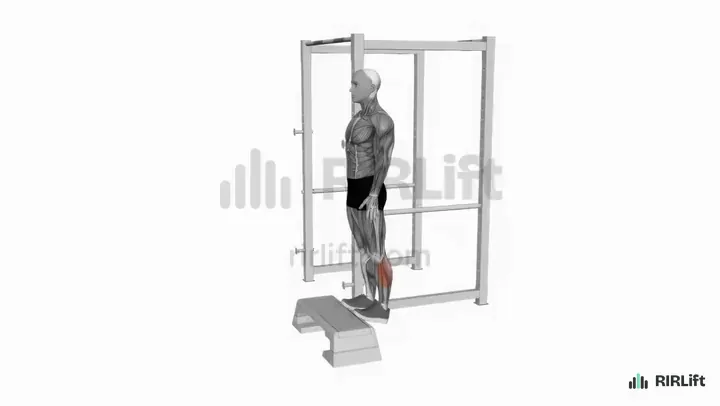
- Standing Calf Raise Calves
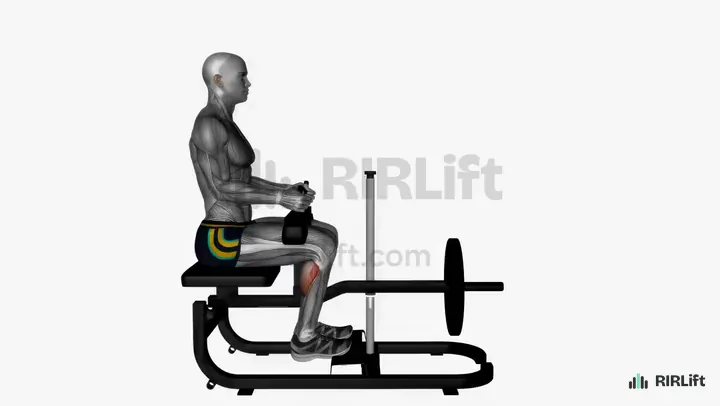
- Seated Calf Raise Calves
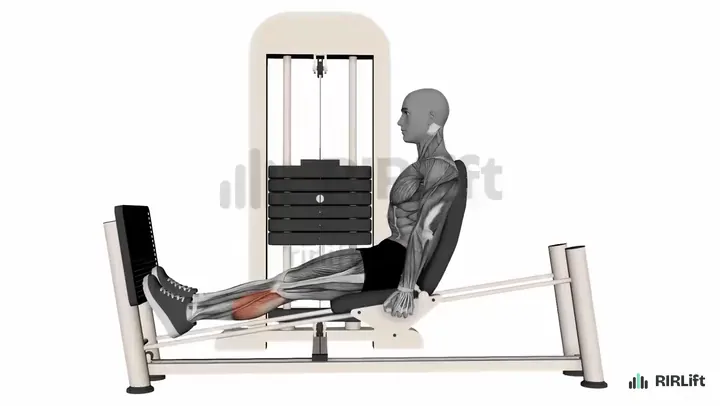
- Leg Press Calf Raise Calves
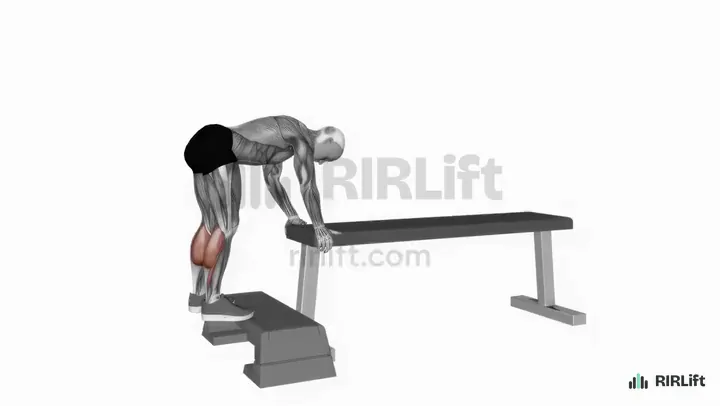
- Donkey Calf Raise Calves
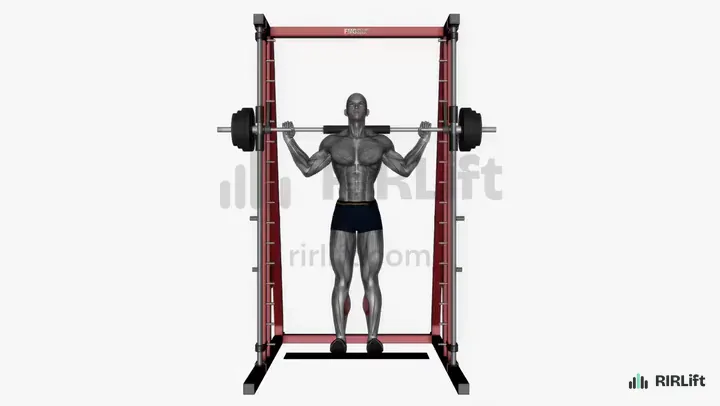
- Smith Machine Calf Raise Calves
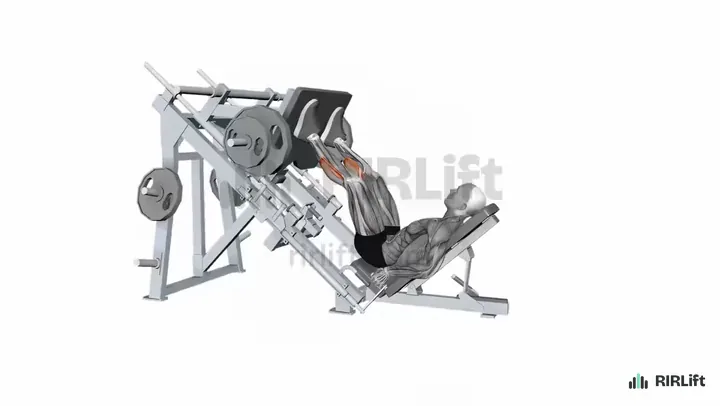
- 45-Degree Leg Press Calf Raise Calves
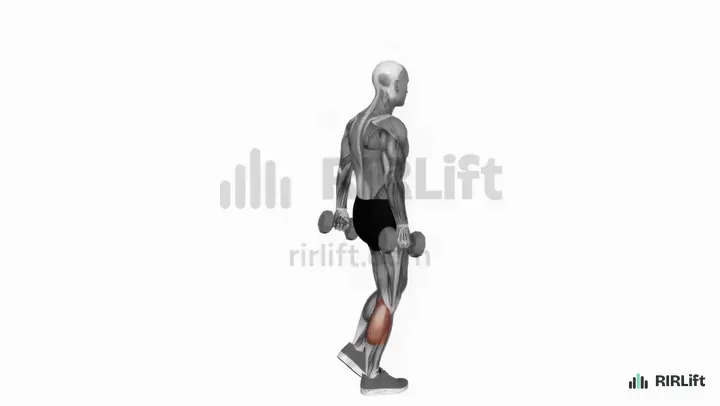
- Single-Leg Calf Raise Calves
Put them together: example sessions
Each session below picks from the exercises above for one situation, with the sets, reps, rest and RIR filled in. Open one in the session builder to change a pick, price it from a recent set, and add it to RIRLift.
-
Session 1
A full gym, calves trained twice a week
You train legs twice a week in a gym with a standing and a seated calf machine, and your calves are behind the rest of your legs.
2× a week · 14 sets a week · ~15 min
-
Session 2
A crowded gym, one leg day, no calf machine free
You get one leg day a week at peak hours and the calf machines always have a queue.
1× a week · 10 sets a week · ~20 min
-
Session 3
A runner adding calf strength, three short sessions
You run several days a week and want stronger calves and Achilles tendons, with 10 minutes after your runs or other gym work.
3× a week · 18 sets a week · ~10 min
Session 1
A full gym, calves trained twice a week
- Workouts2× a week
- Working sets14 a week
- Per workout~15 min
- EquipmentStanding Calf Raise, Seated Calf Raise, Leg Press
You train legs twice a week in a gym with a standing and a seated calf machine, and your calves are behind the rest of your legs.
Day A pairs the standing machine, the heaviest straight-knee raise, with the seated machine for the soleus. Day B swaps in the donkey raise for a deeper stretch and the 45-degree leg press for a load the stack cannot reach. Calves recover quickly and respond to effort, so straight-knee sets run 8 to 12 reps at 1 RIR, bent-knee sets 12 to 20 at 0 to 1 RIR. That is 7 sets per session, 14 per week.
| Exercise | Sets × reps | RIR | Rest |
|---|---|---|---|
| Standing Calf Raise1 warm-up set first1 s pause at the bottom. | 4 × 8–12 | 1 | 90 s |
| Seated Calf RaiseFull stretch, no bounce. | 3 × 12–20 | 1 | 1 min |
Open Calves A in the session builder
| Exercise | Sets × reps | RIR | Rest |
|---|---|---|---|
| 45-Degree Leg Press Calf Raise1 warm-up set firstSafeties set close. | 4 × 8–12 | 1 | 90 s |
| Donkey Calf RaiseHips bent, back flat. | 3 × 10–15 | 0 | 75 s |
Open Calves B in the session builder
- How to run it
- Do A after squats or presses on your first leg day and B on the second, at least two days apart. Calves go last in the session.
- How to progress
- When every set reaches the top of the rep range at the target RIR, add the smallest plate or pin. Keep the one-second pause in the stretch as the weight goes up.
Session 2
A crowded gym, one leg day, no calf machine free
- Workouts1× a week
- Working sets10 a week
- Per workout~20 min
- EquipmentLeg Press, Smith Machine, Barbells
You get one leg day a week at peak hours and the calf machines always have a queue.
Everything here happens at stations you already use on leg day. Leg press calf raises go straight after your leg presses on the same machine, the Smith machine with a plate under your feet covers the straight-knee raise, and a barbell across your knees on a bench replaces the seated machine. With only one session a week, each calf gets 10 sets and the last set of each exercise goes to 0 RIR.
| Exercise | Sets × reps | RIR | Rest |
|---|---|---|---|
| Leg Press Calf RaiseStay on the leg press after your last set. | 4 × 10–15 | 1 | 75 s |
| Smith Machine Calf RaisePlate under the forefeet. | 3 × 8–12 | 1 | 90 s |
| Barbell Seated Calf RaisePad the bar. | 3 × 12–20 | 0 | 1 min |
- How to run it
- Finish leg day with this block. Do the leg press raises right after your last leg press set, then move to the Smith machine.
- How to progress
- Add reps first. When all sets hit the top of the range, add 5 to 10 lb on the machines or 5 lb on the barbell.
Session 3
A runner adding calf strength, three short sessions
- Workouts3× a week
- Working sets18 a week
- Per workout~10 min
- EquipmentSeated Calf Raise, Adjustable Cable
You run several days a week and want stronger calves and Achilles tendons, with 10 minutes after your runs or other gym work.
Running loads one leg at a time with the knee both straight and bent, so the plan uses the single-leg raise for the straight-knee side and the seated machine for the soleus, which absorbs much of the load on every stride. The cable raise adds volume without loading your spine on the day after a long run. Reps are higher and RIR stays at 2 because these sessions sit around running, not instead of it. That is 6 sets per session, 18 per week.
| Exercise | Sets × reps | RIR | Rest |
|---|---|---|---|
| Single-Leg Calf RaiseWeaker leg first, slow lowering. | 3 × 10–15 | 2 | 1 min |
| Seated Calf RaisePause at the top. | 3 × 12–20 | 2 | 1 min |
Open Session 1 in the session builder
| Exercise | Sets × reps | RIR | Rest |
|---|---|---|---|
| Cable Calf RaiseStep close to the stack. | 3 × 12–20 | 2 | 1 min |
| Single-Leg Calf RaiseHold the top for 2 s. | 3 × 10–15 | 2 | 1 min |
Open Session 2 in the session builder
- How to run it
- Do Session 1 and Session 2 on alternate days, and repeat Session 1 at the end of the week. Skip a session the day before a race or hard interval run.
- How to progress
- On the single-leg raise, add a heavier dumbbell when every set reaches 15 reps at 2 RIR. On the machines, add the smallest increment.
Make it fit you
-
Calves barely feel the work
Slow down before you add weight. Lower for two seconds, hold the bottom for one, and rise without bouncing. Most people find the same stack feels twice as heavy.
-
Achilles is sore the next morning
Cut the stretch short for a week, stopping with the heels level with the step instead of below it, and use the seated machine over the standing one. Bring the full range back over two or three sessions.
-
The stack runs out
Move to the 45-degree leg press or the hack squat, which take far more plates, or do the standing raise one leg at a time with the same pin.
-
One calf is smaller
Add two sets of single-leg raises for the smaller side only, done first in the session while you are fresh.
-
Calves are sore after heavy squats
Train calves on your lighter leg day or on an upper-body day. They recover fast enough that a separate day rarely costs you anything.
-
Log the RIR, not just the reps
Calf sets feel hard long before they are, so record how many reps you truly had left. In RIRLift you log that RIR next to each set and it uses it to suggest the next weight, so a stack you stopped at 3 RIR goes up next session.
Questions
What's a good workout for calves at the gym?
A standing calf raise for the upper calf and a seated calf raise for the soleus, 3 to 4 sets each, twice a week. Pause in the stretched position on every rep and finish each set within one or two reps of failure. The full-gym plan on this page is built that way.
What is a calf raise?
Rising onto the balls of your feet by straightening your ankles, then lowering your heels back down. Doing it on a step or machine block lets your heels drop below your toes, which trains the calves through their full range.
What are some isometric calf exercises?
Holding the top of a calf raise, or holding halfway up, for 20 to 45 seconds. The seated or leg press machine makes it easy to load the hold heavily. Isometrics suit a sore Achilles, but for size you still need full reps.
Can walking build calf muscles?
Walking keeps calves conditioned but rarely makes them bigger, because each step is far below what the muscle can lift. Loaded raises taken close to failure are what grow them.
Should I do seated or standing calf raises?
Both. Standing raises with straight knees load the gastrocnemius, and seated raises with bent knees load the soleus. One of each per session covers the whole calf.
How many sets of calves per week?
Around 10 to 16 hard sets a week split over two sessions works for most people. If your calves are stubborn, add sets slowly and keep the pause in the stretch on every rep.
Why won't my calves grow?
The usual reasons are bouncing through short reps, stopping sets far from failure, and training calves once a week as an afterthought. Fix the range first, then add a second weekly session.
Related templates
-
Calf exercises at home: standing and seated raises with a step and a weight
The same two muscles trained with a step, dumbbells and your body weight.
-
Calf raises: how to do them, what they work and what to swap in
Form, programming and variations for the calf raise itself.
-
Machine leg exercises for quads, hamstrings, glutes and calves
The leg press, hack squat and curls that share leg day with these raises.
-
Leg exercises at the gym: barbells, machines and cables
The full gym leg day to put your calf block at the end of.
-
How to use reps in reserve (RIR)
How to judge the 0 to 2 RIR targets in these calf sessions.