
Calf exercises at home: standing and seated raises with a step and a weight
Published October 19, 2026
The best calf exercises at home are the single-leg calf raise on a stair step, the standing calf raise with dumbbells or a kettlebell, and the seated calf raise with the weight resting on your knees. Standing raises with straight knees train the big gastrocnemius; seated raises with bent knees shift the work to the soleus underneath it. Do one of each, stand on a step so your heels drop below your toes, and pause at the bottom of every rep.
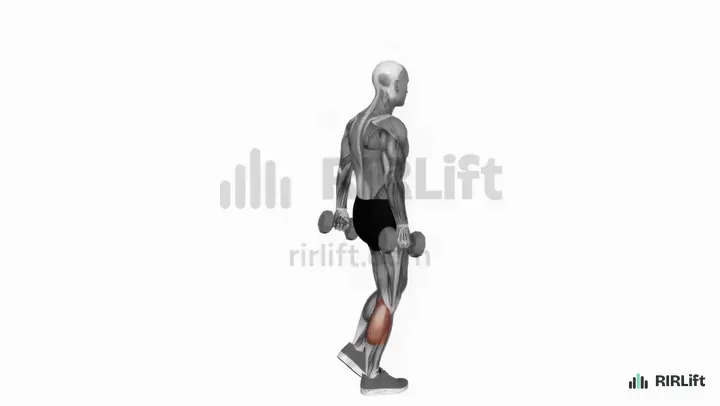
- Single-Leg Calf Raise Calves
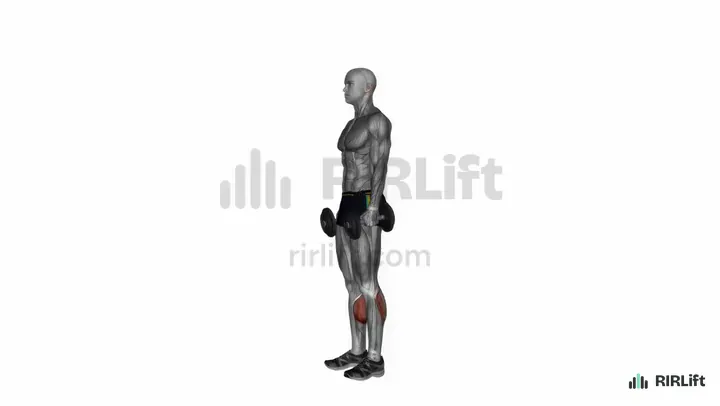
- Dumbbell Standing Calf Raise Calves
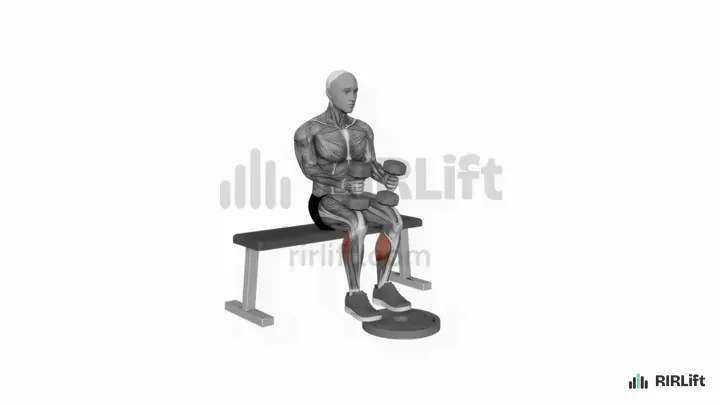
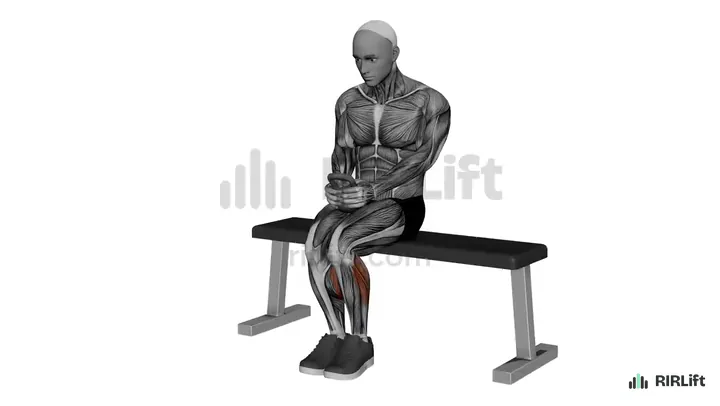
- Dumbbell Seated Calf Raise Calves
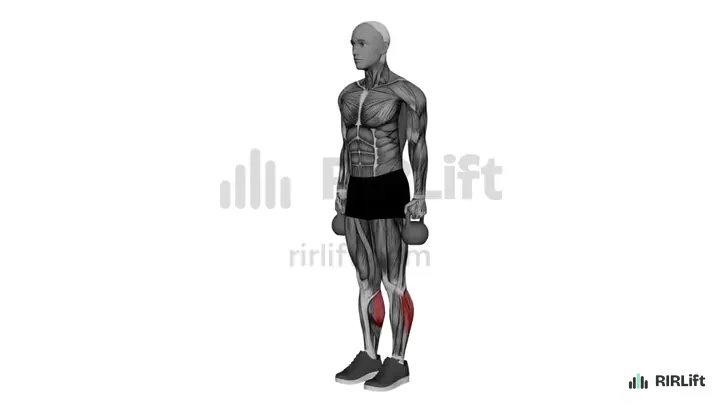
- Kettlebell Calf Raise Calves
- Kettlebell Seated Calf Raise Calves
Put them together: example sessions
Each session below picks from the exercises above for one situation, with the sets, reps, rest and RIR filled in. Open one in the session builder to change a pick, price it from a recent set, and add it to RIRLift.
-
Session 1
A pair of dumbbells and a stair step
You have dumbbells at home, a staircase or sturdy box, and a chair, and you want bigger, stronger calves without a machine.
3× a week · 24 sets a week · ~15 min
-
Session 2
One kettlebell and a chair
Your only weight is a kettlebell, and you want a calf routine that fits it.
2× a week · 14 sets a week · ~10 min
-
Session 3
One dumbbell, 10 minutes after a run or a leg workout
You run, play a sport, or already do a leg workout, and you want to add calf work in about 10 minutes without a second pair of dumbbells.
2× a week · 12 sets a week · ~15 min
Session 1
A pair of dumbbells and a stair step
- Workouts3× a week
- Working sets24 a week
- Per workout~15 min
- EquipmentDumbbells
You have dumbbells at home, a staircase or sturdy box, and a chair, and you want bigger, stronger calves without a machine.
Calves recover quickly and respond to frequent, hard sets, so this plan trains them three times a week with short sessions. It leads with the single-leg raise because one leg at a time makes even light dumbbells heavy, adds the two-leg raise for more total load, and ends with the seated raise so the soleus gets direct work too. The standing sets stop 1 rep short of failure and the seated sets go to failure, since a bent-knee raise is safe to push all the way. That is 8 hard sets per session.
| Exercise | Sets × reps | RIR | Rest |
|---|---|---|---|
| Single-Leg Calf RaisePer leg. Dumbbell in the same-side hand. | 3 × 8–15 | 1 | 1 min |
| Dumbbell Standing Calf RaiseOn a step. 1 s pause at the bottom. | 2 × 12–20 | 1 | 1 min |
| Dumbbell Seated Calf RaiseFeet on a book. Dumbbells on the knees. | 3 × 15–25 | 0 | 45 s |
- How to run it
- Do this after any other workout or on its own, three days a week with a day between sessions. Hold a one-second pause in the bottom stretch of every rep on all three exercises.
- How to progress
- Add reps until every set reaches the top of its range, then add weight: a heavier dumbbell for the single-leg raise, or the next pair for the others. With no heavier dumbbells, hold the bottom stretch for 3 seconds instead of 1.
Session 2
One kettlebell and a chair
- Workouts2× a week
- Working sets14 a week
- Per workout~10 min
- EquipmentKettlebells
Your only weight is a kettlebell, and you want a calf routine that fits it.
With a single kettlebell, the standing raise starts on two legs and moves to one leg as soon as two-leg sets reach 25 reps, and the seated raise uses the kettlebell across both knees where it sits steadiest. Two sessions a week of 7 sets cover both the gastrocnemius and the soleus. The standing sets stop at 1 rep in reserve because balance limits them; the seated sets go to 0.
| Exercise | Sets × reps | RIR | Rest |
|---|---|---|---|
| Kettlebell Calf RaiseOn a step. Go single-leg once 25 is easy. | 4 × 12–25 | 1 | 1 min |
| Kettlebell Seated Calf RaiseBell across both knees. | 3 × 15–30 | 0 | 45 s |
Open Calves A in the session builder
| Exercise | Sets × reps | RIR | Rest |
|---|---|---|---|
| Kettlebell Seated Calf Raise2 s pause at the top. | 4 × 15–30 | 0 | 45 s |
| Kettlebell Calf Raise3 s lowering into the stretch. | 3 × 10–20 | 1 | 1 min |
Open Calves B in the session builder
- How to run it
- Do Calves A and Calves B on two non-consecutive days. Session B puts the seated raise first, so the soleus gets one session where it is trained fresh.
- How to progress
- Once two-leg standing raises hit 25 reps at 1 rep in reserve, switch to one leg with the kettlebell on the working side. For the seated raise, stack a backpack with books on the kettlebell when 30 reps stop being hard.
Session 3
One dumbbell, 10 minutes after a run or a leg workout
- Workouts2× a week
- Working sets12 a week
- Per workout~15 min
- EquipmentDumbbells
You run, play a sport, or already do a leg workout, and you want to add calf work in about 10 minutes without a second pair of dumbbells.
After running, the calves are already tired, so this plan uses only two exercises and keeps 2 reps in reserve on the standing sets: hard enough to build the muscle and tendon, without a strain on legs that just ran. The single-leg raise covers the gastrocnemius with one dumbbell, and the seated raise uses the same dumbbell on one knee at a time for the soleus, which does much of the work when you run. Six sets total.
| Exercise | Sets × reps | RIR | Rest |
|---|---|---|---|
| Single-Leg Calf RaisePer leg. Hand on the rail. | 3 × 10–20 | 2 | 45 s |
| Dumbbell Seated Calf RaiseOne dumbbell on one knee, per leg. | 3 × 12–25 | 1 | 45 s |
- How to run it
- Do it right after two of your runs or leg days each week. Use the bottom step of a staircase so a hand on the rail keeps you steady.
- How to progress
- Add 1 to 2 reps per set each week. When single-leg sets reach 20 reps at 2 reps in reserve, hold a heavier dumbbell or move to 1 rep in reserve. Keep the seated sets at 1 rep in reserve and add load when they pass 25 reps.
Make it fit you
-
No step or box
Stack two or three thick books, or use a folded yoga mat on top of a book, and put a hand on the wall. You need about 5 cm under the balls of your feet for the heels to drop into a real stretch.
-
Calves already tired from running
Keep the after-runs plan and move to 3 reps in reserve during weeks with long runs or races. Drop the standing sets before the seated ones: walking and running already load the standing position all day.
-
No weights at all
Do the single-leg calf raise with bodyweight only and a 3-second lowering. Add a backpack with books for the seated raise. When bodyweight sets pass 25 reps at 1 rep in reserve, a single dumbbell is the next thing worth buying.
-
Calves cramp on the last reps
Rest 90 seconds instead of 45 to 60 and stop at 2 reps in reserve until the cramps stop. Cramping usually eases after the first two weeks of regular calf work.
-
One calf is smaller
Do every single-leg set on the weaker side first, and match the reps on the stronger side rather than doing more. Add one extra set for the smaller calf until they even out.
-
Log the RIR, not just the reps
Calf sets feel hard long before they are close to failure, so write down how many reps you honestly had left. If you log in RIRLift, the next set's weight is picked from that number, so a set you underrated gets a heavier target next time.
Questions
What exercises can I do at home to strengthen my calf muscles?
A single-leg calf raise on a stair step, a standing calf raise holding dumbbells or a kettlebell, and a seated calf raise with the weight on your knees. The standing raises train the gastrocnemius and the seated raises train the soleus, so do at least one of each per session.
Can I do a standing calf raise without a machine?
Yes. Stand with the balls of your feet on a stair or sturdy box, hold a dumbbell or kettlebell, and touch the wall for balance. Doing it on one leg gives each calf as much load as most people use on a machine, without needing heavy weights.
What are some good exercises for strengthening the soleus?
Any calf raise with the knees bent. At home that means a seated calf raise with dumbbells or a kettlebell on your thighs and your feet on a book. The bend in the knee takes the gastrocnemius out of the movement, so the soleus does the lifting.
How long does it take to strengthen your calves?
Expect your reps or load to climb within the first few weeks as you get better at the movement. Visible size takes longer: months of hard sets two to three times a week. Calves grow slowly for many people, so keep the sets close to failure and the stretch at the bottom.
How many calf raises should I do at home?
Aim for 6 to 12 hard sets per week, split over two or three sessions, with each set ending 0 to 2 reps short of failure. Calves respond well to higher reps, so 12 to 25 per set is a good range when your weights are light.
Are calf raises on the floor enough?
They work, but you lose the bottom of the movement, where the calf is stretched and does the most work. Standing on a step or a stack of books costs nothing and makes every rep count for more.
Related templates
-
Calf exercises at the gym: standing, seated and leg press raises
The machine versions: standing, seated and leg press calf raises when you have the gym.
-
Calf raises: how to do them, what they work and what to swap in
Form, muscles and variations of the calf raise in more detail.
-
Leg exercises at home: squats, lunges, hinges, glutes and calves without a gym
Squats, lunges and hinges to pair with the calf work for a full home leg day.
-
The best workout for legs, built for your situation
Complete leg programs that already include calf work.