Tricep exercises for men: heavy presses, overhead extensions and pushdowns

The best tricep exercises for men are the close-grip bench press and dips for heavy loading, an overhead cable or dumbbell extension for the long head, skull crushers for the stretched position, and cable pushdowns for lockout. The long head is the largest of the three heads and only gets a full stretch with your arms overhead, so every week needs one overhead move. Do 8 to 14 hard sets a week over two sessions, 6 to 15 reps, stopping 1 to 2 reps short of failure, and add weight once every set hits the top of the range.

  1. Close-Grip Bench Press Triceps, Chest
  2. Overhead Cable Triceps Extension Triceps
  3. EZ-Bar Skullcrusher Triceps
  4. Cable Triceps Pressdown Triceps
  5. Chest Dip Chest, Triceps
  6. Seated Dumbbell Overhead Triceps Extension Triceps
  7. Close-Grip Push-Up Triceps, Chest
Heavy presses that load the triceps

These are the lifts where your triceps move the most weight. Put one first in a session while you are fresh, keep reps in the 4 to 10 range, and they carry straight over to your bench press and overhead press.

Triceps and chest, heavy press

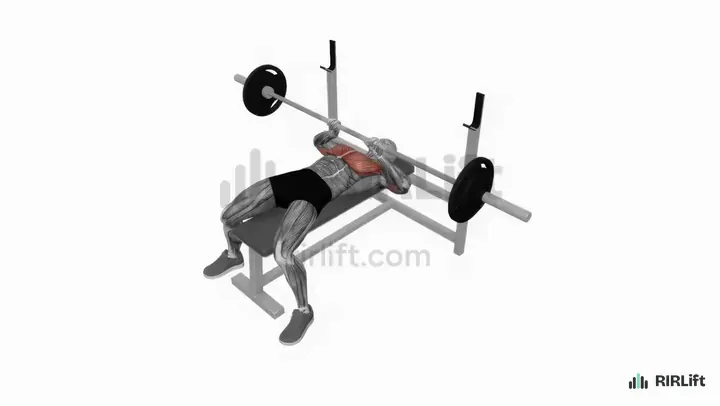
Close-Grip Bench Press

Triceps, Chest

It lets you load the triceps with more weight than any other move on this list, and it is the triceps lift that best carries over to a stronger bench press. Grip just inside shoulder width, not narrower.

How to do it

  1. Lie on a bench and grip the bar about shoulder width.
  2. Lower it to your lower chest with the elbows close to your sides.
  3. Press back up to straight arms.

Cues

  • Shoulder-width grip
  • Elbows tucked

Common mistakes

  • Gripping so narrow the wrists bend: shoulder width is enough.

Swap for: Close-Grip Push-Up, EZ-Bar Skullcrusher, Cable Triceps Pressdown

Triceps, press and extension hybrid

JM Press

Triceps

Half close-grip bench, half skull crusher, it puts heavy load through the elbow extension that finishes a bench press. It is a strong second press once you own the close-grip bench.

How to do it

  1. Lie back on the bench with a shoulder-width grip and the bar over your upper chest, arms straight.
  2. Let your elbows drift forward as you bend them, bringing the bar down and slightly back toward your chin.
  3. Stop a few inches above your throat when your forearms and upper arms are close together.
  4. Press back up the same path to straight arms.

Cues

  • Elbows forward, not out
  • Bar toward your chin
  • Press back the way it came

Common mistakes

  • Lowering straight to the chest like a bench press: the triceps do less; let the elbows travel forward.
  • Lowering too fast near the face: slow down in the bottom third.

Swap for: Close-Grip Bench Press, EZ-Bar Skullcrusher, Machine Triceps Extension

Triceps and chest, bodyweight press

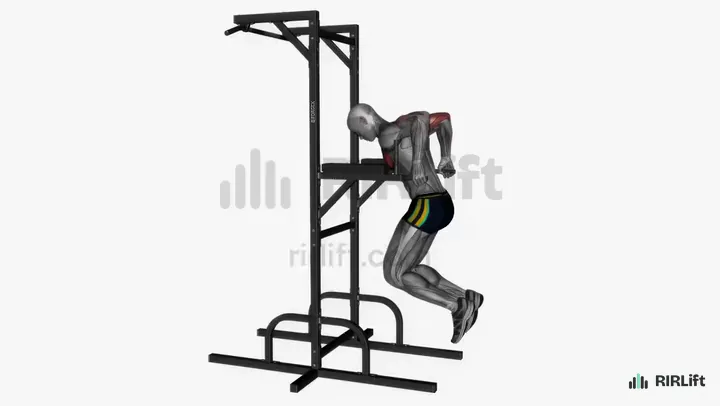
Chest Dip

Chest, Triceps

Dips load the triceps with your full body weight from the first rep, and you can add a belt or a dumbbell between your feet when sets of 12 get easy. Lean only slightly forward, as in the demo, so the triceps keep most of the work.

How to do it

  1. Grip parallel bars and step or jump up until your arms are straight and you are holding yourself above the bars.
  2. Lean your chest slightly forward with your legs under you or a little behind.
  3. Bend your elbows to sink down until your upper arms are about level with the bars.
  4. Press back up to straight arms and lock out.

Cues

  • Shoulders down, chest proud
  • Slight forward lean
  • Lock out every rep

Common mistakes

  • Sinking so deep your shoulders ache: stop when your upper arms reach the level of the bars.
  • Swinging your legs to get up: keep them still and end the set when you need momentum.

Swap for: Machine Triceps Dip, Bench Dip, Close-Grip Bench Press

Triceps, machine press

Machine Triceps Dip

Triceps

The dip pattern with an adjustable stack, so you can go heavy without balancing your body or straining the front of the shoulder. A good main triceps press for a gym arm day.

How to do it

  1. Sit on the machine and set the handles beside your lower ribs.
  2. Take the handles with your chest up and elbows pointing back.
  3. Press down until your arms are straight.
  4. Let the handles rise until your elbows are at about 90 degrees, then press again.

Cues

  • Elbows point behind you
  • Hips stay on the seat
  • Full lockout

Common mistakes

  • Elbows flaring out: keep them tucked so the triceps does the work.
  • Coming off the seat to move the stack: lower the pin.

Swap for: Bench Dip, Close-Grip Bench Press, Machine Triceps Extension

Overhead and stretched extensions for the long head

The long head crosses the shoulder, so it only reaches full length when your elbows are up by your head. Overhead extensions and skull crushers train it in that stretched position, a position worth training every week.

Triceps long head, overhead

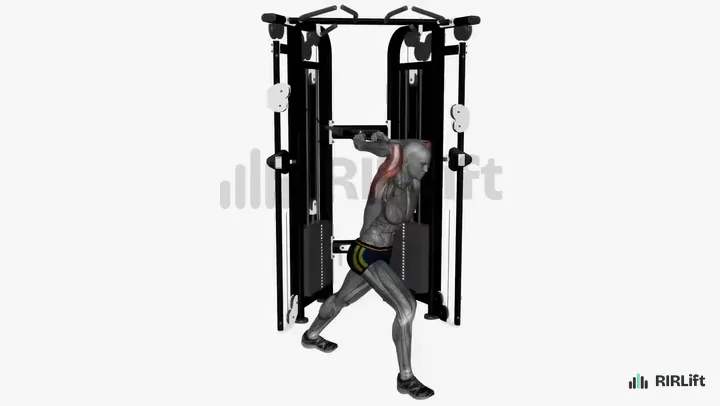
Overhead Cable Triceps Extension

Triceps

The cable keeps tension on the long head at full stretch behind your head, where a dumbbell gets light. If you only have room for one triceps isolation move, make it this one.

How to do it

  1. Attach a rope to a high pulley, take an end in each hand and turn away from the machine.
  2. Step forward into a split stance with your hands behind your head and elbows pointing forward.
  3. Extend your elbows until your arms are straight out in front of your head.
  4. Let your hands return behind your head for a full stretch.

Cues

  • Upper arms stay high
  • Long stretch every rep
  • Brace your trunk

Common mistakes

  • Bringing your elbows down to push: keep them up and still.
  • Shortening the stretch as the set gets hard: reduce the weight instead.

Swap for: Seated Dumbbell Overhead Triceps Extension, EZ-Bar Skullcrusher, Kettlebell Overhead Triceps Extension

Triceps long head, overhead

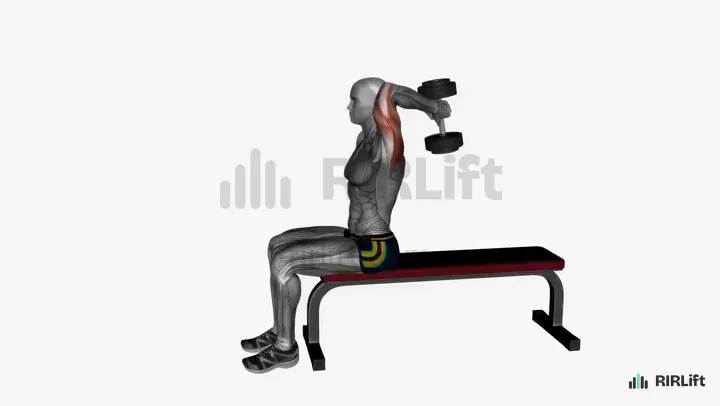
Seated Dumbbell Overhead Triceps Extension

Triceps

The overhead stretch with one dumbbell and a seat. Sitting removes the lower-back arch that creeps into standing versions, so the triceps do the lifting.

How to do it

  1. Sit tall on a chair and lift one dumbbell overhead, both hands under the top plate.
  2. Bend your elbows to bring the weight down behind your neck, upper arms close to your head.
  3. Feel the stretch, then press it back up to straight arms.
  4. Keep your back from arching as you press.

Cues

  • Elbows forward
  • Weight behind your neck
  • Ribs stay down

Common mistakes

  • Elbows drifting out to the sides: keep them pointed ahead.
  • Short lowering: take it as deep as your shoulders allow.

Swap for: Kettlebell Overhead Triceps Extension, Overhead Cable Triceps Extension

Triceps, lying extension

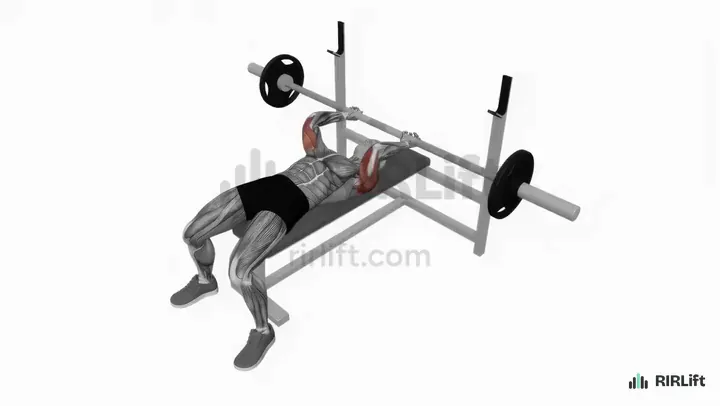
EZ-Bar Skullcrusher

Triceps

Lowering the bar toward the top of your head stretches the long head under a load you can increase in small jumps. Use an EZ bar instead of a straight bar if your wrists complain with palms fully down.

How to do it

  1. Lie back on a flat bench holding an EZ bar or straight bar overhand, hands about shoulder width, arms straight over your shoulders.
  2. Let your upper arms tip back a little toward your head and hold them there.
  3. Bend your elbows to lower the bar just behind the top of your head.
  4. Extend your elbows to return to the start.

Cues

  • Upper arms angled back
  • Elbows point at the ceiling
  • Smooth, slow lowering

Common mistakes

  • Pulling the bar over your face with your shoulders: only the elbows bend.
  • Going heavy for low reps: this lift is kinder to the elbows at 8 to 15.

Swap for: Dumbbell Skullcrusher, JM Press, Overhead Cable Triceps Extension

Triceps, lying extension

Dumbbell Skullcrusher

Triceps

Two dumbbells let each arm work on its own, so a weaker side cannot hide, and you can turn your palms in if elbows complain. It is the home-gym version of the EZ-bar skull crusher.

How to do it

  1. Lie back on a flat bench and press two dumbbells up over your chest, palms turned in.
  2. Tilt your upper arms slightly back toward your head and lock them there.
  3. Bend only at the elbows, lowering the dumbbells beside your ears.
  4. Straighten your elbows to bring the weights back up.
  5. Stop just short of lockout to keep the triceps working.

Cues

  • Upper arms still
  • Lower beside your ears
  • Straighten, do not press

Common mistakes

  • Letting the elbows drift and pressing the weight up: that is a close-grip press. Keep the upper arms fixed.
  • Elbows flaring wide: keep them about shoulder width.

Swap for: EZ-Bar Skullcrusher, Close-Grip Bench Press, Kettlebell Decline Skullcrusher

Pushdowns and kickbacks for lockout

With your elbows pinned at your sides, the lateral and medial heads do most of the work. These are easy to recover from, so take them close to failure at the end of a session for 10 to 15 reps.

Triceps lateral head, pushdown

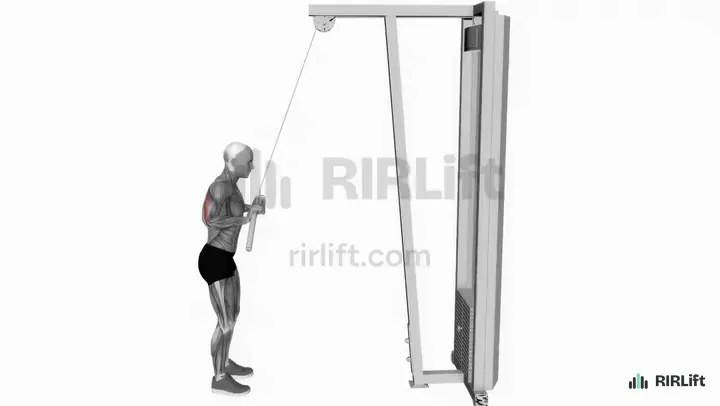
Cable Triceps Pressdown

Triceps

Simple to learn, easy on the elbows and quick to load, which makes it the best finisher for sets of 10 to 15 taken close to failure.

How to do it

  1. Attach a bar or rope to a high pulley and grip it with your elbows at your sides.
  2. Push down until your elbows are straight.
  3. Let the handle rise until your forearms are just past parallel, then push again.

Cues

  • Elbows stay pinned
  • Lock out at the bottom

Common mistakes

  • Letting the elbows rise and flare: keep them glued to your sides.

Swap for: Cable Cross Pushdown, Overhead Cable Triceps Extension, Close-Grip Push-Up

Triceps, single-arm pushdown

Cable Cross Pushdown

Triceps

Pressing down and across trains each arm alone and lets the elbow travel slightly in, a path many lifters find smoother than a straight pushdown. Useful when one arm lags.

How to do it

  1. Set both pulleys high with no handles or single handles, and grab the left cable with your right hand and the right cable with your left.
  2. Stand between them with your hands crossed in front of your chest and your elbows bent.
  3. Press both hands down and apart until your arms are straight beside your hips.
  4. Let your hands come back up and across to the start under control.

Cues

  • Down and out, like an X opening
  • Upper arms still
  • Pause at full lockout

Common mistakes

  • Pulling the hands too wide at the bottom: finish beside your hips, not out to the sides.
  • Hunching forward: stay tall with your chest up.

Swap for: Cable Triceps Pressdown, Cable Triceps Kickback, Overhead Cable Triceps Extension

Triceps, dumbbell isolation

Triceps Kickback

Triceps

Kickbacks are hardest at full lockout, the exact spot pushdowns ease off, and they need nothing but one light dumbbell. Keep the weight low enough to hold the top for a second.

How to do it

  1. Brace one hand on a chair or bench and hinge forward with a flat back.
  2. Lift the dumbbell arm so your upper arm sits against your side, elbow bent.
  3. Push the dumbbell back until your arm is straight, and hold it for a second.
  4. Bend back to the start; finish the set, then change arms.

Cues

  • Upper arm stays level
  • Hold the lockout
  • Light weight

Common mistakes

  • Swinging the weight up: lighten it so you can pause at the top.
  • Upper arm sinking toward the floor: lift it back to your side.

Swap for: Cable Triceps Kickback, Seated Dumbbell Overhead Triceps Extension

Triceps with your body weight

A close-grip push-up and a bench dip are enough to train triceps at home. Make them harder by slowing the lowering phase, raising your feet, or holding a pause at the bottom before adding reps.

Triceps, close-hand push-up

Close-Grip Push-Up

Triceps, Chest
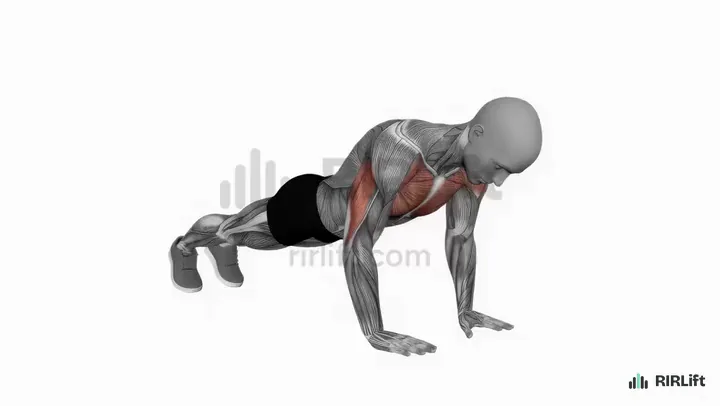
Bringing the hands under your chest shifts a regular push-up onto the triceps. It is the anchor of a no-equipment triceps session and scales by elevating your feet.

How to do it

  1. Get into a high plank with your hands directly below your shoulders.
  2. Lower yourself with your elbows sliding back past your ribs.
  3. Stop just above the floor, then push up to locked elbows.
  4. Drop to your knees for the last reps if your hips start to sag.

Cues

  • Hands under shoulders
  • Elbows travel back
  • Full lockout

Common mistakes

  • Flaring the elbows into a T: that moves the work to your chest.
  • Half reps near the top: lower until your chest is close to the floor.

Swap for: Kneeling Push-Up, Incline Push-Up

Triceps, bodyweight dip

Bench Dip

Triceps

Straight-leg bench dips load the triceps with nothing but a bench or a sturdy chair. Keep the depth to where your upper arms reach parallel to the floor and add a plate on your lap when reps pass 20.

How to do it

  1. Sit on the front of a stable chair, hands gripping the edge next to your hips.
  2. Move your hips off the seat and set your heels out in front.
  3. Lower your body by bending your elbows until your upper arms are level with the floor.
  4. Straighten your arms to come back up.

Cues

  • Hips close to the chair
  • Elbows point back
  • Stop at level

Common mistakes

  • Going so deep that your shoulders pinch: shorten the range.
  • Pushing with your legs: keep them relaxed and let your arms lift you.

Swap for: Floor Triceps Dip, Close-Grip Push-Up

Put them together: example sessions

Each session below picks from the exercises above for one situation, with the sets, reps, rest and RIR filled in.

Session 1

Your bench press stalls halfway up

  • Workouts2× a week
  • Working sets15 a week
  • Per workout~25 min
  • EquipmentBarbells, Flat Bench, Dip Bar, Adjustable Cable

You bench at least once a week, the bar slows or stops in the top half, and you want triceps strength that shows up on the press.

Heavy presses at 4 to 8 reps build the lockout strength the bench needs, and one overhead move keeps the long head growing. That is 15 hard triceps sets a week across two sessions, on top of your normal bench work.

Day 1: Close-grip and dips
ExerciseSets × repsRIRRest
Close-Grip Bench Press2 warm-up sets first 4 × 4–6 2 3 min
Chest Dip 3 × 6–10 2 2 min
Cable Triceps Pressdown 2 × 10–15 1 75 s
Day 2: JM press and overhead
ExerciseSets × repsRIRRest
JM Press1 warm-up set first 3 × 6–8 2 2:30 min
Overhead Cable Triceps Extension 3 × 8–12 1 90 s
How to run it
Run Day 1 right after your main bench session and Day 2 on your second upper-body day. Keep at least 48 hours between them.
How to progress
Add 5 lb to the close-grip bench and JM press when all sets reach the top of the rep range at 2 reps in reserve. For dips and extensions, add reps first, then load.

Session 2

Bigger arms with a gym's cables and machines

  • Workouts2× a week
  • Working sets18 a week
  • Per workout~20 min
  • EquipmentAdjustable Cable, EZ Bar, Flat Bench, Dip Machine +1

You train in a commercial gym, your pressing is fine, and you want the back of your arms to fill out.

Size comes from sets taken close to failure across the full range, so this plan trains the long head overhead and lying down on one day and the other heads with pushdowns on the other. 9 sets per session, 18 a week, is a solid dose for an arm you are trying to grow.

Day 1: Long head
ExerciseSets × repsRIRRest
Overhead Cable Triceps Extension 3 × 10–15 1 90 s
EZ-Bar Skullcrusher 3 × 8–12 1 90 s
Cable Cross PushdownPer arm. 3 × 12–15 1 1 min
Day 2: Machine dip and pushdowns
ExerciseSets × repsRIRRest
Machine Triceps Dip 3 × 8–12 1 2 min
Cable Triceps Pressdown 3 × 10–15 0 75 s
Triceps KickbackPer arm. 3 × 12–15 1 1 min
How to run it
Add each day to the end of a push or upper-body session, or run them on their own short arm days. Leave two days between them.
How to progress
Double progression: stay at the same weight until every set reaches the top of the rep range at the target reps in reserve, then take the next stack plate and start back at the bottom of the range.

Session 3

Home training with a pair of dumbbells and a bench

  • Workouts2× a week
  • Working sets24 a week
  • Per workout~25 min
  • EquipmentDumbbells, Flat Bench

You train at home with adjustable dumbbells and a bench or a sturdy chair, and there is no cable or dip station.

One session hits all three heads with an overhead extension, a lying extension and two bodyweight presses, 12 sets in all. Run it twice a week for 24 sets of triceps-dominant work, making up for the lighter loads you have at home.

Triceps: Home
ExerciseSets × repsRIRRest
Close-Grip Push-Up 3 × 8–15 2 90 s
Seated Dumbbell Overhead Triceps Extension 3 × 10–12 2 90 s
A1 Dumbbell Skullcrusher 2 × 10–12 1 90 s
A2 Bench Dip 2 × 10–20 2 90 s
Triceps KickbackPer arm. 2 × 12–15 1 1 min
How to run it
Do it twice a week with at least two days between, as a standalone arm session or tacked onto a home upper-body day.
How to progress
Add a rep per set each session until you reach the top of the range, then go up one dumbbell size. For push-ups and bench dips, raise your feet or add a slow 3-second lowering once you pass the top of the range.

Make it fit you

Questions

What is the number one tricep exercise?

For size, the overhead cable triceps extension, because it trains the long head at full stretch. For strength, the close-grip bench press, because it loads the triceps heaviest. A good week includes both.

How often should I work out triceps?

Twice a week. Spread 8 to 14 hard sets over two sessions with at least 48 hours between. Your triceps also work in every bench and overhead press, so count those days when you plan.

What is a good workout for triceps and back?

Pair a back exercise with a triceps exercise as a superset, for example a row with a pushdown, or a pull-up with an overhead extension. The two muscles do not compete, so you can alternate sets with short rest and save time.

How do I build triceps at home?

Use close-grip push-ups, bench dips and, if you own dumbbells, seated overhead extensions and dumbbell skull crushers. Take each set within 1 to 2 reps of failure and progress by adding reps, then harder variations or heavier dumbbells.

Should men train triceps differently from women?

No. The muscle and the exercises are the same. What changes is the starting weight and how fast you add load, which reps in reserve handle for anyone.