
Blog
5 day workout split: what each five-day structure gives you per muscle
Published October 16, 2026 · 12 min read
Five days a week is the point where most lifters stop asking whether they train enough and start asking how to spend the sessions. That is the right question, and it is also where the advice splinters. One guide hands you a body part a day. The next insists on push, pull, legs plus two more. A third tells you to run an upper/lower and bolt on a fifth day for whatever is lagging. All three are called a 5 day workout split, and all three produce a different week.
The disagreement is not really about the sessions. It is about what reaches each muscle. A split is a schedule, a way of dividing the muscles you want to train across the days you can train them, and the number that decides whether it works is how many hard sets each muscle ends up with across the week, at an effort that counts. Five days gives you more room than four. What you do with the room is the whole decision, and the five common ways to spend it do not deliver the same thing at all.
What is a 5 day workout split?
A 5 day workout split is a training schedule that divides your week into five gym sessions and two rest days, with each session assigned a set of muscles to train. It is a frequency budget, not a fixed routine: the five days are the same, but how you group the muscles across them decides how often each one is trained and how much volume it can absorb.
That framing matters because the five-day versions people argue about are not competing stimuli. At a matched weekly volume, a split routine and a full body routine produce small to no difference in muscle growth; the dose that drives hypertrophy is the weekly one. So the question is never "is a five-day split good." It is which five-day arrangement puts your weekly sets where you can actually do them well. The split is a container, not the stimulus, and five days is simply a roomier container than three or four.
The five ways to actually spend five days
There are only a handful of structures that fill five days without repeating themselves into nonsense. Each one answers the same question differently: how many muscles per day, and therefore how often does each muscle come around?
- A body part split (the "bro" split). One major muscle group per day: chest, back, legs, shoulders, arms. Each muscle is trained once a week in a single large session. This is the arrangement five days fits most neatly, and it is also the one with a mild evidence disadvantage at matched volume, for a reason the frequency section below makes concrete.
- PPLUL (push, pull, legs, upper, lower). The structure Google's own summary calls the best overall five-day option. Push and upper both hit the pressing muscles, pull and upper both hit the back and biceps, legs and lower both hit the lower body, so almost everything is trained about twice a week. The five letters decode cleanly once you read them as a frequency statement rather than a menu.
- Upper/lower plus a specialization day. An upper/lower run is a four-day structure that already trains everything twice. Add a fifth day aimed at a lagging muscle or movement, and that one group reaches three sessions while the rest stay at two. Five days bought you a targeted bump, not a blanket one.
- A rolling PPL run five days a week. Push, pull, legs repeated on a rolling cycle does not line up with a seven-day week. Run it across five training days and the frequency per muscle averages below twice a week and drifts from week to week, which is the quiet cost of forcing a three-day pattern onto a five-day calendar.
- A fixed five-day PPL (push, pull, legs, push, pull). The compromise that keeps a weekly rhythm but spends it unevenly: the pressing and pulling muscles get two sessions, legs get one. Worth naming because it is common and because its lopsidedness is invisible until you count sessions per muscle.
Every one of these is a real five-day split. None of them is wrong. They just hand each muscle a different deal, and the deal is legible the moment you stop reading the name and start counting.
What each structure gives you per muscle
Here is the same five days, priced in what actually reaches a given muscle. Take a representative weekly target of about 16 hard sets for a major muscle, the middle of the 10 to 20 weekly sets most intermediate lifters work inside, and watch where it lands.
| Five-day structure | Frequency per muscle | How 16 weekly sets land | What it suits |
|---|---|---|---|
| Body part / bro split | About 1x | 16 sets in one session | Advanced lifters who recover from, and prefer, one big session per muscle |
| PPLUL | About 2x | 8 sets across two sessions | Most intermediates who can train five reliable days |
| Upper/lower plus a specialization day | 2x, prioritized muscle 3x | 8 and 8, or 6 and 5 and 5 for the priority group | A lifter with one or two groups that lag |
| Rolling PPL over five days | About 1.5x to 1.7x, and drifting | Uneven week to week | Honestly, almost nobody; the week stops being a week |
| Fixed five-day PPL (P/P/L/P/P) | Press and pull 2x, legs 1x | 8 and 8 up top, 16 in one leg day | Upper-body-focused lifters who accept lagging legs |
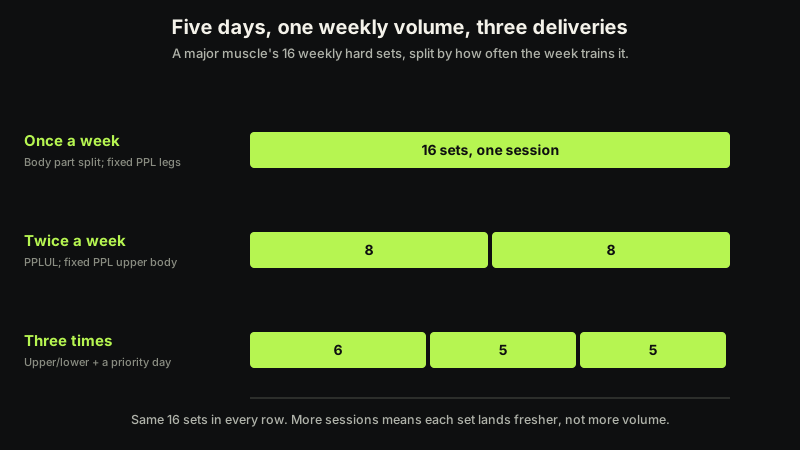
Read down the frequency column and the choice stops being about branding. The body part split concentrates a muscle's entire weekly dose into one sitting. PPLUL and the upper/lower-plus structures spread it across two. The two PPL-on-five-days options leak frequency somewhere, either into drift or into neglected legs. The volume is the same in every row. What changes is whether a muscle meets its sets fresh twice or tired once, and that distinction is the only real lever a five-day split pulls.
Once a week or twice a week?
This is the axis most "best 5 day split" searches are really circling, and it is where the evidence is clearest. When weekly volume is held constant, spreading a muscle's sets across two sessions instead of one tends to be at least as effective for growth, and often slightly better. The mechanism is not mysterious. Sixteen sets of back in a single day means the last several happen deep into accumulated fatigue, at a worse effort and lighter effective load than the first. Eight sets twice a week means nearly every set happens close to fresh. Same weekly dose, better average set.
That is the entire case for the roughly twice-a-week frequency, and it is why the once-a-week body part split is the single five-day structure with a mild disadvantage at matched volume. The disadvantage is not frequency as a magic number. Volume-equated frequency is close to neutral in Schoenfeld, Ogborn and Krieger's meta-analysis; the cost is the per-session ceiling, the point where adding a ninth, tenth, eleventh set to an already-worked muscle buys fatigue instead of stimulus. A twice-a-week structure never has to find out where that ceiling is, because it never asks one session to carry sixteen quality sets.
So if the five-day decision came down to one rule, it would be this: prefer the arrangement that trains each muscle about twice, unless you have a specific reason not to. PPLUL does it by design. Upper/lower plus a fifth day does it for everything and then some for one group. The body part split trades it away for the thing some advanced lifters genuinely want, which is a single, total, uninterrupted session per muscle.
How to pick your five-day structure
Start from two facts about yourself, not from a ranking.
The first is whether you will actually train five days, most weeks, for months. A five-day plan you abandon in a fortnight grows less muscle than a four-day plan you keep for half a year. If five days is aspirational rather than reliable, the honest move is a four-day structure you will not miss, not a five-day one you will.
The second is whether any muscle is clearly lagging. If the answer is no, PPLUL is the default for a reason: it distributes the twice-a-week dose evenly and asks no session to overfill. If one or two groups lag, the upper/lower-plus-a-day structure lets you aim the fifth session without disturbing the rest of the week. And if you simply prefer, and recover from, hammering one muscle at a time, the body part split is a legitimate choice as long as you have read what the once-a-week frequency costs and decided the trade is worth it for you.
What does not belong in the decision is the name. "The best 5 day split" is a question with no general answer, because the two variables that settle it, how well you adhere and how much volume you recover from, are individual and invisible from the outside. The structure that lets you hit your weekly sets at the right effort, week after week, is your best split, and it may not top anyone's list.
The five-day measurement trap
Five days creates a problem four days mostly hides. With more sessions and more muscles in motion, it becomes genuinely hard to know what each muscle received across the week. On paper your PPLUL hits chest twice. In practice the Friday upper day runs long, chest goes last, and those sets land at 4 RIR because you are tired, so the muscle got eight sets but only four of them were hard. Meanwhile the body part day you thought was eight quality sets of shoulders actually decayed to failed reps at zero RIR by the end, which is a fatigue tax, not stimulus.
Neither problem shows up in a routine. Both show up only in the record of what each set actually cost, and five days gives you five sessions' worth of that to keep track of. The number that tells you whether your container is working is not the split's name. It is your weekly hard sets per muscle, hit at an effort around 1 to 3 RIR, and on a five-day week that number is almost impossible to hold in your head.
That is the number RIRLift is built to show. You build whichever five-day structure you chose once on iPhone, run each session from your wrist logging load, reps and RIR per set, and watch the week add itself up per muscle against a target. Chest came up short because Friday ran it tired, legs blew past their number on your one fixed leg day, back is sitting right where you wanted it across two sessions. On a five-day split that readout is not a luxury, it is the only way to tell which of the structures above you are actually running. If you want to size each session before you train it, work the set arithmetic backward.
Common questions
Is a 5 day workout split good for building muscle? Yes, provided it trains each muscle at a frequency you can recover from and accumulates enough weekly volume per muscle. A five-day split gives you room to train most muscles about twice a week, which is where the research lands, so it is a strong choice for intermediate and advanced lifters. The split itself adds no magic; the weekly volume at a real effort does.
Is training 5 days a week too much? Not for most people who recover well and want the training room. Five sessions a week is sustainable when the per-session fatigue is managed, which is exactly what spreading a muscle across two sessions instead of one accomplishes. It becomes too much when every day runs to failure on every set, which is a junk-volume problem, not a five-days problem.
Should each muscle be trained once or twice a week on a 5 day split? About twice is the better default at a matched weekly volume, because the sets happen fresher and the per-session ceiling is never tested. Once a week, the body part approach, is a defensible choice for advanced lifters who prefer a single complete session per muscle and have the recovery for it, but it is the one five-day structure carrying a mild evidence disadvantage.
Can a beginner run a 5 day split? A beginner usually gets more from three or four full-body or upper/lower days, because frequency and practice matter more early than session volume does, and five days is harder to adhere to while still learning the lifts. The five-day structures here pay off most once your weekly volume has climbed past what fewer days can hold well.
Pick the five-day structure you will adhere to, make it train each muscle about twice a week unless you have a clear reason not to, and then stop ranking splits. Read the only scoreboard that settles it: the weekly sets each muscle actually got, and what they cost you to get.