
Blog
Bro split: does training a muscle once a week work?
Published August 7, 2026 · updated September 11, 2026 · 13 min read
The bro split is the most mocked routine on the internet. Chest Monday, back Tuesday, legs Wednesday, shoulders Thursday, arms Friday, and a comment section full of people explaining that science has moved on. It is the default punchline in every "stop doing this" video.
The mockery is mostly correct. It is also, almost universally, correct for the wrong reason.
The stated case against the bro split is frequency: you only hit each muscle once a week, and research says twice is better. That claim was reasonable in 2016 and has not aged well. The frequency literature got tighter, and when it did, most of the effect went away. Frequency is close to neutral once you hold weekly volume constant.
So the bro split survives its most famous criticism. It just runs straight into a different one that nobody in the argument bothers to name, and that second problem is both real and measurable in your own training log.
What is a bro split?
A bro split is a training routine that gives each major muscle group its own dedicated day, so every muscle is trained once per week. The name comes from its association with commercial-gym bodybuilding culture, and the classic version runs five days.
| Day | Muscle group | Typical sets that session |
|---|---|---|
| Monday | Chest | 16 to 20 |
| Tuesday | Back | 16 to 20 |
| Wednesday | Legs | 16 to 22 |
| Thursday | Shoulders | 12 to 18 |
| Friday | Arms | 14 to 20 |
| Weekend | Rest | 0 |
The defining feature is not the five days. It is the once-per-week frequency per muscle, and the high per-session set count that frequency forces. Those two things travel together, and separating them is the whole point of this article.
Push/pull/legs run twice a week, upper/lower run twice, and full body run three times all reach each muscle two or three times. That is the comparison that matters: how often you should train each muscle, not the number of days you show up. The six-day Arnold split is the clearest illustration: it keeps the body-part flavour of a bro split but reaches every muscle twice, and it pays for that by making two large muscle groups share a single session.
Does the bro split work for muscle growth?
Yes, it builds muscle. Whether it builds as much muscle as the alternatives is the interesting part, and the answer has shifted.
The widely cited 2016 meta-analysis found higher frequency favourable for hypertrophy. The problem was that in most of the included studies, the higher-frequency groups also did more total weekly sets. The comparison was not clean, so it could not separate frequency from volume.
Schoenfeld, Grgic and Krieger revisited this in 2019 with volume-equated inclusion criteria. Across 25 studies, once weekly set volume was held constant, there was no significant difference in hypertrophy between higher and lower frequencies. Their conclusion was that for a given training volume, you can pick your weekly frequency based on preference.
The more recent Sports Medicine dose-response meta-regression on weekly volume and frequency points the same way: weekly volume drives the dose-response for hypertrophy, and frequency is largely a way of delivering it.
Read plainly, that is a partial acquittal. Twenty hard sets for chest per week is roughly twenty hard sets for chest per week, whether you take them on one day or spread them over two.
Which raises the obvious question. If frequency is neutral, why does the bro split keep underperforming in practice?
Frequency was never the real problem
Because "volume-equated" is doing enormous work in that sentence, and a once-weekly muscle is the hardest possible condition in which to equate it.
Frequency is a delivery mechanism. It does not create stimulus by itself; it decides how your weekly volume gets packaged. This is the same reason the choice of split matters less than lifters expect: a split is a container, and containers do not grow muscle.
But containers do have capacity limits. When you decide a muscle gets one session per week, you have also decided that its entire weekly volume must fit inside that one session. Twenty sets of chest cannot be spread out. They have to happen on Monday, consecutively, by one increasingly tired person.
And that is where the actual evidence turns against the bro split.
The real problem: one session can only absorb so much
Weekly volume and per-session volume have different dose-response curves. Weekly volume keeps paying for a long time. Per-session volume flattens out much sooner.
A meta-regression on per-session set volume modelled this directly. It found a positive dose-response between per-session sets and hypertrophy, but with clear diminishing returns, and estimated the point of undetectable outcome superiority at roughly 11 fractional sets per session for hypertrophy. Past that, the additional sets in that same workout stopped producing a detectable extra benefit. This one is a preprint rather than a peer-reviewed publication, and the authors note there is thin data at very high per-session volumes, so treat the exact number as a rough landmark rather than a hard cutoff.
Even as a rough landmark, it lands squarely on the bro split's throat. A five-day bro split routinely puts 16 to 20 sets into a single muscle in a single session. That is comfortably past the region where the curve is still climbing steeply.
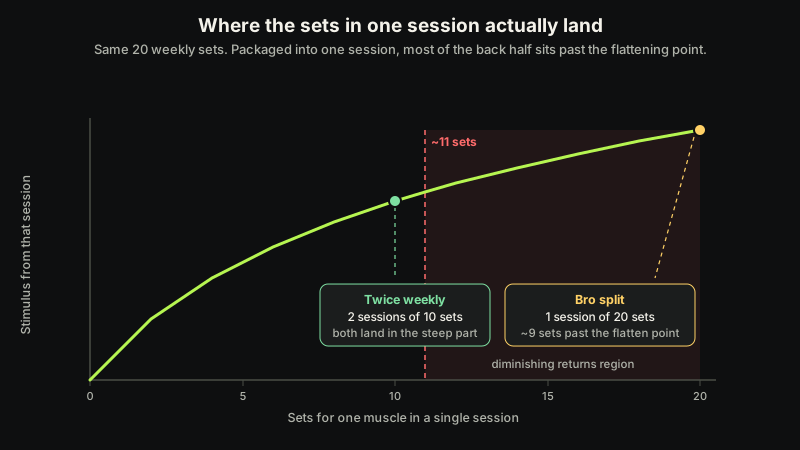
Here is the same weekly volume, packaged two ways.
| Bro split (1 session) | Twice weekly (2 sessions) | |
|---|---|---|
| Weekly sets for chest | 20 | 20 |
| Sets in one session | 20 | 10 |
| Sets in the productive region | ~11 | ~10 and ~10 |
| Sets past the flattening point | ~9 | ~0 |
| Fatigue at the last set | High | Moderate |
| Days per week receiving stimulus | 1 | 2 |
The weekly number is identical. The number of sets that plausibly did something is not.
This is the mechanism behind junk volume, and the bro split is the most efficient way to manufacture it. Not because once a week is too rare, but because the sets you added to compensate for the rarity land in the part of the session where they buy the least.
The RIR tell: what set 14 actually costs you
There is a version of this you can see in your own numbers, and it is more convincing than any meta-analysis.
Most evidence-based hypertrophy guidance asks for working sets in the region of one to three reps in reserve. The stimulus depends on getting genuinely close to failure on sets that count.
Now run a 20-set chest day and log honestly. The first few sets sit where you planned. Somewhere around set eight to ten, the load starts coming down to hold the rep target. By set fourteen you are on the third variation of a press, the weight is well off your opening numbers, and the set is ending because your triceps and your front delts are cooked, not because your chest is.
Your logged RIR will still say 2. It will be a 2 relative to a much weaker version of you, on a movement that is now mostly loading something else. The number is honest and the stimulus is not.
That is the failure mode. It is invisible in a spreadsheet that only records sets, because nineteen sets and twenty sets look identical there. It is obvious the moment you record load, reps and RIR per set and read them back in order. RIRLift logs all three on the wrist as you go, so the decay across a long session shows up as data rather than a vague sense that the last few sets were rough.
Once you can see it, "how many sets fit in one session" stops being a philosophical question. It becomes something you read off your own last chest day.
Who the bro split actually suits
Given all of that, the honest answer is that it suits more people than the internet allows, and fewer than its defenders claim.
It works reasonably well if:
- You train five or six days a week and genuinely enjoy it. Adherence beats theoretical optimality, and a routine you look forward to for two years outperforms a better one you quit in six weeks.
- You are an advanced lifter with a specific lagging muscle and you want one session where that muscle is fresh, prioritised and not competing for energy.
- You keep per-session volume sane rather than maximal, which mostly means resisting the urge to add sets because the muscle will not be trained again for seven days.
- You have a training age high enough that a single very hard session still produces meaningful soreness and recovery demand for several days.
It works badly if:
- You train three or four days a week. This is the big one. A bro split spread across four days means some muscles get trained once every seven to ten days, and a missed session pushes a muscle group to a two-week gap. Fewer training days argues strongly for upper/lower or full body, though an upper/lower comes with its own crowding problem on the upper day, and full body trades the per-session ceiling for the opposite constraint, running out of room before it runs out of muscles.
- You are a beginner or early intermediate. You cannot yet generate enough per-session fatigue to justify a full week of recovery, and you benefit more from practising the movements often.
- Your schedule is unreliable. The bro split has no redundancy. Every muscle depends on exactly one appointment.
- You already know your weekly volume is low. Once a week plus a sane session cap puts a hard ceiling on your weekly sets.
How to run a bro split well
If you are going to run one, run it deliberately.
Cap the per-session volume for a single muscle. Somewhere around 10 to 12 hard sets is where the curve is still worth climbing. Adding a fifth chest exercise because it is chest day is the classic mistake. Our post on how many sets to put in one workout works through where the line usually sits.
Front-load the sets that matter. Put your hardest, most loadable movement first, while you are fresh and your RIR estimate is trustworthy. The sets at the end of a long session are the ones being discounted, so do not spend your best exercise there.
Use fewer exercises with more sets each, not more exercises with fewer. Five exercises for three sets each buys you five warm-up ramps and five bouts of setup fatigue for the same weekly total. Two or three well-chosen movements per muscle is usually enough.
Steal the second exposure. The most useful modification is barely a modification. Add two or three sets of a muscle to another day, so chest gets 12 sets Monday and 4 sets on shoulder day. You keep the structure and the psychology of the bro split, and you quietly convert the muscle to twice weekly. This is what most "modified bro splits" actually are.
Do not add sets to compensate for the gap. The instinct to punish a muscle harder because it waits a week is exactly the instinct that generates the junk. The week does not need to be paid back.
Track what you actually did, not what the plan said. Plans assume you finished. Sessions get cut short, machines get taken, and the fifth exercise silently disappears. A bro split has no second chance that week to make it up.
Common questions
Is the bro split better than PPL? Neither is inherently better for muscle growth. Once you hold weekly volume constant, frequency is close to neutral, so the split that grows the most muscle is the one that lets you deliver your weekly sets while they still count. The practical edge goes to push/pull/legs: running each muscle closer to twice a week makes it far easier to keep per-session volume in the productive region, where the bro split forces everything into one increasingly tired session. Train five or six days and cap your per-session sets and the gap mostly closes.
Is the bro split actually good? Yes, it builds muscle, and its most famous criticism, that once a week is too rare, is largely overblown by the volume-equated research. The real limiter is that a single session can only absorb so much hard volume before the extra sets stop paying. So the bro split is good for lifters who train five or six days and keep each session sane, and poor for anyone training three or four.
What is a good 5-day bro split routine? The classic layout gives chest, back, legs, shoulders and arms their own day. The version that actually works caps each muscle at roughly 10 to 12 hard sets in its session, uses two or three well-chosen movements rather than five, and puts the hardest, most loadable lift first while your effort estimate is still trustworthy. The set count matters more than the exercise list.
Can you run a bro split in 3, 4 or 6 days? Fewer days is where it breaks. A bro split spread over three or four days pushes each muscle past a full week between sessions, and one missed day stretches that to nearly two. A six-day version is the opposite: run in the style of the six-day Arnold split, it can reach most muscles twice a week, which quietly fixes the bro split's one real weakness while keeping the body-part feel.
Why is it called a bro split? The name comes from its association with commercial-gym bodybuilding culture, where training one body part per day, chest on Monday through to arms on Friday, has been the default for decades. It describes who popularised the routine, not whether it works.
Let weekly hard sets settle it
The bro split argument stays unresolved because both sides are arguing about the wrong variable. Frequency, on its own, is close to a non-issue. Per-session capacity is not, and once a week forces you to bump into it every single session.
That reframe also makes the question answerable for you specifically, because both variables are things you can count. Weekly hard sets per muscle, and how many of them landed in a single session while you were still fresh enough to make them count. Everything else is preference, schedule and how much you like training arms on Friday.
RIRLift totals hard sets per muscle across your week automatically, so you can see whether your five days are producing the volume you assumed, and the per-set load, reps and RIR history shows you where in a session your numbers start sliding. You can see how a session runs from your wrist without pulling out a phone between sets, which matters more than usual on a day with twenty of them. The training volume guide covers where to set your weekly targets in the first place.
Run the bro split if you like it. Just count what it actually delivers, rather than trusting the plan or the comment section.