
Blog
Upper/lower split: how to run the 4-day version well
Published August 8, 2026 · updated September 9, 2026 · 13 min read
Ask which routine an intermediate lifter should run four days a week and you will get the same answer almost every time. Upper/lower. It is the default recommendation in coaching articles, in certification textbooks, and in every thread where someone posts their schedule and asks what to do with it.
The recommendation is correct. An upper lower split is a genuinely good structure, and the reasoning behind it holds up better than most training advice does.
The problem is that the recommendation stops exactly where the hard part starts. Every guide tells you to pair upper days with lower days and hands you a list of exercises. Almost none of them mention that the two days are not remotely equivalent, that one of them is chronically over-subscribed, and that the muscles which lose out are the same ones every single week.
What is an upper/lower split?
An upper/lower split is a training routine that divides your body into two sessions, one for everything above the waist and one for everything below, so each half is trained twice a week on a four-day schedule. Sometimes written as an upper body lower body split, the standard version runs two upper days and two lower days, usually as two pairs with a rest day between them. As a 4 day workout split it is the most common structure lifters settle on, and for good reason.
| Day | Session | Muscles trained |
|---|---|---|
| Monday | Upper A | Chest, back, shoulders, biceps, triceps |
| Tuesday | Lower A | Quads, hamstrings, glutes, calves |
| Wednesday | Rest | |
| Thursday | Upper B | Chest, back, shoulders, biceps, triceps |
| Friday | Lower B | Quads, hamstrings, glutes, calves |
| Weekend | Rest |
The A and B sessions are usually differentiated by emphasis rather than by muscle. Upper A might lead with a horizontal press and Upper B with a vertical one, but both still have to cover the whole upper body.
That last point is the one to hold onto. It is also the one the templates gloss over.
Does the upper/lower split work for hypertrophy?
Yes. Running an upper lower split for hypertrophy works, and the reasons are better than "twice a week is better than once."
The frequency argument that upper/lower is usually sold on has weakened considerably. Schoenfeld, Grgic and Krieger's 2019 meta-analysis applied volume-equated inclusion criteria across 25 studies and found no significant hypertrophy difference between higher and lower weekly frequencies once total weekly sets were held constant. The more recent Sports Medicine dose-response meta-regression points the same way: weekly volume drives the dose-response, and frequency is largely the delivery mechanism.
So training a muscle twice a week is not magic. If frequency were the whole story, upper/lower would have no real edge over anything else.
Its actual edge is about packaging. A meta-regression on per-session set volume modelled the returns on sets performed for one muscle within a single workout and found clear diminishing returns, with the point of undetectable outcome superiority landing around 11 fractional sets per session. That paper is a preprint rather than a peer-reviewed publication and the data at very high per-session volumes is thin, so treat the number as a rough landmark.
Even as a rough landmark it explains why upper/lower holds up. A four-day upper/lower naturally gives each muscle somewhere around 3 to 6 sets per session. That sits comfortably inside the region where the curve is still climbing. Compare that to the bro split, where a muscle's entire weekly volume has to land in one session, and you can see what upper/lower is buying: not extra frequency for its own sake, but weekly volume delivered in doses that each session can actually absorb.
The structure is sound. The trouble is arithmetic.
The upper day has to cover five muscle groups
Here is what nobody puts in the template.
A lower day serves quads, hamstrings, glutes and calves. Four groups, and two of them (hamstrings and glutes) overlap heavily on the same movements. An upper day serves chest, back, shoulders, biceps and triceps. Five groups, with the shoulders realistically splitting into front, side and rear.
Now give each of those upper muscles a respectable per-session dose and count.
| Muscle | Sets per upper session | Weekly sets (two sessions) |
|---|---|---|
| Chest | 4 | 8 |
| Back | 5 | 10 |
| Side and rear delts | 4 | 8 |
| Biceps | 3 | 6 |
| Triceps | 3 | 6 |
| Upper session total | 19 | 38 |
Nineteen working sets, before warm-ups. At a realistic pace with rest periods that protect the quality of each set, that is a session pushing 80 to 90 minutes.
And look at the right-hand column. Every upper muscle lands at 6 to 10 weekly sets. That is the low end of most evidence-based volume recommendations, not the middle.
The lower day has the opposite problem.
| Muscle | Sets per lower session | Weekly sets (two sessions) |
|---|---|---|
| Quads | 5 | 10 |
| Hamstrings | 4 | 8 |
| Glutes | 3 | 6 |
| Calves | 3 | 6 |
| Lower session total | 15 | 30 |
Fifteen sets across four groups, with genuine room to add more. The lower day has spare capacity that the upper day does not.
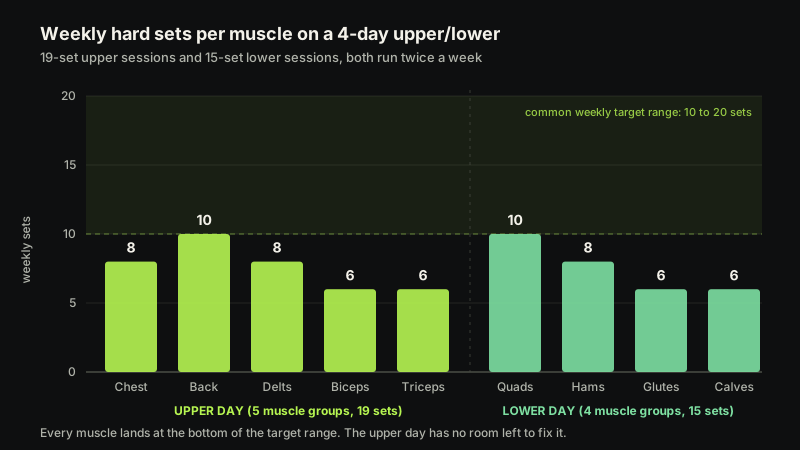
This is the structural asymmetry at the centre of the split, and most templates hide it by giving both days the same number of exercises. Six exercises upper, six exercises lower, looks balanced on paper. It is not, because six exercises have to stretch across five upper muscles and only four lower ones.
To push an upper muscle from 8 weekly sets to 14, you need three more sets per session. Do that for two muscles and your upper day is at 25 sets and well past the two-hour mark. That ceiling is real, and it is the honest answer to the question people actually mean when they ask how many sets belong in one workout.
One thing softens the picture slightly. Presses credit the triceps and front delts, and rows credit the biceps, so direct arm sets are not the only stimulus those muscles receive. Compound movements spread a hard set across several muscles, which is why 6 direct biceps sets a week is less alarming than it looks. It softens the arithmetic. It does not remove it.
Where an upper day breaks down
The set count is only half of it. The other half is where in the session those sets happen.
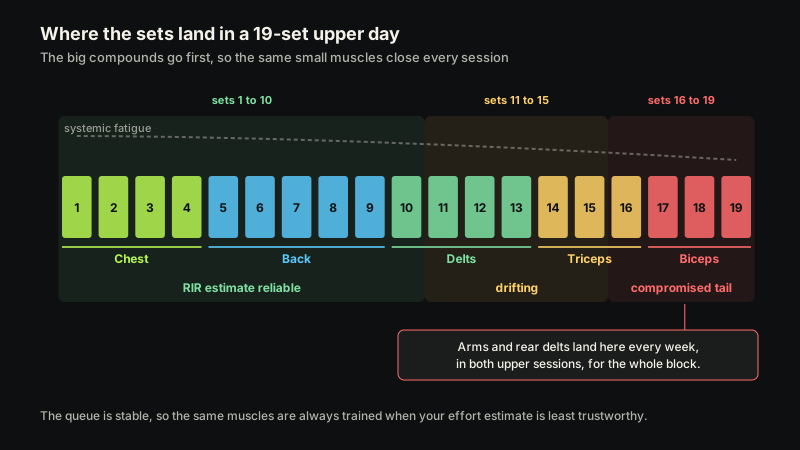
Run the upper day in the order almost everyone runs it. Heavy press, heavy row, secondary press, secondary pull, side delts, then arms. The queue is stable because the reasoning behind it is sound: put the big loadable compounds first while you are fresh.
Which means the small muscles are always last. Not sometimes last. Structurally, permanently last, in both upper sessions, every week of the block.
Most evidence-based guidance puts working sets in the region of one to three reps in reserve. The stimulus depends on genuinely getting close to failure on the sets that are supposed to count.
By set 16 of an upper day, you have been training for over an hour. Your grip is going. Your elbows have absorbed a heavy press and two pulls. You start the curls and the set ends at what you honestly log as 2 RIR.
It probably was 2 RIR. That is the trap. The number is accurate and the stimulus still is not what it would have been, because it is 2 RIR relative to a much more fatigued version of you, on a weight well below what you would have curled fresh. Systemic fatigue, not the biceps, is deciding when the set ends.
Do that twice a week for eight weeks and you have a block where chest and back progressed nicely, and arms and rear delts did not. This is the most common complaint about upper/lower splits, and it almost never gets diagnosed correctly. Lifters conclude their arms are stubborn. Their arms are fine. Their arms have simply never been trained when they were fresh.
It is also close to invisible in a normal training log. A spreadsheet that records sets and reps shows three sets of curls in week 1 and three sets of curls in week 8. What it does not show is that the load drifted down while the logged RIR stayed pinned at 2, which is the signature of sets that have stopped contributing what you think they are contributing. You only catch that by recording load, reps and RIR for every set and reading them back in order.
Upper/lower vs PPL vs full body
The comparison people actually want is upper lower vs ppl, usually because they have four or five days and are trying to decide. Upper/lower is really just one of several ways to spend four days, and it is the one most lifters should reach for first.
| Full body | Upper/lower | Push/pull/legs | |
|---|---|---|---|
| Typical days per week | 3 | 4 | 6 |
| Frequency per muscle | 3x | 2x | 2x |
| Muscle groups per session | 8 to 9 | 4 to 5 | 2 to 3 |
| Sets per muscle per session | 2 to 3 | 3 to 6 | 5 to 8 |
| Session length | Long | Long on upper days | Moderate |
| Main weakness | Nothing gets much per session | The upper day's tail | Needs 6 days to hit 2x frequency |
The honest summary is that all three work when weekly volume matches, which is the same conclusion the research keeps landing on and the reason the choice of split matters less than lifters expect. What differs is the failure mode each one hands you.
Full body vs upper lower comes down to how much you can get done per muscle in a session before quality drops, and a three-day full body split divides your weekly sets into the smallest per-session doses of anything on this table. PPL solves the upper day's crowding by splitting it in two, but it needs six days to deliver twice-weekly frequency, and a five-day PPL rotates through the week so your training days move constantly. Bolt an upper and a lower day onto three PPL sessions and you get the five-day PPLUL hybrid, which reaches twice-weekly frequency on a fixed five-day week. The other six-day option trades the problem rather than solving it: the Arnold split is the only common structure that pairs two large muscle groups, so one of chest or back always runs second.
Upper/lower's failure mode is the one described above, and unlike the others it is fixable without changing the split.
How to run a four-day upper/lower well
The fixes below assume your plan already states a target effort for each slot, not just sets and reps, because that is the column most four-day plans leave out.
Rotate what goes last. This is the single highest-value change. If arms close Upper A, open Upper B with them. Start one upper session with the movement that normally gets the leftovers and you have converted a permanently compromised muscle into one that gets a fresh session every week. Nothing else on this list matters as much, and it is the same principle behind why the last exercise pays for the first in any session.
Differentiate the two upper days properly. Do not run the same session twice with slightly different exercises. Make Upper A press-led and Upper B pull-led, or give each one two priority muscles that go first. Two identical sessions means whatever was disadvantaged on Monday is disadvantaged again on Thursday.
Move the overflow to the lower day. The lower day has capacity the upper day does not. Side delts, rear delts and biceps do not care which day they happen on, they involve no leg fatigue, and they will get a far better set at position 16 of a lower session than at position 16 of an upper one. This is the least intuitive fix and one of the most effective.
Cap the upper session honestly. Around 18 to 20 working sets is where most people's quality holds. If your plan says 26, it is not a plan for four sessions, it is a plan for five.
Do not fix low volume by adding exercises. Adding a sixth upper movement lengthens the tail and pushes more sets into the region where they buy the least. Add sets to a movement that already sits early in the session instead.
Check the actual weekly totals per muscle. Not the planned totals. Sessions get cut short, machines get taken, and the exercise that disappears when you are running late is almost always the last one, which is the same one that was already compromised.
Let your weekly hard sets settle it
Upper/lower deserves its reputation. It delivers twice-weekly frequency at per-session doses each session can absorb, it fits a normal working week, and it survives the research better than most structures. If you want a strength goal bolted onto the same four days, that is how to train for both strength and size at once, and the usual template is PHUL, which assigns two of them to heavy low-rep work; just be aware of what happens when you run heavy and high-rep work in the same week without deciding how hard each day should be.
It just has an honest weakness, and it is not the one people look for. The split is fine. The upper day is crowded, its tail is where your smallest muscles live, and no template will tell you which of your sets are landing there because that depends on your session, your order and your fatigue.
Both of those things are countable. Weekly hard sets per muscle, and where in the session each one happened while your effort estimate was still trustworthy.
RIRLift totals hard sets per muscle across the week automatically, so the gap between the 14 sets you assumed your side delts were getting and the 8 they actually got shows up as a number instead of a suspicion. Logging load, reps and RIR per set on the wrist as the session runs is what makes the tail visible, because the decay shows up in the sequence rather than in a total. You can see how a session runs from your wrist without pulling a phone out between sets, which matters more than usual on a day with nineteen of them. For setting the weekly targets in the first place, the training volume guide covers where the numbers should land.
Run upper/lower. Just make sure the muscles at the back of the queue occasionally get to go first.