
Blog
Block Periodization: How to Plan and Run a Training Block
Published November 9, 2026 · 12 min read
Block periodization splits your training year into short blocks of two to six weeks, each built around one main goal, so you chase one quality at a time instead of everything at once. The standard order is accumulation (build volume and work capacity), transmutation (convert that base into heavier, more specific work), and realization (peak and test). This guide shows how to size each block, what the numbers look like, and how to tell when to move on.
TL;DR
- Block periodization concentrates training on one or two goals per block, usually in the order accumulation, transmutation, realization.
- Per a PMC review, accumulation sits near 50 to 70% of 1RM, transmutation near 75 to 90%, and realization at 90% or more.
- Blocks typically run 2 to 6 weeks. Move on when adaptation slows, not just when the calendar says so.
- Advanced lifters tend to get the most from it. Beginners usually progress fine on simpler models.
- Most failed blocks fail at the handoffs: volume carried too far, or realization volume not cut enough.
Table of Contents
- What block periodization actually is
- The three blocks, with numbers
- Microcycle, mesocycle, macrocycle in a block plan
- A worked 12-week example
- How long should a block last?
- Block periodization vs. linear periodization
- Adapting a block to your goal
- Common mistakes
- FAQ
- Sources
What block periodization actually is
In a conventional plan you train hypertrophy, strength and power in parallel and shift the emphasis slowly. In a block plan you stack the emphasis. One block raises one capacity, the next block uses that capacity as raw material, and the last one sharpens it for a test or competition.
The model was introduced in the mid-1980s by Russian scientist Yuri Verkhoshansky, according to IDEA Health & Fitness Association, to meet the changing needs of advanced athletes. The logic is simple: well-trained lifters stop responding to a little of everything, so concentrating the stimulus gives them a stronger signal for one thing at a time.
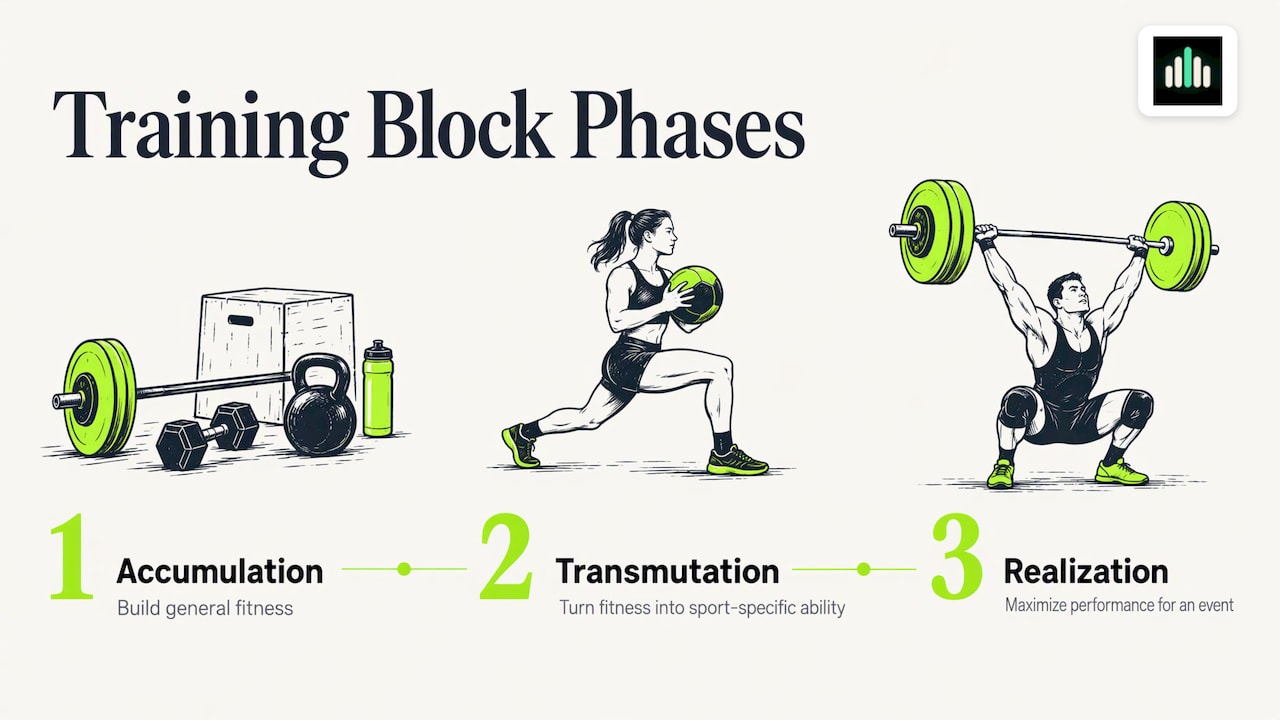
The Human Performance Resource Center describes the three phases this way: accumulation focuses on general fitness, transmutation turns that fitness into sport-specific ability, and realization maximizes performance for an event. For a lifter who does not compete, read that as: build a base, make it heavy and specific, then express it in a top set or a max test.
If you want a second explainer on when a lifter genuinely needs this model, we cover that in our block periodization guide. This article focuses on building and running the blocks themselves.
The three blocks, with numbers
The table uses the ranges from the Lorenz and Morrison review in PMC, which gives accumulation at 50 to 70% of 1RM for roughly 2 to 6 weeks, transmutation at 75 to 90% with more specific exercises, and realization at 90% or higher with the most specific movements. The RIR column is our practice suggestion, not a research figure.
| Block | Main goal | Load (% of 1RM) | Volume | Typical RIR (practice) |
|---|---|---|---|---|
| Accumulation | Work capacity, muscle, technique | 50 to 70% | Highest | 2 to 3 |
| Transmutation | Convert base into heavy strength | 75 to 90% | Moderate | 1 to 2 |
| Realization | Peak and test | 90% or more | Lowest | 0 to 1 on top sets |
Notice the pattern: as load rises, volume falls and exercise selection narrows. Accumulation tolerates a wide variety of lifts. Realization is mostly the competition lifts or close variants.
Accumulation: build the base
This block is about total productive work. Use more hard sets per muscle group, moderate loads, and a rep range that lets you accumulate quality reps without grinding. Technique practice at manageable loads is a built-in bonus.
Keep sets honest by stopping with a couple of reps in reserve (RIR, the number of reps you could still have done). Sets taken to failure every session add fatigue faster than they add useful volume, and fatigue is the thing this block has to outlast.
Transmutation: make it specific
Now you trade volume for intensity. Loads climb into the 75 to 90% range, sets get fewer, and you shift from general variations toward the lifts you want to improve. The EliteFTS powerlifting guide describes the same 75 to 90% window with moderate volume.
This is where the previous block pays off. If accumulation went well, the weights that felt heavy a month ago now feel like working loads, and top sets can move up.
Realization: peak and test
The final block is short and sharp. Volume drops sharply, loads reach 90% or more, and the aim is to express strength, not build it. EliteFTS puts this block at around two weeks and treats it as a taper before competition. Many plans end with a reduced-load week afterward, as the PMC review notes.
If you do not compete, you can still use this block to test a new max or a rep record. It gives the training cycle an endpoint, which makes progress easy to read.
Microcycle, mesocycle, macrocycle in a block plan
These three terms are the nesting dolls of the plan:
- Microcycle: the smallest unit, usually one training week.
- Mesocycle: a block. HPRC says these typically last 2 to 6 weeks.
- Macrocycle: the whole plan, such as a season or a year, containing several mesocycles.
So a 12-week plan is one macrocycle, three or so mesocycles, and about 12 microcycles. For more on how the three levels fit together, see our macrocycle, mesocycle and microcycle explainer.
A worked 12-week example
Here is a practical template for a lifter with a few years of training who wants a stronger squat, bench and deadlift. The percentages stay inside the ranges above. The set and rep numbers are our practice suggestions, so adjust them to your recovery.
| Weeks | Block | Main lift work | Weekly hard sets per main lift (practice) |
|---|---|---|---|
| 1 to 4 | Accumulation | 3 to 4 sets of 6 to 10 at roughly 60 to 70%, plus varied accessories | 8 to 12 |
| 5 to 8 | Transmutation | 3 to 5 sets of 3 to 6 at roughly 75 to 85% | 5 to 8 |
| 9 to 11 | Realization | Singles and doubles at 90% or more, few back-off sets | 3 to 5 |
| 12 | Deload and test | Light week, then a heavy single or rep-max test | 2 to 3 |
A few details make this work in real life:
- Start conservative. Use a recent estimated 1RM, not your best day ever. A 1RM calculator turns a recent set into an estimate you can base percentages on.
- Progress inside the block. Add load or a rep each week while keeping RIR within the target. A set that was meant to leave 2 RIR but left 0 is a signal to hold the weight next week.
- Narrow the exercise list as you go. Accumulation can use paused squats, front squats and rows. By realization, mostly the competition lifts.
- Plan the final week. Fatigue from realization needs to clear before the test.
Other published plans follow the same shape. A 12-week sample from The Workout Mag uses three four-week blocks, and a 14-week powerlifting plan splits training into 4, 6 and 4 weeks, with the longest block devoted to volume.
How long should a block last?
Research-backed ranges overlap but differ. IDEA cites blocks of 2 to 4 weeks depending on program length and the client's goals. HPRC says 2 to 6. ACR Coaching suggests phases need at least 3 to 5 weeks for meaningful adaptation, and that two or more consecutive stalled sessions can signal a phase has run its course.
A workable rule: plan a block at four weeks, then let your logs decide whether to extend or end it.
- Extend by a week when load or reps are still rising and RIR matches the target.
- End early when the same weight keeps feeling harder at the same effort, or reps fall for two sessions in a row.
- Keep realization short. Peaking does not improve with duration. It is a taper, not a phase to live in.
This is where records matter. If you log weight, reps and RIR for every set, the end-of-block decision stops being a feeling and becomes a trend. Our Apple Watch and iPhone app, RIRLift, is built for that kind of set-by-set logging, and its AI Coach reads your history to suggest the next load. If you are planning blocks, the Pro plan is $9.99 per month or $79.99 per year, and the free plan covers core logging.

You can also build the sets, reps and loads for a session with the Session Builder once you know which block you are in.
Block periodization vs. linear periodization
Linear periodization changes training variables gradually, usually raising intensity and lowering reps over many weeks. Block periodization holds a focus for a short stretch and then switches it. The Brookbush Institute notes that block models keep intensity relatively stable for a short duration before moving to a new block, and that the sequence between blocks can itself be linear, reverse linear or non-linear.
What does the evidence say? A randomized crossover study in trained high-intensity functional training athletes linked concentrated block loading to favorable changes in selected maximal strength outcomes without hurting conditioning or cardiovascular health markers. That is encouraging, but it is a single, specific population. The PoinT GO research review says block models suit advanced athletes with about five or more years of training, and that beginners often do as well with simpler linear or undulating models.
| Question | Linear | Block |
|---|---|---|
| Focus at any time | Several qualities, shifting slowly | One or two qualities |
| Best fit | Beginners and early intermediates | Advanced lifters, peaking goals |
| Planning effort | Low | Higher |
| Flexibility with a busy schedule | High | Lower |
If you are earlier in your training, our guides to linear periodization and undulating periodization cover the simpler options.
Adapting a block to your goal
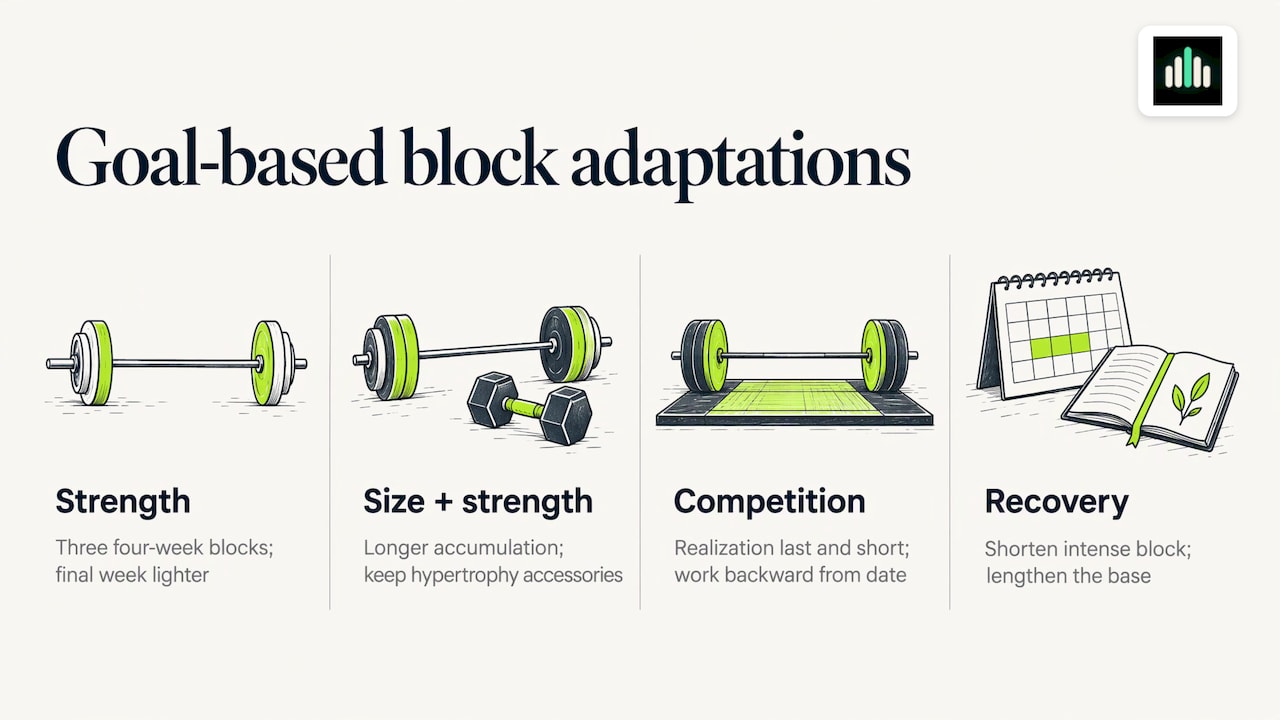
Strength progression without a meet. Run three blocks of four weeks and use the last week of each as a lighter week. You get repeatable test points every month instead of one peak per year.
Strength and size together. Lean the accumulation block longer and keep hypertrophy-style accessory work through later blocks. If this is your goal, our piece on powerbuilding covers how the two aims coexist.
A single competition peak. Work backward from the date. Realization goes last and short, transmutation before it, and accumulation fills the rest. One practitioner source reports volume reduction of 30 to 40% in the pre-season phase for athletes who peak once or twice a year, according to PoinT GO's power guide.
Recovery limits. If sleep, work or life stress is heavy, shorten the intense block and lengthen the base. Lifters sometimes also line up their routines with phases, and one take on how to cycle supplements around training phases follows the same block logic.
Athletes in other sports can apply the same structure. See our strength training for athletes plans for sport-specific examples.
Common mistakes
- Carrying volume forward. Keeping accumulation-level sets into transmutation leaves you tired at the exact time you need to be fresh for heavy loads.
- Staying heavy too long. Holding transmutation intensity through the whole realization block blunts the peak.
- Not cutting realization volume enough. A peak requires real reductions, not a trim.
- Dropping everything else. Blocks can let non-priority qualities fade. Rehab-focused coach Adam Loiacono argues that small maintenance doses of those qualities can limit that loss, which is a practitioner view rather than a trial result.
- Using it too early. If you are still adding weight every week, a simpler plan is probably doing the job.
- Ignoring effort. Percentages assume a 1RM that may be stale. Using RIR as a check keeps heavy days honest when your max has changed.
FAQ
What is the difference between a mesocycle and a microcycle?
A microcycle is usually one training week. A mesocycle is a block of several microcycles, typically 2 to 6 weeks, built around one goal. A macrocycle contains several mesocycles.
Is block periodization better than linear periodization?
Not universally. Block models seem to suit advanced lifters who need a stronger, more focused stimulus, while beginners often progress equally well on linear or undulating plans. Choose based on your training age and whether you have a peak to aim for.
How many weeks should each block be?
Most plans use 2 to 6 weeks, and four is a practical default. Extend a block while load and reps keep climbing at the planned effort, and end it when performance stalls for two or more sessions.
Do I need to peak if I do not compete?
No. A short realization block with a lighter week and a test is still useful, because it gives you a clear measurement of what the previous eight weeks built.
Sources
- Plan your workouts with block periodization, HPRC
- Current concepts in periodization of strength and conditioning, PMC
- Types of Periodization Training, IDEA Health & Fitness Association
- Block periodization vs. traditional periodization in high-intensity functional training, PMC
- Block Periodization, Brookbush Institute
- Training Phases and When to Change Them, ACR Coaching
- A Practical Guide for Implementing Block Periodization for Powerlifting, EliteFTS
- Periodization Models Comparison: Research Review, PoinT GO
- Periodization for Power: Phase Programming Guide, PoinT GO
- Block Periodization: A 12-Week Strength & Hypertrophy Program, The Workout Mag