
Blog
How to Calculate Training Volume: 3 Methods and Examples
Published November 5, 2026 · 13 min read
To calculate training volume, multiply sets by reps by weight for each exercise and add the results (this is called volume load), or count the hard sets you do for each muscle group each week. Volume load is best for tracking one lift over time, and weekly hard sets are best for judging whether a muscle is getting enough work.
Most confusion comes from the fact that "volume" means different things in different places. This guide shows each method with real arithmetic, a full worked week, and a way to combine them so the numbers tell you something useful.
TL;DR
- Volume load = sets × reps × weight. Three sets of 10 at 100 pounds is 3,000 pounds. It works well for comparing the same exercise week to week.
- Hard sets = sets taken close to failure (roughly 3 or fewer reps in reserve), counted per muscle group per week. Warm-ups and easy sets do not count.
- Fractional sets give a muscle full credit for exercises that target it and half credit when it assists. A common starting range for muscle growth is 10 to 20 weekly sets per muscle.
- Tonnage can mislead across different exercises, so use it within a lift and use sets across a muscle group.
- Track every set, including reps in reserve, and the calculation stops being homework.
Table of Contents
- What "training volume" actually measures
- Method 1: Volume load (sets × reps × weight)
- Method 2: Hard sets per muscle group per week
- Method 3: Fractional weekly sets
- A full worked example: one chest week
- Tonnage vs. volume: which to use when
- How much weekly volume should the number be?
- Common calculation mistakes
- Our perspective
- Put the numbers to work with RIRLift
- FAQ
- Sources
What "training volume" actually measures
Training volume is the amount of work you do, but the field has no single agreed way to count it. A 2018 review in the Strength & Conditioning Journal describes volume as the total work performed, commonly measured by sets, total repetitions, or volume load (sets × reps × weight), and notes that no consensus exists on one definitive metric.
In practice, lifters use two families of measurement:
- Load-based: how many pounds you moved in total (volume load, also called tonnage).
- Set-based: how many challenging sets you performed, usually per muscle group per week.
The set-based approach is what most hypertrophy discussions mean by volume. Outlift defines it as hard sets per muscle group per week and says only sets that bring a muscle close to failure count, which excludes warm-ups and easy sets. Volume load is a different, narrower metric: it measures total weight moved rather than how demanding the sets were.
Neither is wrong. They answer different questions, so you choose the one that fits the question you are asking.
Method 1: Volume load (sets × reps × weight)
This is the classic formula and the one most calculators use. For each exercise, multiply the number of sets by the reps per set by the weight, then add up the exercises.
A textbook example from a college exercise science course: 3 sets of 10 dumbbell curls with 25 pounds in each hand (50 pounds total) equals 1,500 pounds of volume.
Here is the same idea with a barbell, using round numbers:
- Bench press, 3 sets × 10 reps × 100 lb = 3,000 lb
- Add a fourth set of 8 reps at 100 lb: 800 lb more, for 3,800 lb
Rules for getting the math right
- Count working sets only. Warm-up sets inflate the total without adding stimulus. If you are unsure how many warm-ups you need, our guide on warm-up sets before working sets covers it.
- Count dumbbells as the combined weight if you want to compare them with a barbell, or per-hand weight if you only compare dumbbell sessions to each other. Pick one and stay consistent.
- Use total body weight plus added load for bodyweight lifts like weighted pull-ups, or log them separately. Again, consistency matters more than the choice.
What volume load misses
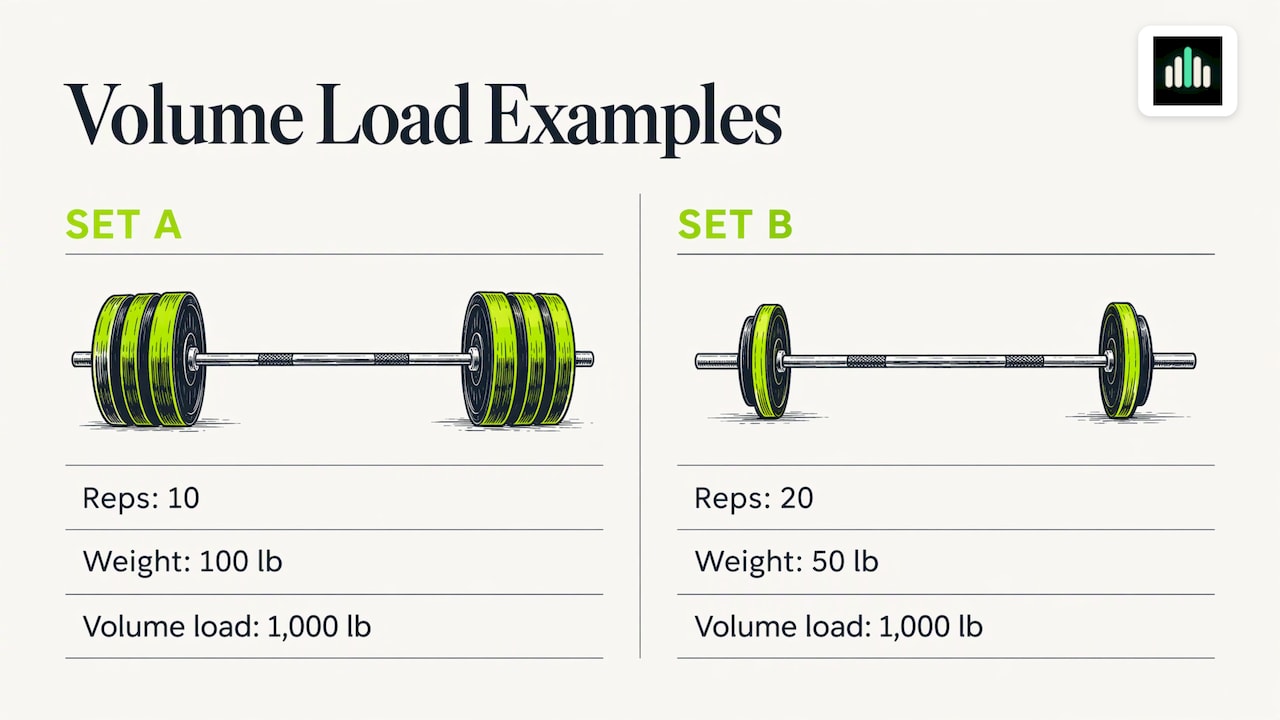
Volume load treats 10 reps at 100 pounds the same as 20 reps at 50 pounds. Both come to 1,000 pounds, but they are very different efforts. SPC Performance Lab points out that the formula is popular for its simplicity but ignores relative intensity, meaning how close the weight is to your one-rep max.
It also ignores proximity to failure. A set of 10 stopped with six reps left and a set of 10 taken to the edge produce the same tonnage on paper. That is the gap the next method closes.
Method 2: Hard sets per muscle group per week
A hard set is a set taken close to failure. A practical rule: if you finished with about three or fewer reps in reserve (RIR), it counts. RIR is simply the number of reps you could still have done when you stopped. Our RIR calculator can help you estimate it from a set.
The Training Volume Calculator at rpetraining.com uses the same logic, defining hard sets as sets at RPE 7 or higher (roughly three reps in reserve). That convention is a handy working definition rather than a law of physiology.
The rep range matters too. SPC Performance Lab cites Baz-Valle and colleagues (2018) for the idea that counting sets works best when sets fall between 6 and 20 repetitions and are taken near failure. Sets of 3 heavy reps for strength or 40 light reps for conditioning do not map neatly onto this count.
Why the week is the unit
For intermediate and advanced lifters, one session is rarely the full overload event. Ben McAllister's analysis argues that the relevant window is a week or longer. So add up hard sets across all sessions in a week, per muscle group, rather than judging one workout in isolation.
Method 3: Fractional weekly sets
Compound lifts train more than one muscle. A bench press works the chest, but also the triceps and front delts. If you count every set as a full set for every muscle involved, your arm volume balloons. If you ignore the overlap, your arm volume looks too low.
Greg Nuckols at Stronger by Science describes a middle path called fractional sets: each set counts as one set for the primary target muscle and half a set for synergists. Four sets of bench press would be 4 sets for chest and 2 for triceps.
This is the most realistic of the three methods, and also the most tedious by hand. For a quick estimate, our sets per muscle group calculator does the tallying for you.
A full worked example: one chest week
Say you train chest twice a week, and one session looks like this. Every set is taken to about 2 RIR.
| Exercise | Sets × reps | Load | Volume load | Hard sets (chest) | Triceps credit (half) |
|---|---|---|---|---|---|
| Barbell bench press | 4 × 8 | 185 lb | 5,920 lb | 4 | 2 |
| Incline dumbbell press | 3 × 10 | 65 lb per hand (130 lb) | 3,900 lb | 3 | 1.5 |
| Cable fly | 3 × 12 | 30 lb | 1,080 lb | 3 | 0 |
| Session total | 10,900 lb | 10 | 3.5 |
What each number tells you:
- 10,900 pounds is the session's volume load. If next week the same session totals 11,300 pounds, you did more work on the same lifts.
- 10 hard sets is the chest count for this session. Repeat the session on a second day and you are at 20 weekly chest sets, the top of the middle range discussed below.
- 3.5 fractional triceps sets per session means your triceps already get 7 sets a week from pressing alone, before any direct arm work.
Notice what the arithmetic cannot do: it cannot tell you whether cable fly tonnage of 1,080 pounds is "less valuable" than bench tonnage of 5,920 pounds. That is exactly why tonnage should not be compared across exercises.
Tonnage vs. volume: which to use when
People often use "tonnage" and "volume load" interchangeably, and "volume" for sets. A clean way to separate them:
| Question | Best metric |
|---|---|
| Did I do more work on bench press than last month? | Volume load (tonnage) on that lift |
| Is my chest getting enough stimulus each week? | Hard sets per muscle group |
| How much do my triceps get from pressing? | Fractional sets |
| Is my session harder than last week's? | Hard sets plus average RIR |
Your Strength Guide notes that tonnage is useful for comparing the same exercise over time but can mislead across different exercises, because ranges of motion differ. A leg press can rack up far more pounds than a squat without being a better leg stimulus. Use tonnage as a within-lift trend line and let sets describe the muscle.
How much weekly volume should the number be?
Calculating is only half the job. You also need a target to compare against.
The 2018 Strength & Conditioning Journal review names 10 or more sets per muscle group per week as a good starting point for hypertrophy-oriented goals. It also suggests that gradually moving from lower volumes (around 10 sets per muscle per week) toward higher ones (around 20) over several months may help promote functional overreaching and supercompensation.
Nuckols frames the same landscape as three bands for hypertrophy: low volume (10 sets a week or fewer), middle-of-the-road (10 to 20), and high volume (more than 20).
A practical way to use this:
- Count your current hard sets per muscle for two typical weeks.
- If most muscles sit under 10, you have room to add sets before changing anything else.
- If you are already between 10 and 20 and progressing, leave the number alone. Your Strength Guide makes the same point: when performance is improving and recovery is good, more work is only better if it leads to better adaptation.
- If a lift stalls for two or three sessions, check sleep and food first, then consider adding a set for that muscle, as LiftDecode suggests.
The ranges are population-level guides, not prescriptions. Your own recovery, schedule and training history decide where you land inside them. For help choosing a number, see our piece on how many sets per workout, and for how a week's sets spread across sessions, training frequency for hypertrophy.
Common calculation mistakes
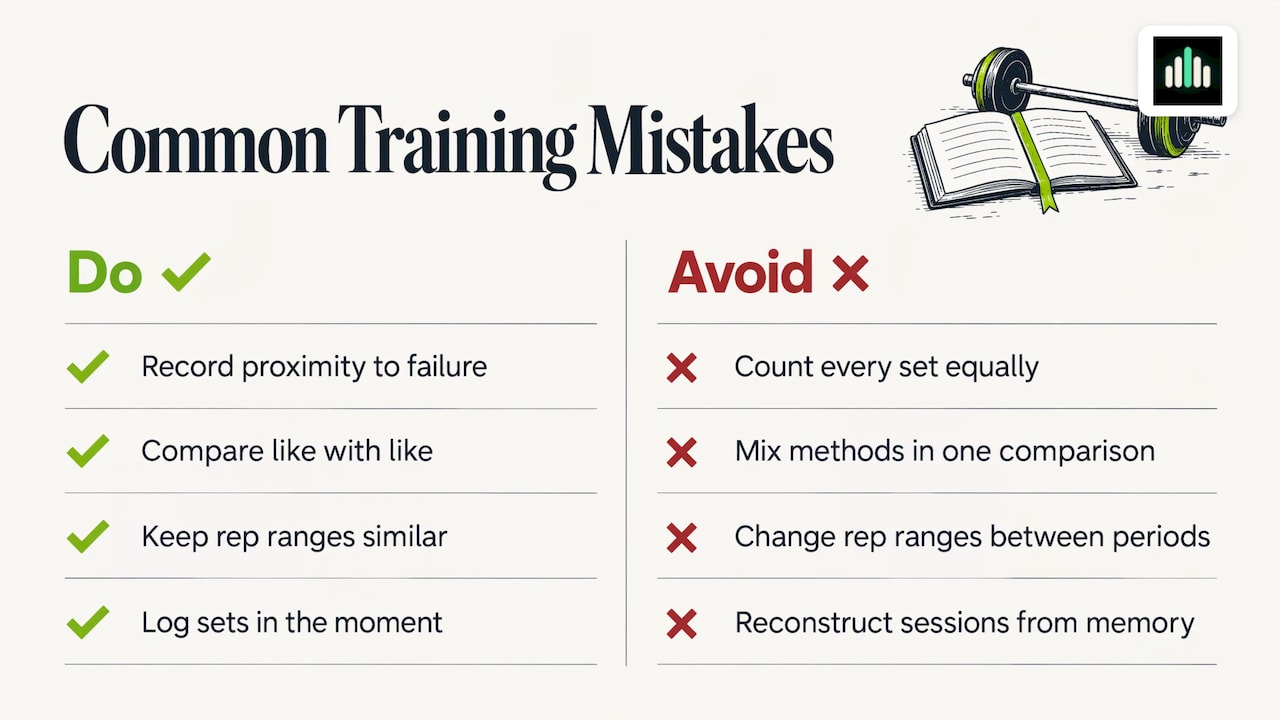
Counting every set equally. Fifteen sets stopped five reps short of failure and 15 sets taken near failure are different weeks. Record proximity to failure with every set, or your count is flattering you.
Mixing methods in one comparison. Do not compare last month's set count with this month's tonnage. Pick the metric that fits the question and compare like with like.
Ignoring rep range. Volume load climbs when you switch from sets of 8 to sets of 20, even if the muscle stimulus does not. Keep rep ranges similar when you compare periods.
Chasing a bigger number. Higher volume is a tool, not a goal. Extra sets that leave you too fatigued to hit your target loads next session may be costing you progress.
Skipping the log. The calculation is simple, and the problem is that nobody wants to do it after a workout. If you only reconstruct sessions from memory, the data will be wrong. Logging sets in the moment, even simply, makes every method above possible. A tracking habit also helps when you want to compare results over time, as in tracking and comparing your scores, where repeatable records are the whole point.
If your plan uses very high set counts per exercise, like 10 sets of 10, our look at German volume training shows how the same arithmetic plays out.
Our perspective
We built our logging around one belief: the best volume number is the one you did not have to calculate. Lifters who try to keep a spreadsheet of sets, reps, weights and effort usually abandon it within a few weeks, and then they are back to guessing.
That is why we record weight, reps and reps in reserve for every set. Once those three values exist, volume load, hard sets and fractional sets are all just views of the same data. You do not pick a method up front, you ask a question later.
We also think the number should lead somewhere. Our AI Coach reads your logged sets and suggests the next load from how you actually performed, using RIR as the signal. It works from your own training data rather than a generic template, and you can talk to it to adjust the plan when life or recovery changes.
And because the Apple Watch app is a full part of the product and not an add-on, you can log sets with just your watch if you want to leave your phone in the locker.
Guilherme
Put the numbers to work with RIRLift
If you would rather lift than do arithmetic, RIRLift is an iPhone and Apple Watch app that logs every set with weight, reps and reps in reserve, then shows workout analytics and a weekly muscle map so you can see volume by muscle group. Core features are free, and RIRLift Pro is $9.99 per month or $79.99 per year in the App Store. It unlocks advanced coaching, analytics and unlimited routines.

Start with the free version at RIRLift and log one full week. You will have your weekly hard sets per muscle without touching a calculator.
FAQ
What is the simplest way to calculate volume?
Multiply sets by reps by weight for each exercise and add them up. Three sets of 10 reps at 100 pounds equals 3,000 pounds. Count only working sets, and compare it only to the same exercise in other weeks.
Is training volume sets or total weight lifted?
Both are used. Total weight lifted is volume load or tonnage, while many hypertrophy discussions define volume as hard sets per muscle group per week. Use tonnage to follow one lift and sets to judge a muscle group.
Which sets count toward weekly volume?
Sets taken close to failure, in practice about three or fewer reps in reserve, count. Warm-ups and easy sets do not. The research literature leans on sets in roughly the 6 to 20 rep range for muscle growth.
How many sets per muscle per week should I aim for?
A common starting point for muscle growth is 10 or more sets per muscle per week, and many lifters work between 10 and 20. Begin at the lower end, track how you recover and progress, and add sets only when a lift stalls and sleep and food are in order.
Sources
- Evidence-Based Guidelines for Resistance Training Volume, Strength & Conditioning Journal (2018)
- What is Training Volume?, Outlift
- Training Volume, Introduction to Exercise Science
- How to Measure Training Volume for Muscle Hypertrophy, SPC Performance Lab
- Training Volume Calculator, rpetraining.com
- Better Charts for Post-Novice Lifting Analysis, Ben McAllister
- More Training, More Gaining, Stronger by Science
- How to Track Training Volume, Your Strength Guide
- How to Progressive Overload (Even When You Can't Add Weight), LiftDecode