
Blog
Conjugate method: how to track a program that never repeats
Published November 14, 2026 · 14 min read
Most programs answer one question every week: did the number go up? You squatted 140 kg for five last Monday, you try 142.5 this Monday, and the log tells you whether it worked. The conjugate method breaks that loop on purpose. Your heavy lift on Monday is a box squat this week, a safety bar squat next week and a good morning the week after, so this week's top set never sits next to last week's. That rotation is the point of the method, and it is also why so many lifters who try it cannot tell after two months whether they are getting stronger or just getting good at variety.
You can tell. It takes a different way of reading your training log than a linear program needs, and this post is about that reading as much as the method itself. First the structure, then the three effort methods, then how to judge each one from what you recorded.
What is the conjugate method?
The conjugate method is a strength training system, popularized by Louie Simmons at Westside Barbell, that trains maximal strength, speed and muscle in the same week instead of in separate blocks. Each week has four main sessions: a max effort day and a dynamic effort day for the lower body, and the same pair for the upper body. The max effort lift rotates to a new variation every one to three weeks so the lifter can keep setting records without grinding the same movement into the ground.
Westside Barbell's own description puts it as combining heavy max effort work with speed work (dynamic effort), anchored by high-volume special exercises (repeated effort), and rotating the max effort lift weekly to avoid burnout. That is the whole system in three parts. The name, and the looser term conjugate training, refers to training several qualities at once and linking them, as opposed to the sequenced approach in block periodization, where you accumulate, then intensify, then peak.
It was built for geared powerlifters, and a lot of its classic detail (bands, chains, specialty bars, board presses) comes from that world. The logic underneath transfers to raw lifters and to people who care more about muscle than about a meet total, which is where most readers of this post will be.
The conjugate week, day by day
A standard conjugate template runs four sessions with at least a day between the max effort and dynamic effort days for the same body half. A common layout looks like this:
| Day | Session | Main work | Typical prescription |
|---|---|---|---|
| Monday | Max effort lower | A squat or deadlift variation | Work up to a 1 to 3 rep max |
| Wednesday | Max effort upper | A bench or press variation | Work up to a 1 to 3 rep max |
| Friday | Dynamic effort lower | Box squat, then speed pulls | 8 to 12 sets of 2 at about 50 to 60% |
| Sunday | Dynamic effort upper | Speed bench | 8 to 9 sets of 3 at about 50 to 60% |
Every one of those sessions then finishes with repeated effort work: accessories for the muscles that limit the main lifts, done for sets of roughly 8 to 15. Hamstrings, glutes, lats, triceps and upper back get most of it.
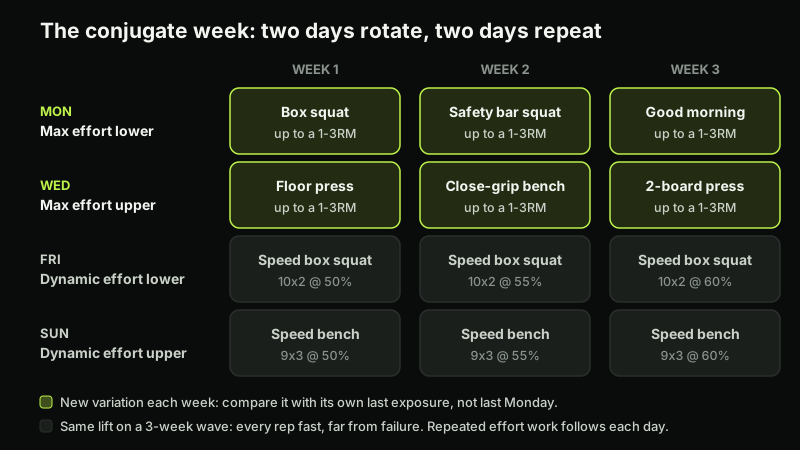
The diagram shows the part that trips people up. The dynamic effort days are stable: same lift, same percentages, moving through a three-week wave. The max effort days change exercise every week or every few weeks. So two of your four sessions are easy to track and two are not, and the hard two are the ones that tell you whether you are getting stronger.
The three effort methods, and what each one is for
The conjugate method is built on three ways of producing high muscular tension, each with a different job. The labels predate Westside; they come from the strength training literature Simmons drew on.
Max effort: the strength driver
Max effort means lifting the heaviest load you can for one to three reps on that day. It trains the nervous system to recruit and coordinate as much muscle as possible under a near-maximal load, which is the single most specific thing you can do for a heavier max. The catch is that true maximal work on the same lift every week stalls fast and beats you up. Rotation is the fix: you go to your limit on a close relative of the competition lift, and because the variation changes before you have adapted to it, the record is still in reach next time.
Good max effort variations differ from the main lift in one meaningful way: a box, a different bar, a pause, a deficit, a raised range, a block. Too different and it stops carrying over.
Dynamic effort: the speed and practice driver
Dynamic effort is the opposite end. Moderate loads, lots of short sets, every rep moved as fast as possible. The goal is rate of force development and a lot of technical practice on the competition pattern at a weight that does not create much fatigue. Westside-style programs add bands or chains so the load gets heavier toward lockout, which matches the strength curve of the squat and bench.
The percentages usually run in a three-week wave (for example 50, 55 and 60% of the competition max) and then reset. If your bar slows down noticeably in the last week of a wave, the wave is set too heavy.
Repeated effort: the muscle driver
Repeated effort means taking submaximal sets close to failure, so the last reps are hard for the right reason: the target muscle can no longer keep up. This is ordinary hypertrophy training under a different name, and on a conjugate program it does two jobs. It builds the muscle that the max effort work later expresses as strength, and it brings up the weak point that made a lift fail. If your bench dies off the chest, more pec and front delt work. If it dies at lockout, triceps.
This is the part of the method where effort tracking does the most for you. Repeated effort sets only work if they end close to failure, and "close" is something you can rate. A practical target is 1 to 3 reps in reserve on the last set of each accessory, a common hypertrophy target that also keeps the accessories from eating into your next max effort day.
Why the conjugate method is hard to read from a log
On a linear program, progress is one comparison: this session against the last one. Progressive overload shows up as a slowly rising line. On a conjugate program, there are four different signals and none of them is that line.
The max effort lift is different almost every week, so a Monday top set has nothing from last Monday to compare with. The dynamic effort lift uses fixed percentages, so its load is set by the program and tells you nothing on its own. The accessories rotate too, just more slowly. And the competition lifts themselves are tested rarely; Westside's own guidance is to retest roughly every nine weeks.
A lifter who just looks at the most recent workouts will see a scatter of unrelated numbers. That is the moment people either decide the method "isn't working" or decide it is and keep running something that stalled a month ago. Both are guesses.
A worked example
Say a lifter's Monday rotation over nine weeks is: box squat, safety bar squat, good morning, then back to box squat in week four, and so on. Their max effort sets look like this:
| Week | Variation | Best set | Same variation last time |
|---|---|---|---|
| 1 | Box squat | 160 kg x 1 | (first exposure) |
| 2 | Safety bar squat | 145 kg x 2 | (first exposure) |
| 3 | Good morning | 110 kg x 3 | (first exposure) |
| 4 | Box squat | 165 kg x 1 | 160 kg x 1 (week 1) |
| 5 | Safety bar squat | 145 kg x 2 | 145 kg x 2 (week 2) |
| 6 | Good morning | 115 kg x 3 | 110 kg x 3 (week 3) |
| 7 | Box squat | 170 kg x 1 | 165 kg x 1 (week 4) |
Read week by week, the numbers jump around between 110 and 170 kg and mean nothing. Read by variation, two of three lifts are climbing steadily and the safety bar squat has stalled for a full rotation. That is a specific, actionable finding: the safety bar is either a bad variation for this lifter right now or it is sitting on a weak point (upper back) that the accessories are not touching. Swap it for something else for the next cycle, add upper back volume, or both.
The comparison that matters on a conjugate program is always "this variation against the last time I did this variation," and the gap between those two sessions is three to nine weeks. Nobody holds that in memory.
How to track the conjugate method properly
The fix is not complicated. It is just more deliberate than most lifters are with a logbook.
Log every variation as its own exercise
A box squat to a parallel box, a box squat to a low box and a free squat are three different exercises with three different bests. Merge them and the record means nothing. Name them precisely enough that the next exposure lands in the same history.
Judge the max effort day against that variation's history
Before the session, look up what you did last time on this exact variation. A new best by any amount is the method working. Matching it is fine once. Failing to match it twice in a row on the same variation is a signal, either about the variation or about recovery.
Rate dynamic effort sets for speed, not strain
Dynamic effort sets should end far from failure; on a reps in reserve scale they should feel like 5 or more reps in the tank, and the reps should look fast. If a wave's top week starts feeling like a grind, the percentages or the band tension are too high. You do not need a velocity tracker to notice that; you need to write down when it happened.
Rate repeated effort sets honestly
This is where RIR earns its place. A set of 12 rows at 4 RIR and a set of 12 at 1 RIR look identical in a log that only stores weight and reps, and only one of them is doing the job. The scale developed by Zourdos and colleagues for exactly this kind of rating is the one most lifters use now. If you log effort per set, RIRLift will suggest the next weight from the load, reps and RIR you recorded, which is the slow-moving progression the accessories need while the main lifts rotate around them.
Watch weekly volume per muscle
Repeated effort work adds up across four days. Because it is spread across many accessories, it is easy to drift into far too many hard sets for the lower back and hamstrings, or far too few for the chest. Count the hard sets per muscle per week; the dose-response research summarized by Schoenfeld and colleagues is the usual reference for how much is worth doing.
Is the conjugate method backed by research?
Partly, and it is worth being clear about which part. The pieces are well supported: heavy singles and triples are the most specific training for a one-rep max, high-velocity submaximal work improves rate of force development, and hard sets taken close to failure build muscle. Periodized training in general beats unperiodized training for maximal strength; a 2017 meta-analysis by Williams and colleagues found a small-to-moderate effect in favour of periodization (an effect size of 0.43 across 18 studies).
What does not exist is a solid body of controlled trials comparing conjugate programming head to head against undulating periodization, block models or simple linear progression in trained lifters. The method's evidence is mostly its competitive track record among geared powerlifters, which is real but specific. A raw lifter or a lifter chasing size should treat the structure as a sound starting point, not a proven optimum, and let their own log decide whether it is working for them.
Who should run the conjugate method
Conjugate programming suits intermediate and advanced lifters who already know their lifts well enough to pick sensible variations and to grind a true max safely. It suits people who get bored or beaten up running the same lift heavy for weeks at a time, and people who like a weekly target. It is also a reasonable fit for a powerbuilding goal, because the repeated effort half of the week is a full hypertrophy program on its own.
It is a poor fit for beginners. A beginner gets stronger from almost any reasonable program, and the simplest of those, adding weight to the same lifts each session, teaches technique far better than rotating eight variations does. If you are still adding weight to your squat every week, run something that lets you keep doing that, like the Texas Method or a linear progression, and come back to conjugate when the weekly jumps stop.
It is also a poor fit if you cannot recover from four sessions with a true max in two of them. That is the most common way the method goes wrong outside Westside. The fixes are to work up to a heavy triple rather than a true single on most max effort days, to keep the dynamic effort percentages honest, and to plan a lighter week when several variations stall at once. A deload week is not part of classic conjugate dogma, but a lifter without a gym full of training partners and a coach watching every rep will usually need one.
Conjugate for muscle growth
A hypertrophy-first version keeps the structure and shifts the weight of the week. Max effort days stop at a heavy set of three to five instead of a single, dynamic effort work stays short, and the repeated effort section grows to cover every muscle you care about at a sensible weekly volume. In practice that looks a lot like an upper and lower split with a heavy rotating opener each day, which is a perfectly good program in its own right. What it keeps from conjugate is the rotation, and with it the same tracking problem: the opener changes, so it has to be judged against its own history.
How it compares with other programs you might run
| Program | What changes week to week | How you read progress |
|---|---|---|
| Linear progression | Load on the same lifts | This session vs last session |
| 5/3/1 | Percentages through a monthly wave | AMRAP reps at the same percentage, cycle to cycle |
| Block periodization | Emphasis, every few weeks | End-of-block test vs last block |
| Conjugate method | Max effort variation, weekly; dynamic wave, every three weeks | Each variation vs its own last exposure; competition lifts at a retest |
None of these is a better way to get stronger in general. They differ in how much rotation they ask you to tolerate and, as a direct consequence, in how much your log has to do. Conjugate asks the most of both.
The verdict
The conjugate method works by never letting you repeat yourself on the heavy day, which keeps the heavy day productive for far longer than a fixed lift would. The cost is that progress stops being visible as a single line and becomes a set of separate histories, one per variation, checked weeks apart. If you track it that way, every max effort session has a clear target and a stalled variation shows up within one rotation. If you do not, the program looks like noise until a retest tells you, nine weeks late, what happened.
Name every variation, log every set with its effort, and compare each lift only with itself. Do that and the conjugate method is as easy to read as any linear program. Log your next conjugate block with load, reps and RIR on every set and let the history do the remembering.