
Blog
Full range of motion: what it means and why your log needs it
Published November 8, 2026 · 13 min read
Six weeks ago your squat was 100 kg for 8. Today it is 110 kg for 8. The log says you are stronger. Then you film a set and the bottom of the rep is four inches higher than it used to be.
That is the most common way a training log lies, and it has nothing to do with effort or programming. The load went up because the rep got shorter. Nobody decided to cut depth; it happened a centimetre at a time, on the hard sets, near failure, where nobody looks.
Full range of motion is usually sold as a muscle-growth rule, and the research does mostly back it. But the more practical reason to care is simpler: a rep is only comparable to last week's rep if it covers the same distance. Without a fixed range, every number in your log is a guess about two variables at once.
This article covers what full range of motion actually means on the lifts you do, what the studies found, and how to set a standard you can repeat and record, so that the progress in your log is progress in your muscles.
What is full range of motion?
In lifting, full range of motion means moving through the whole range the exercise allows, from the position where the target muscle is most stretched to the position where it is most shortened, as far as you can go while keeping control and position. On a squat that means the deepest position you can reach without your lower back rounding. On a bench press it means the bar touches your chest. On a curl it means the arm straight at the bottom and fully flexed at the top.
Two clarifications save a lot of arguing.
First, "full" is relative to the exercise and to you, not to a textbook joint angle. Physical therapists measure range of motion in degrees, and that clinical meaning is a different question (how far can this joint move at all). For training, the useful definition is the range you can control under load on that specific movement. A lifter with long femurs and stiff ankles may hit a lower, safer full squat on a heeled shoe than barefoot, and that is still full range for them.
Second, full ROM is not the same as "as far as possible no matter what". If reaching the bottom of a movement means losing your brace, letting the shoulder roll forward, or bouncing off a passive stretch, that extra inch is not training the muscle. The end of your controlled range is the end of your full range.
| Term | What it covers | Where it shows up |
|---|---|---|
| Full range of motion | Stretched to shortened, under control | The default for almost every exercise |
| Lengthened partial | Stretched half only | Isolation and machine work, near failure |
| Shortened partial | Shortened half only | Quarter squats, half bench reps, ego lifting |
| Partial reps after failure | A few short reps once full reps stop | The end of a set, as an intensifier |
Is full range of motion better for muscle growth?
Mostly yes, with one well-known exception.
The broadest summary is a 2021 meta-analysis by Pallarés and colleagues, which pooled 16 studies comparing full and partial range training. Full range of motion produced more strength and more lower-body hypertrophy than partial range, with a moderate effect on strength and a large one on lower-limb muscle size. Muscle architecture (thickness, pennation angle, fascicle length) did not clearly differ.
Schoenfeld and Grgic's systematic review reached a similar conclusion with an important qualifier: full range generally builds at least as much muscle as partial range, but partials done at long muscle lengths can match it, and occasionally beat it. That exception is the whole subject of lengthened partials, and it does not contradict the rule. What loses is the shortened partial, the top-half rep where the load is easy and the muscle is short.
The squat studies make it concrete:
| Study | Comparison | What happened |
|---|---|---|
| Bloomquist et al., 2013 | Deep (0 to 120 degrees knee flexion) vs shallow (0 to 60 degrees) squats, 12 weeks | Deep squats grew front-thigh cross-sectional area 4 to 7% more |
| Kubo et al., 2019 | Full (140 degrees) vs half (90 degrees) squats, 10 weeks | Quads grew about the same; glutes (6.7% vs 2.2%) and adductors (6.2% vs 2.7%) grew far more with full squats |
Both are small studies of untrained men, so read them as direction rather than precise effect sizes. The direction is consistent, though: cutting the bottom off a squat removes stimulus from the muscles that work hardest in the stretched position.
The mechanism is the one behind most hypertrophy questions. Growth tracks mechanical tension, and many muscles see their highest useful tension near the stretched end of the movement. A shortened partial deletes exactly that part of the rep and keeps the part where leverage is easiest.
So, is full range of motion necessary for muscle growth? Not strictly. You will grow from partial reps, especially long-length ones. But full range is the safest default, it is never worse than a shortened partial, and it has a second advantage the studies do not measure: it is easy to repeat.
What full range of motion looks like on the main lifts
"Go full range" is useless advice without a concrete end point. Here is what full range usually means on common exercises, the shortcut that creeps in, and an objective way to check it.
| Exercise | Bottom (stretched) | Top (shortened) | The shortcut that creeps in | How to check |
|---|---|---|---|---|
| Back squat | As deep as you can hold a neutral back, usually hip crease below the knee | Standing, hips extended | Depth rising on the last reps | Squat to a box or a band at your depth; film from the side |
| Bench press | Bar touches the chest, no bounce | Elbows extended | Stopping an inch short "to keep tension" | A brief touch-and-pause on every rep |
| Romanian deadlift | Hamstrings stretched, back neutral, bar around mid-shin for most | Hips fully extended | Shorter hinge as hamstrings fatigue | Bar to the same spot on the shin, every rep |
| Pull-up / pulldown | Arms straight, shoulders up | Chin over bar / bar to upper chest | Half reps from a bent-arm hang | Full dead hang between reps |
| Dumbbell curl | Elbow straight | Fully flexed | Partial lowering at the end of the set | Forearm touching the bench on preacher work |
| Leg press | As deep as the lower back stays on the pad | Knees extended, not locked hard | Sled stopping higher as load climbs | Mark the sled rail or count plate-guide holes |
| Lateral raise | Arms by the sides | Upper arm level with the shoulder | Swinging into a shorter top half | Mirror line, or stop height marked on a cable |
Two patterns stand out. The shortcut is almost always at the stretched end, and it almost always appears late in a hard set. That is why a set that starts with perfect reps can still finish with the range you trained six weeks ago and the load you claim today.
If you squat, high-bar and low-bar squats reach different depths for structural reasons, and that is fine. Pick one style, set its depth, and stop comparing the numbers across styles.
Why a shorter rep is a different rep
Here is the part that most coverage of range of motion skips.
When the range changes, the load you can lift changes with it. Shallow squats, half bench presses and short pulldowns all allow more weight than their full versions. That is the whole appeal. It also means a load increase that arrives together with a range decrease is not progressive overload. It is a different exercise with a bigger number.
The Bloomquist study shows how separate the two lifts become. Each group got stronger mostly at the depth it trained. The shallow group's big gains in the shallow squat did not carry over to deep squats nearly as well. Strength is specific to the range you train, so a lifter who slowly shortens a lift is building a strength that does not show up on the full movement.
This does three kinds of damage to your training decisions.
It fakes progression. The rule in the progressive overload guide is to add load or reps to the same task. If the task quietly shrinks, the log records progress the muscle never saw, and you keep adding weight to a lift that has actually stalled.
It corrupts your effort estimate. Reps in reserve are counted against a specific rep. If your full-range set would have failed at 9 but your shortened reps keep going to 11, the RIR you log is measured against the wrong movement. The reps in reserve guide assumes the rep you count is the rep you mean.
It hides plateaus until they become injuries. A lift that only progresses by getting shorter hits the bottom of that road eventually, usually when you try a real-depth rep with a load you have never handled through the full range.
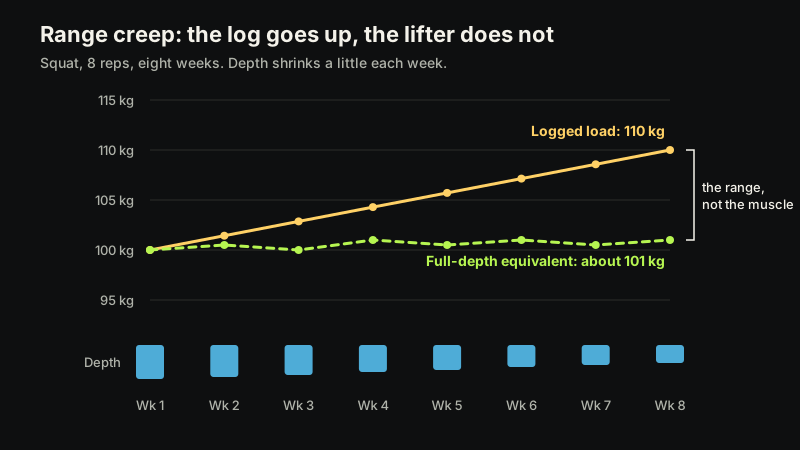
The fix is not to obsess over a perfect rep. It is to hold the range constant so the load and the reps are the only things that change. Then the log can do its job, and deciding when to increase weight goes back to being a question about the numbers.
How to set a range of motion standard you can repeat
A standard has to be checkable in the middle of a hard set, by you, without a coach. Feel is not enough, because feel is the first thing fatigue distorts.
Start by finding the stretched end you can control. Do a light set and go as deep as you can while keeping position. That depth, not a number from a forum, is your full range for this exercise and this setup.
Then turn it into a physical marker. A box or bench you touch on squats, a pause on the chest for bench, a fixed bar position on the shin for RDLs, a dead hang on pull-ups, safety pins set at the right height, a piece of tape on the leg press rail. A marker turns "was that deep enough?" into a yes or no.
Write the standard down where you will see it before the set. A line like "box at second hole, touch and stand" or "1 second pause on chest" takes ten seconds to write and removes the decision. In RIRLift you can put it in the exercise's note, which shows in the workout header while you train, so the standard is in front of you on the set where it matters.
Use the same standard on warm-up sets. Grooving a shallower rep at light loads and then expecting full depth on the work sets is how the range drifts in the first place.
Re-check it every few weeks. Film one work set from the side. If the range has shrunk, take the load back to where full-range reps are honest. You lose a few kilos on paper and gain a log you can trust.
When full range of motion is not the goal
Full range is the default, not a law. A few exceptions are legitimate, and all of them are deliberate rather than accidental.
Lengthened partials are the main one. On machines, cables and isolation exercises, a set of long-length partials, or a few of them added after full reps run out, is a reasonable way to extend a set. The research says they match full reps rather than beat them, so treat them as a tool, not an upgrade.
Pain or a joint limit is another. If the bottom of a range hurts, the answer is a shorter range or a different exercise for now, not grinding through it. Reduce the range on purpose, record it, and work back when you can.
Strength-specific overload work is the third. Pin presses, block pulls and board presses train a sticking point with heavier loads through a short range. Powerlifters use them on purpose. They are separate exercises with their own numbers, not shortcut versions of the main lift.
What is never a good reason: the load went up and the full rep no longer fits. That is the situation where the range is quietly paying for the weight.
How to log reps that do not reach your standard
Log the reps that met the standard as reps. Log anything that did not as something else.
If a set of eight full squats turns into six full reps and two that stopped high, the set was six reps. Write it that way, and note the partials if you want the record. Counting the short reps keeps the number on the screen and makes next week's comparison meaningless.
Partials done deliberately after failure work the same way: record the full reps as the set and the partials as an add-on, not as extra reps. Your rep count and your RIR then both describe the same full-range movement every week, which is the only way the history can tell you whether you are getting stronger.
This is where logging in the moment helps. Effort recalled after the session drifts toward what you wanted the set to be. When you log load, reps and RIR for each set on your Apple Watch, prefilled from last time, you confirm what you actually did seconds after doing it, while you still remember that the last two reps stopped short. Progressing on double progression or any other model then works from numbers that mean the same thing every week.
Do you need to lock out every rep?
No. Full range is about reaching the stretched end; the shortened end is less important for growth. Plenty of lifters stop just short of a hard lockout on leg presses, curls or squats to keep tension on the muscle, and that is fine. What matters is that you stop at the same point every rep and every session. A consistent "stop just short" is a standard. A top that varies with fatigue is not.
The bottom line on full range of motion
Full range of motion is the better default for muscle growth, and the research behind that is reasonably solid. The bigger payoff, though, is consistency. A fixed range makes every rep comparable, keeps your RIR honest, and turns your log into a record of real progress rather than a slowly shrinking movement with a rising number on it.
Pick your range on each lift, give it a marker you can check under fatigue, write it where you will see it, and count only the reps that meet it. Then when the weight goes up, you will know it is because you got stronger.