
Blog
Greyskull LP: how the last set tells you what to do next
Published October 17, 2026 · 12 min read
Most beginner barbell programs ask you to do the same thing on every set: five reps, stop, rack it, add weight next time. Greyskull LP changed one small thing, and the change is the whole reason it is still recommended twenty years later. On each main lift you do two straight sets of five, and then one last set where you do as many reps as you can with good form. Two sets of five, then one set of five-plus.
That final set has a name, the AMRAP (as many reps as possible), and most lifters treat it as a bonus: a chance to grind out a couple of extra reps and feel strong. It is not a bonus. It is a measurement. The number of reps you hit on that set is the single best reading you will get all session of how much room you have left, and if you log it, it tells you exactly what to do next time: add weight, hold, or reset. The program that looks like it runs on autopilot is actually asking you a question every session. This is how to answer it.
What is Greyskull LP?
Greyskull LP is a three-day-a-week novice linear progression program built around a signature set scheme: two working sets of five reps followed by a final set of as many reps as possible, written as 2x5, 1x5+. It was published by John Sheaffer (who writes as Johnny Pain) and spread through the lifting internet, especially the popular Phrak variant, as a more forgiving alternative to the older five-sets-of-five and three-sets-of-five novice templates.
You alternate two workouts, A and B, across three sessions a week, so the week runs A, B, A, then B, A, B the following week. Each session is two or three main barbell lifts run as 2x5, 1x5+, plus some chin-ups or rows. You add weight every session you clear the minimum: roughly 2.5 lb on upper-body lifts and 5 lb on lower-body lifts. When you stall, you do not grind the same weight forever. You reset the load on that lift by about ten percent and build back up, arriving at the sticking point stronger and usually pushing through it.
| Variable | Greyskull LP prescription |
|---|---|
| Main-lift scheme | 2 sets of 5, then 1 set of 5+ (AMRAP) |
| Sessions per week | 3, alternating workouts A and B |
| Load added per session | About 2.5 lb upper body, 5 lb lower body |
| Progression trigger | Hit at least 5 on the AMRAP set |
| Stall handling | Reset the lift about 10 percent, build back up |
| Main lifts | Bench and overhead press alternate by session; squat trained about twice a week, deadlift once |
Set out like that, it reads like every other linear progression: add weight until you cannot, then back off. The part that makes it worth writing about is the one open-ended set.
The last set is the whole program
A straight set of five at a fixed weight gives you one bit of information: you either got five or you did not. The AMRAP set gives you a number, and a number is a reading on a scale.
Think about what the 1x5+ actually tests. The load is fixed by the program. The rep count is whatever your body will give you that day. So the reps you hit on that last set are an inverse measurement of effort relative to that load. Five reps, barely, means the weight is at the top of what you can move for this scheme right now. Ten reps with a rep or two still in the tank means the weight is well under your capacity and you are leaving progress on the table. The AMRAP set converts "did it feel hard" into a logged integer, which is the thing every honest training decision needs and most programs never produce.
This is the same quantity as reps in reserve, read from the other end. Reps in reserve is how many more reps you could have done when you stopped. On a fixed-rep straight set you have to estimate it. On the AMRAP set you measure it, because you kept going until there were none left. A top set of eight reps is a set you could have taken to roughly eleven or twelve, which tells you the two fixed sets of five before it were sitting at five or six reps in reserve. That is a lot of unused runway, and it is invisible on a program that only records "2x5, done."
The AMRAP also keeps the stimulus honest. A set taken to or near failure is where the growth signal lives, and the research on proximity to failure is reassuring here: a meta-analysis by Refalo and colleagues found no meaningful hypertrophy penalty for stopping a rep or two short of failure rather than going all the way. So you do not need to make the AMRAP a ragged, form-breaking max-out. A clean set taken to the point where the next rep would be a grind is both the honest measurement and the productive set. That is also how hard each working set should be on almost any hypertrophy program, which is why the lesson travels well beyond Greyskull.
Reading the AMRAP set: add, hold, or reset
Here is where the logged number earns its place. The program's own rule is simple: if you hit at least five on the top set, add weight next session. But the reps above five are telling you how much runway is left and how fast you can move, and reading them turns a blunt rule into a decision.
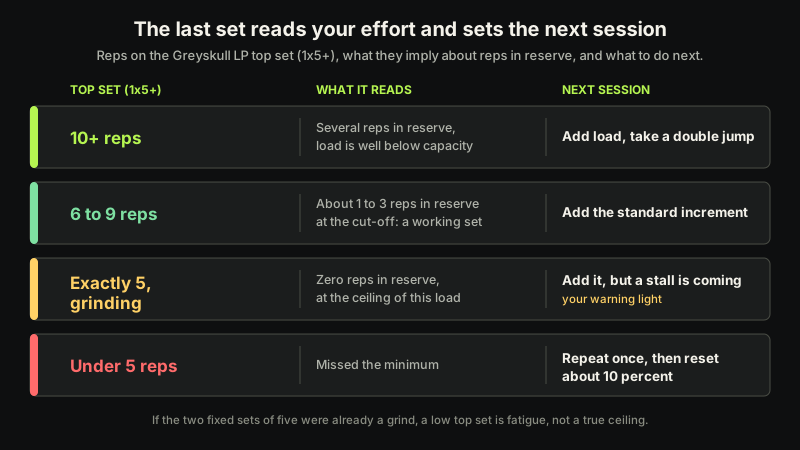
| Top-set result (the 1x5+) | What it means | Next session |
|---|---|---|
| 10 or more, clearly more left | Load is far below capacity, several reps in reserve even on the AMRAP | Take the program's double increment next session (about 5 lb upper, 10 lb lower) |
| 6 to 9 reps | Working set with a small buffer at the cut-off | Add the standard increment (about 2.5 lb upper, 5 lb lower) |
| Exactly 5, grinding | You are at the ceiling of this load, zero reps in reserve | Add the increment, but expect a stall soon. This is your warning light |
| Fewer than 5 | Missed the minimum | Repeat the weight once. Miss again and reset about 10 percent |
The extra reading that almost nobody takes is on the two fixed sets of five before the AMRAP. If those are already a grind, sitting at zero or one rep in reserve, the AMRAP has nowhere to go and will land at five or below no matter how strong you are that day. A low top set that comes after two easy fives is a genuine strength ceiling. A low top set that comes after two brutal fives is a fatigue or recovery problem, and the fix is not a reset, it is a closer look at your sleep, your food, and whether the jumps have been too aggressive. The reps on the fixed sets predict the AMRAP, so logging the effort on all three sets separates "this weight is too heavy" from "I am too tired this week," and those two problems have opposite solutions. This is why it helps to log reps in reserve on all three sets from your wrist and not just the AMRAP count: telling a stalled stimulus apart from accumulated fatigue is a reading you take from the log, not a guess.
Greyskull LP versus Starting Strength and StrongLifts 5x5
Greyskull is usually chosen as an upgrade from the two older novice staples, and the difference that matters is exactly the one this article is about: what the last working set does.
| Program | Last working set | Progression trigger | Stall handling |
|---|---|---|---|
| StrongLifts 5x5 | Five straight sets of five, no AMRAP | Complete all 25 reps, add load next session | Deload about 10 percent after three failed sessions |
| Starting Strength | Three sets of five, no AMRAP | Complete 3x5, add load | Reset about 10 percent after repeated misses |
| Greyskull LP | 2x5, then one open-ended 5+ set | Hit at least 5 on the AMRAP, add load; a big AMRAP means jump faster | Reset about 10 percent after missing 5 |
The two older programs give you a pass or fail every session. You hit the prescribed reps or you did not. Greyskull gives you a pass or fail and a margin. That margin is what lets you jump load faster early, when a beginner can genuinely add weight every session, and it is what warns you a stall is coming before the session where you actually fail. It is the difference between a program that measures effort and a program that only checks a box. Everything else, the alternating A and B days, the ten percent reset, the per-session jumps, is standard novice linear progression and works about as well across the three.
When linear progression runs out
No novice program lasts forever, and the honest part of the Greyskull sales pitch is that the reset only buys you time. Adding weight every session is possible because a new lifter's early progress is a mix of real tissue growth, skill, and neural adaptation, and that engine slows down. When it does, resetting ten percent stops working, because you climb back to the same sticking point and fail again. Understanding why newbie gains feel like a cliff is understanding why Greyskull has an expiry date, and why the slower, weeks-long logic of progressive overload has to take over from here.
The AMRAP set gives you the clearest possible signal that the day has come. On a program that is still working, your top-set reps are stable or climbing at each new weight. When linear progression is ending, the number falls session over session at loads you used to clear easily, and no reset brings it back for long. That is your cue to stop adding load every session and switch to a scheme that progresses over weeks instead of workouts: double progression, where you add reps inside a range at a fixed load and only add weight once you top the range. It is the natural next step precisely because you already understand the signals that a weight has been outgrown from reading your AMRAP sets.
At that point weekly volume starts to matter in a way it did not as a novice, when three hard sets a lift three times a week was plenty. Schoenfeld, Ogborn and Krieger's dose-response meta-analysis associates more weekly hard sets with more growth, within reason, and the operative words are "hard sets." Greyskull trained you to produce exactly those, one measured near-failure set per lift per session, which is a far better foundation for intermediate programming than a template that prescribes sets without ever prescribing effort. You leave Greyskull already in the habit of logging how hard each set was, which is the habit the next program will quietly depend on.
Why you still log RIR on a program that never asks for it
Greyskull never tells you to record reps in reserve. The AMRAP set is supposed to make effort self-evident: you went until you stopped, so of course it was hard. But the top set is only one of three working sets, and the two before it are where the early warning lives.
If you log the reps on the AMRAP and your estimated reps in reserve on the two fixed sets, three things become visible that the program alone hides. You can see the top-set number trending down before you ever miss a session, so a reset stops being a surprise. You can see whether a bad top set came after easy fives (a real ceiling) or hard ones (fatigue), so you fix the right problem. And you can see, across a few weeks, whether the jumps have been too big, because the AMRAP reps crash after a load increase instead of settling. None of that requires a spreadsheet, but all of it requires recording effort and not just load and reps, which a paper logbook and most tracking apps do not capture.
RIRLift logs reps in reserve on every set, so the effort is recorded while you are still catching your breath rather than reconstructed from memory later. Because the record is per set, the top-set trend and the fixed-set effort are both there when you open the next session, and you can see last week's top set at the moment you load the bar instead of trusting your memory of whether it felt heavy. That is the same reading the decision table runs on, turned into something you check in two seconds between sets. If you want the fuller picture of how a planned session runs from the watch, that is how the RIRLift workflow fits together.
The verdict
Greyskull LP earns its reputation on one design choice: it ends every main lift with a set that measures instead of a set that checks a box. Run it as written, hit at least five on the AMRAP, add weight, reset when you miss. But read the number. The reps on that last set, plus the effort on the two before it, tell you whether to add load, hold, or reset, and they warn you a stall is coming while you can still do something about it. A beginner program that teaches you to read your own effort is worth far more than the eight weeks of linear gains on the cover, because the reading is the skill you keep after the weight stops going up every session.