Blog
Hypertrophy-Specific Training (HST): How to Run the Program
Published November 24, 2026 · 13 min read

Scan with your phone camera
Most hypertrophy programs ask you to do more: more sets, more exercises, more days on a body part. Hypertrophy specific training (HST) asks for less of almost everything except two things. You train each muscle three times a week, and the weight on the bar goes up nearly every session.
HST is more than twenty years old and it was built from the exercise physiology of its time. Some of its logic has aged well. Some of it rested on a mechanism the research has since moved past. This post covers the full protocol, how to set every session's load without guessing, what the studies now say about each of its principles, and how to run it in a way you can actually track.
What is hypertrophy specific training (HST)?
Hypertrophy-Specific Training (HST) is a muscle-building method developed by Bryan Haycock in which each muscle is trained three times a week with one or two work sets per exercise, the load rises every workout across two-week blocks of 15, 10 and then 5 reps, and each six to eight week cycle ends with a planned break from lifting called strategic deconditioning.
The best-known write-up of the method is T Nation's 2002 article Hypertrophy-Specific Training, which laid out Haycock's rules and a sample routine. It rests on four principles:
- Mechanical load. Heavy enough load, not fatigue or effort, is what tells a muscle to grow.
- Acute and chronic stimulus. The growth signal from one session fades within a day or two, so the muscle needs to be hit again before it does.
- Progressive load. The muscle adapts to a given weight, so the weight has to keep rising across the cycle.
- Strategic deconditioning. A short complete layoff after each cycle makes lighter loads effective again when you restart.
Three of those four are now textbook. The fourth, deconditioning, sounds like the strangest and has some of the most interesting evidence behind it.
The HST training protocol, week by week
The rules from the original article are short enough to fit on an index card:
- Frequency: each muscle group three times a week, roughly every 48 hours. The sample routine trains Monday, Wednesday and Friday, full body every time.
- Sets: one or two work sets per exercise.
- Blocks: two weeks of 15s, two weeks of 10s, two weeks of 5s. Then either two more weeks at your 5-rep max or two weeks of negatives (lowering-only reps with a heavier load) on exercises where negatives are practical.
- Load: rises every workout, with no fixed weight held for a block.
- Deconditioning: after each 6 to 8 week cycle, about nine days with no training at all.
| Block | Weeks | Reps per set | Sessions | Where the load ends |
|---|---|---|---|---|
| 15s | 1-2 | 15 | 6 | Your 15-rep max |
| 10s | 3-4 | 10 | 6 | Your 10-rep max |
| 5s | 5-6 | 5 | 6 | Your 5-rep max |
| 5s or negatives (optional) | 7-8 | 5, or negatives | 6 | At or above your 5-rep max |
| Strategic deconditioning | about 9 days | none | 0 | Complete rest |
A typical HST session is short. About nine exercises covering the whole body (the original sample alternates squat and leg press, then leg curl, bench or dips, chins or rows, rear delts, shrugs, arms and calves), one or two sets each, done three times a week. If you have run a full-body workout split before, the shape will be familiar. What changes is how the weight moves.
How to set the loads for every session
This is the part of HST that most write-ups skip and the part that decides whether it works. The weight is not picked on the day. It is worked out before the cycle starts, backward from your rep maxes.
Step 1: find your rep maxes. Before the first cycle, establish your 15-, 10- and 5-rep max on each exercise: the heaviest load you can lift for exactly that many clean reps.
Step 2: put each rep max on the last session of its block. Your 10-rep max is the weight for the sixth and final session of the 10s block. Your 5-rep max goes on the last session of the 5s.
Step 3: count backward in small steps. Subtract a fixed increment for each earlier session. The original article's example is a 10-rep max of 200 lb, which gives 175, 180, 185, 190, 195 and 200 across the six sessions: 5 lb a workout. It allows increments anywhere from 5 to 20 lb depending on the lift. A big compound tolerates bigger jumps; a lateral raise does not.
Here is one full cycle on a bench press, with a 15-rep max of 80 kg, a 10-rep max of 90 kg, a 5-rep max of 100 kg and 2.5 kg steps (an illustration, not a prescription):
| Session | 15s block | 10s block | 5s block |
|---|---|---|---|
| 1 | 67.5 kg | 77.5 kg | 87.5 kg |
| 2 | 70 kg | 80 kg | 90 kg |
| 3 | 72.5 kg | 82.5 kg | 92.5 kg |
| 4 | 75 kg | 85 kg | 95 kg |
| 5 | 77.5 kg | 87.5 kg | 97.5 kg |
| 6 | 80 kg | 90 kg | 100 kg |
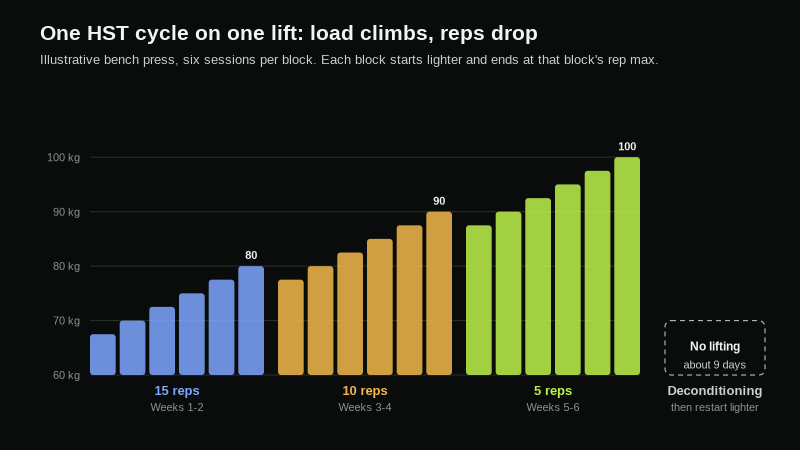
Notice what happens at each block change. The first 10s session (77.5 kg) is lighter than the last 15s session (80 kg). That is deliberate: dropping the reps while backing the load off a little keeps the climb going without a jump you cannot handle. It is a small version of the same rule behind all progressive overload: the stimulus keeps rising, but in steps you can actually take.
For the second cycle, the original article's instruction is simple: add 5 to 10 lb to each lift where you have the room, and rebuild the six-session ladders from there.
Strategic deconditioning: why HST tells you to stop lifting
Every other program treats time off as a cost. HST schedules it. After each cycle you take about nine days without training (the same article elsewhere says one to two weeks, which is the honest range), and you restart the next cycle from lighter loads.
Haycock's argument was that a muscle becomes less responsive to a load it has been exposed to for weeks, and that a short layoff resets that sensitivity so the next cycle's lighter weights are stimulating again. It sounds like a convenient excuse to rest. There is a study that tested almost exactly this.
Ogasawara and colleagues had young men bench press three days a week at 75% of their 1RM for 24 weeks. One group trained straight through. The other trained in cycles of six weeks on and three weeks completely off. After the first six weeks both groups had grown the same. After that, the continuous group's rate of gain slowed, while the periodic group's gains in the second retraining cycle were significantly larger than the continuous group's over the same weeks. At 24 weeks, both groups ended with similar muscle growth and strength, even though the periodic group had trained for about a quarter less time.
That is not proof that time off is better. It is evidence that a few weeks off, built into the plan, does not cost you the muscle you were worried about, and that the weeks after a break are unusually productive. Three weeks is also longer than HST's nine days, so if anything HST's break sits on the safe side. If you are worried about what a short break does to you, how long it takes to lose muscle covers the timelines.
Deconditioning is not the same thing as a deload week. A deload keeps you training at reduced volume or load to shed fatigue. Deconditioning takes you out of the gym entirely. If complete rest does not suit you, a deload in its place is a reasonable substitute, but it is a change to the method, not HST as written.
Does HST work? What the research says now
HST was built from the research available when it was written. Here is how each of its pillars holds up against what has been published since.
Training each muscle often. HST's 48-hour rhythm was based on muscle protein synthesis data. MacDougall and colleagues found that after heavy arm training, protein synthesis was more than double at 24 hours but had almost returned to baseline by 36 hours. Hit the muscle again before the signal fades, the reasoning went, and you stack more growth per week. The frequency research partly agrees. A 2016 meta-analysis concluded that training a muscle twice a week beats once a week. But a 2019 meta-analysis of 25 studies found no significant difference between higher and lower frequencies once weekly volume is equated. Frequency helps mainly because it lets you fit more quality sets into the week. The longer version is in training frequency for hypertrophy.
Load over fatigue. HST never asks you to train to failure. Most sessions are deliberately submaximal and only the last session or two of a block lands near your rep max. That fits the evidence well: a 2023 meta-analysis by Refalo and colleagues found no evidence that training to momentary failure beats stopping short of it for muscle growth. The question of how close to go is covered in should you train to failure?.
Low volume per session. One or two sets per exercise looks thin, but multiplied by three sessions it becomes three to six sets per exercise per week, before counting the other exercises that hit the same muscle. That is the same trade high-frequency, low-volume training makes: the weekly dose is ordinary, it is just spread thin.
Where it shows its age. The weak point is the early sessions of each block. Starting several increments under a rep max with one set means the first few workouts of every block are far from failure. With so few sets, those sessions may not count for much. HST answers that with the load climb, and the original article lets you add a second set. The more modern fix is to stop guessing and measure how hard each set actually was.
Running HST with RIR instead of guessed rep maxes
HST's weakest link is Step 1. A rep max tested on one day is a noisy number, and the whole ladder is built off it. If your 10-rep max was really 85 kg rather than 90 kg, the last two sessions of the block fail. If it was 95 kg, the whole block was too easy.
Rating each set by reps in reserve (RIR) fixes this without changing the method. Keep HST's structure (three sessions a week, one or two sets, 15s then 10s then 5s, load rising every session) and add one rule: log how many reps you had left on each set. Early in a block you should be several reps short of failure. By the last session you should be at or near zero. If you reach zero by the third session, your rep max was set too high, so hold the weight instead of adding. If you are still four reps short at the end, the next cycle's ladder starts higher.
Logging it this way also turns the rep-max test into something you never have to repeat: the last sessions of each block are your rep max, measured under real fatigue, and they set up the next cycle. An app that suggests every set's weight from the load, reps and RIR you logged on the last one keeps that feedback loop running without the spreadsheet.
Who HST suits, and who it does not
HST is a good fit if you:
- Like short, full-body sessions three days a week.
- Prefer a fixed plan to deciding what to do in the gym.
- Recover well from frequent, moderate work but get beaten up by high-volume days.
- Want a structured way to move from lighter, higher-rep work to heavier, lower-rep work.
It is a poor fit if you:
- Can only train two days a week, or want to bring up one lagging muscle with a lot of focused volume.
- Are a beginner who would grow faster from simply adding weight to a basic program every session.
- Do not want a full week off after every cycle. You can swap deconditioning for a deload, but then you are running HST-inspired training rather than HST.
And it is a poor fit for anyone who will not track their numbers. HST has no "go by feel" mode. Every session's load is written down before you walk in, and the method only works if you hit it.
When you come back from the deconditioning break, restart the ladder lighter rather than picking up where you stopped. That restart is part of the design. RIRLift does something similar after a longer layoff: come back after three weeks or more and it offers to ease your suggested weights back in instead of loading you at your old numbers.
Frequently asked questions
How long is an HST cycle?
Six to eight weeks of training followed by a deconditioning break. The core is three two-week blocks (15s, 10s, 5s), and an optional fourth block repeats your 5-rep max or uses negatives. The original article sets the break at about nine days, and elsewhere says one to two weeks.
Can I do HST on a split instead of full body?
The method calls for each muscle three times a week, which is easiest with full-body sessions. An upper/lower split run five or six days a week could reach the same frequency, but it doubles the number of days you train for the same weekly work, which removes one of HST's main appeals.
Do I need to train to failure on HST?
No. HST never prescribes failure. Most sessions are submaximal by design, and only the last session or two of each block reach your rep max. That matches current evidence that training to failure is not required for growth.
Is HST good for beginners?
It can work, but it is not the best first program. A beginner can add weight almost every session on a simple program without the rep-max testing, block structure and planned layoffs HST needs. HST makes more sense once that easy progression has slowed.
What should I do during strategic deconditioning?
Nothing in the gym. The original article allows light cardio of 20 to 40 minutes on off days. The point is a complete break from lifting so the next cycle's lighter loads count again.