
Blog
How Long Does It Take to Lose Muscle? What a Break Really Costs
Published November 10, 2026 · 13 min read
You missed a week. Maybe two. A trip, a cold, a newborn, a deadline. You look in the mirror and your arms look flatter, and the question arrives on schedule: how long does it take to lose muscle, and how much of what you built is gone?
The short answer is reassuring. If you are healthy and moving around normally, a trained lifter loses very little actual muscle tissue in the first two to three weeks off. What changes first is water and stored carbohydrate inside the muscle, which is why you look smaller long before you are. Real loss of size starts to show after roughly three weeks of complete rest and grows slowly from there, and strength fades even more slowly than size.
The long answer depends on what kind of break it is, and that is where most articles stop. This one goes further: how to read what you actually lost off your own training log, and how to come back so the first week back does not cost you another week off.
What is detraining?
Detraining is the partial or complete loss of the adaptations to training (muscle size, strength, and work capacity) that happens when the training stimulus is removed or cut below what is needed to maintain them. It is the reverse of the process that built the muscle, and it runs much slower than people fear and slightly faster than people hope.
Two things that look like detraining are not:
- Glycogen and water loss. Muscle stores carbohydrate as glycogen, and each gram binds water. Stop training and eat a little less, and those stores drop within days. The muscle looks flatter and measures slightly smaller. No contractile tissue has been lost, and it comes back in the first week of training.
- Losing the groove. Your first session back feels clumsy and heavy. Some of that is skill and coordination going stale, not muscle. It returns within a session or two.
Keeping these separate matters, because they are what you see first, and they are what makes people panic.
How long does it take to lose muscle?
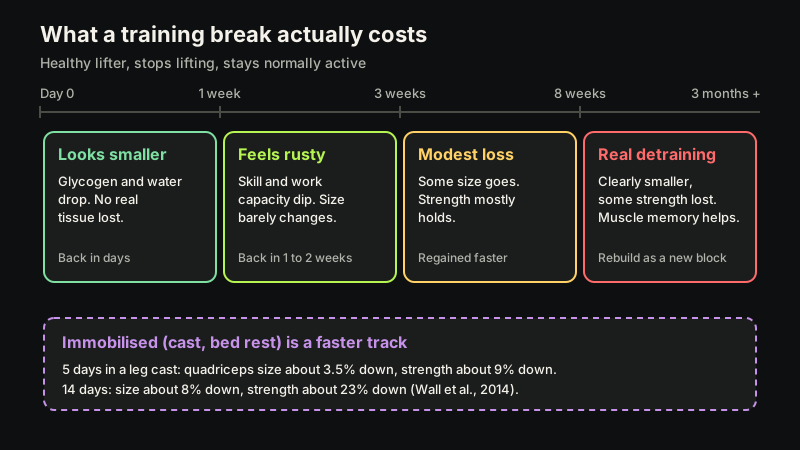
Here is the honest timeline for a healthy, trained lifter who stops lifting but stays normally active.
| Time off | What you notice | What is actually happening | How fast it comes back |
|---|---|---|---|
| 1 week | Muscles look flatter, pump is gone | Glycogen and water drop. No meaningful tissue loss | Days |
| 2 to 3 weeks | First session back feels heavy and awkward | Little real change in size; skill and work capacity dip | One to two weeks |
| 3 to 8 weeks | Clothes fit a bit looser, loads down a little | Measurable but modest loss of muscle size; strength mostly held | Faster than it took to build |
| 3 months and longer | Clearly smaller and weaker | Larger loss of size and some strength | Still faster than the first time, thanks to muscle memory |
The best evidence for the early part of that table comes from a study that did breaks on purpose. Ogasawara and colleagues had one group train continuously for 24 weeks, and a second group train in 6-week blocks separated by 3 weeks of complete rest. At the end, the group that took the breaks had gained a similar amount of muscle and strength. Three weeks off, three times, cost them nothing they could not recover inside the next block.
For longer breaks, the most useful data comes from Bickel and colleagues, who trained adults for 16 weeks and then followed them through 32 weeks of either no training or reduced training. Strength gained during the training phase was largely retained across the detraining period, with only a slight drop by the end. Muscle size was less stubborn, which is the pattern you should expect: you keep strength longer than you keep size.
Rest is not the same as disuse
Everything above assumes you are still walking, carrying things, and living normally. A cast, a hospital bed, or a week on the couch with the flu is a different situation.
When a leg is fully immobilised, loss is fast. In a study by Wall and colleagues, five days in a leg cast reduced quadriceps size by about 3.5% and strength by about 9%. After two weeks, size was down about 8% and strength about 23%. That is why injury layoffs feel so much worse than vacations. It is not the time away from the gym, it is the time away from using the muscle at all.
Strength and size do not leave at the same speed
This is the part that changes what you should do when you come back.
Strength is part muscle size and part nervous system: how well you recruit muscle fibres and coordinate a lift. The neural part is durable for normal breaks. So after a month off, you will often find your strength is down less than your size, and your first sessions back feel easier than the mirror suggested.
The practical consequence is a trap. Because your strength returns quickly, it is tempting to load up to your old numbers in week one. Your muscles can handle it; your connective tissue, your work capacity, and your soreness tolerance cannot. That is how a two-week break turns into a sore, demoralising month.
What makes you lose muscle faster
The timeline shifts with a few factors. None of them is a reason to panic, but they explain why your experience might not match a friend's.
- A calorie deficit. Eating well below maintenance while not training removes both the signal and the supplies. Losing weight during a break means some of it is likely muscle. If you are unsure which, how to tell muscle gain from fat gain covers the same question in reverse.
- Age. In Bickel's study, the dose needed to hold onto muscle size was higher for older adults than for younger ones. If you are older, a reduced program beats stopping completely by a wider margin.
- Illness and immobilisation. As above, disuse is the fast lane. Moving, walking, and light training during recovery slow the loss down a lot.
- Low protein intake. Protein matters more, not less, when you are not training, because the margin for repair and maintenance is smaller.
- How long you have trained. A beginner's early progress is partly neural and partly fluid, so it moves quickly in both directions. The beginner phase and what replaces it explains why early progress behaves differently.
How little training keeps your muscle
You almost never have to choose between full training and nothing. Maintaining muscle takes far less work than building it.
The clearest number again comes from Bickel and colleagues: in younger adults, one third of the original weekly training dose maintained the muscle size they had built. In practice, that means if you normally do 12 hard sets a week for a muscle, roughly 4 hard sets a week, done close to failure, will hold it through a busy stretch.
| Situation | What to do | Weekly sets per muscle | Effort |
|---|---|---|---|
| Normal training | Your usual program | Whatever you were progressing on | Your usual RIR targets |
| Busy few weeks | One or two full-body sessions | About a third of your usual | 1 to 2 RIR on the main sets |
| Travel with a hotel gym | Machines and dumbbells, short sessions | 3 to 6 | 1 to 2 RIR |
| No equipment at all | Push-ups, split squats, rows with a backpack | 3 to 6 | Close to failure, since loads are light |
| Injured body part | Train everything else; follow medical advice for the injury | Normal for unaffected muscles | Normal |
The key word is hard sets. A maintenance session works because the few sets it has are close to failure. The training volume guide explains how hard sets are counted and why easy sets barely register.
Muscle memory: why regaining is faster than gaining
If you do lose muscle, getting it back is quicker than building it the first time. Lifters have known this for decades; the research is catching up on why.
Two mechanisms are proposed. First, muscle fibres gain extra nuclei during training, and in animal studies those nuclei stay put for months after the fibre shrinks, so the machinery for regrowth is already in place. Human data on this is less clear. Second, training seems to leave a lasting chemical mark on muscle DNA. Seaborne and colleagues trained people, detrained them until their muscle returned to baseline, then retrained them. Many genes involved in growth stayed "switched on" through the break, and the second round of training produced a stronger response than the first.
The research is young and the samples are small, so treat the mechanism as likely rather than settled. The practical effect, faster regain after a break, is consistent with everything else above, including the Ogasawara study, where the group that took breaks caught up within each new block.
Read the loss off your log, not the mirror
The mirror lies after a break because water and glycogen move first. Your training log does not, provided you logged effort as well as load and reps.
Here is the test. Pick one main lift per muscle group. Find the last top set you did before the break: say, 100 kg for 8 on the bench at 2 reps in reserve. In your first session back, work up to the same load and do one set to the same effort, 2 RIR, and count the reps.
| First set back at your old load and RIR | What it tells you | What to do |
|---|---|---|
| Same reps or one fewer | Essentially nothing lost | Resume your program at slightly reduced volume for a week |
| Two to three fewer | Modest loss, mostly work capacity and skill | Drop the load about 5 to 10% and rebuild over two to three weeks |
| Four or more fewer | Real detraining | Start at about 80 to 85% of your old load and progress weekly |
This only works if the effort number means something. Reps in reserve are what make two sets at the same load comparable: 8 reps at 2 RIR before the break and 6 reps at 2 RIR after is a real measurement, while "8 reps, felt hard" and "6 reps, felt hard" is a guess. The reps in reserve guide covers how to rate RIR consistently enough to make this comparison honest.
It is also why logging in the moment matters. When your watch prefills last session's load, reps and RIR before each set, the comparison with your pre-break numbers is on the screen the moment you return, instead of buried in a notebook you have not opened in a month.
How to come back after a break
Use the length of the break to set how cautious the first week is. The goal of the first week is not to test anything. It is to finish the week able to train again the next one.
| Break length | Week 1 volume | Week 1 effort | Then |
|---|---|---|---|
| 1 week | Normal | Your usual RIR | Carry on; it was effectively a deload week |
| 2 to 3 weeks | About 50 to 70% of your usual sets | 3 RIR on everything | Back to normal volume by week 2 or 3 |
| 1 to 2 months | About half your usual sets | 3 to 4 RIR | Add sets weekly; return to normal over three to four weeks |
| 3 months or more | A third to half your usual sets | 3 to 4 RIR, loads well below old bests | Treat it as a new block and progress weekly |
A few rules make the return smoother:
- Expect soreness to be out of proportion. The first session back after a few weeks often produces heavy soreness even at modest volume. It fades fast. How long a muscle actually needs between sessions is longer than usual in the first week back, so give the bigger muscle groups an extra day.
- Let the reps lead the load. Rebuild with a rep target first, and add load only when you hit the top of your rep range at your target RIR. That is exactly the rule of double progression, and it stops you chasing old numbers before you have earned them.
- Keep effort honest. The temptation after a break is to push every set to failure to "make up for lost time". You cannot make up for it that way, and the extra fatigue slows the return. Leave a few reps in the tank for the first week.
- Watch the gap close. Compare each week's top sets with your pre-break log. Most lifters are back to their old numbers in less time than the break lasted. When the numbers line up again, deciding when to increase weight goes back to the usual rules.
Frequently asked questions
Will I lose muscle if I don't work out for a week?
No, not in any meaningful amount. A week off costs you glycogen and water, which makes muscles look flatter, and nothing that does not return within a few days of training. For many lifters, a week off works like a deload and they come back slightly stronger.
How long does muscle memory last?
Nobody knows the exact limit in humans, but it is longer than most breaks. The gene changes in the Seaborne study were still present after weeks of detraining, and in animal studies the extra nuclei from training persist for months. Lifters returning after long layoffs regularly regain faster than they first built.
Do you lose muscle or fat first?
During a break with normal eating, you mostly lose water and glycogen first, then a slow amount of muscle. Fat changes depend mostly on your diet. If you keep eating as you did while training hard, you may gain some fat; if you eat less, you lose both.
Can you regain lost muscle?
Yes, and faster than it took to build it the first time. Expect to be close to your previous size and strength within a few weeks to a couple of months, depending on the length of the break.
The break is not the problem; the comeback is
A few weeks off barely touches the muscle you built. The real risk is coming back too hard, getting hurt or wrecked by soreness, and turning a short break into a long one. Measure what you actually lost against your last logged sets, come back at a few reps in reserve, and let the numbers climb back on their own schedule.
That is the job RIRLift is built for. You log load, reps and RIR for every set on your Apple Watch, so when you return after a break, the last numbers you hit are already on the screen and your weekly hard sets per muscle add themselves up as you rebuild. You can see the gap closing set by set instead of guessing from the mirror.