
Blog
PHUL workout: the split that never tells you how hard to lift
Published August 12, 2026 · 13 min read
Most training splits ask you to pick a side. Train heavy and get strong, or train in the hypertrophy ranges and get bigger. PHUL is the program people find when they refuse to choose, and its popularity is easy to understand: two days a week you lift heavy for low reps, two days a week you chase the pump, and the schedule fits neatly into four sessions.
The template that spread across the internet is genuinely well built. It is balanced, it hits every muscle twice a week, and the exercise selection is sensible.
It is also incomplete in a way almost nobody mentions. A PHUL program specifies sets. It specifies reps. It specifies which exercises go on which day. It says nothing at all about how hard any of those sets should be, and PHUL is the one common split where that omission actively hurts, because it is asking you to run two different effort systems inside the same seven days and never tells you they are different.
That missing variable is the one RIRLift makes you commit to before a session starts, so the rest of this article is about what to set it to, and why the two halves of a PHUL week need different answers.
What is the PHUL workout?
PHUL stands for Power Hypertrophy Upper Lower. It is a four-day training split that pairs two heavy power sessions, one upper and one lower, with two higher-rep hypertrophy sessions, again one upper and one lower, so every muscle group is trained twice a week in two different rep ranges. The power days run low reps on the big compound lifts. The hypertrophy days run moderate to high reps with more isolation work.
| Day | Session | Emphasis | Typical reps |
|---|---|---|---|
| Monday | Upper power | Heavy pressing and rowing | 3 to 5 |
| Tuesday | Lower power | Heavy squat and hinge | 3 to 5 |
| Wednesday | Rest | ||
| Thursday | Upper hypertrophy | Volume and isolation | 8 to 12 |
| Friday | Lower hypertrophy | Volume and isolation | 8 to 15 |
| Weekend | Rest |
Structurally, a PHUL split is the upper/lower split with a job assigned to each pair of days. That inheritance matters, because PHUL also inherits the upper/lower split's crowding problem, and then makes it worse by spending half the week's budget on low-rep compounds.
You will see the same program written as a PHUL routine, a PHUL program or a 4 day PHUL split. They are the same thing.
Does PHUL actually work for hypertrophy?
Yes, with one honest correction to the sales pitch.
The pitch is that heavy power work builds a strength base that lets you move more weight on the hypertrophy days, which then builds more muscle. The first half of that is true. The second half is where it gets loose.
Load does not appear to be the variable that decides growth. Schoenfeld and colleagues' meta-analysis of low-load versus high-load training found that hypertrophy was similar across loads when sets were taken close to failure, while strength gains clearly favoured the heavier loads. That is the cleanest way to read the power day: it is not buying you extra size directly, it is buying you strength, which is a legitimate goal in its own right and the actual reason to run this split rather than a pure hypertrophy program.
The frequency side holds up too, though not for the reason usually given. Schoenfeld, Grgic and Krieger's 2019 meta-analysis found no significant hypertrophy advantage for higher weekly frequencies once total weekly sets were equated. Training a muscle twice a week is not magic. What twice-weekly frequency does is let you split a weekly volume target into two doses a session can actually absorb, which is the same argument that makes the upper/lower family of splits work at all.
So PHUL works. It just works as a powerbuilding compromise, a deliberate blend of strength and size work, not as a superior hypertrophy program, and the distinction between those two goals is worth understanding before you commit four days a week to it. If you want size and nothing else, the power days are a cost you are paying for a benefit you did not ask for. That trade is the whole subject of hypertrophy versus strength training.
Why a PHUL workout needs two different RIR targets
Here is the part the templates leave blank.
Proximity to failure is the effort variable that decides how stimulating a set is. Refalo and colleagues' meta-analysis of proximity to failure found that sets taken closer to failure produced somewhat greater hypertrophy, with the returns flattening as the buffer shrank, and that the fatigue cost did not flatten at all. Effort matters, and it is not free.
Now apply that to a split that runs 3 to 5 rep sets on Monday and 8 to 12 rep sets on Thursday. Those two sets have completely different economics:
- A set of 3 to 5 on a heavy compound taken to zero reps in reserve is the most expensive rep in the program. Technique degrades exactly where the load is highest, the systemic fatigue is large, and that fatigue is still present on the hypertrophy day 48 to 72 hours later, which is when you actually wanted to be fresh.
- A set of 8 to 12 on a machine or a cable taken to zero reps in reserve is cheap. It is stable, the failure point is unambiguous, and you recover from it quickly.
Running both at the same effort is the mistake. If you apply a conservative buffer everywhere, your power days are not heavy enough to be power days. If you apply an aggressive buffer everywhere, your Monday and Tuesday quietly eat your Thursday and Friday, and the hypertrophy half of the program, the half doing most of the growing, runs on a fatigued lifter every single week.
What a PHUL plan should specify, and almost never does:
| Session and movement | Reps | Target RIR | Why |
|---|---|---|---|
| Power day, main compound | 3 to 5 | 2 to 3 | Highest technique and fatigue cost, and the fatigue lands on the hypertrophy day |
| Power day, secondary compound | 6 to 10 | 1 to 2 | Moderate cost, still a barbell or heavy dumbbell |
| Hypertrophy day, compound | 8 to 12 | 1 to 2 | The bulk of the growth stimulus, worth pushing |
| Hypertrophy day, isolation | 8 to 15 | 0 to 1 | Cheap to recover from, safe to take near failure |
If you have never worked with a target buffer per exercise, our guide to reps in reserve covers how to estimate it honestly, including why most lifters overestimate how close to failure they actually were.
One practical warning that follows directly from the rep ranges. RIR estimates get noisier as reps get lower. On a set of 12 you have plenty of feedback about how the last few reps are slowing down. On a set of 3 you often do not find out you had nothing left until the rep fails. That is a second, independent reason to keep a 2 to 3 rep buffer on the power day rather than a 0 to 1 buffer: not because the harder set would not work, but because on low-rep compounds you cannot reliably tell where you are.
What the PHUL split actually delivers per muscle
The other thing no PHUL guide does is count.
Take the standard four-day structure, give each exercise its prescribed sets, and total the direct sets each muscle receives across the week. The result is not balanced:
| Muscle | Power-day sets | Hypertrophy-day sets | Weekly total |
|---|---|---|---|
| Quads | 8 | 9 | 17 |
| Chest | 6 | 6 | 12 |
| Back | 6 | 6 | 12 |
| Hamstrings | 6 | 3 | 9 |
| Calves | 4 | 4 | 8 |
| Biceps | 3 | 3 | 6 |
| Triceps | 3 | 3 | 6 |
| Side delts | 0 to 2 | 3 | 3 to 5 |
| Rear delts | 0 | 0 | 0 |
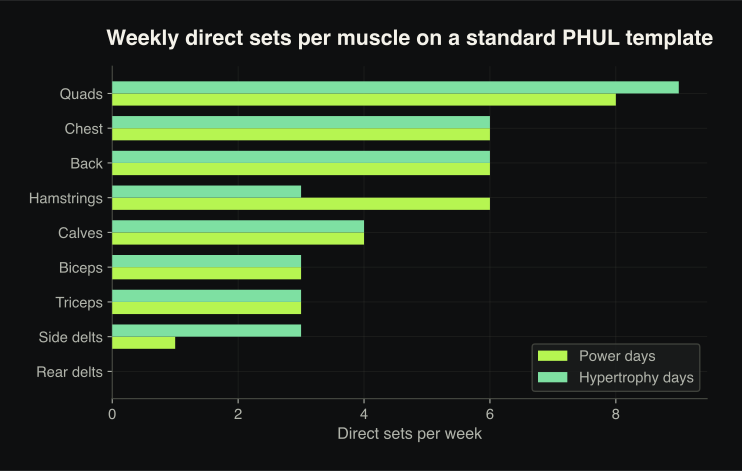
Quads receive roughly three times the direct volume that side delts do, and rear delts receive none at all beyond whatever they pick up from rowing. That is not a rounding error, it is a structural feature of a template built around big compounds: the muscles that ride along on squats, presses and rows accumulate sets automatically, and the small muscles that need dedicated work get whatever is left at the end of the session.
For context on whether those numbers are enough, our guide to training volume for hypertrophy walks through the weekly set landmarks. A meta-regression on per-session set volume is also worth reading here, with the caveat that it is a SportRxiv preprint rather than a peer-reviewed publication, so treat its landmark of roughly eleven fractional sets per muscle per session as a rough ceiling rather than a settled number. Under PHUL, no muscle comes close to that ceiling in a single session, which is a point in the split's favour. The problem is distribution across the week, not dose per session.
Where the standard PHUL workout template runs short
Three fixes, in order of how much they matter:
- Add rear delt work. Two to three sets of a reverse fly or face pull on the upper hypertrophy day. This is the single biggest hole in the template.
- Add side delt work. Three more sets of lateral raises, ideally split across both upper days rather than stacked on one. Side delts recover fast and tolerate frequency well.
- Trim a quad set or two if session length is a problem. Seventeen weekly sets for quads is generous, and the last couple are the ones most likely to be junk volume rather than stimulus.
None of this changes what PHUL is. It just closes the gaps that fall out of building a program around compound lifts.
PHUL vs upper/lower vs PPL vs PHAT
| Split | Days | Frequency per muscle | Best for |
|---|---|---|---|
| PHUL | 4 | 2x | Strength and size together, intermediates |
| Upper/lower | 4 | 2x | Size, with a simpler effort model |
| Push/pull/legs | 3 or 6 | 1x or 2x | Size, at 6 days for twice-weekly frequency |
| PHAT | 5 | 2x | Same premise as PHUL with more volume and a fifth day |
The PHUL vs PHAT question comes up constantly and the answer is usually just arithmetic: PHAT is the same power-plus-hypertrophy idea spread over five days instead of four. If you can train five days consistently it delivers more weekly volume. If you cannot, PHUL is the version that survives contact with your calendar. And if you have six days, a push pull legs rotation gets you twice-weekly frequency with more room per session than either.
Against a plain upper/lower, PHUL trades simplicity for a strength goal. That is a fair trade if you want the strength. It is a bad trade if you do not, because you are accepting a more complicated effort model for a benefit you are not using.
Who PHUL is for
PHUL suits an intermediate lifter who has run a basic program for a year or more, wants to keep adding weight to a barbell, and also wants to look like they lift. That is a real and common set of goals, and PHUL serves it well.
Searches for a PHUL workout for beginners are common, and the honest answer is that a beginner is not the target. Two problems: a novice can add load nearly every session without any need for separate power days, so the structure solves a problem they do not have yet, and low-rep sets near failure demand technique that has not been built yet. A beginner is better served by a simpler full-body or upper/lower structure until progress stops coming session to session.
It is also worth being clear about who PHUL is not for. If your only goal is size, the power days are two sessions a week spent buying strength you did not ask for, and a straight hypertrophy program will put those sessions to better use. If you compete in a strength sport, the reverse applies: two hypertrophy days is a lot of time away from the competition lifts. PHUL earns its place in the middle, where both goals are real and neither is dominant.
One scheduling note that rarely makes it into the templates. PHUL is a block, not a permanent state. Run it for six to ten weeks, then take a lighter week before deciding whether to repeat it. The power days accumulate joint and connective-tissue fatigue slowly enough that it does not show up in any single session, and quickly enough that by week eight the heavy compounds start feeling worse than your logged numbers say they should. That mismatch, rather than the calendar, is the signal to back off.
How to run PHUL so the two halves cooperate
The whole argument of this article reduces to four rules:
- Write a target RIR into every exercise slot, not just sets and reps. Use the table above as a starting point. A plan that says "3 sets of 5" is not finished; a plan that states its progression trigger is.
- Keep the power day at 2 to 3 RIR. Its job is heavy, technically sound work you can repeat next week, not a weekly max attempt.
- Protect the hypertrophy days. They are doing most of the growing. If you consistently arrive at Thursday feeling flattened, the problem is Monday, not Thursday.
- Progress the two halves differently. Power days progress on load. Hypertrophy days progress on reps first and load second, which is exactly the double progression method, and it only works if your logged RIR held while the reps went up.
That last point is where the split lives or dies, and it is why the rep range you pick on the hypertrophy days matters less than most people think. As long as the set finishes close to failure, the exact rep range is largely interchangeable for growth.
None of this is checkable from memory. The signal you need is whether a set you planned at 2 RIR actually came in at 2, and whether that number drifted as the week went on. Recorded in the moment, it takes about a second per set and it tells you next week whether to add load, hold, or back off. Reconstructed on Sunday from what you think you did, it tells you nothing.
RIRLift is built around that record. You set a target RIR per exercise on iPhone, then log load, reps and actual RIR from your wrist as you train, and the weekly muscle volume view shows you the distribution problem from the table above in your own numbers rather than in a template's. If you want to see how a session runs end to end, here is how the workflow fits together.
Run PHUL with the effort variable filled in and it does what it promises. Run it with that variable blank and you are guessing at the one thing the program never told you.