
Blog
Wave loading: what it is and whether it builds muscle
Published August 14, 2026 · 11 min read
The pitch for wave loading is one of the most seductive in the gym. You do a heavy set, rack the bar, and then a minute later a load that felt brutal feels a notch lighter. Ride that feeling, the argument goes, and you can lift more in your second or third wave than you had any right to, breaking a plateau by tricking your nervous system into showing up.
That effect is real, and it has a name. But almost every page that explains wave loading stops there, at the percentages and the "post-tetanic potentiation" line, and never answers the question a hypertrophy lifter actually has: does this build muscle, or does it just feel productive? The honest answer is that wave loading is a strength and peaking tool wearing a hypertrophy costume, and whether it earns a place in your week comes down to counting your hard sets and reading the effort on the top set honestly.
What is wave loading?
Wave loading is a set structure where you perform a short series of sets with rising load and falling reps, then repeat that series one or more times, usually a little heavier each pass. Each series is a "wave." A classic wave is 5 reps, then 3 reps, then 1 rep, with the weight climbing on each set. You rest fully, then run a second wave that starts and finishes slightly heavier than the first.
The common templates you will see are 5-3-1, 6-4-2, or 3-2-1, run on a single big compound like a squat, bench press, deadlift, or overhead press. The reps inside a wave descend while the load ascends, which is the opposite of a warm-up ramp that keeps climbing without ever backing off. Wave loading is a form of undulating loading applied inside one session, and it lives on the strength end of the spectrum, closer to peaking than to bodybuilding accessory work. Human Kinetics describes each wave as a small block of three sets run at a rising effort, with the second wave heavier than the first.
How wave loading actually works: potentiation, not more stimulus
The mechanism behind wave loading is post-activation potentiation (PAP): a hard, heavy contraction briefly raises your capacity to produce force for a few minutes afterward. Your heavy single at the top of the first wave primes the nervous system, so the heavy set at the top of the second wave feels more manageable and moves faster than it otherwise would.
PAP is a genuine, measurable effect, but it is narrower than the gym version suggests. A systematic review and meta-analysis by Seitz and Haff found that potentiation depends heavily on the rest interval, the load, and the lifter's training status: stronger, more experienced lifters potentiate more, and the effect needs enough rest to outlast the fatigue the priming set also creates. Almost all of that research is about jump, sprint, throw, and ballistic performance, not about muscle growth. Nobody has shown that potentiation adds hypertrophy stimulus. It helps you express force you already have; it does not manufacture more of a growth signal.
That distinction is the whole story for a hypertrophy lifter. Wave loading makes heavy sets feel and move better. It does not make them grow more muscle than the same hard sets would on their own.
A wave loading example you can run
Here is a concrete two-wave scheme on a main compound, written the way it should be written, with a load target as a percentage of your estimated one-rep max and a target effort in reps in reserve for each set.
| Set | Reps | Load (% of e1RM) | Target RIR |
|---|---|---|---|
| Wave 1, set 1 | 5 | ~80% | 3 |
| Wave 1, set 2 | 3 | ~86% | 2 |
| Wave 1, set 3 | 1 | ~91% | 2 |
| Wave 2, set 1 | 5 | ~82% | 2 |
| Wave 2, set 2 | 3 | ~88% | 1 to 2 |
| Wave 2, set 3 | 1 | ~93% | 1 to 2 |
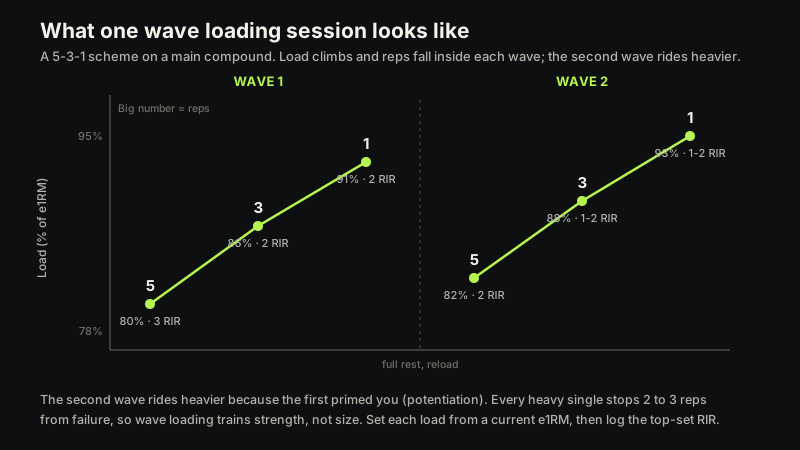
Rest two to four minutes between every set. The reps fall as the load climbs inside each wave, and the second wave nudges everything up a couple of percent because the first wave primed you. If the second wave's top single grinds to a stop or your form breaks, you have found the ceiling for the day and you stop there rather than forcing a third wave.
Notice what the table makes obvious that a bare "5-3-1" never does: the light-looking early sets are not light in effort. A set of 5 at 80% sitting at 3 RIR is a real working set. The heavy singles, by contrast, are strength expressions that stop well short of failure. That gap between load and proximity to failure is exactly why wave loading is a strength method, and it is the thing you have to log to use it well.
Is wave loading good for hypertrophy?
Short version: it is a poor primary driver of growth and a fine occasional tool. Here is the reasoning.
Muscle growth is driven mostly by mechanical tension delivered through hard sets taken reasonably close to failure. The sets that do the most work are the ones near the end of a set, when velocity slows and every available fiber is recruited under load. Wave loading's signature sets, the heavy triples and singles, deliberately stop far from failure so you can express force cleanly. They generate high tension for one or two reps, not the several stimulating reps a set of 8 to 12 near failure delivers.
The strict "count the last few effective reps" model is itself debated, as Stronger by Science lays out, so do not treat effective reps as an exact currency. But the practical point survives the debate: a heavy single at 2 to 3 RIR is a strength rep, not a growth rep, and a wave of 5-3-1 gives you far fewer near-failure reps than it looks like on paper. If you build a week out of waves, your weekly hard sets per muscle, the number that actually tracks with growth, comes in low even though the session felt intense. This is the same arithmetic that catches lifters out with reverse pyramid training, which also progresses off a single heavy top set.
If your goal for a lift is size, straight sets in a moderate rep range near failure will almost always out-grow a wave scheme on the same time budget. Wave loading fits when your goal on that lift is strength or peaking, which is a different job. It helps to be clear about which one you are training for before you pick the structure, because the rep-range difference is smaller than the classic charts claim but the proximity-to-failure difference is real.
Set the waves from your e1RM, not a guessed percentage
Every wave loading template is written in percentages, and percentages have a hidden dependency: they only mean something if you actually know your current one-rep max. Most lifters do not test a true max often, and the number they remember is stale or aspirational. Load a wave off a wrong max and the whole scheme drifts, either too light to potentiate or heavy enough to turn a "single at 2 RIR" into a near-miss.
This is where an honest log does the work a percentage chart cannot. If you have been logging load, reps, and effort, your training history gives you a running estimated one-rep max (e1RM) that updates every time you lift, so the 91% single in the table is anchored to what you can do this week, not last spring. RIRLift surfaces your e1RM and best set inline while you rest, so you can set the next wave's load from a number instead of a guess.
Then read the top set by feel and write it down. The percentage tells you what to load; your reps in reserve on the heavy set tells you whether the wave did its job. A planned 2 RIR single that came in at a genuine 4 says the load was conservative and you can push the next wave. A 2 RIR single that turned into an all-out grind says stop. Logged in the moment, that top-set RIR is the difference between wave loading as a precise tool and wave loading as a vibe. Note that effort estimates get noisier as reps get lower, so a single is harder to rate than a set of 8; give yourself a slightly bigger buffer on the heavy sets to account for it. The same logic makes RPE a natural way to prescribe each wave, since RPE is just the same effort scale counted from the top.
Wave loading vs reverse pyramid vs straight sets
These three structures get lumped together because they all vary load across a session, but they answer different questions.
| Structure | Load pattern | Best for | Hypertrophy value |
|---|---|---|---|
| Straight sets | Same load across sets near failure | Building muscle, simple progression | High: most hard sets per unit time |
| Reverse pyramid | Heaviest set first, then lighter back-off sets | Strength with some size on one top movement | Moderate: one heavy set plus back-offs |
| Wave loading | Rising load and falling reps, repeated in waves | Peaking, potentiation, breaking a strength stall | Low: heavy sets stop far from failure |
Straight sets win for pure growth because they stack the most near-failure work. An ascending pyramid buries warm-ups inside the scheme and reaches one or two hard sets. Wave loading sits furthest from failure of the three, which is the point when you want strength and the problem when you want size. Pick the structure to match the job, not the mood.
When wave loading earns a place, and when to skip it
Wave loading is worth running when:
- You are an intermediate or advanced lifter with a real, current strength base, since potentiation favors stronger lifters.
- The lift is a big compound you are trying to move for strength or peak for a test, not an isolation accessory.
- You have the two to four minutes of rest per set that the method requires to let potentiation outrun fatigue.
- You want a change of pace on a main lift that has stalled, without abandoning progression on it.
Skip it when:
- The lift's job is hypertrophy. Use straight sets near failure and spend the session budget on more hard sets, not fewer heavy ones.
- You are a beginner. Session-to-session linear progression on straight sets will out-produce any fancy loading scheme, and you do not yet potentiate much.
- You are short on time or rest. Rushed waves are just heavy singles with fatigue and no potentiation payoff.
Wave loading is also a poor fit as a whole program. It is a tool you reach for on one or two lifts inside an otherwise normal block, the way you would use it as a way to add load on a stubborn compound, not a template for your entire week.
How to log wave loading
The method only works if you record two things per heavy set: the load and the actual RIR. Without both, a wave is indistinguishable from a random heavy session, and you cannot tell next week whether to load the top single up or hold it. Log the load, reps, and RIR for every set as you go, let your e1RM update off that history, and set the next session's waves from the number rather than a percentage you half-remember. That is the same disciplined-log workflow RIRLift is built around: plan on iPhone and run the session from your wrist, with your best set and estimated max sitting next to the input while you rest.
The bottom line
Wave loading is real, and the potentiation behind it is measurable, but it is a strength and peaking method, not a muscle-building one. The heavy sets that define it stop far from failure by design, so a week built on waves quietly runs short on the near-failure hard sets that actually drive growth. Use it deliberately: on a main compound, for strength or to break a stall, loaded off a current e1RM and steered by the RIR you log on the top set. For everything whose job is size, straight sets near failure will beat it, and your log will show you exactly that.