Blog
Weekly Volume Per Muscle: How to Count and Balance Sets
Published November 20, 2026 · 15 min read

Scan with your phone camera
For most lifters, a good weekly target is 10 to 20 hard sets per muscle, with beginners near the low end and experienced lifters nearer the top. The harder part is counting those sets honestly, because a bench press touches your chest, shoulders and triceps at once, and a pile of easy sets inflates the number without adding growth.
This guide covers the target range and the research behind it, and what counts as a set. It also shows how to credit compound lifts, how to log the numbers each week and how to spot a muscle that is getting too much or too little.
TL;DR
- Start with roughly 10 to 20 hard sets per muscle per week. Research supports at least 10 for hypertrophy, with diminishing returns beyond about 18 to 20.
- A hard set is a working set taken within a few reps of failure. Warm-ups and easy sets do not count.
- Give a compound lift full credit for the prime movers and, if you want a stricter count, half credit for helpers such as triceps on a press. Pick one rule and keep it.
- Compare each muscle's weekly total against its opposing muscle and against your goals, then change one muscle at a time.
- Raise volume gradually and take planned lower-volume weeks, because individual responses to the same dose vary widely.
Table of Contents
- The weekly range, and where the numbers come from
- What counts as a set
- Counting compound lifts without fooling yourself
- Tracking weekly volume in a log
- Checking muscle balance
- Raising volume, and when to pull it back
- Letting your log do the counting
- FAQ
- Sources
The weekly range, and where the numbers come from
The 10 to 20 range is not a rule of thumb pulled from a gym wall. A 2023 umbrella review of resistance training prescription reports that, in Schoenfeld's meta-analysis, 10 or more weekly sets per muscle group produced about 9.8% muscle mass gains versus about 5.4% for fewer than 5 sets. The 2026 American College of Sports Medicine position stand lands in the same place: hypertrophy was enhanced by 10 or more sets per week, and the dose-response curve flattens at roughly 18 to 20 weekly sets for hypertrophy.
The upper end has support too. A systematic review of trained young men found no difference between 12 to 20 and more than 20 weekly sets for quadriceps or biceps, with a benefit for triceps at the higher volume. Its authors conclude that 12 to 20 weekly sets per muscle is a sound standard for that group. The practical reading is that going past 20 rarely buys much, and it costs recovery.
The floor matters as well. A review on time-efficient programs recommends a minimum of 4 weekly sets per muscle group in a 6 to 15 rep range, which is useful when you are short on time or running a maintenance phase.
| Your situation | Weekly hard sets per muscle | Why |
|---|---|---|
| Short on time, maintaining | About 4 to 6 | Enough to hold muscle you already built |
| Beginner, building | About 8 to 12 | Low volume still produces gains while technique develops |
| Intermediate | About 10 to 16 | Above the 10-set threshold with room to add |
| Advanced, prioritizing a muscle | About 14 to 20 | Near the plateau for hypertrophy |
| Any level, a muscle you do not care to grow | Fewer than 10 | Spend your recovery where it counts |
The beginner and intermediate bands in the table are practical ranges built from the thresholds above, not figures from a single study. Treat them as starting points to adjust, not prescriptions.
Why your number may differ from the average
Averages hide a lot. Schoenfeld's volume review cites a large study in which muscle size changes ranged from a 22% loss to a 59% gain between individuals. So someone who stalls at 10 sets may do better at 14, and someone who thrives at 12 gains nothing from 20. Your own log, over several months, is a better guide than any chart. If you want to run your numbers through a quick estimate first, the sets per muscle group calculator does the arithmetic.
What counts as a set
A set counts toward weekly volume when it is hard enough to stimulate growth. Weightology's evidence-based guide defines a countable set as a moderate-to-high rep set of around 8 reps or more, taken to failure or near failure. In practice that means:
- Counts: working sets that finish with roughly 0 to 3 reps in reserve (RIR). RIR is the number of reps you could still have done when you stopped, so a set that ends with 2 reps left is "2 RIR." If you want to calibrate that feeling, the guide to reps in reserve walks through it.
- Does not count: warm-up sets, sets stopped with many reps in the tank, and stretching.
- Counts, with a caveat: heavy low-rep sets. They build strength well, but the hypertrophy research is built mostly around sets of about 6 to 15 reps, so a triple at 90% is better tracked as strength work than as muscle-building volume.
This is why logging RIR next to weight and reps is more useful than logging weight and reps alone. A set of 8 at 100 pounds could be a warm-up or a grinder, and only the RIR tells you which. Without it, weekly totals quietly fill up with sets that did little.
Counting compound lifts without fooling yourself
This is where most weekly tallies go wrong. A bench press hits chest, front delts and triceps. A row hits your back and your biceps. Do you count each of those?
There are two defensible answers, and both come from the literature.
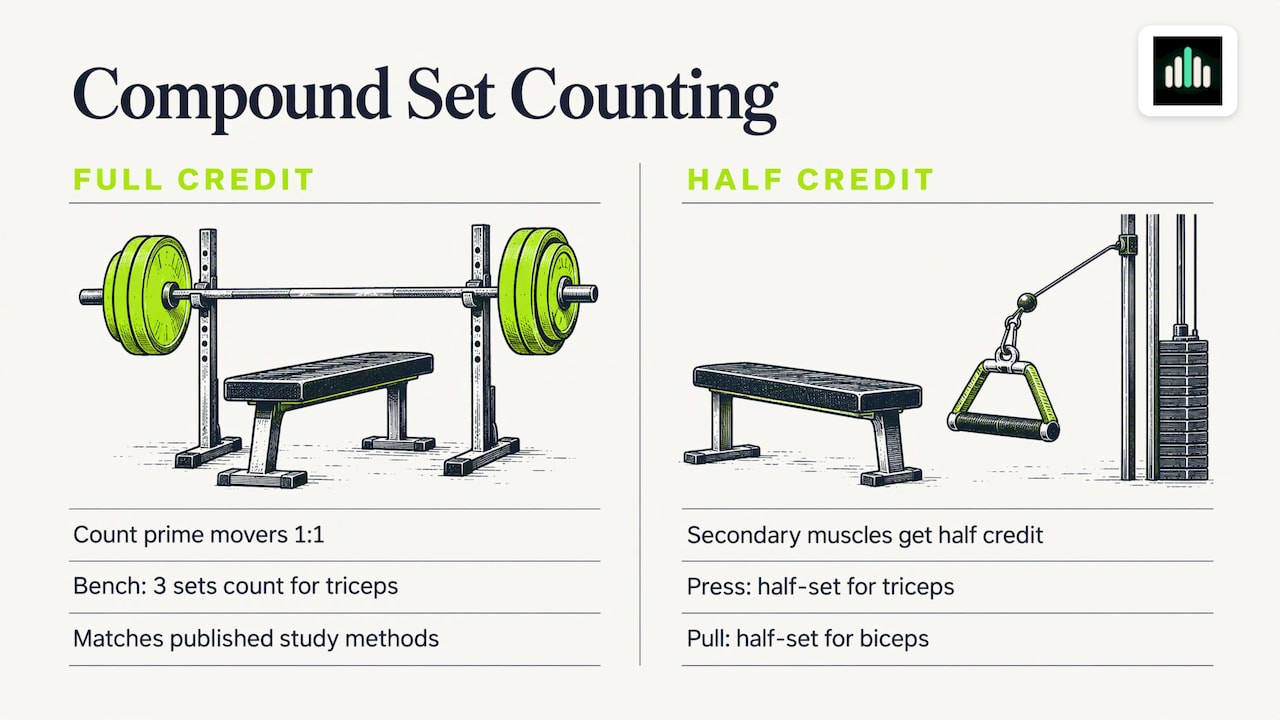
Method 1: full credit for every prime mover. Schoenfeld and colleagues recommend counting set volume 1:1 for multi-joint and single-joint exercises until longitudinal research settles the question. Under this method, 3 sets of bench count as 3 chest sets and 3 triceps sets. The Baz-Valle review noted that the studies it covered also counted multi-joint exercise volume toward triceps, so this method matches how much of the evidence was produced.
Method 2: half credit for secondary muscles. The same authors point out that acute muscle activation data show a squat does not load the hamstrings as much as it loads the quads, so a strict 1:1 count may overstate some muscles. Examine's guidance gives a practical rule: an upper-body press counts as half a set for triceps, and a pull counts as half a set for biceps. Its experts also stress that being consistent matters more than which method you pick.
If you train hard and want a count that does not flatter you, use half credit. If you want to compare your numbers to most published volume studies, use full credit. Either way, do not switch midway through a training block, or your week-to-week comparison stops meaning anything.
If you are choosing between pressing and isolating, the comparison of compound and isolation exercises shows how each affects the totals you are about to count.
A worked example
Here is an upper-body week of two sessions, counted with the half-credit rule. Only hard sets are included.
| Exercise | Sets | Direct muscle | Indirect credit (half) |
|---|---|---|---|
| Bench press (Upper A) | 4 | Chest 4 | Triceps 2 |
| Barbell row (Upper A) | 4 | Back 4 | Biceps 2 |
| Overhead press (Upper A) | 3 | Shoulders 3 | Triceps 1.5 |
| Incline press (Upper B) | 3 | Chest 3 | Triceps 1.5 |
| Pulldown (Upper B) | 4 | Back 4 | Biceps 2 |
| Lateral raise (Upper B) | 4 | Shoulders 4 | None |
| Curl (both days) | 6 | Biceps 6 | None |
| Pushdown (both days) | 6 | Triceps 6 | None |
Weekly totals:
| Muscle | Direct sets | Indirect credit | Combined |
|---|---|---|---|
| Chest | 7 | 0 | 7 |
| Back | 8 | 0 | 8 |
| Shoulders | 7 | 0 | 7 |
| Biceps | 6 | 4 | 10 |
| Triceps | 6 | 5 | 11 |
The picture is instructive. The arms look well fed at 10 and 11 combined sets, while chest, back and shoulders sit below 10. A lifter who wants bigger pecs and a bigger back would not see that from the exercise list, but the weekly totals show it immediately. The fix is not to add arm work. It is to add three or four sets each for chest and back, and perhaps trim a few pushdowns.
Tracking weekly volume in a log
A useful log has four columns per set: the exercise, the weight, the reps and the RIR. From that you can derive the weekly count, as long as you do two things.
- Record the sets you actually completed. The plan says 4 sets, but you did 3 because the session ran long. The log should say 3.
- Apply the same counting rules every week. Whether you choose full or half credit, the rule has to be fixed, or a rise in your totals may simply reflect a change in method.
A spreadsheet handles this with a lookup column that maps each exercise to its primary and secondary muscles. It works, but you spend your rest periods adding up cells, and the workout-by-workout entry is the weak point. The guide to calculating training volume covers three ways to turn a log into a weekly figure if you prefer to keep it manual.
Keep one caution in mind: a weekly set count is an accounting tool. It summarizes how much work a muscle may have received over seven days, but it does not measure tension, fatigue or growth, and two sets with the same label are not necessarily equal. A set of squats at 1 RIR and a set of leg extensions at 1 RIR are both "one set," but they load the quads differently. That is one more reason to track RIR alongside the count.
Splitting the week across sessions
Once you have a target, you need to spread it out. Research summarized in the time-efficient training review finds that weekly volume matters more than training frequency, and frequency matters little once volume is matched. So you can choose a session count that fits your schedule. Twelve weekly sets can be 6 twice a week, 4 three times a week or 3 four times a week.
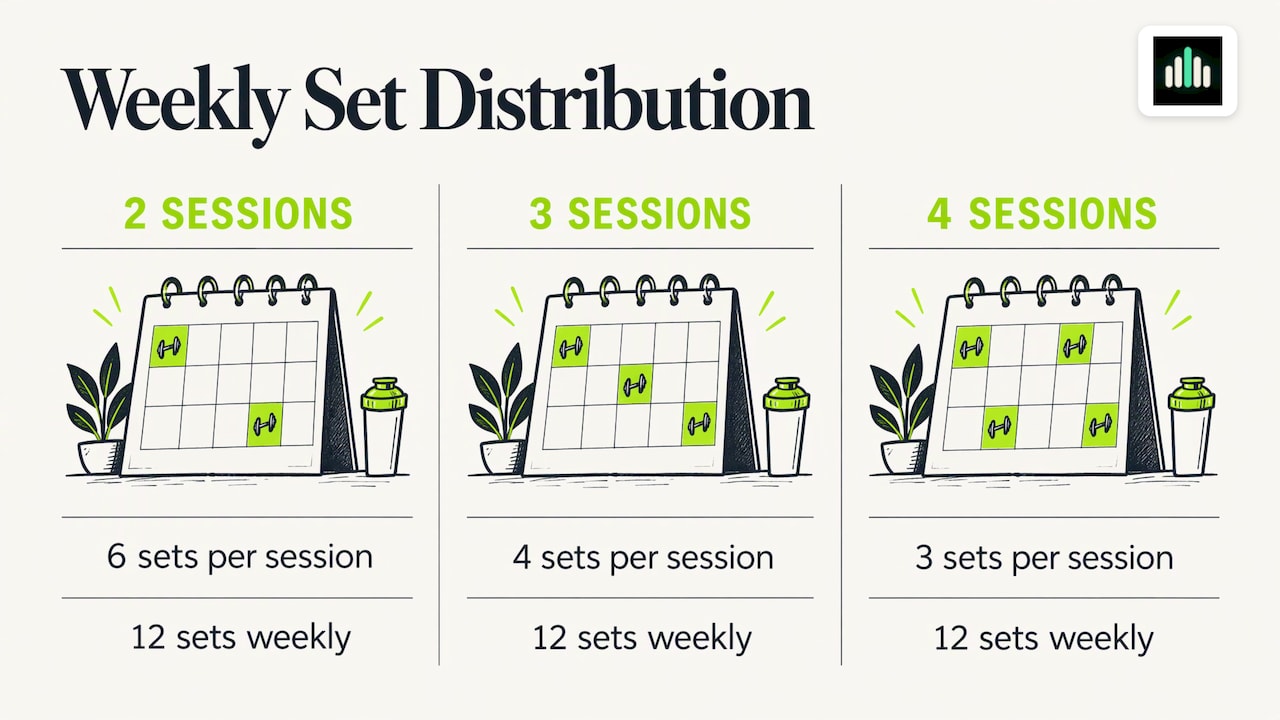
There is a practical ceiling, though. Piling 12 hard sets for one muscle into a single day usually means the last sets are fatigued and no longer productive, which is why most lifters split a large weekly target over at least two sessions. The article on training frequency for hypertrophy goes deeper on how often to hit a muscle.
Checking muscle balance
Once each muscle has a weekly number, balance analysis is a comparison exercise. Ask three questions.
Are opposing muscles roughly matched? Chest against upper back, quads against hamstrings, biceps against triceps. Human Kinetics' program design guidance notes that maintaining balance between opposing muscle groups, such as the hamstring-to-quadriceps ratio, is critical, as is attention to small stabilizers like the rotator cuff and core. Many lifters discover that their pressing volume is double their pulling volume, which is a common pattern when only the chest-and-arms exercises feel exciting.
Does the distribution match your priorities? All major muscle groups need work, but some deserve priority based on your goals and weak points. A lifter who wants a bigger back should see 14 to 16 back sets and perhaps 10 for chest, not the reverse.
Is anything getting indirect work only? Rear delts, calves, forearms and abs are often left to chance. If a muscle's combined count is mostly half-credit sets from other lifts, check whether it is growing the way you want. If not, give it a direct slot.
A simple rule is to keep every major muscle at or above your maintenance floor of about 4 to 6 hard sets, bring your priorities to 12 to 20, and let the rest sit in the middle. Then change one muscle at a time, so you can see what the change did.
Raising volume, and when to pull it back
Starting at the top of the range is a common mistake. Schoenfeld's review suggests progressing from about 10 to about 20 sets per muscle per week over several months, which promotes functional overreaching while limiting the risk of overtraining. Functional overreaching means pushing hard enough that performance dips briefly and then rebounds.
The pace of increase can be brisk for some lifters. A 2024 study in resistance-trained participants found that adding four or six sets per week every two weeks produced greater lower-limb strength over 12 weeks than holding 22 sets constant. That is an aggressive protocol for a short stretch, not a year-round plan.
A reasonable pattern for most lifters:
- Start the block at a volume you can recover from, around 10 sets for the muscle.
- Add 1 to 3 sets per muscle every week or two while performance holds and your RIR stays honest.
- When reps drop, soreness lingers or you cannot hit the planned RIR, hold or reduce volume.
- After the block, drop to a lower-volume phase.
The last step has support as well. The time-efficient training review describes alternating blocks of higher volume for gains with lower-volume maintenance blocks, since less training is needed to maintain muscle than to build it. Lifters who return to training with special health considerations, such as resistance training with osteoporosis, also benefit from thinking in phases rather than constant escalation. If you want the planning side, the guide to block periodization explains how to structure those phases.
Letting your log do the counting
The method above works with a notebook, but it asks you to tally by hand at the end of every week. RIRLift is built around the same inputs: you log weight, reps and RIR for each set on your iPhone or Apple Watch, and the weekly muscle map shows how much work each muscle received. Its AI Coach reads those logs to recommend your next load, adjust future sets and plan multi-week training blocks, and you can chat with Coach about changes. The core features are free, and Pro is $9.99 per month or $79.99 per year, purchased in the App Store, unlocking advanced coaching, analytics and unlimited routines.

If you train with your watch, you can log from the wrist during the session and review the weekly totals afterward. You can see what RIRLift offers and start on the free plan.
FAQ
How many sets per muscle per week do I need to build muscle?
Aim for at least 10 hard sets per muscle per week, and expect diminishing returns beyond about 18 to 20. Beginners often grow well on 8 to 12, while experienced lifters tend to need more. Adjust based on how your performance and recovery respond.
Do compound lifts count toward every muscle they work?
They count for the muscles they train hard. Research commonly credits prime movers at one full set each, and some coaches give helper muscles half a set instead. Choose one method and apply it every week so your totals stay comparable.
Is it better to train a muscle more often or do more sets per session?
Weekly volume matters more than frequency when the totals are matched, so schedule is a fine tiebreaker. Splitting your weekly sets across at least two sessions usually keeps each session's sets productive, since late sets in a long block are more fatigued.
Do warm-up sets and easy sets count toward weekly volume?
No. Only working sets taken close to failure, generally within about 0 to 3 reps in reserve, count as hard sets. Logging RIR on every working set makes it easy to separate those from the sets that were not hard enough.
Sources
- The influence of resistance exercise training prescription variables on skeletal muscle mass (umbrella review, 2023)
- American College of Sports Medicine Position Stand (2026)
- A Systematic Review of The Effects of Different Resistance Training Volumes on Muscle Hypertrophy (2022)
- No Time to Lift? Designing Time-Efficient Training Programs (2021)
- Schoenfeld, Guidelines for Resistance Training Volume (2018)
- Weightology, Set Volume for Muscle Size
- Calculating Set-Volume for the Limb Muscles (2019)
- Examine, Tracking sets for multi-joint and single-joint exercises
- Human Kinetics, How to customize resistance training programs
- Effects of different weekly set progressions, Medicine & Science in Sports & Exercise (2024)