Dumbbell workout on Apple Watch: log every set from your wrist

A dumbbell workout on Apple Watch needs an app that logs each set, because Apple's strength workouts record time and calories, not the weight or the reps. In RIRLift you start the session on your wrist, log the weight of one dumbbell, the reps and your reps in reserve, and the next session's dumbbells are set from those numbers. Copy one of the three sessions below: a home pair, a gym dumbbell rack, or a single dumbbell on the road.

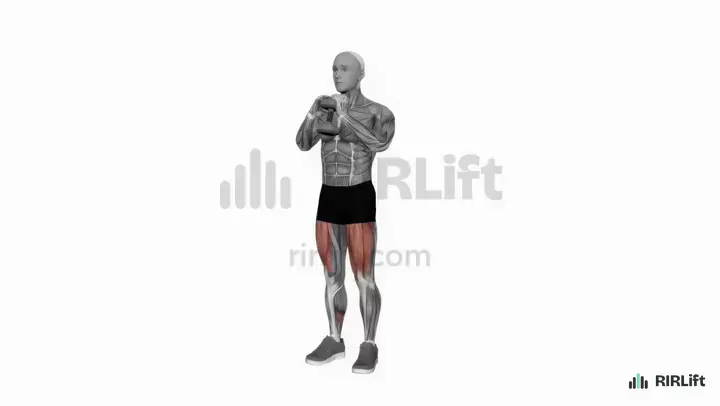
  1. Goblet Squat Quads, Glutes
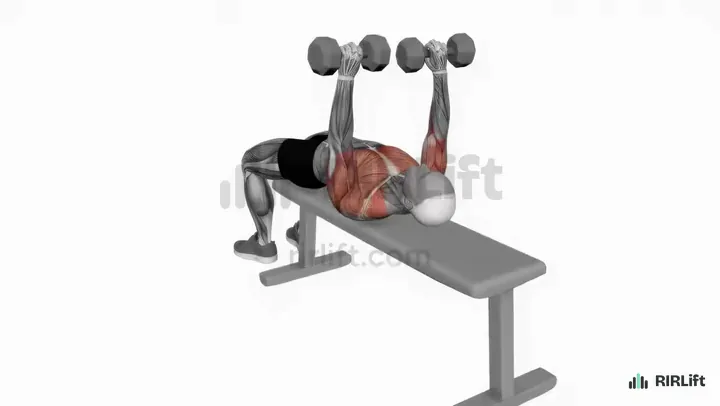
  2. Flat Dumbbell Press Chest
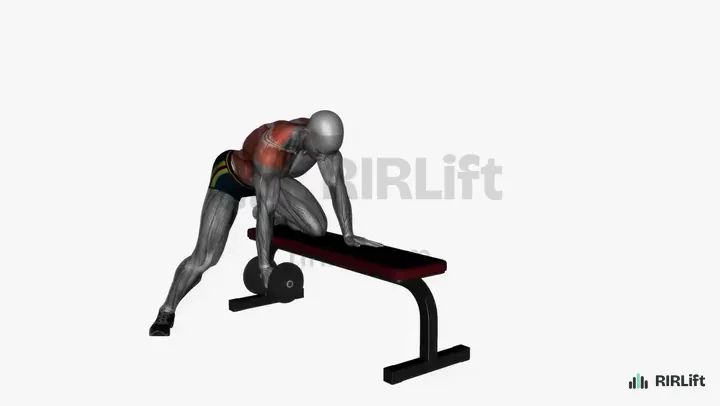
  3. One-Arm Dumbbell Row Lats, Upper Back
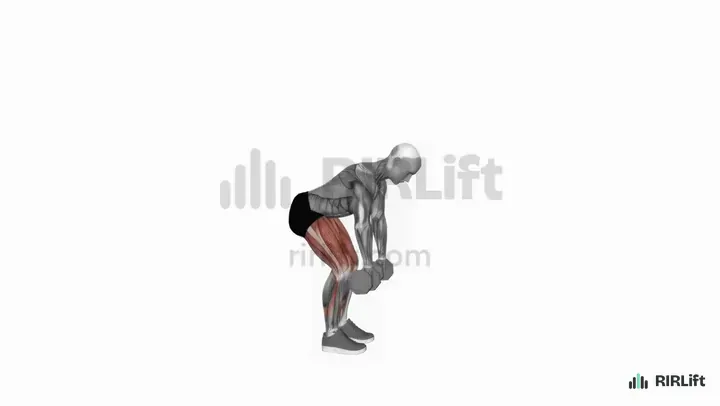
  4. Dumbbell Romanian Deadlift Hamstrings, Glutes
  5. Dumbbell Shoulder Press Shoulders
  6. Bulgarian Split Squat Quads, Glutes
  7. Dumbbell Lateral Raise Shoulders
Legs

Dumbbells load your legs without a rack. The single-leg lifts get more out of a light pair than squats do.

Quads and glutes, dumbbell squat

Goblet Squat

Quads, Glutes

One dumbbell at your chest is the simplest loaded squat. It is the first leg lift of the home sessions.

How to do it

  1. Hold a dumbbell or kettlebell vertically against your chest.
  2. Sit down between your knees, elbows inside them at the bottom.
  3. Stand up tall.

Cues

  • Elbows nudge the knees out at the bottom.
  • Chest stays up behind the weight.

Common mistakes

  • Letting the weight pull you forward.

Swap for: Bodyweight Squat, Barbell Back Squat

Hamstrings and glutes, dumbbell hinge

Dumbbell Romanian Deadlift

Hamstrings, Glutes

The hinge that balances the squat, loaded with the same pair you press with.

How to do it

  1. Stand hip-width apart with a dumbbell in each hand resting against the front of your thighs, palms facing you.
  2. Push your hips straight back and let your torso fold forward, knees softly bent, the dumbbells brushing your legs.
  3. Lower until the dumbbells pass your knees and you feel a strong stretch in your hamstrings, with your back still flat.
  4. Drive your hips forward to stand back up, squeezing your glutes at the top, and repeat.

Cues

  • Hips back, not down
  • Dumbbells slide down your legs
  • Flat back, chin tucked

Common mistakes

  • Bending the knees into a squat so the dumbbells go lower: the depth comes from the hips, and most people stop just past the knees.
  • Rounding the lower back at the bottom: end the rep where your back stays flat, and lighten the load if that is high.

Swap for: Single-Leg RDL, Dumbbell Good Morning, Kettlebell Deadlift

Quads and glutes, rear foot elevated

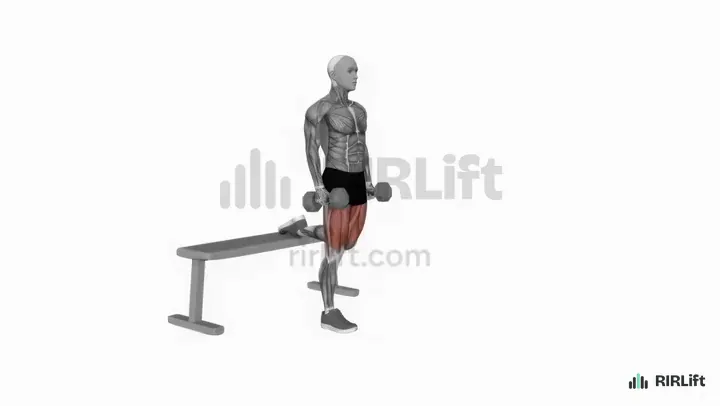
Bulgarian Split Squat

Quads, Glutes

Hard enough with light dumbbells that it keeps your legs progressing after the goblet squat tops out the rack.

How to do it

  1. Set the top of your back foot on a bench and place your front foot a long stride ahead.
  2. Hold a dumbbell in each hand at your sides, and keep your front foot flat.
  3. Drop your back knee straight toward the floor until the front thigh is close to level.
  4. Press through the front foot to rise, then finish all reps before switching legs.

Cues

  • Go deep for the inner thigh
  • Front foot flat
  • Rear foot is just a kickstand

Common mistakes

  • Pushing up with the back leg: let it relax and make the front leg do the work.
  • Front knee collapsing inward: keep it pointed the same way as your toes.

Swap for: Dumbbell Split Squat, Step-Up, Reverse Lunge

Quads and glutes, stepping back

Dumbbell Reverse Lunge

Quads, Glutes

A single-leg lift that needs only floor space and a pair of dumbbells.

How to do it

  1. Start tall with a dumbbell hanging from each hand and your feet under your hips.
  2. Step one foot back and lower until your back knee is just above the floor and your front thigh is near parallel.
  3. Keep your front heel flat and your chest tall.
  4. Push through your front foot to bring the back foot forward to the start, then alternate or finish all reps on one side.

Cues

  • Front shin stays vertical
  • Back knee kisses the floor
  • Drive through the front heel

Common mistakes

  • Taking a short step so the front knee shoots forward and the heel lifts: step farther back.
  • Letting the torso twist or lean to the side as you tire; keep both dumbbells hanging straight down.

Swap for: Reverse Lunge, Step-Up, Dumbbell Split Squat

Chest and shoulders

Presses on a flat or incline bench, overhead presses and raises. The one-arm versions work with a single dumbbell.

Chest, shoulders and triceps, flat press

Flat Dumbbell Press

Chest

The main chest press with dumbbells. Each arm moves on its own, so a weaker side cannot hide.

How to do it

  1. Lying on a flat bench, hold two dumbbells above your chest.
  2. Lower the bells to the sides of your chest with elbows at about 45 degrees.
  3. Press them back up over your shoulders.

Cues

  • Shoulder blades pinched.
  • Control the lowering.

Common mistakes

  • Flaring the elbows straight out.

Swap for: Push-Up, Barbell Bench Press

Upper chest and shoulders, incline press

Incline Dumbbell Press

Chest

The incline version for the upper chest. It leads the gym upper day.

How to do it

  1. Set the backrest to about 30 to 45 degrees and sit with the dumbbells on your thighs.
  2. Lean back and bring the weights to the outside of your shoulders as your back meets the pad.
  3. Squeeze your shoulder blades back and keep your hips on the seat.
  4. Press up and slightly in until your arms are straight over your upper chest.
  5. Lower under control until your elbows are just below the bench line.

Cues

  • Low incline, not a shoulder press
  • Wrists stacked over elbows
  • Touch the stretch, then press

Common mistakes

  • Setting the bench steeper than about 45 degrees: the front delts take over. Drop it a notch if you mostly feel your shoulders.
  • Lifting your hips off the seat to finish a rep: that turns it back into a flat press.

Swap for: Single-Arm Incline Dumbbell Press, Incline Dumbbell Squeeze Press, Incline Barbell Bench Press

Shoulders, seated dumbbell press

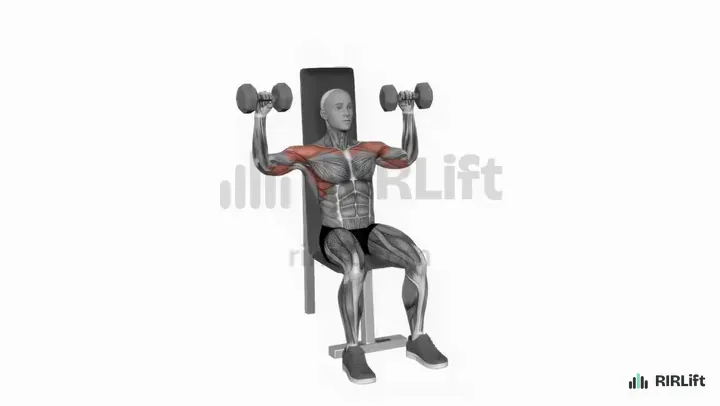
Dumbbell Shoulder Press

Shoulders

The overhead press of the dumbbell sessions, seated so your back is supported.

How to do it

  1. Set a bench upright or one notch back from vertical, sit with your feet flat, and rest a dumbbell on each thigh.
  2. Kick one knee up at a time to bring the dumbbells to shoulder height, then set your back against the pad.
  3. Turn your elbows slightly forward so they sit a little in front of your torso, palms facing forward or angled in.
  4. Drive both weights overhead on a slight inward arc until your elbows are straight, keeping your ribs down and your back on the pad.
  5. Lower slowly until the dumbbells are around ear height or a bit below, then press again.

Cues

  • Ribs down, back on the pad
  • Elbows a little forward
  • Press up and slightly in

Common mistakes

  • Arching your lower back off the pad to finish reps: that turns it into an incline press, so lighten the weight and keep your ribs stacked over your hips.
  • Flaring the elbows straight out at shoulder height: bring them a little forward so the shoulder joint stays comfortable at the bottom.
  • Stopping each rep well above your ears: lower to around ear height so the delts work through a full range.

Swap for: Machine Shoulder Press, Arnold Press, Landmine Press

Shoulders, one-arm press

Single-Arm Dumbbell Shoulder Press

Shoulders

Works with a single dumbbell, which makes it the press of the travel session.

How to do it

  1. Sit on an upright bench with your back on the pad and one dumbbell at shoulder height.
  2. Rest your free hand on your thigh and plant your feet.
  3. Press the dumbbell straight up to a locked elbow.
  4. Lower it to the shoulder, finish the set, then switch arms.

Cues

  • Stay level
  • Back on the pad
  • Even reps both sides

Common mistakes

  • Leaning toward the free side to get the weight up: if your torso tilts, the dumbbell is too heavy.
  • Arching off the backrest: keep your ribs down and your back on the pad.
  • Doing more reps on the strong side: match the weaker arm's count.

Side shoulders, raise

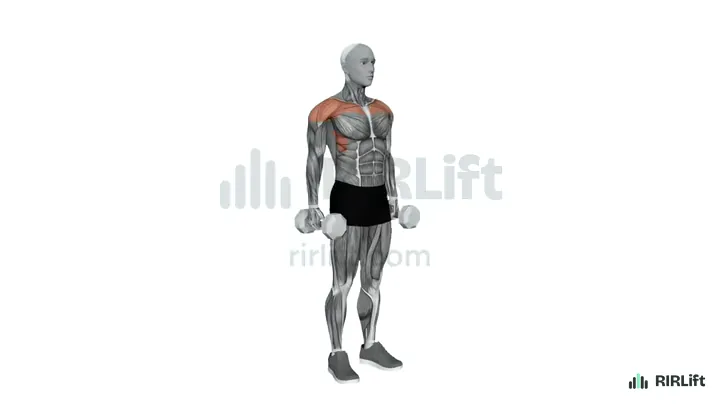
Dumbbell Lateral Raise

Shoulders

Light weight and high reps. It adds width to the shoulders with short rests.

How to do it

  1. Pick light dumbbells you can raise for 12 clean reps, and stand with your feet hip width apart, the weights hanging by your thighs.
  2. Lean your chest forward a few degrees, pull your shoulders down away from your ears and soften your elbows.
  3. Sweep the weights out and slightly forward, leading with your elbows, until your upper arms are level with your shoulders.
  4. Hold that top position for a beat, then take two to three seconds to lower until the dumbbells are a hand's width from your thighs.
  5. Start the next rep from there without resting at the bottom or bouncing out of it.

Cues

  • Elbows lead, hands follow
  • Shoulders down, neck long
  • Push the weights out, not up

Common mistakes

  • Shrugging the weight up: if your shoulders rise toward your ears, drop to lighter dumbbells and stop each rep where your upper arm is level.
  • Swinging the torso to start each rep: brace, stand still and keep the first inch of the lift as slow as the rest.
  • Bending the elbows more and more as the set goes on: set the bend on rep one and keep it, or the lever shortens and the set gets easier without you noticing.

Swap for: Cable Lateral Raise, Band Lateral Raise, Machine Lateral Raise

Side shoulders, one-arm raise

Single-Arm Dumbbell Lateral Raise

Shoulders

Holding a post with the free hand lets you raise one dumbbell strictly, so one bell is enough.

How to do it

  1. Stand next to a sturdy post or rack, hold it with your free hand and the dumbbell at your side with the other.
  2. Raise the bell out sideways with your elbow softly bent.
  3. Stop at shoulder height, with your elbow leading.
  4. Lower over two to three seconds and repeat, then switch arms.

Cues

  • Elbow leads
  • Stop at shoulder height
  • Slow on the way down

Common mistakes

  • Shrugging your shoulder up to start the rep: push the shoulder down and let the arm do the lifting.
  • Swinging from your hips: use a lighter dumbbell.

Swap for: Dumbbell Lateral Raise, Leaning Dumbbell Lateral Raise, Seated Dumbbell Lateral Raise

Back

One row supported on a bench, one with both bells and no support. Between them they cover the back with any pair.

Lats and upper back, one-arm row

One-Arm Dumbbell Row

Lats, Upper Back

Supported on a bench or chair, it lets you row the heaviest dumbbell you have.

How to do it

  1. Put one hand and the same-side knee on a bench, or your hand on a chair seat with both feet on the floor, so your back is flat.
  2. Hold a dumbbell in the other hand with your arm hanging straight.
  3. Pull your elbow back toward your hip until the dumbbell reaches your ribs.
  4. Lower it until your arm is straight again, finish all reps, then switch sides.

Cues

  • Elbow to your hip
  • Back flat as a table
  • Full stretch at the bottom

Common mistakes

  • Twisting your chest open to lift the dumbbell higher: keep both shoulders level.
  • Shrugging the shoulder up toward your ear: pull the elbow back, not the shoulder up.

Swap for: Band Bent-Over Row, Dumbbell Bent-Over Row, Seated Cable Row

Upper back and lats, two-arm row

Dumbbell Bent-Over Row

Upper Back, Lats

Both dumbbells at once, no bench needed. Hold the hinge for the whole set.

How to do it

  1. Take one dumbbell per hand, feet about hip-width apart, and hinge forward from the hips with soft knees until your torso is nearly level with the floor.
  2. Let the dumbbells hang straight down under your shoulders, palms turned in.
  3. Pull both dumbbells up to your lower ribs, keeping the elbows close, and hold the top for a beat.
  4. Lower to straight arms without letting your torso rise and repeat.

Cues

  • Torso angle stays locked
  • Pull to the ribs
  • Squeeze, then lower

Common mistakes

  • Letting the hinge rise until you are rowing upright: keep a mirror or phone camera to the side and stop the set when your chest climbs.
  • Yanking the dumbbells with your hips: the legs stay still and the elbows do the work.

Arms

Short sets at the end of a session. Two curls and a triceps extension cover both sides of the arm.

Biceps, dumbbell curl

Dumbbell Curl

Biceps

The basic curl. Two sets at the end of a session are enough for most people.

How to do it

  1. Stand tall with one or two dumbbells, palms facing forward.
  2. Curl the weight toward your shoulder, keeping your upper arm still.
  3. Squeeze the biceps hard when your forearm is upright.
  4. Lower until your elbow is straight.

Cues

  • Upper arm still
  • Squeeze at the top
  • Straight elbow at the bottom

Common mistakes

  • Rocking your body: brace against a wall.
  • Stopping short at the bottom: lower all the way.

Swap for: Kettlebell Curl, EZ-Bar Curl

Biceps and forearms, neutral-grip curl

Hammer Curl

Biceps, Forearms

The thumbs-up grip brings in the forearms and lets you handle a little more weight.

How to do it

  1. Hold the dumbbells at your sides with your palms facing your thighs.
  2. Bend one elbow to bring that dumbbell up, thumb leading.
  3. Keep the dumbbell vertical the whole way, then lower it slowly to the start.
  4. Curl the other arm, and keep alternating until the set is done.

Cues

  • Thumbs lead
  • Dumbbells vertical
  • Elbows by your sides

Common mistakes

  • Swinging heavier weight with your back: keep your torso still.
  • Curling across your body: keep each dumbbell in line with its shoulder.

Swap for: Band Hammer Curl, Alternating Hammer Curl

Triceps, lying extension

Dumbbell Skullcrusher

Triceps

Trains the triceps through a long stretch on a flat bench, after the presses.

How to do it

  1. Lie back on a flat bench and press two dumbbells up over your chest, palms turned in.
  2. Tilt your upper arms slightly back toward your head and lock them there.
  3. Bend only at the elbows, lowering the dumbbells beside your ears.
  4. Straighten your elbows to bring the weights back up.
  5. Stop just short of lockout to keep the triceps working.

Cues

  • Upper arms still
  • Lower beside your ears
  • Straighten, do not press

Common mistakes

  • Letting the elbows drift and pressing the weight up: that is a close-grip press. Keep the upper arms fixed.
  • Elbows flaring wide: keep them about shoulder width.

Swap for: EZ-Bar Skullcrusher, Close-Grip Bench Press, Kettlebell Decline Skullcrusher

Put them together: example sessions

Each session below picks from the exercises above for one situation, with the sets, reps, rest and RIR filled in.

Session 1

A home pair up to 50 lb, 3 days a week

  • Workouts3× a week
  • Working sets33 a week
  • Per workout~25 min
  • EquipmentDumbbells, Flat Bench

You have adjustable dumbbells up to 50 lb and a flat bench, and you train at home three days a week.

Two full-body days alternate, each with 11 working sets. The pair covers every muscle, and the single-leg lifts keep the legs progressing once 50 lb feels light.

Day A
ExerciseSets × repsRIRRest
Goblet Squat 3 × 8–15 2 90 s
Flat Dumbbell Press 3 × 8–12 2 90 s
Dumbbell Bent-Over Row 3 × 8–12 2 75 s
Dumbbell Curl 2 × 10–15 1 1 min
Day B
ExerciseSets × repsRIRRest
Dumbbell Romanian Deadlift 3 × 8–12 2 90 s
Dumbbell Shoulder Press 3 × 8–12 2 90 s
Dumbbell Reverse LungePer leg. 3 × 8–12 2 75 s
Dumbbell Skullcrusher 2 × 10–15 1 1 min
How to run it
Alternate Day A and Day B, three times a week. Start the routine on the Watch and change the dumbbells during the rest.
How to progress
Log the weight of one dumbbell. Goblet squat at 50 lb for 15, 15, 15 has reached the top of the range, and your pair goes no heavier: replace it with Bulgarian split squats from the Watch. Split squats at 30 lb for 12, 12, 12 are at the top of 8 to 12, so the next session opens at 35 lb for 8.

Session 2

Gym dumbbell rack, 30 minutes, upper and lower

  • Workouts4× a week
  • Working sets38 a week
  • Per workout~20 min
  • EquipmentDumbbells, Incline Bench

You train at a gym but use only the dumbbell area, in 30-minute slots, four days a week.

An upper day and a lower day, each run twice a week, so every muscle is trained twice. The full rack means the weights never run out.

Upper
ExerciseSets × repsRIRRest
Incline Dumbbell Press 3 × 6–10 1 2 min
One-Arm Dumbbell RowPer arm. 3 × 8–12 2 75 s
Dumbbell Lateral Raise 3 × 12–20 1 45 s
Hammer Curl 2 × 10–12 1 1 min
Lower
ExerciseSets × repsRIRRest
Bulgarian Split SquatPer leg. 3 × 8–12 2 90 s
Dumbbell Romanian Deadlift 3 × 8–12 2 90 s
Goblet Squat 2 × 12–15 1 75 s
How to run it
Upper, lower, rest, upper, lower. Grab both pairs for a session before you start it on the Watch, so you are not walking the rack between sets.
How to progress
Incline press at 55 lb with a target of 9: you log 10, 9, 9, the weakest set hit 9, so the dumbbells stay at 55 lb and the next target is 10. Lateral raises at 20 lb for 20, 20, 20 have hit the top of 12 to 20, so they move to 25 lb for 12.

Session 3

One dumbbell in a hotel or an office gym

  • Workouts2× a week
  • Working sets26 a week
  • Per workout~30 min
  • EquipmentDumbbells

You are traveling and the gym has a single usable dumbbell, or you packed none and borrowed one.

Every lift here takes one dumbbell: a goblet squat, a one-arm press, a one-arm row and a one-arm raise. Four sets of squats make up for the missing leg work, for 13 sets in about 30 minutes.

One dumbbell
ExerciseSets × repsRIRRest
Goblet Squat 4 × 10–15 2 75 s
Single-Arm Dumbbell Shoulder PressPer arm. 3 × 8–12 2 1 min
One-Arm Dumbbell RowPer arm. 3 × 10–12 2 1 min
Single-Arm Dumbbell Lateral RaisePer arm. 3 × 12–15 1 45 s
How to run it
Twice during a trip, with a day between. Do every one-arm set on your weaker side first and match the reps on the other side.
How to progress
With one dumbbell the weight cannot change, so the reps do the work. When a lift tops out its range, slow the lowering to 3 seconds or add a set, and log the dumbbell you used. Back home, the next session works from what you logged.

Make it fit you

Questions

Is there a weightlifting workout on the Apple Watch?

Apple's Workout app has Traditional and Functional Strength Training, which record time and calories. RIRLift adds the set log on the Watch and saves the session to Apple Health as Traditional Strength Training.

What is a good dumbbell workout routine?

Two full-body days alternated three times a week: a squat, a press, a row and an arm move on one day, a hinge, an overhead press, a lunge and a triceps move on the other, 3 sets each. The home pair session above is exactly that.

Do I log the weight of one dumbbell or both?

One. RIRLift treats dumbbell weights as per hand, so a pair of 40s is 40 lb, and the next weight it suggests is per hand too.