
Arm exercises for beginners: start on machines, then add dumbbells
Published October 19, 2026
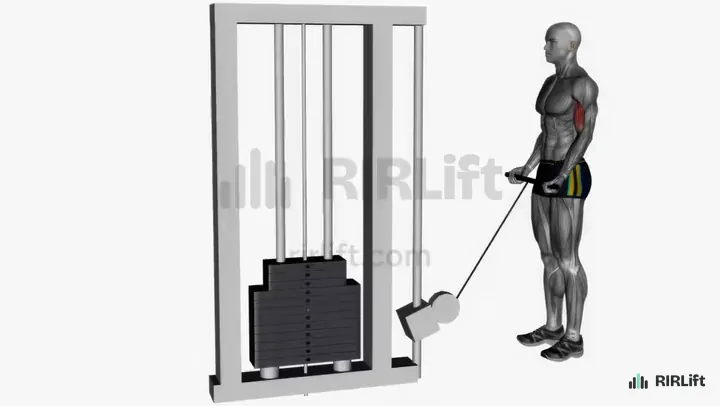
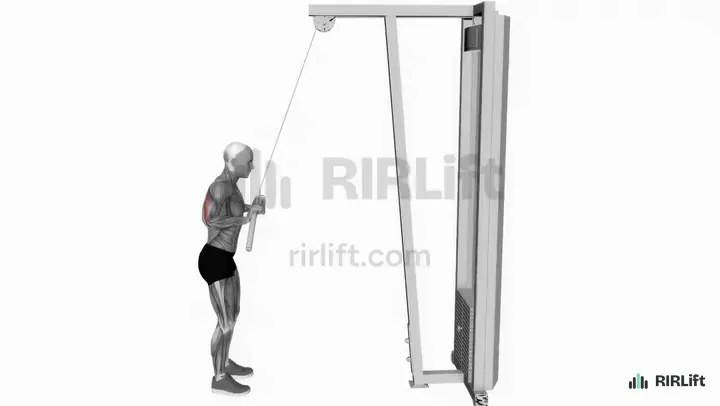
The best arm exercises for beginners are the cable curl and the cable triceps pressdown, followed by the machine triceps extension, the preacher curl on a cable station, and later the dumbbell curl, hammer curl and seated overhead extension. Machines and cables guide the path of the handle, so you can learn what a hard set feels like without also learning to balance a weight. Start with one biceps and one triceps exercise, 2 or 3 sets each, stopping 2 to 3 reps before failure, twice a week. That is enough to grow at first; add more exercises only when those stop moving.
- Cable Curl Biceps
- Cable Triceps Pressdown Triceps
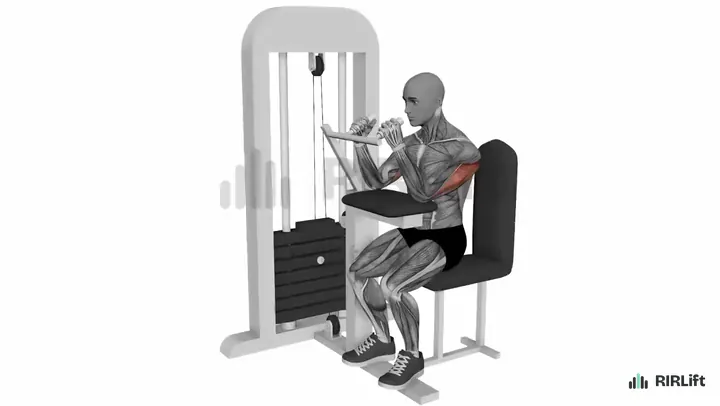
- Machine Triceps Extension Triceps
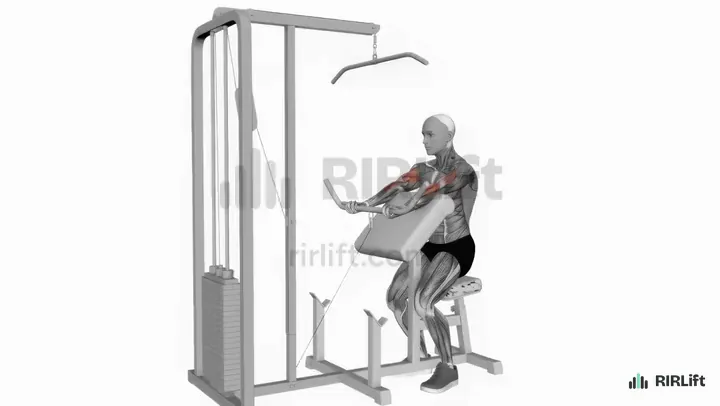
- Machine Preacher Curl Biceps
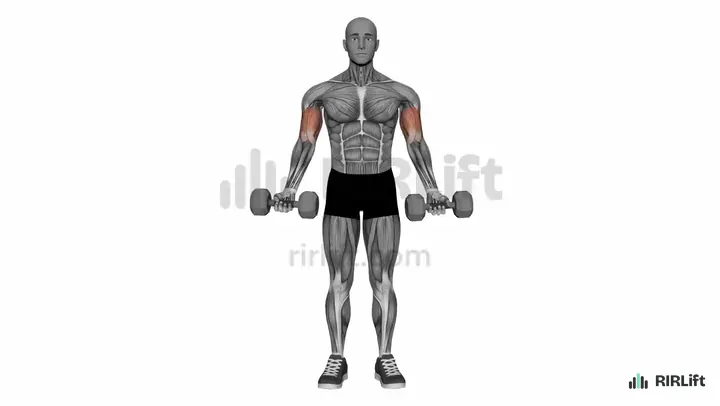
- Dumbbell Curl Biceps
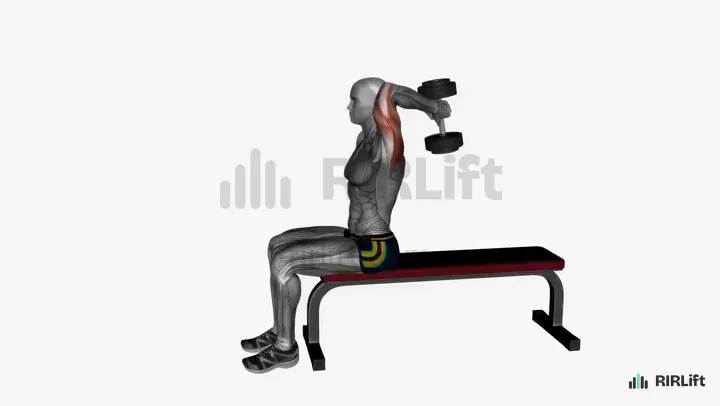
- Seated Dumbbell Overhead Triceps Extension Triceps
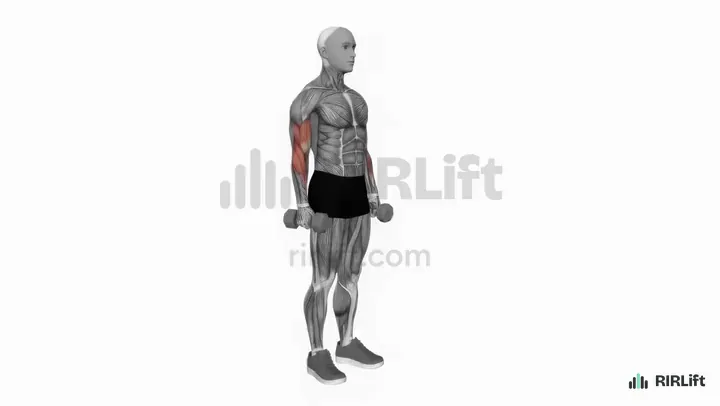
- Hammer Curl Biceps, Forearms
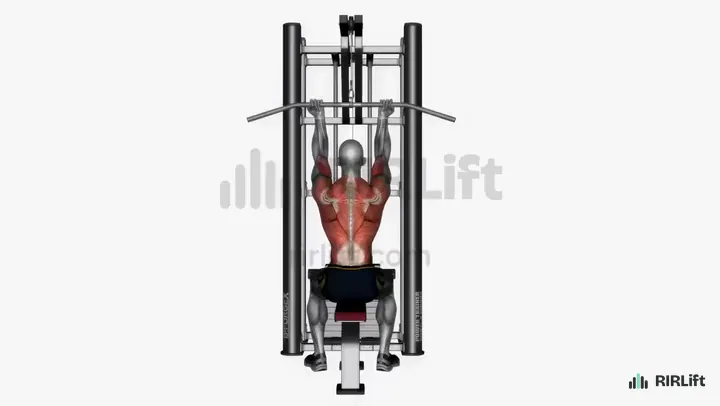
- Reverse-Grip Lat Pulldown Lats
Put them together: example sessions
Each session below picks from the exercises above for one situation, with the sets, reps, rest and RIR filled in. Open one in the session builder to change a pick, price it from a recent set, and add it to RIRLift.
-
Session 1
New to the gym, machines and cables only
You have just joined a gym, you are not yet comfortable with free weights, and you want your arms to come along with a beginner full-body routine.
2× a week · 12 sets a week · ~15 min
-
Session 2
At home with one pair of dumbbells
You train at home with a single pair of light or medium dumbbells and a chair or bench, and you have never followed an arm routine before.
2× a week · 20 sets a week · ~20 min
-
Session 3
Ten minutes after a full-body gym workout
You already follow a beginner full-body or upper/lower plan at a gym and want a short, direct arm finish at the end of upper-body days.
2× a week · 12 sets a week · ~10 min
Session 1
New to the gym, machines and cables only
- Workouts2× a week
- Working sets12 a week
- Per workout~15 min
- EquipmentLat Pulldown, Adjustable Cable, Preacher Curl Machine, Triceps Machine +1
You have just joined a gym, you are not yet comfortable with free weights, and you want your arms to come along with a beginner full-body routine.
Every exercise here has a cable or machine guiding the path, so you can focus on effort instead of balance. There are only four exercises per session and two sets of each, because beginners grow from very little volume and need the extra recovery to learn the movements. Every set stops 3 reps short of failure in the first weeks, which is close enough to grow and far enough to keep the form clean while you learn what a hard set feels like.
| Exercise | Sets × reps | RIR | Rest |
|---|---|---|---|
| Reverse-Grip Lat PulldownPalms facing you. Bar to upper chest. | 2 × 10–12 | 3 | 2 min |
| Cable CurlLow pulley. Elbows still. | 2 × 10–15 | 3 | 75 s |
| Cable Triceps PressdownStraight bar. Lock out each rep. | 2 × 10–15 | 3 | 75 s |
Open Arms A in the session builder
| Exercise | Sets × reps | RIR | Rest |
|---|---|---|---|
| Machine Preacher CurlArmpits snug on the pad. | 2 × 10–15 | 3 | 75 s |
| Machine Triceps ExtensionElbows level with the pivot. | 2 × 10–15 | 3 | 75 s |
| Farmer's WalkReps are steps. Heavy but upright. | 2 × 20–30 | 3 | 90 s |
Open Arms B in the session builder
- How to run it
- Do Arms A and Arms B once each per week, on different days, after or between your main full-body workouts. If you already do a pulldown in your full-body plan, skip it here.
- How to progress
- Add a rep per set when you can. When both sets hit the top of the range at 3 reps in reserve, move the pin down one plate. After four weeks, drop the target to 2 reps in reserve.
Session 2
At home with one pair of dumbbells
- Workouts2× a week
- Working sets20 a week
- Per workout~20 min
- EquipmentDumbbells
You train at home with a single pair of light or medium dumbbells and a chair or bench, and you have never followed an arm routine before.
Without cables or machines, the three dumbbell basics carry the plan, and the incline push-up on a bench or counter adds triceps work you can scale by changing the height. A fixed pair gets easy fast, so the rep ranges run higher, up to 20, and the sets stop 2 short of failure rather than 3, which keeps the light dumbbells challenging enough to grow on. One session, 10 working sets, fits in about 25 minutes.
| Exercise | Sets × reps | RIR | Rest |
|---|---|---|---|
| Dumbbell CurlBoth arms together. Elbows still. | 3 × 10–20 | 2 | 75 s |
| Seated Dumbbell Overhead Triceps ExtensionOne dumbbell, both hands. Sit tall. | 3 × 10–20 | 2 | 75 s |
| Hammer CurlPalms facing in. | 2 × 10–20 | 2 | 1 min |
| Incline Push-UpHands on a bench or counter, a bit narrow. | 2 × 8–15 | 2 | 90 s |
- How to run it
- Do the session twice a week with at least two days between. If a dumbbell feels too heavy for the overhead extension, use one end of it with both hands and slow the lowering to three seconds.
- How to progress
- Add reps until every set reaches the top of the range at 2 reps in reserve. Then slow every lowering to three seconds, or lower the push-up surface one step, before you buy heavier dumbbells.
Session 3
Ten minutes after a full-body gym workout
- Workouts2× a week
- Working sets12 a week
- Per workout~10 min
- EquipmentAdjustable Cable, Dumbbells, Triceps Machine
You already follow a beginner full-body or upper/lower plan at a gym and want a short, direct arm finish at the end of upper-body days.
Your rows, pulldowns and presses already train the biceps and triceps, so the finish only needs one curl and one triceps exercise. Pairing them back to back as a superset, one muscle resting while the other works, fits 6 working sets into ten minutes. You are tired at the end of a workout, so the target stays at 2 reps in reserve to keep the form clean.
| Exercise | Sets × reps | RIR | Rest |
|---|---|---|---|
| A1 Cable CurlSuperset with the pressdown. | 3 × 10–15 | 2 | 1 min |
| A2 Cable Triceps PressdownRope or bar. | 3 × 10–15 | 2 | 1 min |
Open Finisher A in the session builder
| Exercise | Sets × reps | RIR | Rest |
|---|---|---|---|
| A1 Hammer CurlSuperset with the extension. | 3 × 10–15 | 2 | 1 min |
| A2 Machine Triceps ExtensionPause at lockout. | 3 × 10–15 | 2 | 1 min |
Open Finisher B in the session builder
- How to run it
- Add Finisher A to your first upper-body day of the week and Finisher B to the second. Do one set of the first exercise, go straight to the second, rest, and repeat.
- How to progress
- Add a rep each time until every set hits the top of the range at 2 reps in reserve, then raise the weight one step. Swap A and B every four weeks so both curls and both triceps moves get time first.
Make it fit you
-
Your arms are sore for days after each session
Cut every exercise to one set for a week, then go back to two. Being very sore early on is normal and fades within a few sessions; it is not a sign you trained better.
-
You only have a resistance band
Stand on the band for curls and hammer curls, and anchor it high on a door for pressdowns. Bands get harder near the top of each rep, so slow down there and stop 2 reps short of failure.
-
Your elbows ache on triceps exercises
Use the rope for pressdowns and let your hands drift apart at the bottom, and keep overhead extensions lighter with a slower lowering. If one move still hurts, drop it and give its sets to the one that feels fine.
-
You want toned arms, not bigger arms
Train the plans as written. At a beginner's volume your arms firm up and get a little fuller, and how lean they look depends mostly on overall body fat, not on which exercise you choose.
-
Not sure how much weight to start with
Pick a weight you think you can lift 15 times. If you reach 15 with more than 3 reps left, go up one step next set; if you cannot reach 10, go down one step.
-
Log the RIR, not just the weight
After every set, write down how many more reps you could have done. If you log in RIRLift, it uses that number to suggest the next weight, so you know when to add load instead of guessing.
Questions
What is a good arm day workout for beginners?
One biceps exercise and one triceps exercise, 2 or 3 sets each, 10 to 15 reps, stopping 2 to 3 reps before failure. At a gym, the cable curl and the cable pressdown are the easiest pair to learn. At home, use the dumbbell curl and the seated overhead extension. That is a complete arm workout for your first two months.
Are 4 exercises enough for arm day?
For a beginner, four is more than enough, and two is often plenty. Most of the growth in your first months comes from a few hard sets done consistently, and your arms already work during rows and presses. Add a third or fourth exercise only when the first two stop progressing.
What are some good arm exercises with dumbbells for beginners?
The dumbbell curl, the hammer curl and the seated overhead triceps extension. They cover the front, the side and the back of the arm, need only one pair of dumbbells and a chair, and have very little technique to learn.
Should beginners use machines or dumbbells for arms?
Machines and cables are easier to start with, because they guide the movement and keep tension on the muscle through the whole rep. Both build muscle equally well when the sets are hard enough. If you have access to a gym, start on cables and add dumbbells after a few weeks; at home, start with dumbbells.
How long does it take to firm up flabby arms?
Most beginners notice their arms feel firmer within 4 to 8 weeks of training them twice a week, as the muscle underneath grows and gets more tone at rest. How defined they look also depends on body fat, which training your arms alone does not change much.
How many times a week should a beginner train arms?
Twice a week is the sweet spot. Each session can be short, 4 to 6 hard sets for the arms, and a day or two between sessions gives the muscles time to recover before you train them again.
How heavy should a beginner lift for arm exercises?
Heavy enough that you finish each set with only 2 or 3 good reps left. For most beginners that is a weight you can lift 10 to 15 times. The number on the dumbbell does not matter; how close the set ends to failure does.
Related templates
-
The best workout for beginners
The full-body beginner plans these arm sessions slot into.
-
Dumbbell arm exercises for biceps, triceps and forearms
More curls, extensions and forearm work once you move past the basics.
-
Arm exercises at home: biceps, triceps and grip with whatever you have
More options if you train with dumbbells and bands only.
-
How to use reps in reserve (RIR)
How to judge 2 or 3 reps left when you are new to hard sets.