
Barbell bicep exercises: the curls and rows that load your biceps heaviest
Published October 19, 2026
The best barbell bicep exercises are the barbell curl, the preacher curl, the EZ-bar curl and the drag curl, with the reverse curl and underhand row as supporting lifts. A barbell lets both arms share one load, so you can curl more weight than with dumbbells and add it in small steps. Two curls per session, 3 to 4 sets each at 0 to 2 reps in reserve, twice a week, is enough for most lifters.
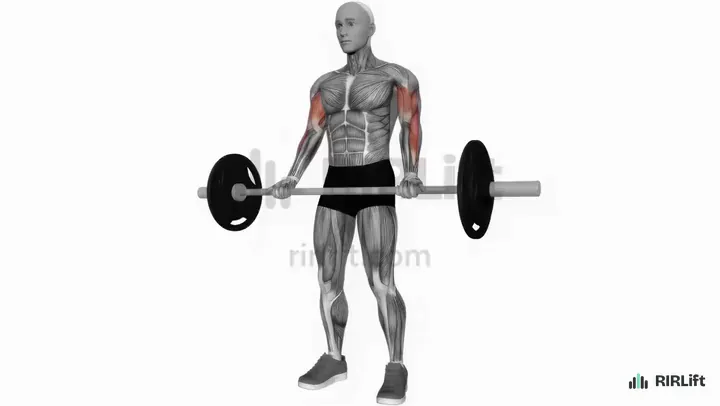
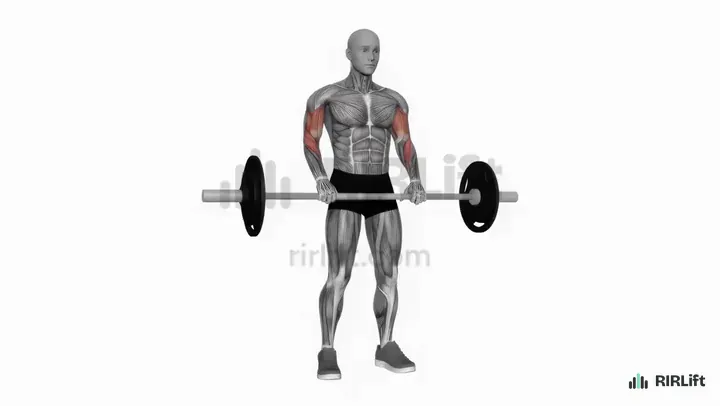
- Barbell Curl Biceps
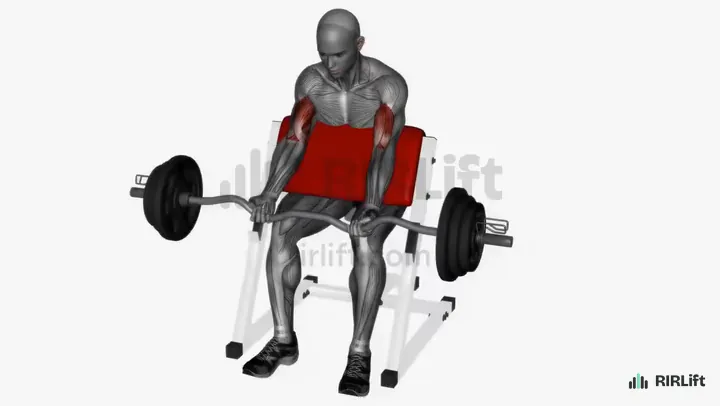
- Preacher Curl Biceps
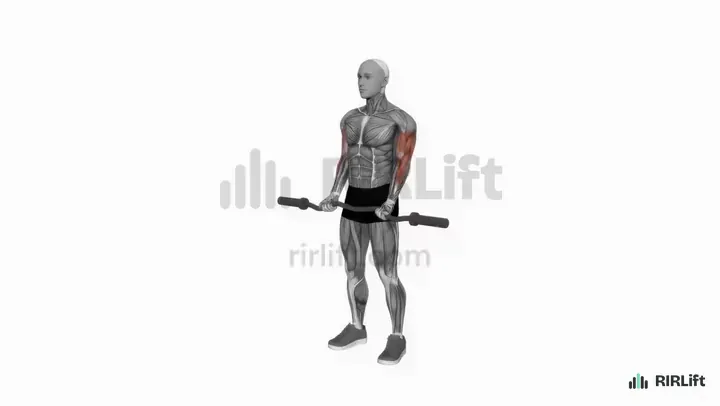
- EZ-Bar Curl Biceps
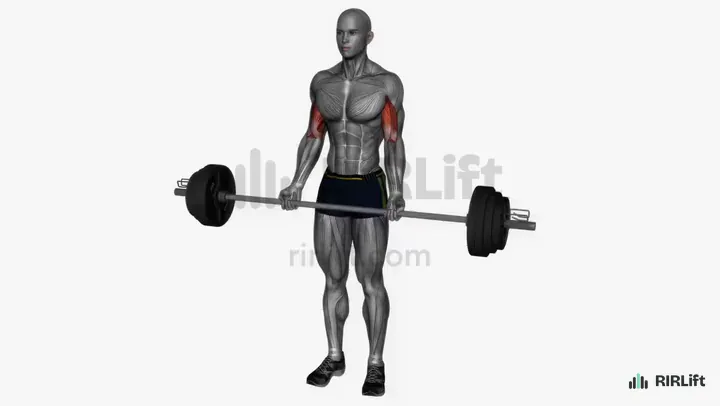
- Barbell Drag Curl Biceps
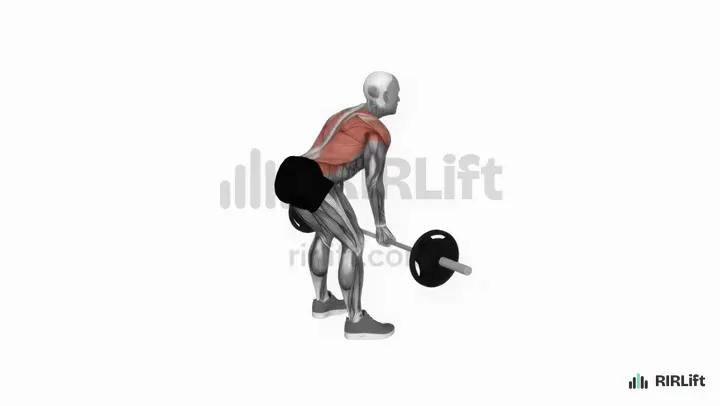
- Underhand Barbell Row Upper Back, Lats
- Reverse Curl Biceps, Forearms
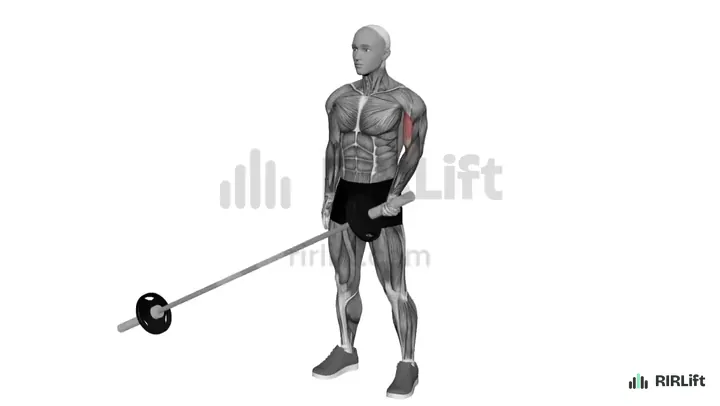
- Landmine Curl Biceps
Put them together: example sessions
Each session below picks from the exercises above for one situation, with the sets, reps, rest and RIR filled in. Open one in the session builder to change a pick, price it from a recent set, and add it to RIRLift.
-
Session 1
One straight barbell, no rack or bench
You have a barbell and plates at home and nothing to rest it on, so everything starts from the floor or a hang.
2× a week · 18 sets a week · ~20 min
-
Session 2
Gym with an EZ bar, preacher bench and landmine
Your arms are the priority this block, and your gym has the full set of bars and benches.
2× a week · 18 sets a week · ~20 min
-
Session 3
Biceps inside a barbell strength program
You run a squat, bench and deadlift program three days a week and have 15 minutes left for arms on one of them.
1× a week · 10 sets a week · ~25 min
Session 1
One straight barbell, no rack or bench
- Workouts2× a week
- Working sets18 a week
- Per workout~20 min
- EquipmentBarbells
You have a barbell and plates at home and nothing to rest it on, so everything starts from the floor or a hang.
Without a bench or landmine, the straight bar covers it: the barbell curl is the main lift, the drag curl takes the shoulders out of the second movement, and the reverse curl adds brachialis and forearm work. Session B leads with underhand rows, picked off the floor, so your back and biceps both get a heavy pull. Curls end 1 RIR on the first exercise and 0 to 1 after; the row stays at 2 so your lower back is not the limit. About 9 to 10 sets per session.
| Exercise | Sets × reps | RIR | Rest |
|---|---|---|---|
| Barbell Curl1 warm-up set firstPick the bar up from the floor with a flat back. | 4 × 6–12 | 1 | 90 s |
| Barbell Drag CurlBar slides up your body. | 3 × 8–12 | 1 | 75 s |
| Reverse CurlPalms down, wrists flat. | 2 × 10–15 | 0 | 1 min |
Open Biceps A in the session builder
| Exercise | Sets × reps | RIR | Rest |
|---|---|---|---|
| Underhand Barbell Row1 warm-up set firstTorso at 45°. Palms up. | 3 × 6–10 | 2 | 2 min |
| Barbell CurlSlower lowering than session A. | 3 × 8–15 | 0 | 75 s |
| Barbell Drag CurlElbows back. | 3 × 10–15 | 0 | 1 min |
Open Biceps B in the session builder
- How to run it
- Do Biceps A and Biceps B on different days. Either can follow a lower-body or push workout.
- How to progress
- Add 5 lb to the barbell curl once every set hits 12 reps at the target RIR. Drag and reverse curls move up in 2.5 lb steps, or add reps first.
Session 2
Gym with an EZ bar, preacher bench and landmine
- Workouts2× a week
- Working sets18 a week
- Per workout~20 min
- EquipmentEZ Bar, Preacher Bench, Barbells, Landmine
Your arms are the priority this block, and your gym has the full set of bars and benches.
The preacher curl is the stretched-position lift, the EZ-bar curl the heavier standing one, and the landmine curl a smooth third angle that is easy to push close to failure. The Meadows row replaces a second biceps exercise on day B because its long one-arm pull adds biceps work while training the back. Preacher curls stop at 1 RIR, since the stretch under fatigue is where elbows complain; the landmine and EZ curls go to 0. About 20 biceps sets a week counting rows at half.
| Exercise | Sets × reps | RIR | Rest |
|---|---|---|---|
| EZ-Bar Curl1 warm-up set firstChoose the grip your wrists prefer. | 4 × 6–10 | 1 | 90 s |
| Preacher CurlSlow on the bottom half. | 3 × 8–12 | 1 | 90 s |
| Reverse CurlEZ or straight bar. | 2 × 10–15 | 1 | 1 min |
Open Arms Heavy in the session builder
| Exercise | Sets × reps | RIR | Rest |
|---|---|---|---|
| Meadows RowPer arm. | 3 × 8–12 | 1 | 90 s |
| Preacher CurlArmpits tight to the pad. | 3 × 10–15 | 1 | 75 s |
| Landmine CurlBoth hands on the sleeve. | 3 × 12–20 | 0 | 1 min |
Open Arms Pump in the session builder
- How to run it
- Run Arms Heavy and Arms Pump on two non-consecutive days, alongside your normal training.
- How to progress
- Double progression on every curl: reach the top of the rep range on all sets, then add the smallest plate. Add weight to the Meadows row at 12 clean reps per arm.
Session 3
Biceps inside a barbell strength program
- Workouts1× a week
- Working sets10 a week
- Per workout~25 min
- EquipmentBarbells
You run a squat, bench and deadlift program three days a week and have 15 minutes left for arms on one of them.
Heavy pulling already trains your biceps, so this plan keeps one row and one curl and nothing else. The overhand barbell row sits at 2 RIR because it shares the lower back with your deadlifts; the barbell curl goes to 1, then a single 0 RIR set of underhand rows at the end loads the biceps and lats one more time without adding a recovery cost your main lifts will feel. Ten sets in one session.
| Exercise | Sets × reps | RIR | Rest |
|---|---|---|---|
| Barbell RowOverhand. Brace each rep. | 4 × 6–10 | 2 | 2 min |
| Barbell CurlStrict, no hip drive. | 4 × 6–10 | 1 | 90 s |
| Underhand Barbell RowLighter bar, palms up. | 2 × 10–15 | 0 | 90 s |
- How to run it
- Add it to the end of your lightest main-lift day once a week. Skip the final row set in weeks you test a deadlift max.
- How to progress
- Raise the curl by 5 lb at 10 reps on every set. Add weight to the overhand row only when your deadlift is not stalling.
Make it fit you
-
Straight bar hurts your wrists
Switch to the EZ bar, or take a slightly wider grip on the straight bar so your hands sit outside your forearms. If neither helps, do the landmine curl, where your hands cup the sleeve and can rotate.
-
Your curl stalls at the same weight
Barbell curls are easy to cheat as they get heavy, and the cheating hides the stall. Stand with your back against a wall for a few weeks, drop 10 to 15 percent, and build back up with strict reps.
-
Elbows ache after preacher curls
Stop each rep a few degrees short of a straight elbow and slow the lowering down. Move preacher curls to the second slot in the session so your elbows are warm before the stretch.
-
You want a fuller-looking arm
Biceps size is only part of it: the brachialis under it pushes the biceps up. Keep the reverse curl in every session and count your underhand rows toward biceps volume.
-
Only light plates at home
Use the drag curl and slow lowering to make a light bar hard, and end each curl at 0 RIR. Fractional plates of 1.25 lb or 0.5 kg let you keep adding weight without big jumps.
-
Log the RIR, not just the weight
Write down how many reps you could still have done after each set. In RIRLift you log that RIR with the reps, and the app suggests the next weight from it, so a curl set that stopped at 3 RIR when you aimed for 1 tells you the bar is ready to go up.
Questions
What is the best barbell exercise for biceps?
The standing barbell curl. It lets both arms share one heavy load at full supination and progresses in small plate steps. Add a preacher curl as your second exercise to train the stretched position.
What exercise peaks the bicep?
No exercise changes the shape of your biceps peak; that comes from where the muscle attaches, which is genetic. A bigger biceps shows more of the peak you have. The preacher curl and barbell curl together train both the stretched and shortened ends of the range.
Is a 20 pound bicep curl good?
On a barbell, 20 lb is a light start, and most lifters can add to it within weeks. Judge the weight by reps in reserve rather than the number: if you finish 10 strict reps with 1 or 2 left, the weight is right for you today.
How long does it take to grow biceps?
Newer lifters usually notice their arms filling out within a few months of training biceps twice a week close to failure. Growth is fastest in the first year and slows after that, so a log of your curl weights and reps shows progress before the tape measure does.
Should I curl with a straight bar or an EZ bar?
Use the straight bar if it feels fine on your wrists, because it supinates the forearm fully. Use the EZ bar if your wrists or elbows ache. The biceps works hard with either.
Do barbell rows work biceps?
Yes. Every row bends the elbows under load, and the underhand row works the biceps most. Count a hard set of rows as about half a biceps set when you add up your weekly volume.
Related templates
-
Barbell arm exercises: biceps, triceps and forearms with one bar
Add triceps presses and extensions to make it a full barbell arm day.
-
Barbell curl: how to do it right, what it works, and how much to lift
The straight-bar curl in depth, with grip widths and programming.
-
Dumbbell bicep exercises: curls for the stretch, the squeeze and arm thickness
Incline, spider and hammer curls when you have dumbbells instead.
-
EZ-bar curl: how to do it, which grip to use, and how it compares to a straight bar
How to pick the grip and set up the angled bar.
-
The best workout for biceps, matched to your setup
Full biceps programs mixing bars, cables and chin-ups.