
Barbell curl: how to do it right, what it works, and how much to lift
Published October 19, 2026
A barbell curl is a standing biceps curl with a straight bar held in an underhand grip about shoulder-width apart. With your elbows at your sides, curl the bar up until your forearms are vertical, then lower it until your arms are fully straight. Because both arms lift one bar, it is the curl where you can use the most weight, which makes it a good main biceps lift as long as your torso stays still.
- WorksBiceps
- AlsoForearms
- EquipmentBarbells
- Start with3 × 10–15, 1 in reserve, 90 s rest
How to do the barbell curl
Both arms share one bar, so you can load more than on almost any other curl and add weight in small steps over time. The straight bar keeps your palms fully turned up, which is the position where the biceps work hardest.
Steps
- Stand tall with your feet hip-width apart and hold the bar with an underhand grip, hands a little wider than your hips.
- Let the bar hang at your thighs with your arms straight and your elbows touching your sides.
- Curl the bar up in an arc by bending your elbows, with your upper arms still and your wrists straight.
- Stop when your forearms are vertical and the bar is in front of your shoulders, and squeeze your biceps for a moment.
- Lower the bar under control until your arms are completely straight, then start the next rep.
Cues
- Elbows pinned to your ribs
- Ribs down, no lean back
- Straight arms at the bottom of every rep
Common mistakes
- Leaning back and using the hips: brace your stomach and squeeze your glutes; if the bar only moves with a swing, it is too heavy.
- Letting the elbows drift forward at the top: that brings the shoulders in and takes tension off the biceps; stop when the forearms are vertical.
- Half reps that never straighten the arms: lower all the way every time, or the weight on the bar overstates what your biceps can do.
Swap for: EZ-Bar Curl, Dumbbell Curl, Cable Curl
Muscles the barbell curl works
The barbell curl works the biceps first, with the brachialis and the brachioradialis in the forearm helping to bend the elbow. Your forearm flexors grip the bar, and your abs and lower back keep your torso still.
Sets, reps and reps in reserve for the barbell curl
| Goal | Sets × reps | RIR | Rest |
|---|---|---|---|
| Build muscle | 3–4 × 8–12 | 1–2 | 90 s |
| Add 5 lb once you reach the top of the range on every set. | |||
| Build strength | 3–4 × 5–8 | 2 | 2 min |
| Keep it strict; heavier sets are where the lean back creeps in. | |||
| Volume finisher | 2 × 15–20 | 0–1 | 60 s |
| Use about half your working weight and keep the reps continuous. | |||
Barbell curl variations
-
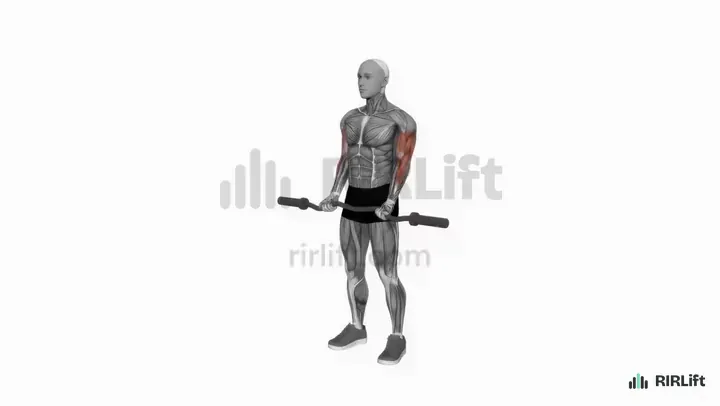
EZ-Bar Curl
Use the angled EZ-bar when a straight bar bothers your wrists or elbows; it turns your palms slightly inward.
Build a session with it -
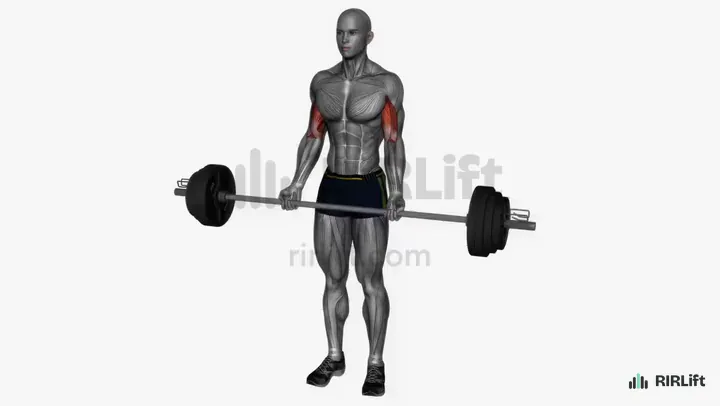
Barbell Drag Curl
Drag the bar up your torso with your elbows moving back when you want more of the biceps' upper part and less front shoulder.
Build a session with it -
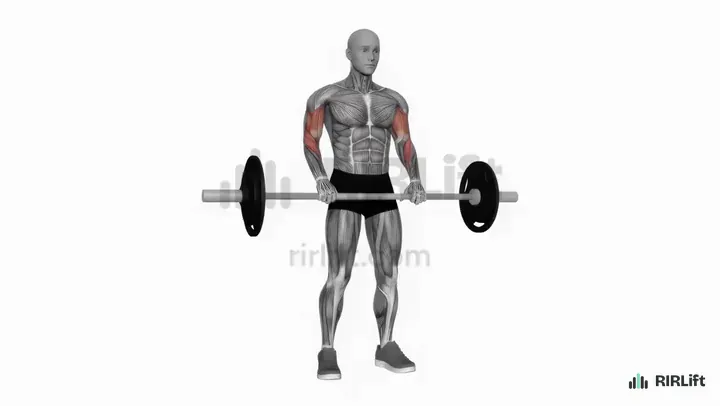
Reverse Curl
Curl the bar with an overhand grip when you want to train the brachialis and forearms.
Build a session with it
Barbell curl alternatives
Dumbbell curls
-
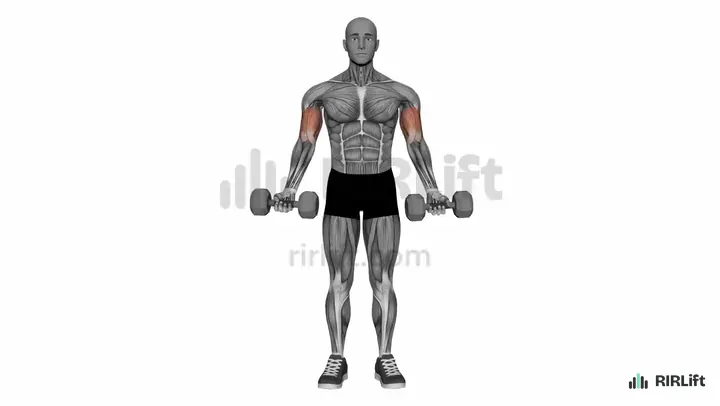
Dumbbell Curl
Curl dumbbells when you want each arm to work alone and turn the palms freely.
Build a session with it -
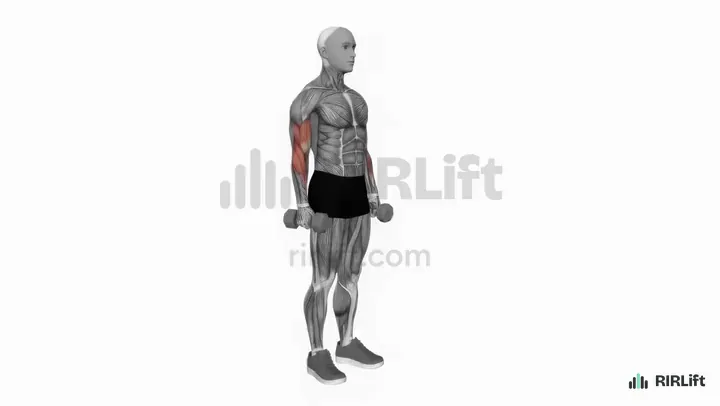
Hammer Curl
Hold the dumbbells thumbs up when you want more brachialis and forearm work.
Build a session with it
Cable and supported curls
-
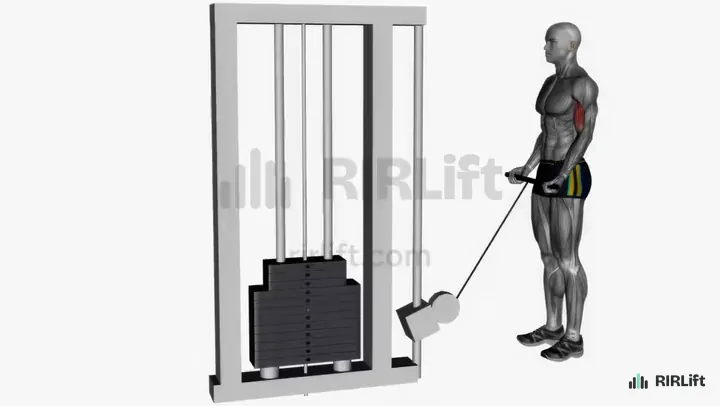
Cable Curl
Curl from a low cable when you want constant tension from bottom to top.
Build a session with it -
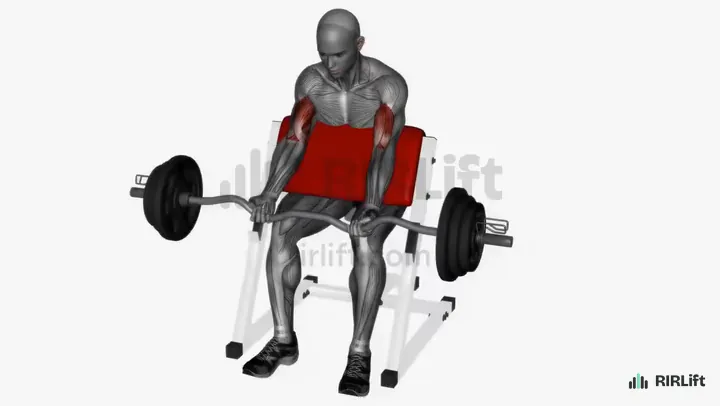
Preacher Curl
Rest your arms on a preacher pad when you can't stop swinging the barbell.
Build a session with it
Barbell curl vs dumbbell curl
The barbell curl usually lets you lift more total weight, because both arms share one bar and you can balance it easily. Dumbbell curls are harder per arm, let each side work alone so a weaker arm can't lean on the stronger one, and let you rotate your wrists.
Both build the biceps. A common setup is a barbell curl first for heavier sets and a dumbbell curl second for each arm on its own.
What is a good barbell curl weight?
It depends on your size and training age, so compare yourself to yourself. A useful benchmark is that most people can strictly curl somewhere around a third to half of their bench press. Start with an empty bar or a light fixed bar, find a weight you can curl for 8 to 12 strict reps with one or two in reserve, and add weight only when every set reaches the top of the range.
Questions
Is the barbell curl effective?
Yes. It lets you use the most load of any curl and progress in small steps, which makes it one of the best main lifts for the biceps.
How do you barbell curl correctly?
Grip the bar shoulder-width with palms up, keep your elbows at your sides, curl until your forearms are vertical, and lower until your arms are fully straight without leaning back.
Is the barbell curl harder than the dumbbell curl?
Most people can lift more total weight on a barbell. Per arm, dumbbells are usually harder because each arm works alone and has to stabilize its own weight.
Is a 70 lb barbell curl good?
A strict 70 lb curl for reps is strong for most lifters. What matters more is that the number goes up over time with the same form.
What muscles do barbell curls work?
The biceps most, with the brachialis and brachioradialis helping. The forearms grip the bar and the core keeps you still.
Should I use a straight bar or an EZ-bar?
Use the straight bar if your wrists are comfortable; it keeps the palms fully up. Switch to an EZ-bar if the straight bar strains your wrists or elbows.
Related templates
-
EZ-bar curl: how to do it, which grip to use, and how it compares to a straight bar
The wrist-friendly version of the barbell curl.
-
Dumbbell curl: how to do it, alternating or together, and how heavy to go
Train each arm on its own.
-
Reverse curl: how to do it, what it works, and how to program it
An overhand barbell curl for the forearms.
-
Barbell arm exercises: biceps, triceps and forearms with one bar
More barbell lifts to build an arm day.
-
The best workout for biceps, matched to your setup
A full biceps session with a heavy main curl.