Bicep exercises at home: chin-ups, bands and curls with one weight

The best bicep exercises at home are the chin-up if you have a pull-up bar, the doorway bodyweight curl and band curls if you have no weights, and the dumbbell or kettlebell curl if you own a single weight. Push-ups do not train the biceps, so at home you need a pull or a curl. Two sessions a week, 6 to 10 hard sets each, stopping 0 to 2 reps short of failure, is enough to grow them.

  1. Chin-Up Lats
  2. Bodyweight Bicep Curl Biceps
  3. Band Hammer Curl Biceps
  4. Dumbbell Curl Biceps
  5. Concentration Curl Biceps
  6. Kettlebell Curl Biceps
  7. Waiter Curl Biceps
  8. Close-Grip Chin-Up Lats, Biceps
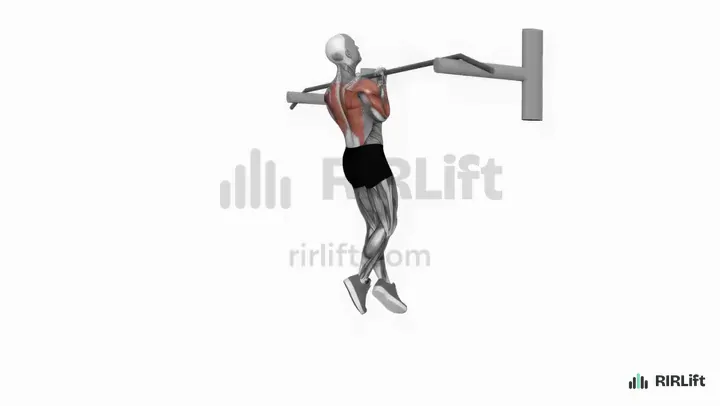
Bicep exercises on a pull-up bar

A doorway bar is the cheapest piece of home gear that trains the biceps heavily. Palms facing you is the grip that puts the most work on them.

Biceps and back, heaviest bodyweight pull

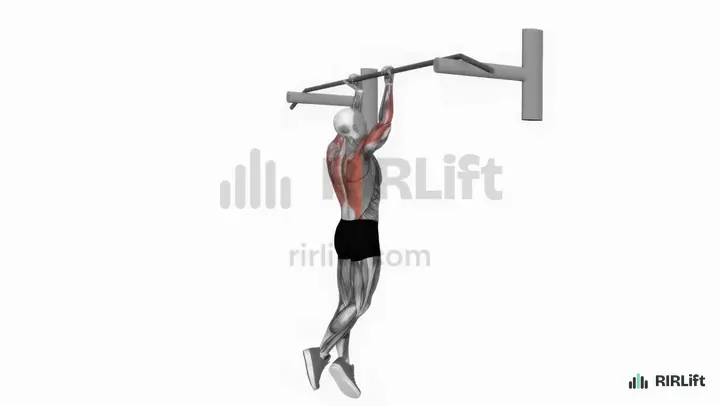
Chin-Up

Lats

With your palms facing you, a chin-up makes the biceps lift your whole bodyweight along with the lats. If you have a doorway pull-up bar, it is the hardest biceps exercise you can do at home.

How to do it

  1. Hang from the bar with your palms facing you, hands about shoulder-width, arms fully straight.
  2. Pull your chest toward the bar by driving your elbows down to your sides.
  3. Keep pulling until your chin clears the bar.
  4. Lower yourself all the way back to a dead hang before the next rep.

Cues

  • Palms toward your face
  • Elbows down to the ribs
  • Full hang every rep

Common mistakes

  • Kicking the legs to get over the bar: cross your ankles and keep your legs still.
  • Stopping with bent arms at the bottom: the biceps grows from the full range, so straighten out.

Swap for: Close-Grip Chin-Up, Assisted Pull-Up, Lat Pulldown

Build a session with Chin-Up

Chin-up with more elbow bend

Close-Grip Chin-Up

Lats, Biceps

Moving your hands closer together, a few inches apart, bends the elbows more at the top, which gives the biceps a larger share of the pull. Use it instead of the regular chin-up when your shoulders prefer a narrow grip.

How to do it

  1. Grab the bar palms-up with your hands about a fist's width apart.
  2. From a straight-arm hang, pull until your upper chest nears the bar.
  3. Squeeze at the top with your elbows tight to your body.
  4. Lower slowly to a full hang.

Cues

  • Hands close
  • Chest to the bar
  • Three seconds down

Common mistakes

  • Shrugging your shoulders to your ears at the bottom: keep a little tension so the shoulders stay set.
  • Swinging between reps: pause in the hang until your body is still.

Swap for: Chin-Up, Neutral-Grip Pull-Up

Bicep exercises without weights

With no dumbbells, a door frame or a band provides the load. The doorway curl is the closest bodyweight match to a curl, and bands add tension that grows toward the top.

Biceps curl with your bodyweight in a doorway

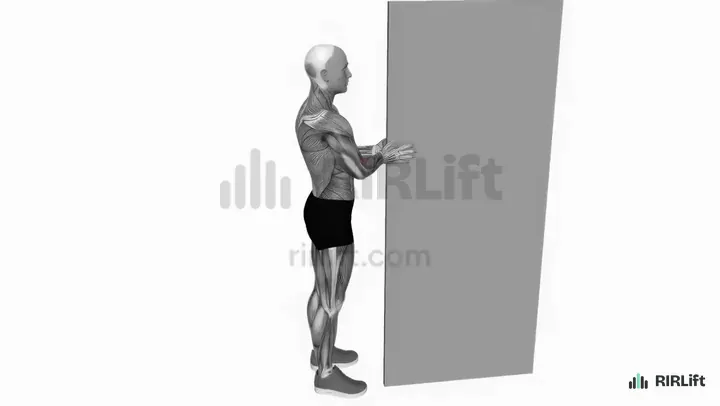
Bodyweight Bicep Curl

Biceps

Holding a door frame and leaning back, you curl your body toward your hands. It is a palms-up curl with no equipment at all, and moving your feet closer to the frame makes it harder.

How to do it

  1. Stand in a doorway, grip both sides of the frame near hip level with your palms facing up or in, and walk your feet forward.
  2. Lean back with straight arms until your body is at an angle, heels on the floor and body rigid.
  3. Bend your elbows to pull your chest toward the frame without letting your hips drop.
  4. Straighten your arms slowly to lean back out.

Cues

  • Body stiff like a plank
  • Elbows bend, shoulders stay still
  • Feet closer for harder reps

Common mistakes

  • Pulling with the back by driving the elbows behind you: keep them pointing forward like a curl.
  • Hips sagging: squeeze your glutes so the whole body moves as one.

Swap for: TRX Chin-Up, Chin-Up

Neutral-grip curl with a resistance band

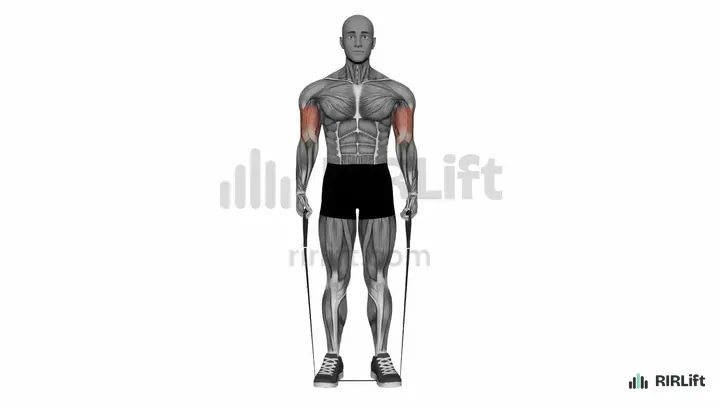
Band Hammer Curl

Biceps

Standing on a band and curling with your palms in trains the brachialis and forearm. The band gets tighter as your hands rise, so the top of the rep is the hardest part.

How to do it

  1. Step onto the center of a band with your feet hip-width and hold an end in each hand, palms facing your legs.
  2. Pin your elbows to your sides and curl your hands up with your thumbs leading.
  3. Stop when your forearms are upright, and hold for a second against the band.
  4. Lower slowly until your arms are straight and the band is still slightly taut.

Cues

  • Thumbs up
  • Elbows pinned
  • Slow on the way down

Common mistakes

  • Letting the band snap your arms down: take two seconds to lower.
  • Standing on too little band so the set is easy: widen your stance or choke up on the ends.

Swap for: Hammer Curl, Cable Rope Hammer Curl

Row with a band, biceps as helper

Band Bent-Over Row

Lats, Upper Back

A band row lets your biceps and back work together when you have no bar or dumbbells. Counted at about half, its sets add to your weekly biceps work.

How to do it

  1. Stand on the band with both feet, grab the ends, and hinge forward until your torso is at about 45 degrees.
  2. Your arms hang long below your shoulders.
  3. Row your hands to your lower ribs, elbows brushing your sides.
  4. Lower under control to straight arms.

Cues

  • Flat back
  • Elbows to the hips
  • Pause at the top

Common mistakes

  • Standing up as you row: keep the hinge angle fixed.
  • Rounding your back: hinge from the hips and keep your chest proud.

Swap for: One-Arm Dumbbell Row, Kettlebell Row

Bicep curls with one or two dumbbells

Five dumbbell exercises that need nothing but the weight and a chair. Each works with a single dumbbell, done one arm at a time or held in both hands.

Palms-up curl, one dumbbell or two

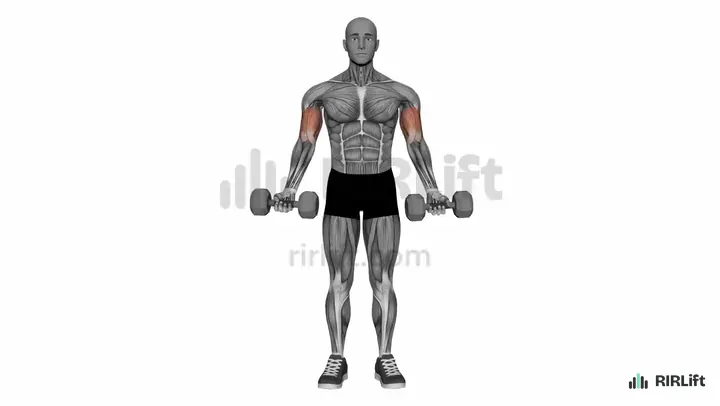
Dumbbell Curl

Biceps

The standard dumbbell curl is still the base of home biceps training. One dumbbell is enough: curl one arm at a time and switch.

How to do it

  1. Stand with a dumbbell in one or both hands, arms straight and palms forward.
  2. Curl the dumbbell toward your shoulder without letting your upper arm swing forward.
  3. Turn your little finger slightly up as you finish the rep.
  4. Lower until your elbow is straight again.

Cues

  • Upper arm still
  • Pinky up at the top
  • All the way down

Common mistakes

  • Using momentum from the hips: put your back against a wall.
  • Cutting the lowering short: count two on the way down.

Swap for: Kettlebell Curl, EZ-Bar Curl

Neutral-grip dumbbell curl

Hammer Curl

Biceps, Forearms

With your palms turned toward each other, the brachialis and forearm do more of the curl. It adds width to the arm and usually lets you lift a little more than a palms-up curl.

How to do it

  1. Hold the dumbbells at your sides with your palms facing in.
  2. Raise them toward your shoulders with your thumbs on top.
  3. Keep your wrists straight and upper arms against your sides.
  4. Lower slowly to straight arms.

Cues

  • Thumbs on top
  • Wrists neutral
  • No swing

Common mistakes

  • Twisting the dumbbell into a palms-up curl: keep it vertical.
  • Going too heavy and cutting reps short: use a full range.

Swap for: Band Hammer Curl, Alternating Hammer Curl

Biceps up, forearms down

Zottman Curl

Biceps, Forearms

You curl with your palms up and lower with your palms down, so the biceps works on the way up and the forearm muscles on the slower way down. It gets two exercises out of one light pair.

How to do it

  1. Stand with dumbbells at your sides, palms facing forward.
  2. Curl them up to shoulder height.
  3. At the top, turn your palms to face down.
  4. Lower slowly with palms down, then turn them back up at the bottom for the next rep.

Cues

  • Up palms up
  • Down palms down
  • Three seconds lowering

Common mistakes

  • Rotating the wrists halfway down: finish the turn at the top.
  • Picking a weight for the curl that the lowering cannot control: the palms-down half sets the load.

Swap for: Hammer Curl, Reverse Curl

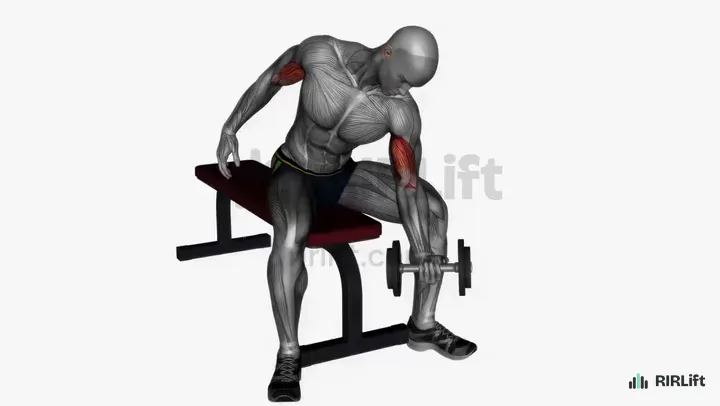
Strict curl seated on a chair

Concentration Curl

Biceps

Sitting on a chair with your elbow braced against your inner thigh removes all swing, so even a light dumbbell feels heavy. The curl is hardest with your elbow fully bent.

How to do it

  1. Sit on a chair with your feet wide, holding a dumbbell in one hand.
  2. Rest the back of that upper arm against your inner thigh, arm straight down.
  3. Curl the dumbbell toward your chest and hold the top for a moment.
  4. Lower to a straight arm. Finish the set, then switch sides.

Cues

  • Elbow against the thigh
  • Hold the top
  • Straight arm at the bottom

Common mistakes

  • Using your leg to push the arm up: the thigh is only a brace.
  • Lowering halfway: go until the elbow is straight.

Swap for: Kettlebell Concentration Curl, Spider Curl

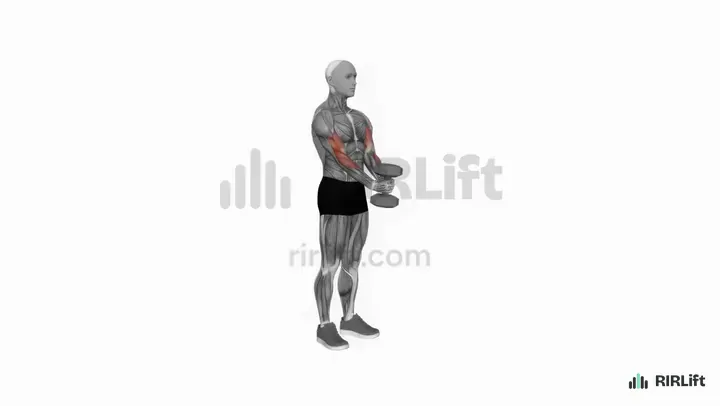
Two hands under one dumbbell

Waiter Curl

Biceps

Cupping one dumbbell under its top plate with flat palms takes your grip out of the curl. It is a biceps exercise that two hands can do with one heavier dumbbell.

How to do it

  1. Hold one dumbbell upright with both palms flat under the top plate.
  2. Keep your elbows by your sides with arms straight.
  3. Curl it to chest height, keeping the dumbbell vertical.
  4. Lower slowly back to straight arms.

Cues

  • Palms flat
  • Dumbbell upright
  • Straight arms at the bottom

Common mistakes

  • Tilting the dumbbell back toward you: hold it vertical.
  • Swinging the last reps: end the set at 0 RIR, not after it.

Swap for: Kettlebell Goblet Curl, Dumbbell Curl

Bicep curls with a kettlebell

If a kettlebell is your only weight, curl it by the handle with one arm or by the horns with two.

Curl with one kettlebell

Kettlebell Curl

Biceps

Curling a kettlebell by the handle puts its weight behind your hand, so the biceps stays loaded near the finish of each rep where a dumbbell curl gets easier. Do one arm at a time if you have one bell.

How to do it

  1. Hold a kettlebell by the handle in one hand, arm straight and palm facing forward.
  2. Curl it up toward your shoulder, letting the bell rest against your forearm.
  3. Keep your upper arm against your side throughout.
  4. Lower slowly to a straight arm.

Cues

  • Elbow at your side
  • Smooth path
  • Lower slowly

Common mistakes

  • Letting the bell flip and bang your wrist: grip it a bit off-center so it settles.
  • Leaning to one side: brace your free hand on your hip.

Swap for: Dumbbell Curl, Kettlebell Goblet Curl

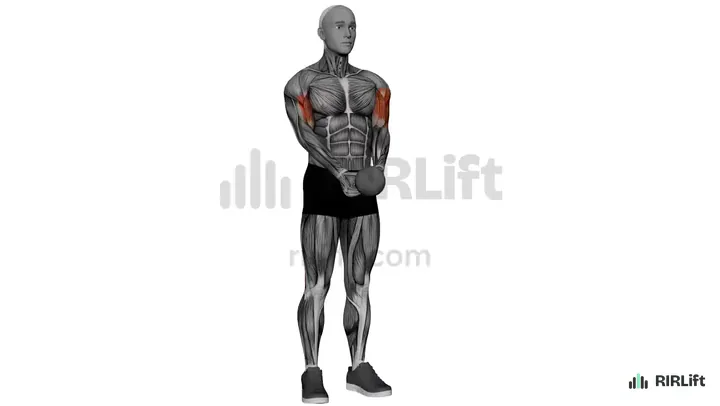
Two hands on one kettlebell

Kettlebell Goblet Curl

Biceps

Holding the bell by both horns lets two arms share one weight, which makes a light kettlebell useful for heavier curling. Your hands face each other, so it trains the biceps and brachialis together.

How to do it

  1. Hold a kettlebell by the horns in front of your thighs, arms straight.
  2. Keep your elbows tucked by your ribs and curl the bell up to your chest.
  3. Squeeze at the top for a second.
  4. Lower until your arms are straight.

Cues

  • Hands on the horns
  • Elbows tucked
  • Squeeze at the chest

Common mistakes

  • Bending back to lift the bell: soften your knees and brace.
  • Flaring your elbows wide: keep them in by your sides.

Swap for: Waiter Curl, Kettlebell Curl

A row that counts toward your biceps

Rows load the biceps as a helper, so a session of rows and one curl covers both back and arms.

Back row that also trains the biceps

One-Arm Dumbbell Row

Lats, Upper Back

A one-arm row against a chair works the back and biceps together with one dumbbell. It suits a short session that wants pulling and arm work in the same exercise.

How to do it

  1. Place one hand on a chair seat or bench and step back so your back is flat.
  2. Hold the dumbbell straight under your shoulder.
  3. Row it toward your hip until your elbow passes your torso.
  4. Lower until your arm is straight. Do all reps, then switch.

Cues

  • Pull to the hip
  • Back flat
  • Stretch at the bottom

Common mistakes

  • Twisting your torso open to lift more: keep your hips and shoulders square.
  • Short reps at the bottom: let the arm hang straight.

Swap for: Band Bent-Over Row, Kettlebell Row

Put them together: example sessions

Each session below picks from the exercises above for one situation, with the sets, reps, rest and RIR filled in. Open one in the session builder to change a pick, price it from a recent set, and add it to RIRLift.

Session 1

Pull-up bar and a door frame, no weights

Open in the session builder
  • Workouts2× a week
  • Working sets14 a week
  • Per workout~20 min
  • EquipmentPull-Up Bar

You own a doorway pull-up bar and nothing else, and want bigger arms without buying weights.

Chin-ups are the heaviest biceps work you can get at home, so both sessions start with them at 1 to 2 RIR, leaving room so the last set still has full reps. The doorway curl follows as the isolation work: it loads the biceps without the back, and moving your feet changes the load. Two sessions of 7 to 8 sets each is enough for most people whose arms are not already trained hard on other days.

Session A
ExerciseSets × repsRIRRest
Chin-Up1 warm-up set firstFull hang between reps. 4 × 5–12 2 2:30 min
Bodyweight Bicep CurlBody stiff. 3 × 10–15 1 75 s

Open Session A in the session builder

Session B
ExerciseSets × repsRIRRest
Close-Grip Chin-UpThree seconds down. 3 × 5–12 1 2:30 min
Bodyweight Bicep CurlFeet closer than Session A. 4 × 12–20 0 1 min

Open Session B in the session builder

How to run it
Do Session A and Session B on different days, two or more days apart. If you cannot do 5 chin-ups yet, do slow lowerings: jump to the top and take five seconds to come down, for the same set count.
How to progress
Add a rep to each chin-up set when all sets hit the top of the range. Once you reach 12, slow the lowering to four seconds. On the doorway curl, walk your feet one step closer once all sets reach 15.

Session 2

Resistance bands only

Open in the session builder
  • Workouts2× a week
  • Working sets18 a week
  • Per workout~15 min
  • EquipmentResistance Bands

You have a set of loop or tube bands, train in a small space or while traveling, and have about 20 minutes.

Bands are lightest at the bottom and heaviest at the top, so each session pairs a band exercise with the doorway curl, which is hardest when you lean back with straight arms. The band row brings in the back and biceps together, and the band hammer curl trains the brachialis. Band sets go to 0 to 1 RIR because the resistance is light at the start of each rep. Nine sets per session.

Bands A
ExerciseSets × repsRIRRest
Band Hammer CurlHold the top 1 s. 3 × 12–20 1 1 min
Bodyweight Bicep CurlDoor frame, body stiff. 3 × 10–15 1 75 s
Band Bent-Over RowElbows to the hips. 3 × 12–20 1 1 min

Open Bands A in the session builder

Bands B
ExerciseSets × repsRIRRest
Bodyweight Bicep CurlFeet one step closer. 3 × 10–15 1 75 s
Band Hammer CurlSlow lowering. 3 × 15–25 0 1 min
Band Bent-Over RowPause at the ribs. 3 × 12–20 0 1 min

Open Bands B in the session builder

How to run it
Run Bands A and Bands B on separate days. Use a band that lets you reach at least 12 reps; switch to a heavier band when you pass 20 at 0 RIR.
How to progress
Add reps first. When a band gets easy for 20, use a stronger band or double it up and start again at 12.

Session 3

One dumbbell or one kettlebell

Open in the session builder
  • Workouts2× a week
  • Working sets18 a week
  • Per workout~20 min
  • EquipmentDumbbells, Kettlebells

You own a single dumbbell or kettlebell and a chair, and train arms once or twice a week at home.

A single weight cannot get heavier, so this plan uses it three ways: one-arm curls, which double the load each arm lifts, and the two-handed waiter or goblet curl, which works both arms at once. The concentration curl on a chair makes a light weight hard by removing all swing, and the one-arm row covers the back. Curls go to 0 to 1 RIR; the row stops at 1. About 10 sets per session.

Session A
ExerciseSets × repsRIRRest
Dumbbell CurlOne arm at a time. 3 × 10–15 1 75 s
Waiter CurlPalms under the plate. 3 × 10–15 0 1 min
Concentration CurlPer arm. Elbow on the thigh. 3 × 10–15 0 1 min

Open Session A in the session builder

Session B
ExerciseSets × repsRIRRest
One-Arm Dumbbell RowPer arm. Hand on a chair. 3 × 10–15 1 90 s
Kettlebell CurlPer arm. 3 × 10–15 1 75 s
Kettlebell Goblet CurlHold by the horns. 3 × 10–20 0 1 min

Open Session B in the session builder

How to run it
Do Session A and Session B on two days in the week. With a kettlebell, swap the dumbbell curl for the kettlebell curl and the waiter curl for the goblet curl.
How to progress
Add reps until all sets reach the top of their range, then slow each lowering to three seconds. When even that is easy at 0 RIR, the next heavier weight is worth buying.

Make it fit you

Questions

How do I build big biceps at home?

Pick exercises you can make hard: chin-ups on a doorway bar, doorway curls, and curls with whatever weight you own. Do about 8 to 16 hard sets a week over two sessions, end each set 0 to 2 reps short of failure, and make the exercise harder every time the reps reach the top of the range.

Can I train biceps without weights?

Yes. A doorway curl and chin-ups load the biceps with your bodyweight, and bands add more. The limit is how hard you can make them, so move to tougher variations once you pass about 20 reps.

Do push-ups work the biceps?

Barely. Push-ups straighten the elbow, which is the triceps' job. The biceps only works to steady the arm, which is not enough to make it grow. You need a pulling or curling exercise.

Is a 20 pound bicep curl good?

For most people, curling a 20 lb dumbbell for 8 to 12 clean reps per arm is solid. What matters more for growth is that each set ends close to failure, whether the weight is 10 lb or 40 lb.

How many bicep exercises should I do at home?

Two per session is enough: one heavy pull or curl and one lighter curl. The plans on this page use two or three, depending on the gear.